SLIDE 1 Pongsagon Pothavorn Scispec Co., Ltd.
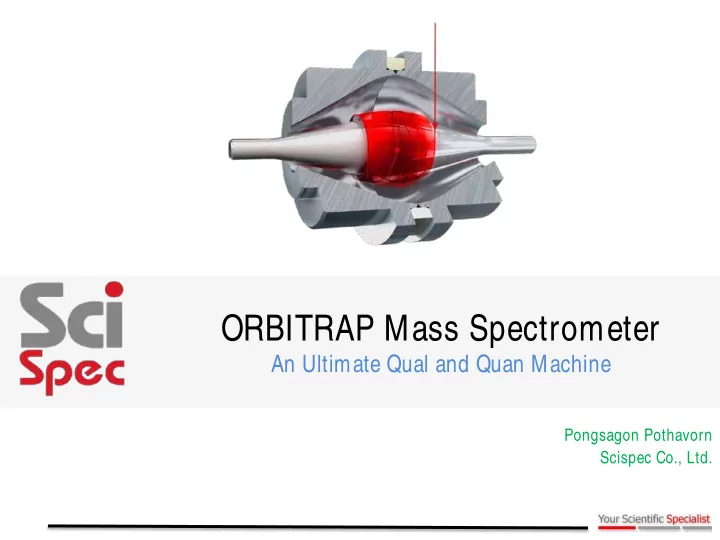
ORBITRAP Mass Spectrometer
An Ultimate Qual and Quan Machine
SLIDE 2
Information Rich Data
SLIDE 3
Accurate Mass in Life Science
SLIDE 4 LC-MS solutions for all analytical challenges
SLIDE 5 z φ r
{ }
) / ln( 2 / 2 ) , (
2 2 2 m m
R r R r z k z r U ⋅ + − ⋅ =
Induced by ion packets moving inside the trap
- Ions trapped in an electrostatic field
- Central electrode kept on high voltage
- Outer electrode is split and able to pick up an image current induced by ion
packets moving inside the trap
SLIDE 6 Ion Injection and Formation of Ion Rings
(r,φ) (r,z)
- An ion packet of a selected m/z enters the field
- Increasing voltage squeezes ions
- Voltage stabilises and ion trajectories are also stabilized
- Angular spreading forms a ROTATING RING
SLIDE 7 Fourier Transform-based
- The moving ion rings induce an image current on outer electrodes
- The frequency of harmonic oscillations is proportional to ions’ m/z
SLIDE 8 Orbitrap and Nuclear Magnetic Resonance (NMR)
- Free Induction Decay (FID)
Time Domain ->Fourier Transform -> Spectrum (Frequency Domain)
SLIDE 9
Strategies for Analysis
Organic Contaminants Known Known unknowns Unknown
Target Screening Non-Target Screening
Rapid and sensitive screening methods able to assign positive hits undoubtedly to particular organic compounds
SLIDE 10
Typical Mass Accuracy
Type of MS Mass accuracy Utility for Quadrupole 0.1 µ Identify Traps 0.1 µ Identify TOF 0.0001 µ Empirical formula/ composition Sector 0.0001 µ Empirical formula/ composition FT-MS 0.0001 µ Empirical formula/ composition
SLIDE 11
Thiamethoxam: [M+H] + = C8H11ClN5O3S (292.02656) Parathion: [M+H] + = C10H15NO5PS (292.04031) Isobaric Pesticides
SLIDE 12
Isobaric Pesticides 3:1 Mix
SLIDE 13 Resolution – Why Is It Important?
- Enables accurate mass
- Increases confidence of identification
- Improves quantitative accuracy
- Gives access to qualitatively different information
SLIDE 14
Average Mass
SLIDE 15 How’s About Mass Accuracy
- Average Mass = summing the average atomic masses of the
constituent elements, H2O; 1.00794 + 1.00794 + 15.9994 = 18.01528.
- Exact Mass = summing the masses of the individual isotopes of the
molecule, H2O; 1.0078 + 1.0078 + 15.9994 = 18.0106. The Others Stories;
- Isotopomer (Isotopic Isomer) = same type of isotope but difference
in position, CH3CHDCH3 vs CH3CH2CH2D
- Isotopologues = difference in isotope in the molecules, H2O HOD
- Monoisotopic = sum of masses in molecule. Using of most
abundance or stable isotope.
SLIDE 16
Mass Accuracy – What for?
Mass measured Tolerance [Da] Suggestions Calc Mass 32.0 +/- 0.2 O2 CH3OH N2H4 S 31.9898 32.0261 32.0374 31.9721 32.02 +/- 0.02 CH3OH N2H4 32.0261 32.0374 32.0257 +/- 0.002 CH3OH 32.0261 C = 12.0000 H = 1.0078 N = 14.0031 O = 15.9949 S = 31.9721
SLIDE 17
Determine Fine Isotopic Pattern
SLIDE 18 Mass Accuracy across the Elution Profile
- 21 scans per elution peak
- External calibration
- 3
- 2
- 1
1 2 3 775 780 785 790 795 800 err [ppm] Scan #
M ass Accuracy [ppm]
RT: 1.72 - 1.96 1.75 1.80 1.85 1.90 1.95 Time (min) 10 20 30 40 50 60 70 80 90 100 Relative Abundance 477.23016
SLIDE 19
Average Isotope Ratio Variation
SLIDE 20
Mass Accuracy
SLIDE 21
Rosolving Power and Mass Accuracy
SLIDE 22
Long-term mass accuracy with external calibration
SLIDE 23 Advantage
- Easy method development for multi-residue analysis especially in
complex matrices
- Easy troubleshooting with detection of all adducts, degradation and
contaminants
- Higher detection specification
- Simultaneous Qual and Quan analysis
SLIDE 24
Comparison
SLIDE 25 Non-Targeted Screening or Newborn Ideal
- High isolation power for higher discrimination
- High precision for accurate mass identification
- High resolution for more identification
- High mass stability for a long lasting mass calibration
- MSn
- Library availability for easy interpretations
SLIDE 26
Orbitrap Analyzer - the ‘Heart’ of a Mass Spectrometer
1.2 x 1.5 x Standard Orbitrap High-field Orbitrap
SLIDE 27
Resolution VS m/z
SLIDE 28
Resolving Power
SLIDE 29
Orbitrap VS QToF
SLIDE 30
Labelling Techniques
SLIDE 31 Intact Protein Analysis
- Complete charge state envelope of IgG ‘Humira’
- Major glycosylation forms are baseline separated
- Relative intensity reproducibility
within a few percent
SLIDE 32 Intact Protein Analysis
- Mass measurement accuracy
- Average error for 34 measurements 6.9 ppm
- Standard deviation 6.4 ppm
Confirmation of protein primary structure
SLIDE 33 Sequence Confirmation of mAB
- ETD fragmentation of an intact IgG ‘Humira’
- Resolution settings 240,000
for fragment detection
- Increased sequence coverage
- Localization of modifications
(deamidation)
SLIDE 34 What do we gain by selected ion monitoring?
- Signal visibility is dependent, whether a signal is visible
above the spectrum noise
- Spectrum noise is dependent on the ratio of compound
within a certain ion population
20 40 60 80 100 Relative Abundance 20 40 60 80 100 195.0876 N=248402.81 195.0877 N=20741.58 NL: 1.94E8 [150.00-2000.00] NL: 1.12E8 [190.10-200.10]
Full MS SIM (10amu) S/N = 745 S/N = 5400
Lowest detected signal/scan 250330 Lowest detected signal/scan 28240
1000 2000 3000 4000 5000 6000 195.082 195.084 195.086 195.088 195.09 195.092 195.094 S/ N (spectrum) S/ N (FM S) S/ N (SIM 10)
Gain in sensitivity (7x)
Sensitivity gain 5 – 10 x with SIM mode
Caffeine
SLIDE 35 AZ_1000ng_ml_100k_1e6_HypersilGoldPFP #246 RT: 3.46 AV: 1 SB: 1 3.25 NL: 1.36E6 T: FTMS + p ESI Full ms [140.00-1800.00] 140 160 180 200 220 240 260 280 300 m/z 10 20 30 40 50 60 70 80 90 100 Relative Abundance 267.16994 C 14 H23 O3 N2
214.09034 195.08837 C 10 H13 O3 N
158.02816 289.15189 C 14 H22 O3 N2 Na
229.14414 C 10 H24 O2 N K 1.22476 ppm 149.02451 251.12632 C 10 H23 O2 N K Na 2.05409 ppm 185.11564 C 8 H18 O3 Na 4.44492 ppm 292.93153
Atenolol C14 H22 N2 O3 M+H = 267.17030
Full Scan Spectrum of Atenolol
SLIDE 36 AZ_1000ng_ml_100k_1e6_HypersilGoldPFP #92 RT: 1.27 AV: 1 SB: 1 1.04 NL: 1.86E6 T: FTMS + p ESI Full ms [140.00-1800.00] 140 145 150 155 160 165 170 175 m/z 10 20 30 40 50 60 70 80 90 100 Relative Abundance 170.08135 C 8 H12 O3 N 1.03533 ppm 144.98848 157.03556 168.02009 C 11 H4 O2
152.07113 C 8 H10 O2 N 3.45525 ppm 162.97397 145.98632 171.08468 153.01050 173.07839 143.99090 149.94382 146.98632 159.03166 C 9 H5 O2 N 1.12952 ppm 166.99569 154.00835
Pyridoxine C8 H11 N O3 M+H = 170.08117
Full Scan Spectrum of Pyridoxine
SLIDE 37 Alprazolam Y = 6366.31+514.015*X R^2 = 0.9967 W: 1/X 2000 4000 6000 8000 10000 fg/uL 500000 1000000 1500000 2000000 2500000 3000000 3500000 4000000 4500000 5000000 5500000 Area
Alprazolam, Full Scan Experiment
50 100 150 200 250 300 fg/uL 20000 40000 60000 80000 100000 120000 140000 160000 180000 200000 Area
50 ppt – 10 ppb 250 fg oc - 50 pg oc
Zoom in 50 ppt- 100ppt
SLIDE 38 Alprazolam Y = -3135.8+552.216*X R^2 = 0.9982 W: 1/X
10 ppt – 10 ppb 50 fg oc - 50 pg oc
2000 4000 6000 8000 10000 fg/uL 1000000 2000000 3000000 4000000 5000000 6000000 Area
Alprazolam SIM Experiment
Zoom 10 ppt- 100ppt
20 40 60 80 100 120 fg/uL 10000 20000 30000 40000 50000 60000 70000 80000 90000 100000 110000 120000 Area
SLIDE 39 Non-Targeted Screening or Newborn Ideal
- High isolation power for higher discrimination
- High precision for accurate mass identification
- High resolution for more identification
- High mass stability for a long lasting mass calibration
- MSn
- Library availability for easy interpretations
SLIDE 40
Orbitrap VS QToF
SLIDE 41
- Extending the mass range
- Protein assemblies up to 1 million Da
IgG antibody 150 kDa HK97 bacteriophage capsomers 253 kDa Yeast proteasome 730 kDa
Analysis of Protein Complexes
SLIDE 42 Ligand Binding Stoichiometry
2000 4000 6000 8000 10000 12000 14000 m/z 10 20 30 40 50 60 70 80 90 100 Relative Abundance
11122.79 R=2048
10821.94 R=2161 11279.60 R=2002 11441.23 R=1873 10537.11 R=2186 11607.90 R=1600 11780.59 R=1353 8521.29 R=1342 10266.99 R=2252
801 kDa
SLIDE 43 Data Dependent Decision Tree
- Decision tree–driven tandem mass spectrometry for shotgun proteomics
SLIDE 44 Product Dependent Trigger
- ZIC HILIC separation of a glycoprotein digest
SLIDE 45 Product Dependent Trigger
- HCD fragmentation spectrum of m/z 645.6194
- Oxonium ions observed among top 20 peaks
SLIDE 46
Extended Top-down Capability
SLIDE 47 Product Dependent Trigger: HCD PD ETD
- ETD fragmentation triggered
– Peptide sequence information – Glycosylation site localization
SLIDE 48 Elevator Speech
The orbitrap provides reproducible high resolution accurate mass with superior U-HPLC compatibility at resolution unattainable by QTOFs without compromising the sensitivity and dynamic range in MS or MS-MS data. With orbitrap, you will have fewer false positives, higher quality, better accuracy and more confidence in your quan/qual measurements.
SLIDE 49 Qual-Quan
Target Confirmation Target Quantification
- Accurate Mass (AM)
- Retention Time (RT)
- Isotope Pattern
- MS/MS spectrum
- MS/MS Transitions
- LC Peak Area
- Precursor
- MS/MS
Transitions
HR/AM Targeted Quan
From Discovery to Quantification - do it all with a Q Exactive
mass
- MS/MS spectrum
- Precursor accurate
mass
Discovery Discovery Quan
- Protein / peptide ID
- TMT
- Label free
- SILAC
- All Targeted Quan
SLIDE 50 Routine
High throughput Optimized assays Clinical, Pharma & Biopharma Quantitation EFS
Development
Medium throughput Verification Translational Research, Biopharma, Metabolomics, Drug Discovery, Various Biomarker, EFS Research
Research
Low throughput Discovery Traditional Proteomics, Metabolomics, Metabolism, Biomarker Research
Range of Experiments
All Q TOF All Q TOF Triples & Q Trap
Quantitative Qualitative ▪ Identification ▪ Confirmation ▪
Quanfirmation Quantitative Qualitative
Quanfirmation = No Compromise!
Exactives & Ion Traps Orbitraps Triples
SLIDE 51 Linearity and Precision
Stolker, A.A.M. et al; Anal. and Bioanal. Chem. 2010 accepted for publication
SLIDE 52 Drug identification using ToxIDTM2.1.0
- Fully automated analysis and reporting
- Drug identification based on
- Molecular weight
- MS2 spectra
- Chromatographic retention time
- Built-in library of about 300 drugs
- Library spectra acquired under real world conditions
for robust and accurate ID
- The software uses proven NIST search engine
- Feature to easily create and expand library
- Excellent results review and reporting
- Summary report
- Data review report
- Excel spreadsheet
SLIDE 53
ToxID Summary Report
SLIDE 54
ToxID Review Report
SLIDE 55 What is Mass Frontier?
- Software for small molecule structural elucidation via mass spectral
interpretation
– Predict fragmentation given a compound structure – Annotate spectra with fragment structures – Store MSn spectra along with structures, peak annotations, ID numbers, pathway information, etc – Match unknown spectra against library entries – And MUCH more… Tag Line: Mass Frontier helps you to go from SPECTRA to STRUCTURES!
SLIDE 56 Who should get Mass Frontier?
- Anyone who is doing small molecule structural elucidation /
confirmation via mass spectrometry
– Metabolite Identification in Drug Metabolism – Impurity and Degrading analysis in QC/QA – Endogenous Metabolite Identification in Metabolomics – Forensic Analyses in Federal and State Agencies – Doping Control in Horse Racing – Chemistry/Biochemistry/Pharmacy Departments in Universities doing small molecule research – Service labs for synthetic chemists
SLIDE 57 General Unknown Screening using Mass Frontier
Standards Library Unknowns Standards Standards IDs
Match Score Above Threshold
Individual Spectrum Search
Partial Structures Structure Candidates
Tree Search infusion LC-MSn Add
Match Score Below Threshold Sheldon et al. Determination of Ion Structures in Structurally Related Compounds Using Precursor Ion
- Fingerprinting. JASMS, 2009, 20, 370-376
SLIDE 58 MSn Spectral Trees— the ONLY Route to Unambiguous Structural Elucidation! This information collectively, uniquely defines the structure of the molecule
Accurate mass information is powerful – provides a potential formula However MSn information still necessary to distinguish between structural isomers Trees can automatically be generated by Data Dependant LC-MS/MS runs on
Component Detection from Mass Frontier can automatically deconvolute MSn spectral trees!
MS MS2 MS3 MS4
SLIDE 59
How Do You Get a Structure From MS Data?
MS MS2 MS3 MS3 MS3
+ +
SLIDE 60
Mass Frontier: Toolbox for Structural Elucidation
Chromatogram Processor Easy Structural Editor Fragmentation Pathways Component Detection
SLIDE 61 Fragmentation Prediction: Three Knowledge Bases
- 1. General fragmentation rules
- 2. Mass Frontier Fragmentation Library™
- 3. User Libraries
Total number of Mass Frontier 6.0 Fragmentation Schemes 30.936 Individual Reactions 129.229 Chemical Structures 151.762 Decoded Mechanisms 120.029 Total number of Mass Frontier 6.0 Fragmentation Schemes 30.936 Individual Reactions 129.229 Chemical Structures 151.762 Decoded Mechanisms 120.029
SLIDE 62
Fragmentation Library™ in 6.0 now covers >99% published literature
SLIDE 63 Predictive Fragmentation
- 1. General Rules
- 2. Literature Library
- 3. User Libraries
SLIDE 64
How Do I Annotate Spectral Trees? … Automatically
SLIDE 65 Database Manager: Integrated Knowledge Management
- All records of installed libraries are shown in Database Manager
- All records are accessible without querying
- Spectral and Fragmentation libraries are unified in Database Manager
- Searches are universal, independent of data type (structures, m/z values, names, CAS number,
biological activity, etc)
One Record: Spectral tree with corresponding fragmentation mechanisms & more!
SLIDE 66
Library: HighChem ESI Neg 2008 Tree Count: 524 Spectra Count: 3805 Fragmentation Schemes: 263 Library: HighChem ESI Pos 2008 Tree Count: 1251 Spectra Count: 10180 Fragmentation Schemes: 702 Common pharmaceutical compounds and human metabolites Peaks manually annotated and fragmentation mechanism elucidated
HighChem Spectral Tree Libraries—Free with the software!
SLIDE 67
Compound Discoverer
SLIDE 68
Flexible Workflow
SLIDE 69
Identifying Unknown
SLIDE 70
Predicted Composition
SLIDE 71
Conclusion
SLIDE 72 Summary
- High resolution is a key characteristics of MS data enabling
- Mass accuracy
- Confident identification
- Reliable quantitation
- Data dependent acquisition offers an elegant simplicity and has
proven highly useful for discovery-driven proteomics
- Mass spectrometry technology enables comprehensive analysis of
proteomics samples
- Multiple fragmentation techniques
- MSn capability
- Quan&Qual experiments done on a single platform