
SLIDE 1
Pongsagon Pothavorn Scispec Co., Ltd.
ORBITRAP Mass Spectrometer
An Ultimate Qual and Quan Machine
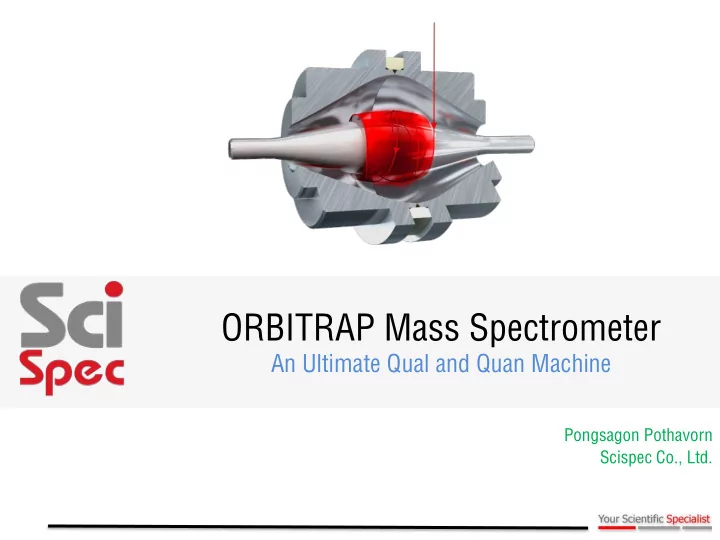
ORBITRAP Mass Spectrometer An Ultimate Qual and Quan Machine - - PowerPoint PPT Presentation
ORBITRAP Mass Spectrometer An Ultimate Qual and Quan Machine Pongsagon Pothavorn Scispec Co., Ltd. Information Rich Data Accurate Mass in Life Science Resolution FT Ultra - ICR Brukers FT-ICR Waters Ion Mobility LC-MS solutions for all
Pongsagon Pothavorn Scispec Co., Ltd.
An Ultimate Qual and Quan Machine
Accurate Mass in Life Science
Resolution
FT Ultra - ICR
Brukers FT-ICR
Waters Ion Mobility
LC-MS solutions for all analytical challenges
z φ r
{ }
) / ln( 2 / 2 ) , (
2 2 2 m m
R r R r z k z r U ⋅ + − ⋅ =
Induced by ion packets moving inside the trap
packets moving inside the trap
Ion Injection and Formation of Ion Rings
(r,φ) (r,z)
Fourier Transform-based
Orbitrap and Nuclear Magnetic Resonance (NMR)
Time Domain ->Fourier Transform -> Spectrum (Frequency Domain)
Strategies for Analysis
Organic Contaminants Known Known unknowns Unknown
Target Screening Non-Target Screening
Rapid and sensitive screening methods able to assign positive hits undoubtedly to particular organic compounds
Typical Mass Accuracy
Type of MS Mass accuracy Utility for Quadrupole 0.1 µ Identify Traps 0.1 µ Identify TOF 0.0001 µ Empirical formula/ composition Sector 0.0001 µ Empirical formula/ composition FT-MS 0.0001 µ Empirical formula/ composition
by the mass spectrometer.
(relative measure) or mDa (absolute measure) Mass error = Measured – Exact Mass x 106
Exact Mass
C = 12.0000 H = 1.0078 N = 14.0031 O = 15.9949 S = 31.9721
Good
786.6003 (-1.19 ppm)
794 792 790 788 786 100 90 80 70 60 50 40 30 20 10
786.60124 787.60463 788.60773 789.61068 786.70 (+124 ppm)
error = 786.6003 – 786.60124 x 10⁶ 786.60124
error = 786.7000 – 786.60124 x 10⁶ 786.60124
Not so Good
Mass Accuracy
794 792 790 788 786 100 90 80 70 60 50 40 30 20 10 794 792 790 788 786 100 90 80 70 60 50 40 30 20 10
Δm
= 0.786
Mass Resolution
ratios (isobars). m - measured mass
Δm - peak width measured at 50% peak
intensity (Full Width Half Maximum) Low Resolution R = 786.6 = 1,000 High Resolution R = 786.6 = 100,000 0.786 0.007
Δm
= 0.007
Commercial High Resolution MS Technology Race
Ti Time e prog
ession (
ear) Mas ass r res esol
ution
FWHM)
Bendix Tof
50000 100000 150000 200000 250000 300000 350000 400000 450000 500000
1955 1965 1975 1985 1995 2005 2015
Orbitrap Tof / QTof
Ion Trap-Orbitrap Quad Orbitrap Tribrid Orbitrap ORBITRAP’s spectacular climb in performance in a decade! First Q-Tof Q-Orbitrap* New Q-Orbitrap New Tribrid Orbitrap Entry Q-Orbitrap LIT-Orbitrap ETD
Thiamethoxam: [M+H]+ = C8H11ClN5O3S (292.02656) Parathion: [M+H]+ = C10H15NO5PS (292.04031) Isobaric Pesticides
Isobaric Pesticides 3:1 Mix
Resolution – Why Is It Important?
Average Mass
How’s About Mass Accuracy
constituent elements, H2O; 1.00794 + 1.00794 + 15.9994 = 18.01528.
molecule, H2O; 1.0078 + 1.0078 + 15.9994 = 18.0106. The Others Stories;
in position, CH3CHDCH3 vs CH3CH2CH2D
abundance or stable isotope.
Mass Accuracy – What for?
Mass measured Tolerance [Da] Suggestions Calc Mass 32.0 +/- 0.2 O2 CH3OH N2H4 S 31.9898 32.0261 32.0374 31.9721 32.02 +/- 0.02 CH3OH N2H4 32.0261 32.0374 32.0257 +/- 0.002 CH3OH 32.0261 C = 12.0000 H = 1.0078 N = 14.0031 O = 15.9949 S = 31.9721
Determine Fine Isotopic Pattern
Mass Accuracy across the Elution Profile
1 2 3 775 780 785 790 795 800 err [ [ppm] Scan # can #
Ma Mass A ss Accura racy y [p [ppm] m]
RT: 1.72 - 1.96 1.75 1.80 1.85 1.90 1.95 Time (min) 10 20 30 40 50 60 70 80 90 100 Relative Abundance 477.23016
Average Isotope Ratio Variation
Mass Accuracy
Resolving Power and Mass Accuracy
Long-term mass accuracy with external calibration
Advantage
complex matrices
contaminants
Comparison
Non-Targeted Screening or Newborn Ideal
Orbitrap Analyzer - the ‘Heart’ of a Mass Spectrometer
1.2 x 1.5 x Standard Orbitrap High-field Orbitrap
Resolution VS m/z
Resolving Power
Orbitrap VS QToF
Labelling Techniques
Intact Protein Analysis
within a few percent
Intact Protein Analysis
Confirmation of protein primary structure
Sequence Confirmation of mAB
for fragment detection
(deamidation)
What do we gain by selected ion monitoring?
above the spectrum noise
within a certain ion population
20 40 60 80 100 Relative Abundance 20 40 60 80 100 195.0876 N=248402.81 195.0877 N=20741.58 NL: 1.94E8 [150.00-2000.00] NL: 1.12E8 [190.10-200.10]
Full MS SIM (10amu) S/N = 745 S/N = 5400
Lowest detected signal/scan 250330 Lowest detected signal/scan 28240
1000 2000 3000 4000 5000 6000 195.082 195.084 195.086 195.088 195.09 195.092 195.094 S/N ( (spect ectrum) um) S/N (FMS) S/N (SIM10)
Gain in sensitivity (7x)
Sensitivity gain 5 – 10 x with SIM mode
Caffeine
AZ_1000ng_ml_100k_1e6_HypersilGoldPFP #246 RT: 3.46 AV: 1 SB: 1 3.25 NL: 1.36E6 T: FTMS + p ESI Full ms [140.00-1800.00] 140 160 180 200 220 240 260 280 300 m/z 10 20 30 40 50 60 70 80 90 100 Relative Abundance 267.16994 C 14 H23 O3 N2
214.09034 195.08837 C 10 H13 O3 N
158.02816 289.15189 C 14 H22 O3 N2 Na
229.14414 C 10 H24 O2 N K 1.22476 ppm 149.02451 251.12632 C 10 H23 O2 N K Na 2.05409 ppm 185.11564 C 8 H18 O3 Na 4.44492 ppm 292.93153
Atenolol C14 H22 N2 O3 M+H = 267.17030
Full Scan Spectrum of Atenolol
AZ_1000ng_ml_100k_1e6_HypersilGoldPFP #92 RT: 1.27 AV: 1 SB: 1 1.04 NL: 1.86E6 T: FTMS + p ESI Full ms [140.00-1800.00] 140 145 150 155 160 165 170 175 m/z 10 20 30 40 50 60 70 80 90 100 Relative Abundance 170.08135 C 8 H12 O3 N 1.03533 ppm 144.98848 157.03556 168.02009 C 11 H4 O2
152.07113 C 8 H10 O2 N 3.45525 ppm 162.97397 145.98632 171.08468 153.01050 173.07839 143.99090 149.94382 146.98632 159.03166 C 9 H5 O2 N 1.12952 ppm 166.99569 154.00835
Pyridoxine C8 H11 N O3 M+H = 170.08117
Full Scan Spectrum of Pyridoxine
Alprazolam Y = 6366.31+514.015*X R^2 = 0.9967 W: 1/X 2000 4000 6000 8000 10000 fg/uL 500000 1000000 1500000 2000000 2500000 3000000 3500000 4000000 4500000 5000000 5500000 Area
Alprazolam, Full Scan Experiment
50 100 150 200 250 300 fg/uL 20000 40000 60000 80000 100000 120000 140000 160000 180000 200000 Area
50 ppt – 10 ppb 250 fg oc - 50 pg oc
Zoom in 50 ppt- 100ppt
Alprazolam Y = -3135.8+552.216*X R^2 = 0.9982 W: 1/X
10 ppt – 10 ppb 50 fg oc - 50 pg oc
2000 4000 6000 8000 10000 fg/uL 1000000 2000000 3000000 4000000 5000000 6000000 Area
Alprazolam SIM Experiment
Zoom 10 ppt- 100ppt
20 40 60 80 100 120 fg/uL 10000 20000 30000 40000 50000 60000 70000 80000 90000 100000 110000 120000 Area
A Switch is on from QqQ to Orbitrap
Biocrates – 188 Metabolites
Biocrates – ONLY Orbitrap 408 Metabolites
Non-Targeted Screening or Newborn Ideal
Orbitrap VS QToF
IgG antibody 150 kDa HK97 bacteriophage capsomers 253 kDa Yeast proteasome 730 kDa
Analysis of Protein Complexes
Ligand Binding Stoichiometry
2000 4000 6000 8000 10000 12000 14000 m/z 10 20 30 40 50 60 70 80 90 100 Relative Abundance
11122.79 R=2048
10821.94 R=2161 11279.60 R=2002 11441.23 R=1873 10537.11 R=2186 11607.90 R=1600 11780.59 R=1353 8521.29 R=1342 10266.99 R=2252
801 kDa
Data Dependent Decision Tree
Product Dependent Trigger
Product Dependent Trigger
Extended Top-down Capability
Product Dependent Trigger: HCD PD ETD
– Peptide sequence information – Glycosylation site localization
Structural Elucidation
Discovery and Characterization of Components Extracted Ion Chromatogram and Isotopic Pattern MS and MS2 Spectrum MS2 Spectrum Interpretation
Elevator Speech
The orbitrap provides reproducible high resolution accurate mass with superior U-HPLC compatibility at resolution unattainable by QTOFs without compromising the sensitivity and dynamic range in MS or MS-MS data. With orbitrap, you will have fewer false positives, higher quality, better accuracy and more confidence in your quan/qual measurements.
Qual ual-Quan uan
Targe rget Confi Confirmatio ion Targe rget Quantification
Transitions
HR/ R/AM AM Tar arget eted ed Quan uan
From Discovery to Quantification - do it all with a Q Exactive
mass
mass
Discov cover ery Discov cover ery Quan uan
Routine
High throughput Optimized assays Clinical, Pharma & Biopharma Quantitation EFS
Development
Medium throughput Verification Translational Research, Biopharma, Metabolomics, Drug Discovery, Various Biomarker, EFS Research
Research
Low throughput Discovery Traditional Proteomics, Metabolomics, Metabolism, Biomarker Research
All Q TOF All Q TOF Triples & Q Trap
Quantitative Qualitative ▪ Identification ▪ Confirmation ▪
Quanfirmation Quantitative Qualitative
Quanfirmation = No Compromise!
Exactives & Ion Traps Orbitraps Triples
Linearity and Precision
Stolker, A.A.M. et al; Anal. and Bioanal. Chem. 2010 accepted for publication
for robust and accurate ID
ToxID Summary Report
ToxID Review Report
interpretation
– Predict fragmentation given a compound structure – Annotate spectra with fragment structures – Store MSn spectra along with structures, peak annotations, ID numbers, pathway information, etc – Match unknown spectra against library entries – And MUCH more… Tag Line: Mass Frontier helps you to go from SPECTRA to STRUCTURES!
Who should get Mass Frontier?
confirmation via mass spectrometry
– Metabolite Identification in Drug Metabolism – Impurity and Degrading analysis in QC/QA – Endogenous Metabolite Identification in Metabolomics – Forensic Analyses in Federal and State Agencies – Doping Control in Horse Racing – Chemistry/Biochemistry/Pharmacy Departments in Universities doing small molecule research – Service labs for synthetic chemists
General Unknown Screening using Mass Frontier
Standards Library Unknowns Standards Standards IDs
Match Score Above Threshold
Individual Spectrum Search
Partial Structures Structure Candidates
Tree Search infusion LC-MSn Add
Match Score Below Threshold Sheldon et al. Determination of Ion Structures in Structurally Related Compounds Using Precursor Ion Fingerprinting. JASMS, 2009 2009, 20, 370-376
MSn Spectral Trees—the ONLY Route to Unambiguous Structural Elucidation! Thi This i inf nfor
ation col
ectivel ely, , uni uniquel uely def efines nes t the he struct uctur ure of e of t the m he mol
ecule
Accurate m mass information i is powerfu ful – provides a a poten ential formula However MS MSn info formati tion s sti till necessary t to distinguish between s structural isomers Trees c can a automatically b be generated b by Data Dependant LC-MS/MS r runs on
instruments Component D Detection f from Mass Frontier can au automatically deconvolute MS MSn spectral t trees!
MS MS MS MS2 MS MS3 MS MS4
How Do You Get a Structure From MS Data?
MS MS MS MS2 MS MS3 MS MS3 MS MS3
Mass Frontier: Toolbox for Structural Elucidation
Chromatogram Processor Easy Structural Editor Fragmentation Pathways Component Detection
Fragmentation Prediction: Three Knowledge Bases
1.
Gener eneral al frag agment entat ation
ules es 2.
ass Fr Front
er Fr Frag agment entat ation Li
ary™ 3.
User er Li Librar aries es
Total number of Mass Frontier 6.0 Fragmentation Schemes 30.936 Individual Reactions 129.229 Chemical Structures 151.762 Decoded Mechanisms 120.029 Total number of Mass Frontier 6.0 Fragmentation Schemes 30.936 Individual Reactions 129.229 Chemical Structures 151.762 Decoded Mechanisms 120.029
Fragmentation Library™ in 6.0 now covers >99% published literature
Predictive Fragmentation
How Do I Annotate Spectral Trees? …Automatically
Database Manager: Integrated Knowledge Management
names, CAS number, biological activity, etc)
One Record: Spectral tree with corresponding fragmentation mechanisms & more!
Li Librar ary: HighChem ESI Neg eg 2008 Tree C ee Count
Spect ectra C a Count
Fr Frag agment entat ation S
chemes es: 263 Li Librar ary: HighChem ESI Pos
Tree C ee Count
Spect ectra C a Count
Fr Frag agment entat ation S
chemes es: 702
HighChem Spectral Tree Libraries—Free with the software!
Compound Discoverer
Flexible Workflow
Identifying Unknown
Predicted Composition
Conclusion
Summary
proven highly useful for discovery-driven proteomics
proteomics samples