TAYLORED MAGNETIC ANISOTROPIES OF IRON ON BATIO 3 AND SRTIO 3 - - PDF document

taylored magnetic anisotropies of iron on batio 3 and
SMART_READER_LITE
LIVE PREVIEW

TAYLORED MAGNETIC ANISOTROPIES OF IRON ON BATIO 3 AND SRTIO 3 - - PDF document

18 TH INTERNATIONAL CONFERENCE ON COMPOSITE MATERIALS TAYLORED MAGNETIC ANISOTROPIES OF IRON ON BATIO 3 AND SRTIO 3 SURFACES WITH ELECTRIC FIELDS: AN AB INITIO STUDY H. Choi and Y.-C. Chung* Department of Materials Science and Engineering, Hanyang


slide-1
SLIDE 1

18TH INTERNATIONAL CONFERENCE ON COMPOSITE MATERIALS

1 General Introduction With further downscale of electrical devices the capability to control and confine interface properties will be the key issue to realize the full potential of perovskite ferroelectric materials in varistors, field effect devices and non-volatile memories [1]. Magnetic anisotropy energy (MAE), which is the energetic stability of electron spins to align in a certain direction, is the most important magnetic property for denser device integration [2]. Magnetism of pseudomorphically grown Fe on the surfaces of ferroelectric materials has attracted attention due to its high magnetic moment and controllable MAE. The MAEs of ultra-thin ferromagnetic films have been widely utilized in modern magnetic recording technology for decades. The MAE of ferromagnetic thin films in memory devices crucially determine the “write” or “read” error rates, power consumption, and the thermal stability of the stored information [2]. Fe on perovskite BaTiO3 (BTO) surface is one of the most widely used systems for the memory storage due to the highly sensitive response of Fe magnetism to electric polarization induced by either mechanical pressure

  • r electric field [3-6]. In spite of the same crystal

structure with BTO, some other perovskite oxide materials do not show such multiferroic behavior (correlation between ferroelectric and ferromagnetic behavior). Hence, designing of new functional materials which have controllable multiferroic properties is a very promising work for the advance

  • f the memory storage technology. However, there

have been no theoretical research efforts to study about the physical origins of sensitive response of the Fe/BaTiO3 magnetism to external electric field. With the expectation to shine a light onto the mechanism of sensitive magnetic response of Fe/ferroelectric-perovskites to electric field, we explored the electronic structures of Fe/ferroelectrics under external electric fields. In this study, using the density functional theory [3] based ab initio calculations, we compared the change of the MAE

  • f ferromagnetic Fe films on BTO and STO surfaces

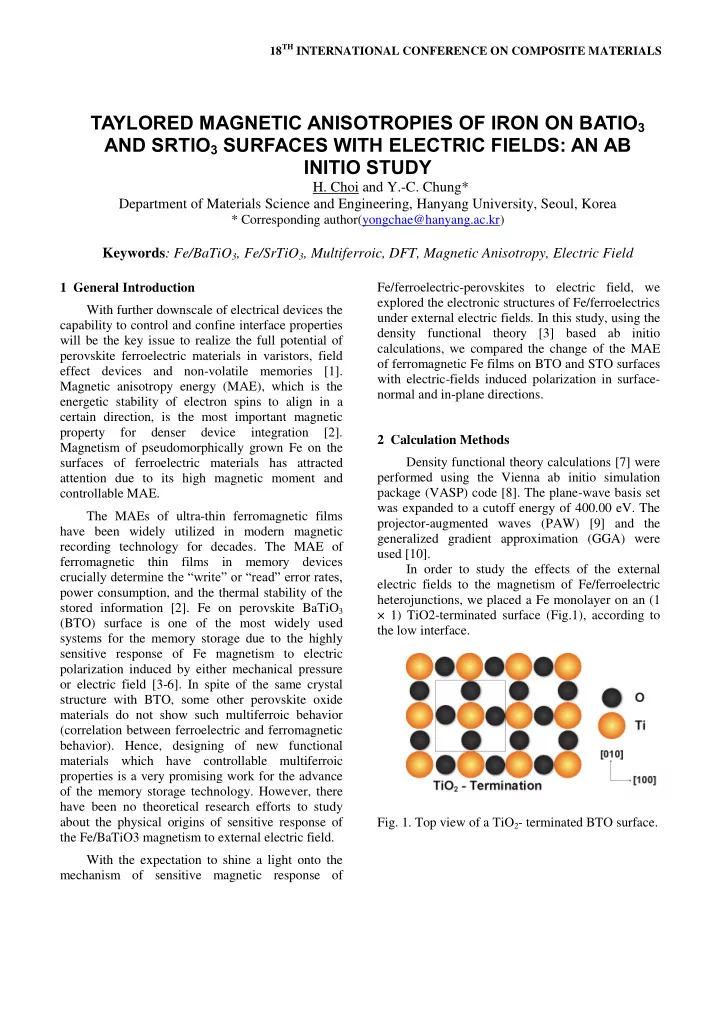
with electric-fields induced polarization in surface- normal and in-plane directions. 2 Calculation Methods Density functional theory calculations [7] were performed using the Vienna ab initio simulation package (VASP) code [8]. The plane-wave basis set was expanded to a cutoff energy of 400.00 eV. The projector-augmented waves (PAW) [9] and the generalized gradient approximation (GGA) were used [10]. In order to study the effects of the external electric fields to the magnetism of Fe/ferroelectric heterojunctions, we placed a Fe monolayer on an (1 × 1) TiO2-terminated surface (Fig.1), according to the low interface.

  • Fig. 1. Top view of a TiO2- terminated BTO surface.

TAYLORED MAGNETIC ANISOTROPIES OF IRON ON BATIO3 AND SRTIO3 SURFACES WITH ELECTRIC FIELDS: AN AB INITIO STUDY

  • H. Choi and Y.-C. Chung*

Department of Materials Science and Engineering, Hanyang University, Seoul, Korea

* Corresponding author(yongchae@hanyang.ac.kr)

Keywords: Fe/BaTiO3, Fe/SrTiO3, Multiferroic, DFT, Magnetic Anisotropy, Electric Field

slide-2
SLIDE 2

The slabs of both BTO(001) and STO(001) consisted of 6 MLs of BaO and STO alternating with 6 MLs of TiO2, respectively (Fig. 2).

  • Fig. 2. The supercell of Fe/ATiO3 (A = Ba or Sr).

The blue, yellow, green, and red spheres represent the Fe, O, A, and Ti atoms, respectively. The vacuum is placed right-hand side of the Fe layer to avoid the interactions between repeated supercells. The theoretically obtained lattice constant of BTO from the GGA method was 4.036 Å, which is

  • nly 0.3% smaller than the theoretical value, 4.050

Å. The spin-orbit coupling term was included for the non-collinear magnetism calculations with a 8 × 8 × 1 k-point grid generated by the Monkhorst-Pack scheme [10]. The 20 Å vacuum spacers were placed along the surface-normal direction to avoid interactions between the periodically repeating Fe/BTO and Fe/STO slabs. The atoms in the two bottom layers were fixed while the atoms in the

  • ther three layers were allowed to move. For the

electron density of states (DOS), we used the Gaussian broadening scheme with a width of 0.1 eV. Ionic relaxation was performed using the conjugate gradient method. The applied external electric fields were perpendicular to the BTO and STO surfaces

  • 3. Results and Discussion

At first, we compared the response of the MAEs of Fe/BTO and Fe/STO systems to the external electric fields (Fig. 3). Without electric field, MAE of Fe/BTO was calculated to be 1.5meV/atom. When the surface-normal electric field was applied to the system, the MAEs were suddenly reduced. However, the MAE of Fe/STO system was not affected by the electric field. This different magnetic behavior of Fe/BTO and Fe/STO is corresponding to the experimental observation. We can see that the negative electric field (downward to Fe surface) reduces the MAE of Fe/BTO more strongly than the positive electric field (upward from the Fe surfaces). The MAE is calculated using the equation, ([ ]) ([ ]) (1).

  • Fig. 3. The calculated MAE of Fe/BTO and Fe/STO.

Balck squares and red circles are for Fe/BTO(001) and Fe/STO(001), respectively. Hence, the positive (negative) values of MAE mean the spin direction perpendicular (parallel) to the Fe/ATO surface. The [100] direction was the most stable in-plane magnetization. Under the positive electric fields, the MAE of Fe/BTO fluctuates around 0.6 – 0.7 meV/atom. The reduction of MAE from 1.5 to 0.6meV/atom means 80% reduction of the voltage save in perpendicular magnetic memory storage systems [11] because the electric current for switching magnetization direction is proportional to the MAE of the material [2]. The MAEs of Fe/BTO under the negative electric fields is reduced much further to the magnitudes below 0.2 meV/atom. The ideal MAE of magnetic system for stable memory storage against thermal fluctuation and is reported to be ~ 1.2eV. Accordingly, the two-dimensional magnetic Fe layer with 0.2 meV/atom MAE should have area of ~ 1000 nm2, which is the size of the tiniest two- dimensional Fe magnetic layer for memory storage ever has been made [12]. Therefore, negative electric fields are not desirable because MAE which

slide-3
SLIDE 3

3 PAPER TITLE

is lower than 0.2meV degrades the stability of data storage due to the thermal fluctuations [ ]. In order to find the origin of the different responses of MAEs of Fe/BTO and Fe/STO, we have explored the Fe 3d-orbital electron DOS because the magnetic properties of Fe structure is determined by 3d-orbital electron states. In figure 4, the DOS of Fe 3dz2-orbital is plotted. Figure 4(a) is the DOS of the Fe on BTO under the -0.5 eV/nm electric field, which switches the magnetic

  • Fig. 4. The 3dz2-orbital electron DOS of Fe layer on

BTO under (a) -0.5 V/nm and (b) 1.0 V/nm electric

  • fields. The negative and positive fields are inward

and outward of the Fe/BTO, respectively. The black and gray lines are the DOS of the Fe/BTO with and without electric fields. As shown in figure 4(a) and figure4(b), the reduced DOS of spin-majority states of 3dz2 – orbital below Fermi levels were found to be the origins of the reduced MAE value. The shapes of all the other 3d-

  • rbitals (3xy, 3yz, 3zx, and 3x2-y2) were kept almost

same under electric fields. We could see that the contribution of 3dz2-orbital to reduce the MAE of Fe layer on BTO is contrary to the case of Fe layer on rock salt MgO surface [ ], where the 3yz and 3zx states are the main origin to change the MAE of Fe under the external electric field effect.

  • 4. Conclusion

Using the electronic structure calculations based on density functional theory, we found that the

  • rigin of the reduced MAE of Fe on perovskite BTO

by the external electric field is due to the reduced spin-majority states of the Fe 3dz2-orbital, which differ from the case of Fe layer on other oxide

  • surfaces. We expect that this observation can give a

direction to design new functional multiferroic materials for controllable magnetization switching energy barrier and thermal resistivity. References

[1] C.-G. Duan, S. S. Jaswal, and E. Y. Tsymbal, Phys.

  • Rev. Lett. 97 (2006) 047201.

[2] E. Chen, D. Apalkov, Z. Diao, A. Driskill-Smith, D. Druist, D. Lottis, V. Nikitin, X. Tang, S. Watts, S. Wang,

  • S. A. Wolf, A. W. Ghosh, J. W. Lu, S. J. Poon, M. Stan,
  • W. H. Butler, S. Gupta, C. K. A. Mewes, Tim Mewes,

and P. B. Visscher, IEEE Trans. Magn. 46, 1873 (2010). [3] J. P. Velev, C.-G. Duan, J. D. Burton, A. Smogunov,

  • M. K. Niranjan, E. Tosatti, S. S. Jaswal, E. Y. Tsymbalet

al, Nano Lett. 9 (2009) 427. [4] C.-G. Duan, S. S. Jaswal, and E. Y. Tsymbal, Phys.

  • Rev. Lett. 97 (2006) 047201.

[5] C.-G. Duan, J. P. Velev, R. F. Sabirianov, W. N. Mei,

  • S. S. Jaswal, and E. Y. Tsymbalet al, Appl. Phys. Lett. 92

(2008) 122905. [6] J. P. Perdew, K. Burke and M. Ernzerhof, Phys. Rev. Lett.78, 1396 (1997). [7] G. Kresse and J. Furthmüller, 2001 Vienna Ab-initio Simulation Package (Vienna: University of Wien). [8] G. Kresse, D. Joubert, Phys. Rev. B 59, 1758 (1999). [9] J. P. Perdew, J. A. Chevary, S. H. Vosko, K. A. Jackson, M. R. Pederson, D. J. Singh, C. Fiolhais, Phys.

  • Rev. B 46, 6671 (1992).

[10] H. J. Monkhorst and J. D. Pack, Phys. Rev. B 13, 5188 (1976).

slide-4
SLIDE 4

[11] J. Hafner, J. Phys.: Condens. Matter 22, 384205 (2010). [12] D. C. Worledge, et al., Appl. Phys. Lett. 98, 022501 (2011).