
SLIDE 1
Photo: Mission Meridian(Moule & Polyzoides)
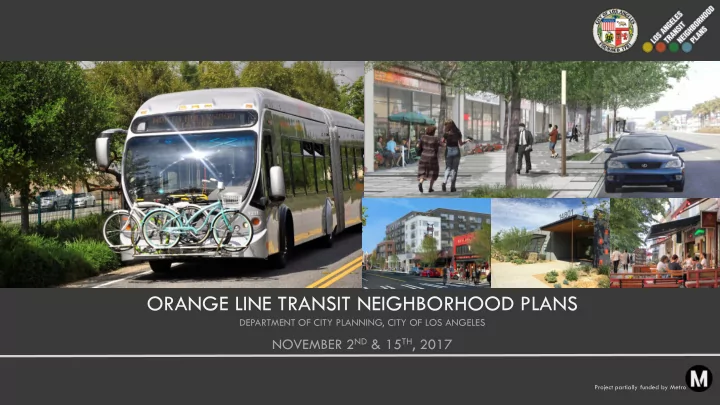
ORANGE LINE TRANSIT NEIGHBORHOOD PLANS
DEPARTMENT OF CITY PLANNING, CITY OF LOS ANGELES
NOVEMBER 2ND & 15TH, 2017
Project partially funded by Metro
ORANGE LINE TRANSIT NEIGHBORHOOD PLANS DEPARTMENT OF CITY PLANNING, - - PowerPoint PPT Presentation
Photo: Mission Meridian(Moule & Polyzoides) ORANGE LINE TRANSIT NEIGHBORHOOD PLANS DEPARTMENT OF CITY PLANNING, CITY OF LOS ANGELES NOVEMBER 2 ND & 15 TH , 2017 Project partially funded by Metro ORANGE LINE TRANSIT NEIGHBORHOOD PLANS
Photo: Mission Meridian(Moule & Polyzoides)
DEPARTMENT OF CITY PLANNING, CITY OF LOS ANGELES
Project partially funded by Metro
ME T RO – A c o untywide a g e nc y tha t pla ns,
c o nstruc ts, a nd o pe ra te s b us a nd ra il line s a nd tra nsit sta tio ns
Los Angeles Department of City Planning Overview | Vision | Strategies | Next Steps
DE PART ME NT OF CIT Y PL ANNING – A City o f L
de pa rtme nt tha t re g ula te s the de ve lo pme nt o f priva te pro pe rty ne a r tra nsit, inc luding de nsity, he ig ht, size , a nd de sig n re g ula tio ns
MAJOR RE L AT E D PL ANNI NG E F F ORT S
Ge ne ra l Pla n upda te – A visio ning pro c e ss to upda te the
sta te -re q uire d Ge ne ra l Pla n e le me nts
L
a nd Use E le me nt – An e ffo rt to upda te the la nd use a nd zo ning o f 35 Co mmunity Pla ns, inc luding thre e So uthwe st Valle y Co mmunity Plans (Ca no g a Pa rk-Winne tka -Wo o dla nd Hills-We st Hills, E nc ino -T a rza na , Re se da -We st Va n Nuys)
T r ansit Ne ighbor hood Plans – A tar ge te d planning pr
ar
ange L ine stations, inc luding two stations (She r man Way and Re se da) within the Southwe st Valle y Community Plans
re :c o de L
A – A re write o f the City’ s zo ning c o de , whic h the T ra nsit Ne ig hb o rho o d Pla ns will utilize
Los Angeles Department of City Planning Overview | Vision | Strategies | Next Steps
T ra nsit Ne ig hb o rho o d Pla ns a re pa rtia lly funde d thro ug h Me tro g ra nts se c ure d in 2014 fo r sta tio n-a re a pla nning a ro und tra nsit to impro ve a c c e ss a nd re duc e g re e nho use g a s e missio ns
T he T ra nsit Ne ig hb o rho o d Pla ns initia tive wa s la unc he d to ta ke a dva nta g e o f the o ppo rtunity fo r a dditio na l re so urc e s prio r to the Ge ne ra l Pla n upda te a nd a c c e le ra te d Co mmunity Pla n upda te s
All pla nning e ffo rts a re se pa ra te , b ut c lo se ly c o o rdina te d within the De pa rtme nt o f City Pla nning
Ora ng e L ine T ra nsit Ne ig hb o rho o d Pla ns sta tio ns we re se le c te d to ta ke a dva nta g e o f a nd imple me nt re c e nt c o mmunity-le d pla nning e ffo rts, inc luding Ca no g a Co nne c t a nd T a rza na Cro ssing
Los Angeles Department of City Planning Overview | Vision | Strategies | Next Steps
Ora ng e L ine T ra nsit Ne ig hb o rho o d Pla ns Pro je c t
Ne w zo ning fo r five tra nsit ne ig hb o rho o ds a lo ng the Ora ng e L ine
Guide fo r future de ve lo pme nt thro ug h 2040
No de ve lo pme nt pro je c ts a re pro po se d – this lo ng - ra ng e pla nning e ffo rt will de ve lo p re g ula tio ns fo r a ny ne w de ve lo pme nt
Go a ls
Cre a te o ppo rtunitie s fo r mo re jo b s a nd ho using ne a r tra nsit
F
I nc re a se a c c e ss to a va rie ty o f mo b ility o ptio ns fo r a ll
I mpro ve q ua lity o f pub lic spa c e s fo r re side nts, e mplo ye e s, a nd visito rs
Los Angeles Department of City Planning Overview | Vision | Strategies | Next Steps
Re vise d Plan & Adoption Imple me ntation E nvir
Re vie w Plan De ve lopme nt Community E ngage me nt
Conc e pt Plan & Public F e e dbac k
2016 2019 2017 2018 Los Angeles Department of City Planning Overview | Vision | Strategies | Next Steps
F
c o mmunity g ro ups, BIDs
Pre se nta tio ns to
Ne ig hb o rho o d Co unc ils
4 Pub lic Visio ning
Wo rksho ps
Wa lking T
Re vise d Plan & Adoption Imple me ntation E nvir
Re vie w Plan De ve lopme nt Community E ngage me nt
Conc e pt Plan & Public F e e dbac k
2016 2019 2017 2018 Los Angeles Department of City Planning Overview | Vision | Strategies | Next Steps
Re vise d Plan & Adoption Imple me ntation E nvir
Re vie w Plan De ve lopme nt Community E ngage me nt
Conc e pt Plan & Public F e e dbac k
2019 2018 2016 2017
Re vie w o f E
xisting Re g ula tio ns
Ma rke t Stud y F
e a sib ility Ana lysis
Initia l Co nc e pts
Los Angeles Department of City Planning Overview | Vision | Strategies | Next Steps
Re vise d Plan & Adoption Imple me ntation E nvir
Re vie w Plan De ve lopme nt Community E ngage me nt
Conc e pt Plan & Public F e e dbac k
2019 2018 2016 2017
Sha re initia l
c o nc e pts a nd visio ns
Co lle c t fe e d b a c k Ma ke re visio ns
Los Angeles Department of City Planning Overview | Vision | Strategies | Next Steps
DESIRE FOR DESTINATIONS & NEIGHBOROHOD-SERVING USES DIVERSITY OF TYPES & COST OF HOUSING SAFE CROSSINGS SHADE FROM THE VALLEY HEAT ADEQUATE PARKING OPEN SPACE & GREEN SPACE AMENITIES NEAR BIKE PATH KEEP DENSITY CLOSER TO STATIONS OPTIONS AROUND MOBILITY SAFETY & CLEANLINESS PEDESTRIAN-FRIENDLY DESIGN & WAYFINDING GE T T ING AROUND PL ACE S L IVABIL IT Y DE SIGN
Los Angeles Department of City Planning Overview | Vision | Strategies | Next Steps
NEED FOR AFFORDABLE HOUSING & SOCIAL SERVICES
Los Angeles Department of City Planning Overview | Vision | Strategies | Next Steps Reseda Boulevard Station Area Vision: Tarzana Crossing - Junction of Medicine, Education & Culture
Capitalize on arts, education, and health assets, and create mixed-use, pedestrian-friendly connections via alley network and along Reseda corridor to link north to downtown Reseda and CSUN and south to Ventura Boulevard and the Providence Tarzana Medical Center. Allow for a limited mixture of industrial with retail, restaurants, and housing for unique incubator mixed-use district.
Van Nuys & Sepulveda Station Area Vision: Regional Gateway - Civic Center & Jobs Hub
Enhance the vibrancy of the Civic Center and commercial corridor with around-the-clock activity, adapt the industrial corridor to encourage studio and production facilities while protecting current jobs uses, and foster the growing office and creative hub along Sepulveda Boulevard.
Sherman Way Station Area Vision: Historic Main Street and Innovation Corridor
Enhance and expand the Canoga Park main street along Sherman Way with pedestrian-friendly and sustainable building design and alleyways, preserve dense jobs uses while also accommodating clean tech enterprises, and improve connections to Warner Center and the headwaters of the Los Angeles River.
North Hollywood Station Area Vision: Creative Industry and Artisanal Hub
Destination arts center and hub for creative jobs such as recording studios, choreography, and post production, as well as supporting office space, restaurants, and boutique hotels. Enhance the regional center while promoting walkability and protecting opportunities for makers, artisans, and other creative professionals.
Main Str e e ts - Enhance pedestrian orientation along corridors and increase
Place buildings at the sidewalk and provide pedestrian entrances
Require minimum storefront transparency for safety, activation, and rhythm
Encourage reuse of older main street buildings through parking exceptions
Mixe d Use Hubs & Cor r idor s - Focus development where it can be sustained, as
long as it provides community benefits
Develop “Base” and “Bonus” system to encourage provision of community benefits
Incorporate metrics from existing design overlays
Create parking setbacks to prevent parking lots along main streets
Jobs Ce nte r s – Preserve existing jobs and accommodate emerging industries
Encourage industrial areas to have clean uses and density of jobs
Address adjacency of commercial and industrial uses abutting residential through use limitations, “good neighbor” policies, and landscape buffering or screening
Ne ighbor hoods Cor r idor s – Allow residential and neighborhood uses that foster a
more walkable environment and place more people near transit corridors
Promote “missing middle” housing that provide a diversity of low-scale housing choices, such as townhomes, duplexes, or bungalow courts
Allow limited neighborhood-serving uses, such as daycares or corner stores
Ne ighbor hoods – Reflect and encourage diverse building types and housing options
Encourage the retention of existing rent-stabilized units
Incentivize development of affordable housing through “Base” and “Bonus” system Los Angeles Department of City Planning Overview | Vision | Strategies | Next Steps Neighborhood Corridors Mixed Use Hubs & Corridors Main Streets Main Streets Job Centers Neighborhoods Job Centers Neighborhoods Open Space Mixed Use Hubs & Corridors
Los Angeles Department of City Planning Overview | Vision | Strategies | Next Steps
Main Str e e ts - Enhance pedestrian orientation along corridors and increase
Place buildings at the sidewalk and provide pedestrian entrances
Require minimum storefront transparency for safety, activation, and rhythm
Encourage reuse of older main street buildings through parking exceptions
Mixe d Use Hubs & Cor r idor s - Focus development where it can be sustained, as
long as it provides community benefits
Develop “Base” and “Bonus” system to encourage provision of community benefits
Incorporate metrics from existing design overlays
Create parking setbacks to prevent parking lots along main streets
Jobs Ce nte r s – Preserve existing jobs and accommodate emerging industries
Encourage industrial areas to have clean uses and density of jobs
Address adjacency of commercial and industrial uses abutting residential through use limitations, “good neighbor” policies, and landscape buffering or screening
Ne ighbor hoods Cor r idor s – Allow residential and neighborhood uses that foster a
more walkable environment and place more people near transit corridors
Promote “missing middle” housing that provide a diversity of low-scale housing choices, such as townhomes, duplexes, or bungalow courts
Allow limited neighborhood-serving uses, such as daycares or corner stores
Ne ighbor hoods – Reflect and encourage diverse building types and housing options
Encourage the retention of existing rent-stabilized units
Incentivize development of affordable housing through “Base” and “Bonus” system Neighborhood Corridors Mixed Use Hubs & Corridors Main Streets Main Streets Job Centers Neighborhoods Job Centers Neighborhoods Open Space Mixed Use Hubs & Corridors
Los Angeles Department of City Planning Overview | Vision | Strategies | Next Steps
Main Str e e ts - Enhance pedestrian orientation along corridors and increase
Place buildings at the sidewalk and provide pedestrian entrances
Require minimum storefront transparency for safety, activation, and rhythm
Encourage reuse of older main street buildings through parking exceptions
Mixe d Use Hubs & Cor r idor s - Focus development where it can be sustained, as
long as it provides community benefits
Develop “Base” and “Bonus” system to encourage provision of community benefits
Incorporate metrics from existing design overlays
Create parking setbacks to prevent parking lots along main streets
Jobs Ce nte r s – Preserve existing jobs and accommodate emerging industries
Encourage industrial areas to have clean uses and density of jobs
Address adjacency of commercial and industrial uses abutting residential through use limitations, “good neighbor” policies, and landscape buffering or screening
Ne ighbor hoods Cor r idor s – Allow residential and neighborhood uses that foster a
more walkable environment and place more people near transit corridors
Promote “missing middle” housing that provide a diversity of low-scale housing choices, such as townhomes, duplexes, or bungalow courts
Allow limited neighborhood-serving uses, such as daycares or corner stores
Ne ighbor hoods – Reflect and encourage diverse building types and housing options
Encourage the retention of existing rent-stabilized units
Incentivize development of affordable housing through “Base” and “Bonus” system Neighborhood Corridors Mixed Use Hubs & Corridors Main Streets Main Streets Job Centers Neighborhoods Job Centers Neighborhoods Open Space Mixed Use Hubs & Corridors
Los Angeles Department of City Planning Overview | Vision | Strategies | Next Steps
Main Str e e ts - Enhance pedestrian orientation along corridors and increase
Place buildings at the sidewalk and provide pedestrian entrances
Require minimum storefront transparency for safety, activation, and rhythm
Encourage reuse of older main street buildings through parking exceptions
Mixe d Use Hubs & Cor r idor s - Focus development where it can be sustained, as
long as it provides community benefits
Develop “Base” and “Bonus” system to encourage provision of community benefits
Incorporate metrics from existing design overlays
Create parking setbacks to prevent parking lots along main streets
Jobs Ce nte r s – Preserve existing jobs and accommodate emerging industries
Encourage industrial areas to have clean uses and density of jobs
Address adjacency of commercial and industrial uses abutting residential through use limitations, “good neighbor” policies, and landscape buffering or screening
Ne ighbor hoods Cor r idor s – Allow residential and neighborhood uses that foster a
more walkable environment and place more people near transit corridors
Promote “missing middle” housing that provide a diversity of low-scale housing choices, such as townhomes, duplexes, or bungalow courts
Allow limited neighborhood-serving uses, such as daycares or corner stores
Ne ighbor hoods – Reflect and encourage diverse building types and housing options
Encourage the retention of existing rent-stabilized units
Incentivize development of affordable housing through “Base” and “Bonus” system Neighborhood Corridors Mixed Use Hubs & Corridors Main Streets Main Streets Job Centers Neighborhoods Job Centers Neighborhoods Open Space Mixed Use Hubs & Corridors
Los Angeles Department of City Planning Overview | Vision | Strategies | Next Steps
Main Str e e ts - Enhance pedestrian orientation along corridors and increase
Place buildings at the sidewalk and provide pedestrian entrances
Require minimum storefront transparency for safety, activation, and rhythm
Encourage reuse of older main street buildings through parking exceptions
Mixe d Use Hubs & Cor r idor s - Focus development where it can be sustained, as
long as it provides community benefits
Develop “Base” and “Bonus” system to encourage provision of community benefits
Incorporate metrics from existing design overlays
Create parking setbacks to prevent parking lots along main streets
Jobs Ce nte r s – Preserve existing jobs and accommodate emerging industries
Encourage industrial areas to have clean uses and density of jobs
Address adjacency of commercial and industrial uses abutting residential through use limitations, “good neighbor” policies, and landscape buffering or screening
Ne ighbor hoods Cor r idor s – Allow residential and neighborhood uses that foster a
more walkable environment and place more people near transit corridors
Promote “missing middle” housing that provide a diversity of low-scale housing choices, such as townhomes, duplexes, or bungalow courts
Allow limited neighborhood-serving uses, such as daycares or corner stores
Ne ighbor hoods – Reflect and encourage diverse building types and housing options
Encourage the retention of existing rent-stabilized units
Incentivize development of affordable housing through “Base” and “Bonus” system Neighborhood Corridors Mixed Use Hubs & Corridors Main Streets Main Streets Job Centers Neighborhoods Job Centers Neighborhoods Open Space Mixed Use Hubs & Corridors
Re vise d Plan & Adoption Imple me ntation E nvir
Re vie w Plan De ve lopme nt Community E ngage me nt
Conc e pt Plan & Public F e e dbac k
2019 2018 2016 2017 Los Angeles Department of City Planning Overview | Vision | Strategies | Next Steps
E nvir
Re vie w
Co nd uc t pub lic
Sc o ping Me e ting
Ana lyze po te ntia l
e nviro nme nta l impa c ts
Los Angeles Department of City Planning Overview | Vision | Strategies | Next Steps