
SLIDE 1
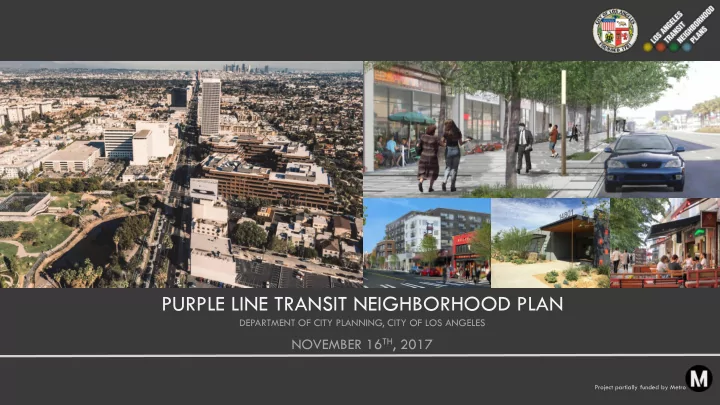
Photo: Mission Meridian(Moule & Polyzoides)
PURPLE LINE TRANSIT NEIGHBORHOOD PLAN
DEPARTMENT OF CITY PLANNING, CITY OF LOS ANGELES
NOVEMBER 16TH, 2017
Project partially funded by Metro
PURPLE LINE TRANSIT NEIGHBORHOOD PLAN DEPARTMENT OF CITY PLANNING, - - PowerPoint PPT Presentation
Photo: Mission Meridian(Moule & Polyzoides) PURPLE LINE TRANSIT NEIGHBORHOOD PLAN DEPARTMENT OF CITY PLANNING, CITY OF LOS ANGELES NOVEMBER 16 TH , 2017 Project partially funded by Metro PURPLE LINE TRANSIT NEIGHBORHOOD PLAN Overview: Roles
Photo: Mission Meridian(Moule & Polyzoides)
DEPARTMENT OF CITY PLANNING, CITY OF LOS ANGELES
Project partially funded by Metro
METRO – A countywide agency that plans, constructs, and operates bus and rail lines and transit stations
Los Angeles Department of City Planning Overview | Vision | Strategies | Next Steps
DEPARTMENT OF CITY PLANNING – A City of Los Angeles department that regulates the development of private property near transit, including density, height, size, and design regulations
MAJOR RELATED CITY PLANNING EFFORTS
General Plan update – A visioning process to
Land Use Element – An effort to update the land
Purple Line Transit Neighborhood Plan – A targeted
re:code LA – A rewrite of the City’s zoning
Los Angeles Department of City Planning Overview | Vision | Strategies | Next Steps
Los Angeles Department of City Planning Overview | Vision | Strategies | Next Steps
Transit Neighborhood Plans are partially funded through Metro grants secured in 2014 for station-area planning around transit to improve access and reduce greenhouse gas emissions
The Transit Neighborhood Plans initiative was launched to take advantage of the opportunity for additional resources prior to the General Plan update and accelerated Community Plan updates
All planning efforts are separate, but closely coordinated within the Department of City Planning
Los Angeles Department of City Planning Overview | Vision | Strategies | Next Steps
Purple Line Transit Neighborhood Plans Project
New zoning for three transit neighborhoods along the Purple Line
Guide for future development through 2040
No development projects are proposed – this long-range planning effort will develop regulations for any new development
Goals
Create opportunities for more jobs and housing near transit
Foster a vibrant mix of uses within each station area
Increase access to a variety of mobility options for all
Improve quality of public spaces for residents, employees, and visitors
Los Angeles Department of City Planning Overview | Vision | Strategies | Next Steps
Revised Plan & Adoption Implementation Environmental Review Plan Development Community Engagement
Concept Plan & Public Feedback 2016 2019 2017 2018
Los Angeles Department of City Planning Overview | Vision | Strategies | Next Steps
Focus Groups with
community groups, BIDs
Presentations to
Neighborhood Councils
2 Public Visioning
Workshops
Walking Tours
Revised Plan & Adoption Implementation Environmental Review Plan Development Community Engagement
Concept Plan & Public Feedback 2016 2019 2017 2018
Los Angeles Department of City Planning Overview | Vision | Strategies | Next Steps
Revised Plan & Adoption Implementation Environmental Review Plan Development Community Engagement
Concept Plan & Public Feedback 2019 2018 2016 2017
Review of Existing
Regulations
Market Study Feasibility Analysis Initial Concepts
Los Angeles Department of City Planning Overview | Vision | Strategies | Next Steps
Revised Plan & Adoption Implementation Environmental Review Plan Development Community Engagement
Concept Plan & Public Feedback 2019 2018 2016 2017
Share initial
concepts and visions
Collect feedback Make revisions
Los Angeles Department of City Planning Overview | Vision | Strategies | Next Steps
DESIRE FOR DESTINATIONS & NEIGHBOROHOD-SERVING USES DIVERSITY OF TYPES & COST OF HOUSING
SAFE CROSSINGS & ACCESSIBILITY
RESPECT FOR HISTORIC CHARACTER ADEQUATE PARKING OPEN SPACE & GREEN SPACE BICYCLE AMENITIES KEEP DENSITY CLOSER TO STATIONS OPTIONS AROUND MOBILITY SAFETY & CLEANLINESS PEDESTRIAN-FRIENDLY DESIGN & WAYFINDING
GETTING AROUND PLACES LIVABILITY DESIGN
Los Angeles Department of City Planning Overview | Vision | Strategies | Next Steps
NEED FOR AFFORDABLE HOUSING & SOCIAL SERVICES
Los Angeles Department of City Planning Overview | Vision | Strategies | Next Steps
Wilshire Corridor & Major Intersections - Focus development where it can be sustained, as long as it provides community benefits
Develop “Base” and “Bonus” system to encourage provision of community benefits
Allowable development stepping down in intensity from Wilshire
Incorporate metrics from existing design overlays
Required step-backs for taller buildings to minimize imposing mass and allow for light
Urban Main Streets - Enhance pedestrian orientation along corridors and increase opportunities for mixed-use development
Place buildings at the sidewalk and provide pedestrian entrances
Require minimum storefront transparency for safety, activation, and rhythm
Encourage reuse of older main street buildings through parking exceptions
Create parking setbacks to prevent parking lots along main streets
Neighborhoods – Reflect diverse building forms and neighborhood character
Encourage the retention of existing rent-stabilized units
Retain existing character-residential areas
Accommodate build-out pattern, scale, and mass of existing neighborhoods
Los Angeles Department of City Planning Overview | Vision | Strategies | Next Steps
Wilshire Corridor & Major Intersections - Focus development where it can be sustained, as long as it provides community benefits
Develop “Base” and “Bonus” system to encourage provision of community benefits
Allowable development stepping down in intensity from Wilshire
Incorporate metrics from existing design overlays
Required step-backs for taller buildings to minimize imposing mass and allow for light
Urban Main Streets - Enhance pedestrian orientation along corridors and increase opportunities for mixed-use development
Place buildings at the sidewalk and provide pedestrian entrances
Require minimum storefront transparency for safety, activation, and rhythm
Encourage reuse of older main street buildings through parking exceptions
Create parking setbacks to prevent parking lots along main streets
Neighborhoods – Reflect diverse building forms and neighborhood character
Encourage the retention of existing rent-stabilized units
Retain existing character-residential areas
Accommodate build-out pattern, scale, and mass of existing neighborhoods
Los Angeles Department of City Planning Overview | Vision | Strategies | Next Steps
Wilshire Corridor & Major Intersections - Focus development where it can be sustained, as long as it provides community benefits
Develop “Base” and “Bonus” system to encourage provision of community benefits
Allowable development stepping down in intensity from Wilshire
Incorporate metrics from existing design overlays
Required step-backs for taller buildings to minimize imposing mass and allow for light
Urban Main Streets - Enhance pedestrian orientation along corridors and increase opportunities for mixed-use development
Place buildings at the sidewalk and provide pedestrian entrances
Require minimum storefront transparency for safety, activation, and rhythm
Encourage reuse of older main street buildings through parking exceptions
Create parking setbacks to prevent parking lots along main streets
Neighborhoods – Reflect diverse building forms and neighborhood character
Encourage the retention of existing rent-stabilized units
Retain existing character-residential areas
Accommodate build-out pattern, scale, and mass of existing neighborhoods
Los Angeles Department of City Planning Overview | Vision | Strategies | Next Steps
Revised Plan & Adoption Implementation Environmental Review Plan Development Community Engagement
Concept Plan & Public Feedback 2019 2018 2016 2017
Los Angeles Department of City Planning Overview | Vision | Strategies | Next Steps
Environmental Review
Conduct public
Scoping Meeting
Analyze potential
environmental impacts
Los Angeles Department of City Planning Overview | Vision | Strategies | Next Steps