Optimising the Conservation Agriculture system for non- commercial - - PowerPoint PPT Presentation
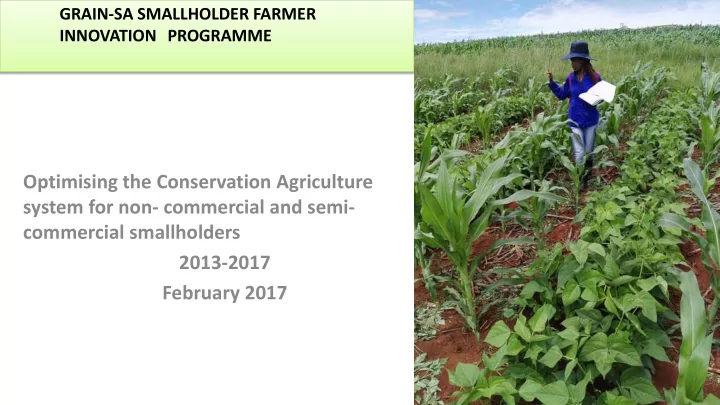
GRAIN-SA SMALLHOLDER FARMER INNOVATION PROGRAMME Optimising the Conservation Agriculture system for non- commercial and semi- commercial smallholders 2013-2017 February 2017 Smallholders-CA study areas and team Erna Kruger, Mazwi Dlamini,
Erna Kruger, Mazwi Dlamini, Sylvester Selala, Thabani Madondo,Phumzile Ngcobo New staff member: Temakholo Mathebula Interns: Khethiwe Mthethwa, Nonkhanyiso Zondi and Sandile Madlala
- 18 villages, 7 Savings and credit
groups, 10 Local facilitators,2 farmer centres
- Matatiele; 4 villages, 3 savings and
credit groups, 1 Local facilitator
- Ixopo: 4 villages, 4 Local facilitators
- Creighton and Umzimkhulu
- Nkandla, Cornfields, Emhlopeni
New study area: EC and Southern KZN- 70
Smallholders-CA study areas and team
New study area: KZN Midlands- 32 Study area: Bergville – 240
- Adaptive research into CA processes appropriate for smallholder farmers:
looking at the whole value chain; inputs, appropriate tools and equipment, different production options, storage options, milling, fodder etc
- Partnership: MDF, KZN DARD, Lima RDF, Siyazisiza Trust,KwaNalu, StratAct,
Ubuhlebezwe and other Municipalities, LandCare …….
- Farmer experimentation linked to larger learning groups using the
Farmer Field School approach. People work together in teams, belong to savings groups, do bulk buying and support each other with food and marketing
- Horizontal scaling model starting with a nodal village in each area and
expanding within and between villages:
- 2013: 3 Villages EC and 3 in Bergville (total trial participants: 50)
- 2014: 7 villages EC, 9 villages Bergville (Total trial participants: 100)
- 2015: 8 villages EC, 10 Bergville, 2 Nkandla (total trial participants: 210)
- 2016: 12 Villages EC-SKZN; 4 Midlands, 17 Bergville (total participants:
350)
- Farmer volunteers, local facilitators, farmer centres (for each node
surrounded by 3-5 villages close by for input and equipment provision as well as production advice)
Description of Model and Process
Farmer level experimentation
- Year 1: Predefined with the research team:
– Choice of planting method; hand hoes, hand planters, animal drawn planters
- Year 2: Choices and options within the same overall design:
– Different varieties maize (white yellow, OPV, hybrid) – Different varieties and types of legumes – Early planting – Manure and fertilizer combinations – Targeted fertility regimes and pest control measures
- Year 3 +: Own design of experiments by participants :
– Intercropping vs crop rotation options – Summer and winter cover crops – Mulching – Organic options – Different herbicide and pesticide spray regimes – Different planting times – As well as options for year 2.
Incremental change in yr 1,2,3
- Average Maize price 2017:
R2 500/ton
- Break even yield:
3,9 t/ha
- Average yield:
1,4 - 4,2t/ha
- Average price sugar
beans; R8 000/ton
- Average yield 0,5-1,75t/ha
Costs of inputs
What does this mean??
CONSERVATION AGRICULTURE PLOTS, KZN 2016-2017
0.1= Ha PLOTS Events Cost Costs (0.1ha)-2015 Costs 0,1ha - 2016 INPUTS ha lit / kg ( R / kg,l) Seeds - maize (PAN 6479) 0,075 25 1 104 R 195,00 R 216,45 Seeds - drybeans (PAN 148 or Gadra) 0,05 75 1 42,6 R 159,75 R 177,32 Fertilizer MAP 0,1 250 1 9,2 R 230,00 R 255,30 Fertilizer LAN 0,1 150 1 5 R 75,00 R 83,25 Lime 0,1 1000 1 1 R 100,00 R 111,00 Pesticides (Decis Forte) 0,1 0,1 3 875 R 26,25 R 29,14 Herbicides: Roundup 0,1 3 2 109 R 65,40 R 72,59 Herbicides: Dual Gold 0,1 1,2 1 250 R 30,00 R 33,30 Summit/surfactant 0,1 0,2 1 296 R 5,92 R 6,57 Input costs per 0.1 ha R 887,32 R 984,93 Input costs per 1 ha R 8 873,20 R 9 849,25
We need more than 4 tons/ha maize to make a profit
- Biggest cost is fertilizer…. Even when micro-dosing
– Need ways to reduce fertilizer needs
- The next cost is seed (Here Hybrid, plus legume)
– Carefully weigh up different seed types against other costs and yields.
- Labour costs for weeding; ~R250/0,1ha (R50pppd x 5days), ploughing
~R500/0,1ha
– Compare these prices (herbicides and pesticides)with ploughing and labour for weeding
O,1ha cost summaries SEED PRICES 25kg Pesticides, herbicides R 141,60 OPV R 400,00 Fertilizers R 449,55 Hybrid (generic) R 1 150,00 Seed R 393,77 GM R 2 700,00
Cost summaries; How to deal with rising costs
Not ploughing saves a lot of money, Seed costs need to be weighed against yield increase Reduce fertilizer and chemical use to a minimum Ways to improve soil health
- Minimal soil
disturbance
- Soil cover
- Diversity
– Right: A 3year old CA plot with developing cover – Far right: A ploughed plot with no soil cover – Insert: Mulching…..
Conservation Agriculture: All three principles
- A mix of systems; household, larger
fields
- OPV, hybrid and GM all being
planted –
- Injudicious use of herbicides
Southern KZN
We like the OPVs and hybrids because the yields are similar to GM and the seed is a lot
- cheaper. It is also better for eating and local
processing. Intercropping is good as it increases the vigour of the maize and provides and alternative income stream
- Now many smallholders involved
- Working with Local Facilitators and
Farmer Centres are important
- Some participants 4 years under CA
Bergville KZN
We prefer to do crop rotation as the intercrop plots are difficult to weed and the bean yields are lower. Cowpeas are not generally preferred. The cover crops are great for soil health, but still struggling to keep seed. Growing separate plots for this now. Seed funding Payment by Centre Inputs bought Date Potential profit (at 12,5% mark up) R2900.00 8x50kg 3:2;! 201611/11 R1345.00 2x50kg 3:2:1, 5x50kg PAN 413 2016/11/30 R1364.30 9x50kg Pan413 2016/11/23 R1333.20 2x50kg 3:2:1, 3x50kg LAN 2016/12/06 Money in hand R1666.80 2016/12/07 TOTAL R6942.50 R850.00
- 3-4 years: Reduced need for herbicide
- Increased organic matter, reduced fertilizer
requirements
- Reduced runoff
- Increased yields and diversity
Bergville Continued
Mphumelele Hlongwane- Ezibomvini
Far left: : the run off plot in Phumelele Hlongwane’s trial maize (3 (3 years under CA) A) and Left: : The run off from the plot in the buck cket. . Runoff is only 42 42mm (2 (2016/ 016/12/ 12/07) 07) and water is almost perfect ctly cl clear. Far left: : Th The run off plot in Phumelele Hlongwane’s control plot- ploughed. Left: : the run off from the co control plot in the buck cket. . Runoff is 19 195m 5mm (20 (2016/ 16/12/ 12/07) 07) and water is quite muddy with substantial sediments
Phumelele Hlongwane’s plots, showing where soil samples were collected .
Soil health tests for different practices
- The veld provides a good positive benchmark for soil health scores
- The maize CA control plot has a higher score than the Maize CA trial plot.
- The CA plots with maize and maize and legume intercrops provided for the highest N reserve
values, meaning that a balance between nitrogen utilised and nitrogen in reserve was created in these plots.
- The cover crop plots (Lab-Lab and summer cover crops) provided the most available nitrogen for
use by the following crop, but did not build nitrogen reserves in the soil to a significant extent.
Soil health tests for different practices results
- 3-4 years: Own mix of runner beans and different
spacing in intercrop
- Maize and sunflower intercrop
- GM maize – DARD and GrainSA FDP
- Millet