Envir ironm nment ntal al A Acco count ntin ing a and d - - PowerPoint PPT Presentation

envir ironm nment ntal al a acco count ntin ing a and d
SMART_READER_LITE
LIVE PREVIEW

Envir ironm nment ntal al A Acco count ntin ing a and d - - PowerPoint PPT Presentation

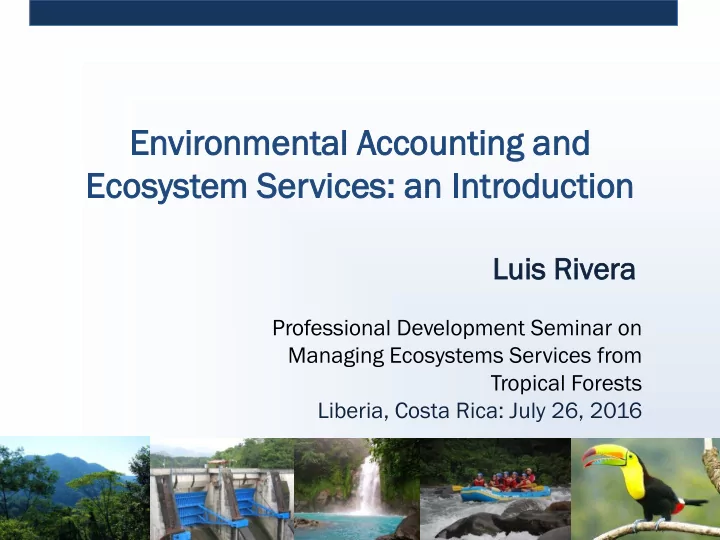
Envir ironm nment ntal al A Acco count ntin ing a and d Ecosystem S Service ices: a an I n Introdu duct ctio ion Luis Riv Rivera ra Professional Development Seminar on Managing Ecosystems Services from Tropical Forests


slide-1
SLIDE 1

Envir ironm nment ntal al A Acco count ntin ing a and d Ecosystem S Service ices: a an I n Introdu duct ctio ion

Luis Riv Rivera ra

Professional Development Seminar on Managing Ecosystems Services from Tropical Forests Liberia, Costa Rica: July 26, 2016

slide-2
SLIDE 2

Outline

  • Natural Capital Brief
  • Environmental Accounting: Methods and

Examples

  • NCA in Costa Rica
  • Relevance for Policy
  • Discussion
slide-3
SLIDE 3

NATURAL CAPITAL

slide-4
SLIDE 4

Components of Wealth

Natural capital accounts for:

 36% of total wealth in low income countries  21% in middle income countries  and 3% in high income countries

Source: WAVES –The World Bank databases

slide-5
SLIDE 5

Example: Australia´s Capital Base, current prices—as at 30 Jun

5

Source: Australian System of National Accounts, 2010–11 (ABS cat. no. 5204.0)

slide-6
SLIDE 6

Example: Total Wealth of Costa Rica (2005 US$ per capita)

NOTE: Natural Capital estimation does not include Ecosystem Services Source: own ellaboration with data from World Bank (2011)

  • 5,000

5,000 15,000 25,000 35,000 45,000 55,000 65,000 75,000 85,000 T

  • tal Wealth

Intangible Capital NFA Produced Capital Natural Capital 2005 US$

US$9,300 Protected Areas: US$1,000

slide-7
SLIDE 7

ENVIRONMENTAL ACCOUNTING

slide-8
SLIDE 8

Integrated Approach: Environmental-Economic Accounting

slide-9
SLIDE 9
  • Adopted as an international standard by

the United Nations Statistical Commission in 2012.

  • Interactions between the economy and

the environment:

  • physical flows between the

environment and the economy

  • the stocks of environmental assets

and changes in those stocks

  • economic activity and transactions

related to the environment

  • It puts statistics on the environment and

its relationship to the economy at the core of official statistics.

SEEA Central Framework

slide-10
SLIDE 10

Physical flows of natural inputs, products and residuals

Source: United Nations et al (2014a)

slide-11
SLIDE 11

Supply-Use Table

Source: United Nations et al (2014a)

slide-12
SLIDE 12

Asset Account

Source: United Nations et al (2014a)

slide-13
SLIDE 13

Example: Physical asset account for water resources of Costa Rica, 2012 (million of m3)

Source: BCCR (2016)

Surface water Groundwater Soil water Total Opening stock of water resources 2 001 2 001 Additions to stock (+) Returns (H.1) 26 465 881 27 346 Precipitation (B.1) 170 036 170 036 Inflows from other territories (B.2) Inflows from other inland water 94 893 23 723 118 617 Total additions to stock 121 358 24 604 170 036 315 998 Reductions in stock (-) Abstraction (E.1) 27 581 380 27 961 for hydro power generation 25 584 25 584 for irrigation of crops 1 746 42 1 788 for other uses 250 338 589 Evaporation & actual evapotranspiration (C.1) 51 419 51 419 Outflows to other territories (C.2 39 500 39 500 Outflows to the sea (C.2.2) 54 515 24 224 78 739 Outflows to other inland water resources 118 617 118 617 Total reductions in stock 121 596 24 604 170 036 316 235 Closing stock of water resources 1 764 1 764 Change in assets

  • 237
  • 237

Type of water resource

slide-14
SLIDE 14
  • Integrated accounting structure of

ecosystem services and ecosystem condition (physical and monetary).

  • Basic focus for measurement:

spatial areas (ecosystem asset).

  • Measurement of ecosystem

services generated from ongoing ecosystem processes (i.e. regulation of climate, air filtration and flood protection) and human engagement with the environment (such as through recreation activity).

SEEA Experimental Ecosystem Accounting

slide-15
SLIDE 15

“Contributions of ecosystems to benefits used in economic and other human activity”

Ecosystem Services in SEEA

Source: United Nations et al (2014b)

slide-16
SLIDE 16

Selected Ecosystem Services

Source: United Nations et al (2014b)

slide-17
SLIDE 17
  • Basic spatial units (BSUs):

Basic spatial units (BSUs): tessellations (e.g., of 1 km2), land parcels cadaster, remote-sensing pixels; grid squares: available information, landscape diversity and analytical requirements.

  • Land

Land-co cover/eco cosystem funct ctional u units (LCEUs) s): : characteristics of an ecosystem (land-cover type, water resources, climate, altitude, soil type); FAO´s Land Cover Classification System, version 3 (LCCS 3).

  • Ecosystem accounting units (EAUs):

Ecosystem accounting units (EAUs): administrative boundaries, environmental management areas, large-scale natural features (e.g., river basins), areas for reporting purposes (e.g., national parks and

  • ther protected areas).

UNITS: BSUs, LCEUs and EAUs

The statistical units of ecosystem accounting are spatial areas about which information is collected and statistics are compiled

Source: United Nations et al (2014b)

slide-18
SLIDE 18
  • Ecosystem accounting units (EAUs):

Ecosystem accounting units (EAUs): Limburg (administrative area)

  • Land

Land-co cover/eco cosystem funct ctional u units (LCEUs) s): : Landelijk Grondgebruiksbestand Nederland ver. 6

  • Basic spatial units (BSUs):

Basic spatial units (BSUs): 25m2 grid cells

Example: Limburg (Netherlands)

Source: Remme et al (2014)

slide-19
SLIDE 19

TABLES: flows of ecosystem services and stocks of ecosystem assets

Source: United Nations et al (2014b)

slide-20
SLIDE 20

Example: ecosystem services in the Central Highlands of Victoria (Australia), 2010-2015

Source: Keith et al (2016)

slide-21
SLIDE 21

Example: Area at risk of Soil degradation in Costa Rica, 2013

Source: Vega-Araya and Rivera, work in progress

slide-22
SLIDE 22

Valuation of Ecosystem Services

  • Different ecosystem services contribute to economic and
  • ther human activity and link to benefits and well-being

in different ways (Provisioning, Regulating, Cultural):

– how the service leads to the generation of benefits – the relation between those benefits and the recording of the related economic activity in the SNA

22

Source: United Nations et al (2014b)

slide-23
SLIDE 23

Exchange Value Approach

  • Non-market transactions: proxy for “prices”
  • Shadow prices
  • Total Economic

Value (TEV): Direct Use Value Indirect Use Value Option Value Non-use Value

23

slide-24
SLIDE 24

Pricing of Ecosystem Services

  • Unit Resource Rent

Unit Resource Rent: associated with provisioning services (outputs of the agriculture, forestry and fishing industries)

  • Replacement Cost Method:

Replacement Cost Method: particular relevance in the case

  • f regulating services (water purification, flood control)
  • Payments for ecosystem services and trading schemes

Payments for ecosystem services and trading schemes: markets for regulating services

  • Revealed and stated preference methods

Revealed and stated preference methods:

– Production function methods (contribution of ecosystem services to production processes) – Hedonic pricing methods (environmental qualities affect the prices that people pay for market products or assets) – Travel cost methods (ecosystem services associated with recreational sites) – Stated preference methods (people’s willingness to pay for ecosystem services without observing an actual payment or transaction): Contingent Valuation, Choice Experiments.

24

slide-25
SLIDE 25

Resource Rent

Economic rent is best considered to be the surplus value accruing to the extractor or user

  • f an asset calculated after all costs and normal returns have been taken into account

Source: United Nations et al (2014a)

slide-26
SLIDE 26

Example: Resource Rent of Rice, Corn, Coconut, Oil Palm, 2014 (Southern Palawan, Philippines)

Source: Southern Palawan Technical Working Group (TWG), WAVES (2016)

Ecosystem Units Area Production Costs per hectare Yield Farm - Gate Price Resource Rent/ ha Resource Rent, Pulot W atershed I nterm ediate Consum ption Com pensation to Em ployees Taxes and Subsidies User Costs

  • f

Produced Assets ( ha) ( Php) ( Php) ( Php) ( Php) ( ton/ ha) ( Php/ kg) ( Php) ( m illion Php) Annual Crop Ecosystem , Rice and Corn

6 0 8 3 5 .4 5

Rainfed Rice

150 8,531 16,150

  • 3.2

15 22,696 3.4

Irrigated Rice (paddy- paddy)

398 65,447 26.0

1st Cropping

8,995 16,150

  • 4.0

15 34,447 13.7

2nd Cropping

8,233 15,904

  • 3.3

17 30,882 12.3

Irrigated Rice (paddy-corn- paddy)

99,682 6.02

Yellow Corn

40 9,183 16,519 141 4,269 3.0 13 12,421 0.5

White Corn

20 9,183 16,519 141 5,209 3.0 16 21,815 0.4

Coconut

1 ,4 5 5 1,271 9,421

  • 2,424

1.3 18 13,547 1 9 .7

Oil Palm

1 ,3 1 6 36,424 14,350

  • 5,168

9.7 5 (6,709) ( 8 .8 3 )

slide-27
SLIDE 27

Discounting for Future Value

  • Vt = value of the asset of time t
  • N = asset life
  • RR = resource rent
  • r = nominal discount rate

27

Source: United Nations et al (2014a)

slide-28
SLIDE 28

Example: Costa Rica, value of carbon sequestration (2007 USD)

28

Social cost of carbon $36 (2007 USD/T), @3% Social cost of carbon $11 (2007 USD/T), @5% 1997 $400,954,884 $122,513,992 2008 $410,843,664 $125,535,564 2013 $446,120,136 $136,314,486

Source: Vega-Araya and Rivera, work in progress

slide-29
SLIDE 29

Summary: The Ecosystem Accounts

29

Source: UNSD (2015)

slide-30
SLIDE 30

Example: San Martín (Peru), Water Supply, 2011 (m3/year)

30

Source: Fundación Conservación Internacional (2016)

slide-31
SLIDE 31

Example: UK, Pollination of Crops, 2010

31

Source: Office for National Satistics (2016)

Crop Dependence on Pollinators (%) Production Value (£ millions) 2010 Pollination Value (£ millions) 2010 Oilseed Rape 25 674 169 Strawberries 45 261 118 Dessert Apples 85 63 54 Raspberries 45 103 46 Cucumbers 65 53 35 Culinary 85 40 34 Apples Tomatoes 25 115 29 Runner Beans 85 17 14 Pears 65 16 10 Plums 65 13 8 Other 5-85 285 88 Total

  • Approx. 603
slide-32
SLIDE 32

Example: Australia, Environmental Assets (Value per capita, 2005–2014)

32

Source: ABS (2016)

slide-33
SLIDE 33

Example: ESPH (Costa Rica), Water Supply by Industry, 2013 (m3)

33

Source: BCCR (2016)

slide-34
SLIDE 34

NCA IN COSTA RICA

slide-35
SLIDE 35

Good Measurement for Good Policy

  • Costa Rica is a country with an abundant natural

wealth: five percent of the world´s biodiversity

  • The production of ecosystem services sustain (and

determine) the country´s development potential

  • Agriculture, renewable energy, and leading industries

like tourism, are all valuable returns from its natural capital

  • However, most of this wealth has not been

accounted for and reflected in national indicators

35

slide-36
SLIDE 36

First Environmental Accounts

  • With World Bank and WAVES support, Costa Rica

compiled three Accounts: Water, Forests, Energy

  • The Central Bank of Costa Rica (BCCR) created a

new Unit to continue the work on environmental accounting: updates to be published every June

  • The implementation of SEEA will contribute a better

integration with Sustainable Development Goals (SDGs), Green Growth and other international statistical frameworks

36

slide-37
SLIDE 37

Some Policy Questions

37

  • For
  • rest A

Account: Contribution of Forests to national wealth

– Investments on Payments for Environmental Services (PES) – REDD+ Strategy – National Forests Policy and National Climate Change Strategy (2021 carbon neutrality goal)

  • Wat

ater A Account: Water Resources integrated management

– Water supply in the long term (quantity and quality) – Water productivity (decoupling of economic growth from unsustainable use) – Water as a “human right” and the need to “value it”

slide-38
SLIDE 38

Forest Accounts show Forests contribution to GDP

38 Source: BCCR (2016)

slide-39
SLIDE 39

Indicators from Forest Accounts (example)

  • Forest cover: 52,4% of total land area
  • Forest cover change (2011-2013): increase of 96,140

hectares (3.8%), resulting mainly from reductions in Crops (-48,036 ha) and Grassland (-46,171 ha)

– Conservation of forests as a key policy in last decades – Possible trade-offs with alternative productive activities – Relevance of ecosystem em s services es and the need to account them

39

slide-40
SLIDE 40

Water Flows in the Costa Rican Economy, 2012 (km3/year)

Agriculture Internal Water Resources 0.76 0.30 Water Utilities Irrigation Districts Households Hydroelectric Plants Sewerage Mining, Manufacturing and Services 1.02 0.013 Drinking water supply 0.20 0.40 0.62 0.52 0.28 25.6 25.6 0.04 Returns 0.35 0.01 0.06 0.0 0.086 0.09

Abstraction Losses Returns Source: BCCR (2016)

slide-41
SLIDE 41

Indicators from Water Accounts (example)

  • 99% of population using improved water

sources

  • Physical loss in water utilities: 57%
  • Average Tariff: 576 colones/m3

– Use of water and production (added value) – Management and sustainability of water sources

41

slide-42
SLIDE 42

USE FOR POLICY

slide-43
SLIDE 43

Environmental accounts in the information system and policy cycle

Source: Vardon et al (2016)

slide-44
SLIDE 44

Indicators for Decision Makers

Source: BCCR (2016)

slide-45
SLIDE 45

Example: Energy and Emissions intensity in Costa Rica (GJ and tCO2, per million colones)

Source: BCCR (2016)

slide-46
SLIDE 46

Example: birds, pest control and coffee yield in Río Negro, Costa Rica

Source: Carp et al (2013)

Coffee’s most damaging insect pest is the coffee berry borer (Hypothenemus hampeii), a ~ 2 mm beetle native to Africa

slide-47
SLIDE 47

Integration of (scattered) Data with a Policy-information perspective

  • PES
  • REDD+
  • Productive Sustainable Landscapes
  • Climate Smart Agriculture
  • Adaptation Fund
  • Biodiversity Fund
  • LEDS
  • Water Smart Economy
slide-48
SLIDE 48

DISCUSSION

slide-49
SLIDE 49

Some Points

49

  • Environmental Accounting as an integration tool
  • Interaction of NCA with key environmental

issues

  • Relevance of Natural Capital Accounting (NCA)

for policy design, implementation and monitoring

  • Perspectives to consolidate Ecosystem

Accounting in the near future

slide-50
SLIDE 50

THANK YOU

LUIS.RIVERA@UCR.AC.CR

50

slide-51
SLIDE 51

References (a)

  • Banco Central de Costa Rica, BCCR (2016): Cuentas Ambientales de Costa Rica. Available

at http://www.bccr.fi.cr/Cuentas_Ambientales/index.html#HERMES_TABS_1_1

  • Keith, H., M. Vardon, J. Stein, J. Stein, and D. Lindenmayer (2016): Experimental

Ecosystem Accounts for the Central Highlands of Victoria. Fenner School of Environment and Society. ANU College of Medicine, Biology and Environment

  • Office for National Satistics (2016): UK Natural Capital: Ecosystem accounts for farmland

(Experimental Statistics).

  • Fundación

Conservación Internacional (2016): Cuentas Experimentales de los Ecosistemas en San Martín, Perú. Reporte técnico para el MINAM, INEI, y ARA.

  • Remme, R, M. Schröter, and L Hein (2014): “Developing spatial biophysical accounting for

multiple ecosystem services.” Ecosystem Services 10 (2014) 6-18

  • Remme, R., B. Edens, M. Schroter, and L. Hein (2015): “Monetary accounting of

ecosystem services: A test case for Limburg province, the Netherlands.” Ecological Economics 112 (2015) 116-128

  • United Nations, European Union, Food and Agriculture Organization of the United Nations,

International Monetary Fund, Organisation for Economic Co-operation and Development, The World Bank (2014a): System of Environmental-Economic Accounting 2012—Central

  • Framework. United Nations, Document symbol: ST/ESA/STAT/Ser.F/109.

51

slide-52
SLIDE 52

References (b)

  • United Nations, European Union, Food and Agriculture Organization of the United Nations,

Organisation for Economic Co-operation and Development, and World Bank Group (2014b): System of Environmental-Economic Accounting 2012—Experimental Ecosystem

  • Accounting. United Nations, Document symbol: ST/ESA/STAT/Ser.F/112.
  • UNSD (2015): SEEA Experimental Ecosystem Accounting: Technical Recommendations.

Consultation Draft – December 2015. Prepared as part of the joint UNEP / UNSD / CBD project on Advancing Natural Capital Accounting funded by NORAD.

  • Vardon, M., P. Burnett and S. Dovers (2016): “The accounting push and the policy pull:

balancing environment and economic decisions.” Ecological Economics 124 (2016) 145– 152.

  • World

Bank (2011): The Changing Wealth

  • f

Nations. Measuring Sustainable Development in the New Millennium. Washington D.C.

52