
SLIDE 1
18TH INTERNATIONAL CONFERENCE ON COMPOSITE MATERIALS
1 Introduction An ultracentrifuge is essential equipment in bioindustry to separate tiny biogenic substances such as hormones. The equipment should be able to generate the G-force (gravitational force) higher than 600,000 ´ g. Among diverse components of an ultracentrifuge, a fixed angle type rotor is the most important component that affects the equipment’s performance. There have been several studies related to rotating
- structures. The problem on the stress distribution of
a rotating isotropic disc with a central hole is a well- known example[1]. A rotating anisotropic disc was firstly analyzed by Tang, and he derived the analytic solutions of the centrifugal stresses[2]. Belingardi also considered a rotating anisotropic disc, but constructed approximated solutions[3]. Studies concentrated on designing centrifuge rotors are as follows. Hai-jun carried out failure analysis of an isotropic centrifuge rotor, and suggested how to
- ptimize the rotor structure[4]. Joe designed a
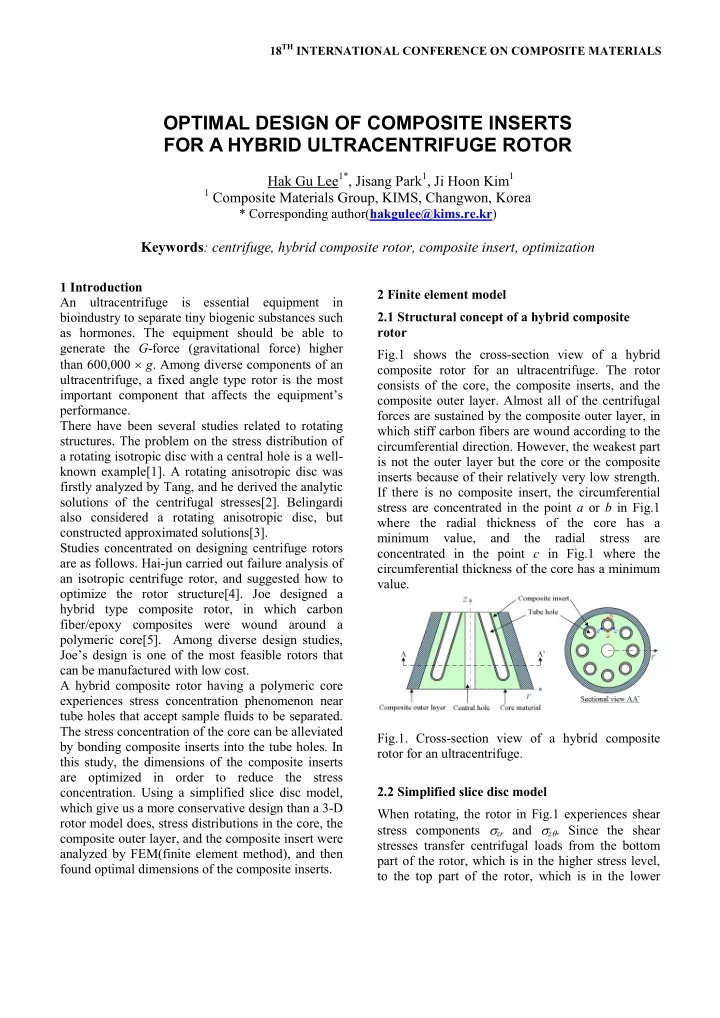
hybrid type composite rotor, in which carbon fiber/epoxy composites were wound around a polymeric core[5]. Among diverse design studies, Joe’s design is one of the most feasible rotors that can be manufactured with low cost. A hybrid composite rotor having a polymeric core experiences stress concentration phenomenon near tube holes that accept sample fluids to be separated. The stress concentration of the core can be alleviated by bonding composite inserts into the tube holes. In this study, the dimensions of the composite inserts are optimized in order to reduce the stress
- concentration. Using a simplified slice disc model,