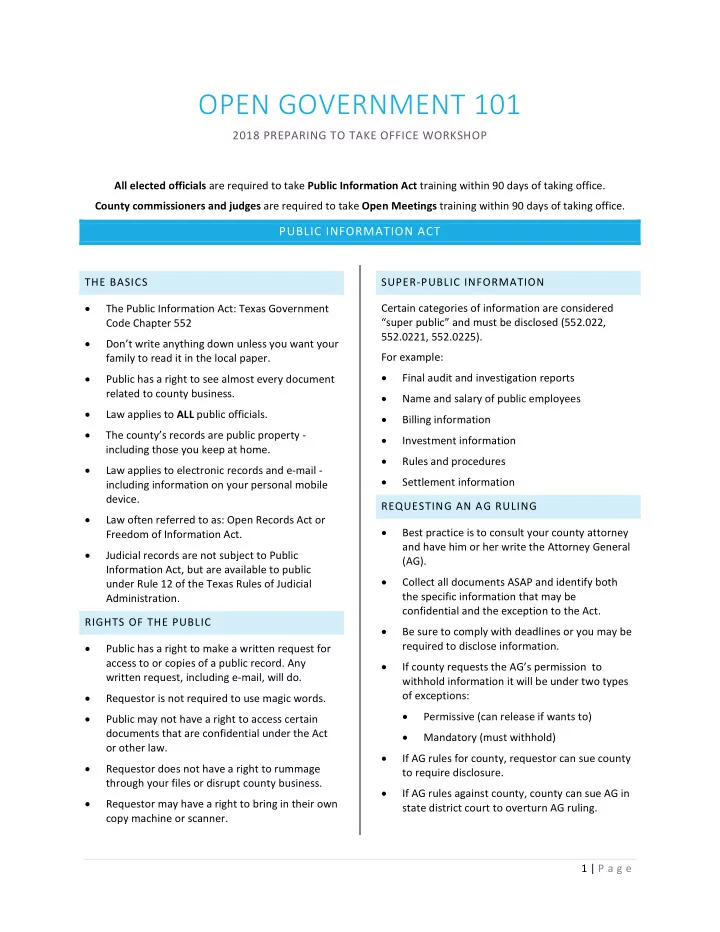
OPEN GOVERNMENT 101 2018 PREPARING TO TAKE OFFICE WORKSHOP All - - PDF document

open government 101
SMART_READER_LITE
LIVE PREVIEW

OPEN GOVERNMENT 101 2018 PREPARING TO TAKE OFFICE WORKSHOP All - - PDF document

OPEN GOVERNMENT 101 2018 PREPARING TO TAKE OFFICE WORKSHOP All elected officials are required to take Public Information Act training within 90 days of taking office. County commissioners and judges are required to take Open Meetings training


slide-1
SLIDE 1

1 | P a g e

OPEN GOVERNMENT 101

2018 PREPARING TO TAKE OFFICE WORKSHOP

All elected officials are required to take Public Information Act training within 90 days of taking office. County commissioners and judges are required to take Open Meetings training within 90 days of taking office.

PUBLIC INFORMATION ACT

THE BASICS

  • The Public Information Act: Texas Government

Code Chapter 552

  • Don’t write anything down unless you want your

family to read it in the local paper.

  • Public has a right to see almost every document

related to county business.

  • Law applies to ALL public officials.
  • The county’s records are public property -

including those you keep at home.

  • Law applies to electronic records and e-mail -

including information on your personal mobile device.

  • Law often referred to as: Open Records Act or

Freedom of Information Act.

  • Judicial records are not subject to Public

Information Act, but are available to public under Rule 12 of the Texas Rules of Judicial Administration. RIGHTS OF THE PUBLIC

  • Public has a right to make a written request for

access to or copies of a public record. Any written request, including e-mail, will do.

  • Requestor is not required to use magic words.
  • Public may not have a right to access certain

documents that are confidential under the Act

  • r other law.
  • Requestor does not have a right to rummage

through your files or disrupt county business.

  • Requestor may have a right to bring in their own

copy machine or scanner. SUPER-PUBLIC INFORMATION Certain categories of information are considered “super public” and must be disclosed (552.022, 552.0221, 552.0225). For example:

  • Final audit and investigation reports
  • Name and salary of public employees
  • Billing information
  • Investment information
  • Rules and procedures
  • Settlement information

REQUESTING AN AG RULING

  • Best practice is to consult your county attorney

and have him or her write the Attorney General (AG).

  • Collect all documents ASAP and identify both

the specific information that may be confidential and the exception to the Act.

  • Be sure to comply with deadlines or you may be

required to disclose information.

  • If county requests the AG’s permission to

withhold information it will be under two types

  • f exceptions:
  • Permissive (can release if wants to)
  • Mandatory (must withhold)
  • If AG rules for county, requestor can sue county

to require disclosure.

  • If AG rules against county, county can sue AG in

state district court to overturn AG ruling.

slide-2
SLIDE 2

2 | P a g e BEST PRACTICES As soon as you or one of your employees receives a written request for documents that might be public records:

  • Date stamp the request
  • Immediately locate the records
  • Notify your county attorney if you think you may

need to withhold some of the records RECORD RETENTION

  • If you don’t have the record because you have

disposed of it under your schedule, you don’t have to produce it.

  • If you still have a public document you could

have destroyed, you must produce it. THE 10-DAY “RULE” Within 10 business days after receiving the request, you must:

  • Produce the records or notify the requestor

when they will be available; or

  • Request an AG’s ruling authorizing you to

withhold the records Records are presumed to be public and you must produce them if, within 10 business days, you fail to either:

  • Produce the records or notify requestor of time

they will be available; or

  • Request an AG’s ruling authorizing you to

withhold the records CONFIDENTIALITY

  • There is potential civil liability for disclosure of

documents subject to a valid claim of confidentiality.

  • If you have any question about whether to

release a record – request an AG determination. ORD REQUESTS If requesting an open records decision (ORD) from the AG, by the 15th business day, you must:

  • Submit written comments stating what

exceptions apply

  • Submit a copy of the request for information
  • Submit a signed statement as to the date you

received the request for information.

  • Submit written copy of specific information

requested (or representative sample)

  • Label written copy to indicate portions where

exceptions apply

  • Send copy of your comments to requestor

DO’S AND DON’TS

  • DO produce records as quickly as possible with

the least fuss.

  • DO request clarification if you do not

understand what is being requested or if it is very broad.

  • DON’T ask a requestor why he or she wants the

records.

  • DON’T create a record that does not exist to

comply with a request.

  • DON’T try to comply with a “standing” or on-

going request. COSTS & CHARGES

  • AG’s Office determines allowable charges for

records.

  • County may charge for labor and overhead for

big requests, but must send an estimate in advance and get requestor’s acceptance.

  • County may also require a bond or deposit for

large request.

  • County cannot require requestor to obtain or

pay for copies if the request is for access only. EXCEPTIONS TO DISCLOSURE Remember - you must request an AG ruling to claim an exception in most cases. AG Open Records Decision No. 684 lists information that doesn’t require an AG ruling to withhold, including information about a:

  • Personal tax return
  • Driver’s license number
  • Social Security number
  • Credit card number
  • Personal e-mail address
slide-3
SLIDE 3

3 | P a g e

  • Military record information
  • Certified agenda and tape of executive session

EXCEPTIONS OF IMPORTANCE Include information that is:

  • Considered confidential by law (constitution,

statute, court order)

  • A clearly unwarranted invasion of personal

privacy

  • Related to competitive bidding that is

confidential

  • Involved in law enforcement prosecution
  • A private communications of an elected official

if disclosure would constitute an invasion of privacy

  • Related to ongoing litigation

EXCEPTIONS FOR PERSONAL INFORMATION Within 14 days of employment, election, or appointment, a public employee or official must elect NOT to allow public access to his or her:

  • home address
  • home phone
  • social security number
  • emergency contact information
  • information that reveals information about

family members CERTAIN OFFICALS EXCEPTED Information made categorically confidential by the Act includes information related to a:

  • peace officer
  • current or former county or district

attorney and his or her current or former employees

  • current or former federal or state judge and

his or her spouse,

  • current or former county or district judge,
  • r a justice of the peace

PENALTIES – PUBLIC INFORMATION ACT

  • Refusing to produce a public record:

Misdemeanor

  • Fine up to $1,000
  • Jail up to 6 months
  • Both fine and jail
  • Official misconduct (automatic removal)
  • Unlawful disclosure of confidential information:

Misdemeanor

  • Fine up to $1,000
  • Jail up to 6 months
  • Both fine and jail
  • Official misconduct (automatic removal)
  • Destroying, altering or concealing public record:

Misdemeanor

  • Fine – $25 minimum to $4,000 maximum
  • Jail – 3 days minimum to 3 months

maximum

  • Both fine and jail.

NOTES ___________________________________________ ___________________________________________ ___________________________________________ ___________________________________________ ___________________________________________ ___________________________________________ ___________________________________________ ___________________________________________ ___________________________________________

slide-4
SLIDE 4

4 | P a g e

OPEN MEETINGS ACT

THE BASICS

  • The Open Meetings Act: Texas Government

Code Chapter 551.

  • The public has a right to know about how, when

and why you make your decisions as a public

  • fficial.
  • All commissioners court meetings must be

public. WHAT IS A MEETING

  • A meeting is a deliberation among a quorum of

the members of the court during which:

  • public business or policy is discussed; or
  • the commissioners court takes formal

action.

  • Quorum is three for commissioners court.
  • “Walking quorum” is an illegal meeting of less

than a quorum in an attempt to avoid the Act. AGENDA PREPERATION

  • Commissioners court as a whole is responsible

for preparation of the agenda.

  • Each member of the commissioners court must

be permitted to place any item on the agenda.

  • Commissioners court may or may not use the

county clerk to prepare and post its agenda. NOTICE OF A PUBLIC MEETING

  • Notice must be in writing and posted not less

than 72 hours before the beginning of the meeting at a place accessible to the public.

  • Notice must be posted both at the county

courthouse and online if the county has a website.

  • Notice must include: date, hour, place, and

actions under consideration. DISCUSSION AND ACTION

  • Commissioners court may not discuss items that

are not posted on the agenda.

  • Commissioners court can only take action on an

item that is on the agenda.

  • The commissioners court may only meet in

executive session on a posted agenda item. EMERGENCY MEETING Emergency meetings require two hour notice, but must be real emergency:

  • Imminent threat to public health and safety.
  • Unforeseeable situation that required

immediate action.

  • A governmental body’s determination that an

emergency exists is subject to judicial review. MINUTES Minutes of a public meeting must be recorded or in writing and show:

  • Each subject considered; and
  • The vote, order, decision or action on each item.

EXECUTIVE SESSION

  • Public meeting must be convened before the

court may go into executive session. EXECPTIONS TO OPEN MEETING Executive sessions are exceptions to the rule of public discussion. For example:

  • Real estate – must relate to county’s

negotiations.

  • Economic development – must relate to

county’s offer to business being solicited.

  • Consultation with attorney – lawyer must be

there.

  • Personnel matters – must be county staff and

must be open at request of employee under discussion.

slide-5
SLIDE 5

5 | P a g e RIGHTS OF THE PUBLIC

  • Public has a right to attend and record a public

meeting.

  • Public does not have a right to talk during a

meeting.

  • Commissioners court may allow public comment

as agenda item. DO’S AND DON’TS

  • DO publish notice of a meeting, even a

committee meeting of less than a quorum if court is likely to rubber stamp decision.

  • DO get what you want to talk about on the

agenda with enough information that a reasonably intelligent person will know what you are going to discuss.

  • DON’T communicate with other court members
  • utside of a public meeting with the intention of

persuading them to vote a certain way – this includes e-mail or text.

  • DON’T vote in executive session – no “straw

votes”.

  • DON’T debate issues raised in public comment

period unless the issue is also posted – limit response to facts or policy statement. PENALTIES – OPEN MEETINGS ACT

  • Actions taken in violation of Open Meetings Act

are voidable by court order.

  • Meeting in numbers less than a quorum with

intent to violate the law; or

  • Participation in an illegal closed meeting:

Misdemeanor

  • Fine: $100 - $500
  • Jail: 1-6 months
  • Both fine and jail
  • You can commit a violation by participating in an

illegal executive session even if you don’t know that the closed meeting is not allowed.

  • It is an affirmative defense if you relied on a

written opinion from the county attorney saying the executive session was allowed. TRAINING & RESOURCES

  • Attorney General’s Office has required training

and basic information online at texasattorneygeneral.gov

  • AG’s office has online handbooks on both the

Public Information Act and the Open Meetings Act.

  • TAC Legal also has print and online handbooks
  • n both the Public Information Act and the

Open Meetings Act. HOW TO FIND HELP

  • TAC Legal: 888-ASK-TAC4 (275-8224)
  • TAC Website: county.org
  • Texas AG’s Open Government Helpline:

877-OPEN-TEX (673-6839)

  • AG’s Public Information Act Cost Hotline:

888-OR-COSTS (672-6787)

  • AG’s Website: texasattorneygeneral.gov

NOTES ___________________________________________ ___________________________________________ ___________________________________________ ___________________________________________