SLIDE 1
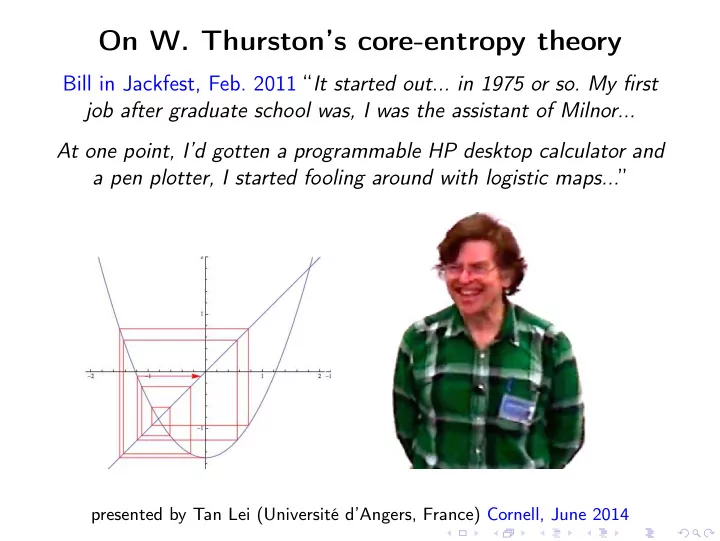
On W. Thurston’s core-entropy theory
Bill in Jackfest, Feb. 2011 “It started out... in 1975 or so. My first job after graduate school was, I was the assistant of Milnor... At one point, I’d gotten a programmable HP desktop calculator and a pen plotter, I started fooling around with logistic maps...”
presented by Tan Lei (Université d’Angers, France) Cornell, June 2014
SLIDE 2
Classic Milnor-Thurston kneading theory
Let f : I → I continuous, by Misiurewicz-Szlenk, htop(f , I) := lim
n→∞
log{#laps of f n} n
SLIDE 3
Classic Milnor-Thurston kneading theory
Let f : I → I continuous, by Misiurewicz-Szlenk, htop(f , I) := lim
n→∞
log{#laps of f n} n
SLIDE 4
Classic Milnor-Thurston kneading theory
Let f : I → I continuous, by Misiurewicz-Szlenk, htop(f , I) := lim
n→∞
log{#laps of f n} n
SLIDE 5
Classic Milnor-Thurston kneading theory
Let f : I → I continuous, by Misiurewicz-Szlenk, htop(f , I) := lim
n→∞
log{#laps of f n} n
SLIDE 6
Classic Milnor-Thurston kneading theory
Let f : I → I continuous, by Misiurewicz-Szlenk, htop(f , I) := lim
n→∞
log{#laps of f n} n
SLIDE 7
Classic Milnor-Thurston kneading theory
Let f : I → I continuous, by Misiurewicz-Szlenk, htop(f , I) := lim
n→∞
log{#laps of f n} n
SLIDE 8
Classic Milnor-Thurston kneading theory
Let f : I → I continuous, by Misiurewicz-Szlenk, htop(f , I) := lim
n→∞
log{#laps of f n} n
SLIDE 9
Classic Milnor-Thurston kneading theory
Let f : I → I continuous, by Misiurewicz-Szlenk, htop(f , I) := lim
n→∞
log{#laps of f n} n
SLIDE 10
Classic Milnor-Thurston kneading theory
Let f : I → I continuous, by Misiurewicz-Szlenk, htop(f , I) := lim
n→∞
log{#laps of f n} n MT : Itinerary of the critical point encodes the entropy
SLIDE 11
Real quadratic polynomias
fc(z) := z2 + c, c ∈ [−2, 1/4]
◮ c →entropy(fc) is continuous (Milnor-Thurston) : kneading
series
◮ and monotone log 2 ց 0 (Douady, Hubbard, Sullivan).
SLIDE 12
Real quadratic polynomias
fc(z) := z2 + c, c ∈ [−2, 1/4]
◮ c →entropy(fc) is continuous (Milnor-Thurston) : kneading
series
◮ and monotone log 2 ց 0 (Douady, Hubbard, Sullivan).
SLIDE 13
Real quadratic polynomias
fc(z) := z2 + c, c ∈ [−2, 1/4]
◮ c →entropy(fc) is continuous (Milnor-Thurston) : kneading
series
◮ and monotone log 2 ց 0 (Douady, Hubbard, Sullivan).
SLIDE 14
Real polynomial acts also on C
Julia set Kf := {z ∈ C | f ◦n(z) ∞}.
SLIDE 15
Real polynomial acts also on C
Julia set Kf := {z ∈ C | f ◦n(z) ∞}. core := Kf ∩ R, core-entropy:= htop(f , core)
SLIDE 16
What is Core(z2 + c) for c complex ?
SLIDE 17
What is Core(z2 + c) for c complex ?
If exists, a good substitute is the Hubbard tree : the smallest finite tree in Kf containing the iterated orbit of 0. It is automatically forward invariant.
SLIDE 18 What is Core(z2 + c) for c complex ?
2 1 3 4
If exists, a good substitute is the Hubbard tree : the smallest finite tree in Kf containing the iterated orbit of 0. It is automatically forward invariant. Trees do exist for a (combinatorially) dense set of z2 + c...
SLIDE 19 Douady-Hubbard ray-foliation
Φc
− → The external rays Rc(t) foliate C Kc, and fc(Rc(t)) = Rc(2t). Binding-entropy:= htop(F,{angle-pairs landing together}), F : s t
2s 2t
T2 → T2
- Theorem. Binding-entropy is always well defined, and
= Core-entropy if core exists.
SLIDE 20 Douady-Hubbard ray-foliation
Φc
− → The external rays Rc(t) foliate C Kc, and fc(Rc(t)) = Rc(2t). Binding-entropy:= htop(F,{angle-pairs landing together}), F : s t
2s 2t
T2 → T2
- Theorem. Binding-entropy is always well defined, and
= Core-entropy if core exists.
SLIDE 21
Encoding polynomials by laminations
A primitive major m of degree d = {disjoint leaves and ideal polygons in D} s.t. D m has d regions, each occupies 1/dth ∂D-space. A degree 2 major = a diagonal chord.
SLIDE 22
The major { 1
10, 3 5} encodes
3/5 1/10 Rays land at the same point iff same itinerary, or D/Φc ≈ Kc.
SLIDE 23 Combinatorial core of and its entropy
Given d ≥ 2, consider the expanding cover
F : T2 → T2,
t
d · t
Given a major m, h(m) (T2, F) binding(m)
SLIDE 24 Combinatorial core of and its entropy
Given d ≥ 2, consider the expanding cover
F : T2 → T2,
t
d · t
Given a major m, h(m) (C, Pm) core (T2, F) binding(m)
SLIDE 25 Combinatorial core of and its entropy
Given d ≥ 2, consider the expanding cover
F : T2 → T2,
t
d · t
Given a major m, h(m) (C, Pm) core (T2, F) binding(m) if rational, log λ(Γm) by passing core
SLIDE 26 Computing core-entropy bypassing cores (march 2011)
basis={pairs}=
5, 2 5}, {1 5, 4 5}, {1 5, 3 5}, {2 5, 3 5}, {2 5, 4 5}, {3 5, 4 5}
{ 1
5, 2 5} same side
− − − − − − − − →
double angles {2 5, 4 5},
{1
5, 4 5}
− − − − − − − → {1
5, 2 5} + {1 5, 3 5}
· · · , · · · Growth=1.39534.
Works for any degree.
SLIDE 27 Computing core-entropy bypassing cores (march 2011)
basis={pairs}=
5, 2 5}, {1 5, 4 5}, {1 5, 3 5}, {2 5, 3 5}, {2 5, 4 5}, {3 5, 4 5}
{ 1
5, 2 5} same side
− − − − − − − − →
double angles {2 5, 4 5},
{1
5, 4 5}
− − − − − − − → {1
5, 2 5} + {1 5, 3 5}
· · · , · · · Growth=1.39534.
Works for any degree.
SLIDE 28
"Jack, I’d like to share a plot I find fascinating"
SLIDE 29
Core-entropy of cubic primitive majors.
SLIDE 30
Parametrize degree-d majors ?
Bill at Topology Festival, May 2012 "It took me a while to realize that the set of degree-d majors describes a spine for the set of d disjoint points in C, that is, its fundamental group is the braid group and higher homotopy groups are trivial."
SLIDE 31 Let’s try to trace Bill’s discovery path : 26 march 2011
For quadratics : this just means a single diameter of the circle. For cubics :
middle annulus upper curve lower curve generic parallel triangle
SLIDE 32
"This figure can be embedded in S3, which should somehow connect to the parameter space picture"
(show Rugh’s scilab animations...)
See also Branner-Hubbard 1985
SLIDE 33 "You can make a Moebius band by twisting a long thin strip 3 half-turns, so that its boundary is a trefoil knot. In S3, if you make the
Moebius band wider and wider, eventually you can make the boundary collide with itself in a circle, where it wraps around the circle 3 times.
Another way to say this : take two great circles in S3... This is also a spine for the complement of the discriminant locus for cubic polynomials, but I’m not sure how that description fits in." Next day. "I think you can describe this surface implicitly as ... " "I don’t know exactly how this relates either to the cubic major set
- r to the parameter space, but it’s suggestive."
SLIDE 34
??
← → a poly. with simple roots
SLIDE 35
At last (announced 1 april 2011), a bijection !
go backward : a major ← − poly. with simple roots.
− → : glue slit copies of C following the major pattern and uniformize...
SLIDE 36
At last (announced 1 april 2011), a bijection !
go backward : a major ← − poly. with simple roots.
− → : glue slit copies of C following the major pattern and uniformize...
SLIDE 37
At last (announced 1 april 2011), a bijection !
go backward : a major ← − poly. with simple roots.
− → : glue slit copies of C following the major pattern and uniformize...
SLIDE 38
Combining with kneading theory ? Bill wrote (march 2011) :
"For real polynomials, the kneading determinant works really well to get entropy. I’m trying to understand how this theory generalizes, particularly so entropy can be directly computed for cases that are not postcritically finite. Maybe there’s a method that’s essentially the same... I’m interested in understanding the monotonicity issue — how to make a partial order on the kneading data that makes entropy monotone."
SLIDE 39 Kneading on Hubbard trees, work of Tiozzo (2010-2011)
2 1 3 4
SLIDE 40
Kneading on Hubbard trees, work of Tiozzo (2010-2011)
SLIDE 41
Bill in March-April 2012
"I’m getting geared up to prove the continuity of entropy... " "I’ve been working out more of the theory of invariant laminations, partial ordering (generalizing the tree structure for degree 2) and entropy... I’ve been enjoying it. " "Better for more people to be involved. The next topic is to investigate more carefully the topology of the boundary of the connectedness locus for higher degree polynomials... it’s rather intricate and interesting, and I want to get it right. It’s a fun and interesting topic ..."
SLIDE 42
Core-entropy over M, computed by Jung, converted by Lindsey
SLIDE 43
Animated Milnor-Thurston kneading theory
SLIDE 44
Animated Milnor-Thurston kneading theory
SLIDE 45
Animated Milnor-Thurston kneading theory
SLIDE 46
Contributors (incomplete list...)
Baik, Bartholdi, Chéritat, deCarvalho, Gao, Hironaka, Hubbard, Jung, Lindsey, Rugh, Dylan Thurston, Tiozzo...
SLIDE 47
Hi King Bill, Some beautiful shapes out there ?