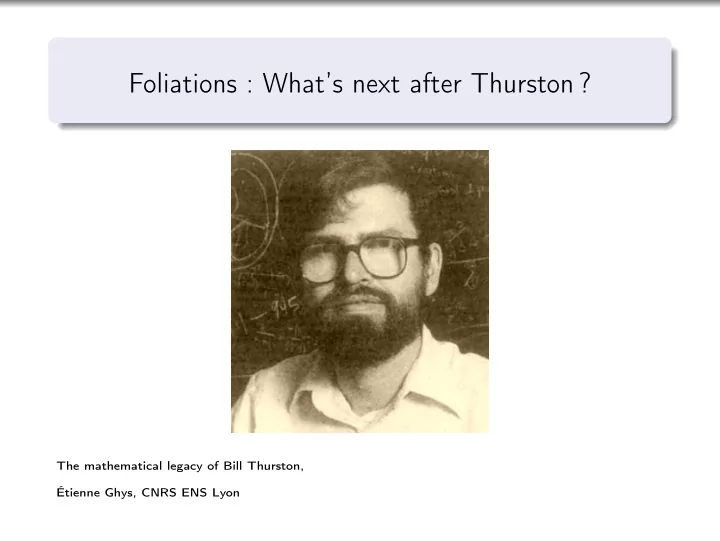
SLIDE 1 Foliations : What’s next after Thurston ?
The mathematical legacy of Bill Thurston, Étienne Ghys, CNRS ENS Lyon
SLIDE 2
A dozen publications between 1972 and 1976
SLIDE 3 On proofs and progress in mathematics, Thurston 1994
“First I will discuss briefly the theory of foliations, which was my first subject, starting when I was a graduate
I fairly rapidly proved some dramatic theorems. I proved a classification theorem for foliations, giving a necessary and sufficient condition for a manifold to admit a
- foliation. I proved a number of other significant theorems.
I wrote respectable papers and published at least the most important theorems. It was hard to find the time to write to keep up with what I could prove, and I built up a backlog.”
SLIDE 4
Foliations ?
SLIDE 5 “An interesting phenomenon occurred. Within a couple of years, a dramatic evacuation of the field started to take
- place. I heard from a number of mathematicians that they
were giving or receiving advice not to go into foliations—they were saying that Thurston was cleaning it
- ut. People told me (not as a complaint, but as a
compliment) that I was killing the field. Graduate students stopped studying foliations, and fairly soon, I turned to other interests as well.”
SLIDE 6
Foliations
Codimension q foliation on a manifold X : An open covering Ui of X. Submersions fi : Ui → Rq. A cocycle θi,j of C ∞ diffeomorphisms between open sets of Rq such that θj,k ◦ θi,j = θi,k where it is defined and fj = θi,j ◦ fi.
SLIDE 7
Leçons de Stockholm (1895)
SLIDE 8
The Reeb component (1948)
SLIDE 9
1895 : Leçons de Stockholm (Painlevé). 1944-1948 : Foliation on the 3-sphere (Reeb). 1955-1958 : Inexistence of codimension 1 analytic foliations on spheres (Haefliger). 1964 : Every codimension 1 foliation on the 3-sphere has a compact leaf (Novikov). 1968 : Topological obstruction to integrability : certain plane fields are not homotopic to a foliation (Bott). 1970 : Classifying space BΓ (Haefliger).
SLIDE 10
Thurston’s helical wobble (1971)
SLIDE 11
Helical wobble
SLIDE 12
On proofs and progress in mathematics, Thurston 1994
“I threw out prize cryptic tidbits of insight, such as “the Godbillon-Vey invariant measures the helical wobble of a foliation”, that remained mysterious to most mathematicans who read them. This created a high entry barrier : I think many graduate students and mathematicians were discouraged that it was hard to learn and understand the proofs of key theorems.”
SLIDE 13 Helical wobble
Alejandra Ruddoff “Diacronia” 2005
SLIDE 14
Godbillon-Vey invariant (1971)
A (transversaly orientable) codimension 1 foliation F on M is defined by a 1-form ω. Integrability of F implies ω ∧ dω = 0. There exists α such that dω = ω ∧ α. The 3-form α ∧ dα is closed. Its cohomology class in H3(M, R) is independent of all choices : this is the Godbillon-Vey invariant of F. If dim(M) = 3 and if M is oriented, this is a number : gv(F) ∈ R. Two cobordant foliations have the same Godbillon-Vey number.
SLIDE 15
Godbillon-Vey invariant (1971)
A (transversaly orientable) codimension 1 foliation F on M is defined by a 1-form ω. Integrability of F implies ω ∧ dω = 0. There exists α such that dω = ω ∧ α. The 3-form α ∧ dα is closed. Its cohomology class in H3(M, R) is independent of all choices : this is the Godbillon-Vey invariant of F. If dim(M) = 3 and if M is oriented, this is a number : gv(F) ∈ R. Two cobordant foliations have the same Godbillon-Vey number.
SLIDE 16
Godbillon-Vey invariant (1971)
A (transversaly orientable) codimension 1 foliation F on M is defined by a 1-form ω. Integrability of F implies ω ∧ dω = 0. There exists α such that dω = ω ∧ α. The 3-form α ∧ dα is closed. Its cohomology class in H3(M, R) is independent of all choices : this is the Godbillon-Vey invariant of F. If dim(M) = 3 and if M is oriented, this is a number : gv(F) ∈ R. Two cobordant foliations have the same Godbillon-Vey number.
SLIDE 17
Godbillon-Vey invariant (1971)
A (transversaly orientable) codimension 1 foliation F on M is defined by a 1-form ω. Integrability of F implies ω ∧ dω = 0. There exists α such that dω = ω ∧ α. The 3-form α ∧ dα is closed. Its cohomology class in H3(M, R) is independent of all choices : this is the Godbillon-Vey invariant of F. If dim(M) = 3 and if M is oriented, this is a number : gv(F) ∈ R. Two cobordant foliations have the same Godbillon-Vey number.
SLIDE 18
Godbillon-Vey invariant (1971)
A (transversaly orientable) codimension 1 foliation F on M is defined by a 1-form ω. Integrability of F implies ω ∧ dω = 0. There exists α such that dω = ω ∧ α. The 3-form α ∧ dα is closed. Its cohomology class in H3(M, R) is independent of all choices : this is the Godbillon-Vey invariant of F. If dim(M) = 3 and if M is oriented, this is a number : gv(F) ∈ R. Two cobordant foliations have the same Godbillon-Vey number.
SLIDE 19
Godbillon-Vey invariant (1971)
A (transversaly orientable) codimension 1 foliation F on M is defined by a 1-form ω. Integrability of F implies ω ∧ dω = 0. There exists α such that dω = ω ∧ α. The 3-form α ∧ dα is closed. Its cohomology class in H3(M, R) is independent of all choices : this is the Godbillon-Vey invariant of F. If dim(M) = 3 and if M is oriented, this is a number : gv(F) ∈ R. Two cobordant foliations have the same Godbillon-Vey number.
SLIDE 20
Godbillon-Vey invariant (1971)
A (transversaly orientable) codimension 1 foliation F on M is defined by a 1-form ω. Integrability of F implies ω ∧ dω = 0. There exists α such that dω = ω ∧ α. The 3-form α ∧ dα is closed. Its cohomology class in H3(M, R) is independent of all choices : this is the Godbillon-Vey invariant of F. If dim(M) = 3 and if M is oriented, this is a number : gv(F) ∈ R. Two cobordant foliations have the same Godbillon-Vey number.
SLIDE 21
Theorem (Thurston 1971) :
There exists of family Fλ of foliations on S3 such that gv(Fλ) varies continuously.
SLIDE 22
Helical wobble
Unit tangent bundle of the Poincaré disc T 1(D).
SLIDE 23
Helical wobble
Unit tangent bundle of the Poincaré disc T 1(D).
SLIDE 24
Helical wobble
Unit tangent bundle of the Poincaré disc T 1(D).
SLIDE 25
Main open problem
Suppose that the Godbillon-Vey invariant of a codimension 1 foliation on a 3-manifold is 0. Does that imply that the foliation is cobordant to zero ? gv : Cobordism(Foliations on 3 manifolds) → R
SLIDE 26
Main open problem
Suppose that the Godbillon-Vey invariant of a codimension 1 foliation on a 3-manifold is 0. Does that imply that the foliation is cobordant to zero ? gv : Cobordism(Foliations on 3 manifolds) → R
SLIDE 27
Theorem (Thurston) 1972 If M is a circle bundle over a compact surface, every codimension 1 foliation on M with no compact leaf can be isotoped to a foliation transversal to the fibers, therefore associated to a group of diffeomorphisms of the circle.
SLIDE 28
Haefliger Γ-structures
Codimension q Haefliger Γ-structure on a manifold X : An open covering Ui of X. Continuous maps fi : Ui → Rq, A cocycle θi,j of C ∞ diffeomorphisms of open sets of Rq such that θj,k ◦ θi,j = θi,k where it is defined and fj = θi,j ◦ fi. André Haefliger (1970) There exists a classifying space BΓ∞
q .
Every codimension q Γ-structure is the pull-back of a universal structure by some map f : X → BΓ∞
q .
SLIDE 29
Haefliger Γ-structures
Codimension q Haefliger Γ-structure on a manifold X : An open covering Ui of X. Continuous maps fi : Ui → Rq, A cocycle θi,j of C ∞ diffeomorphisms of open sets of Rq such that θj,k ◦ θi,j = θi,k where it is defined and fj = θi,j ◦ fi. André Haefliger (1970) There exists a classifying space BΓ∞
q .
Every codimension q Γ-structure is the pull-back of a universal structure by some map f : X → BΓ∞
q .
SLIDE 30
Existence of codimension q foliations
Theorem (Thurston) 1973 : A codimension q ≥ 2 Γ-structure on a compact manifold M is homotopic to a foliation if and only if its (abstract) normal bundle embeds in the tangent bundle of M.
SLIDE 31
SLIDE 32
jiggling
SLIDE 33
Existence of codimension 1 foliations
Theorem (Thurston) 1973 : Every C ∞ hyperplane field is homotopic to a foliation.
SLIDE 34
Homotopy type of the classifying space : Mather et Thurston
Theorem 1973 : There exists a “natural” continuous map B Diff r
c (Rq) → Ωq(BΓr q)
inducing an isomorphism in integral homology. Corollaries : Every plane field, in any dimension, is homotopic to a C 0 foliation. Cobordism(Foliations on 3 manifolds) ≃ H3(BΓ∞
1 , Z) ≃
H2(Diff∞
c (R), Z).
SLIDE 35
Homotopy type of the classifying space : Mather et Thurston
Theorem 1973 : There exists a “natural” continuous map B Diff r
c (Rq) → Ωq(BΓr q)
inducing an isomorphism in integral homology. Corollaries : Every plane field, in any dimension, is homotopic to a C 0 foliation. Cobordism(Foliations on 3 manifolds) ≃ H3(BΓ∞
1 , Z) ≃
H2(Diff∞
c (R), Z).
SLIDE 36
Warwick, Summer 76
SLIDE 37
SLIDE 38
On proofs and progress in mathematics, Thurston 1994
“I believe that two ecological effects were much more important in putting a damper on the subject than any exhaustion of intellectual resources that occurred. First, the results I proved [...] were documented in a conventional, formidable mathematician’s style. They depended heavily on readers who shared certain background and certain insights. [...] The papers I wrote did not (and could not) spend much time explaining the background culture. They documented top-level reasoning and conclusions that I often had achieved after much reflection and effort.”
SLIDE 39 On proofs and progress in mathematics, Thurston 1994
“Second is the issue of what is in it for other people in the
- subfield. When I started working on foliations, I had the
conception that what people wanted was to know the
- answers. I thought that what they sought was a collection
- f powerful proven theorems that might be applied to
answer further mathematical questions. But that’s only
- ne part of the story. More than the knowledge, people
want personal understanding. And in our credit-driven system, they also want and need theorem-credits.”
SLIDE 40
SLIDE 41
Back to Godbillon-Vey invariant.
What is the “qualitative meaning” of a non zero Godbillon-Vey number ? Suppose two codimension one foliations of class C ∞ on a 3 manifold are topologically equivalent. Do they have the same Godbillon-Vey number ?
SLIDE 42 Godbillon-Vey : some kind of self linking number of a foliation ?
Dennis Sullivan : Let F be a codimension 1 foliation on M3. Choose a flow φt transverse to the foliation. Think of F as a 2-current : approximate by a large number of large balls in leaves. Compute link(F, φt(F) =
gv(F) = d2 dt2 link(F, (φt)⋆(F))|t=0
SLIDE 43 Godbillon-Vey : some kind of self linking number of a foliation ?
Dennis Sullivan : Let F be a codimension 1 foliation on M3. Choose a flow φt transverse to the foliation. Think of F as a 2-current : approximate by a large number of large balls in leaves. Compute link(F, φt(F) =
gv(F) = d2 dt2 link(F, (φt)⋆(F))|t=0
SLIDE 44
Godbillon-Vey and resilient leaves
Theorem (Duminy) 1982 : If gv(F) = 0, there is a resilient leaf.
SLIDE 45
Godbillon-Vey and projective group
Let R : π1(Σ) → Diff∞
+ (S1).
Obstruction to be projective in schwarz(R) ∈ H1(Diff∞
+ (S1), {u(x)dx2})
If Rt depends on a parameter, dRt dt ∈ H1(Diff∞
+ (S1), {v(x) ∂
∂x }) Pairing H1(π1(Σ)), {u(x)dx2}) ⊗ H1(π1(Σ), {v(x) ∂ ∂x }) → H2(π1(Σ), {w(x)dx}) → R
SLIDE 46
Godbillon-Vey and projective group
Let R : π1(Σ) → Diff∞
+ (S1).
Obstruction to be projective in schwarz(R) ∈ H1(Diff∞
+ (S1), {u(x)dx2})
If Rt depends on a parameter, dRt dt ∈ H1(Diff∞
+ (S1), {v(x) ∂
∂x }) Pairing H1(π1(Σ)), {u(x)dx2}) ⊗ H1(π1(Σ), {v(x) ∂ ∂x }) → H2(π1(Σ), {w(x)dx}) → R
SLIDE 47
Godbillon-Vey and projective group
Let R : π1(Σ) → Diff∞
+ (S1).
Obstruction to be projective in schwarz(R) ∈ H1(Diff∞
+ (S1), {u(x)dx2})
If Rt depends on a parameter, dRt dt ∈ H1(Diff∞
+ (S1), {v(x) ∂
∂x }) Pairing H1(π1(Σ)), {u(x)dx2}) ⊗ H1(π1(Σ), {v(x) ∂ ∂x }) → H2(π1(Σ), {w(x)dx}) → R
SLIDE 48
Godbillon-Vey and projective group
Let R : π1(Σ) → Diff∞
+ (S1).
Obstruction to be projective in schwarz(R) ∈ H1(Diff∞
+ (S1), {u(x)dx2})
If Rt depends on a parameter, dRt dt ∈ H1(Diff∞
+ (S1), {v(x) ∂
∂x }) Pairing H1(π1(Σ)), {u(x)dx2}) ⊗ H1(π1(Σ), {v(x) ∂ ∂x }) → H2(π1(Σ), {w(x)dx}) → R
SLIDE 49
Godbillon-Vey and projective group
Theorem (Maszczyk) 1999 d gv(Rt) dt = schwarz(Rt).dRt dt
SLIDE 50
Gelfand and Fuchs simple model : "piecewise projective foliations"
Start with a simplicial complex. Foliate each simplex by a pencil of hyperplanes containing a codimension 2 subspace, disjoint from the simplex. All these foliations should be coherent on boundaries of simplices.
SLIDE 51
Gelfand and Fuchs simple model : "piecewise projective foliations"
SLIDE 52
Gelfand and Fuchs simple model : "piecewise projective foliations"
SLIDE 53
Gelfand and Fuchs simple model : "piecewise projective foliations"
Theorem (Gelfand and Fuchs) There is a classifying space BPL. There is a non trivial “Godbillon-Vey invariant” H3(BPL, R).
SLIDE 54 A combinatorical cocyle for "piecewise projective foliations"
Rogers L function for 0 < x < 1. L(x) = −1 2 x ln(1 − t) t + t 1 − t
6 Theorem The Gelfand-Fuchs-Godbillon-Vey invariant on piecewise projective foliations is represented by L evaluated on the cross ratio of four hyperplanes. H3(BPL, Z) → R is injective !
SLIDE 55 A combinatorical cocyle for "piecewise projective foliations"
Rogers L function for 0 < x < 1. L(x) = −1 2 x ln(1 − t) t + t 1 − t
6 Theorem The Gelfand-Fuchs-Godbillon-Vey invariant on piecewise projective foliations is represented by L evaluated on the cross ratio of four hyperplanes. H3(BPL, Z) → R is injective !
SLIDE 56 Thurston cocycle on the group of diffeomorphisms of the circle
Thurston(f , g, h) =
ln Df d ln Df 1 ln Dg d ln Dg 1 ln Dh d ln Dh
is a homogeneous 2-cocycle on Diff which represents the Godbillon-Vey class.
SLIDE 57 What is the “natural” domain of definition of Godbillon-Vey ?
- S1 x(t) dy(t) is the area of a curve (x(t), y(t)) in the plane.
C 2 foliations. f of class C 1 such that ln Df has bounded variation (Duminy and Sergiescu). f is of class C 1+α with α > 1/2 (Katok-Hurder) BΓ1+α
1
is contractible if α < 1/2 (Tsuboi).
SLIDE 58 What is the “natural” domain of definition of Godbillon-Vey ?
- S1 x(t) dy(t) is the area of a curve (x(t), y(t)) in the plane.
C 2 foliations. f of class C 1 such that ln Df has bounded variation (Duminy and Sergiescu). f is of class C 1+α with α > 1/2 (Katok-Hurder) BΓ1+α
1
is contractible if α < 1/2 (Tsuboi).
SLIDE 59 What is the “natural” domain of definition of Godbillon-Vey ?
- S1 x(t) dy(t) is the area of a curve (x(t), y(t)) in the plane.
C 2 foliations. f of class C 1 such that ln Df has bounded variation (Duminy and Sergiescu). f is of class C 1+α with α > 1/2 (Katok-Hurder) BΓ1+α
1
is contractible if α < 1/2 (Tsuboi).
SLIDE 60 What is the “natural” domain of definition of Godbillon-Vey ?
- S1 x(t) dy(t) is the area of a curve (x(t), y(t)) in the plane.
C 2 foliations. f of class C 1 such that ln Df has bounded variation (Duminy and Sergiescu). f is of class C 1+α with α > 1/2 (Katok-Hurder) BΓ1+α
1
is contractible if α < 1/2 (Tsuboi).
SLIDE 61 What is the “natural” domain of definition of Godbillon-Vey ?
- S1 x(t) dy(t) is the area of a curve (x(t), y(t)) in the plane.
C 2 foliations. f of class C 1 such that ln Df has bounded variation (Duminy and Sergiescu). f is of class C 1+α with α > 1/2 (Katok-Hurder) BΓ1+α
1
is contractible if α < 1/2 (Tsuboi).
SLIDE 62
Malliavin-Shavgulidze “Haar measure”.
How to choose a diffeomorphism of the circle “at random” ? Choose it so that the log of its derivative is a random function on the circle. Choose a random path t ∈ [0, 1] → u(t) ∈ R with u(0) = 0. Transform it into a random bridge t ∈ [0, 1] → b(t) = u(t) − tb(1), so that b(0) = b(1) = 0. Define a random diffeomorphism of the circle R/Z by f (t) = f (0) + exp( t
0 b(t) dt)
exp( 1
0 b(t) dt)
where f (0) is random with respect to the Lebesgue measure. This defines the Malliavin-Shavgulidze probability measure on Diff+
1 (S1).
Almost surely, the derivative of a circle diffeomomorphism is Holder 1/2.
SLIDE 63
Malliavin-Shavgulidze “Haar measure”.
How to choose a diffeomorphism of the circle “at random” ? Choose it so that the log of its derivative is a random function on the circle. Choose a random path t ∈ [0, 1] → u(t) ∈ R with u(0) = 0. Transform it into a random bridge t ∈ [0, 1] → b(t) = u(t) − tb(1), so that b(0) = b(1) = 0. Define a random diffeomorphism of the circle R/Z by f (t) = f (0) + exp( t
0 b(t) dt)
exp( 1
0 b(t) dt)
where f (0) is random with respect to the Lebesgue measure. This defines the Malliavin-Shavgulidze probability measure on Diff+
1 (S1).
Almost surely, the derivative of a circle diffeomomorphism is Holder 1/2.
SLIDE 64
Malliavin-Shavgulidze “Haar measure”.
How to choose a diffeomorphism of the circle “at random” ? Choose it so that the log of its derivative is a random function on the circle. Choose a random path t ∈ [0, 1] → u(t) ∈ R with u(0) = 0. Transform it into a random bridge t ∈ [0, 1] → b(t) = u(t) − tb(1), so that b(0) = b(1) = 0. Define a random diffeomorphism of the circle R/Z by f (t) = f (0) + exp( t
0 b(t) dt)
exp( 1
0 b(t) dt)
where f (0) is random with respect to the Lebesgue measure. This defines the Malliavin-Shavgulidze probability measure on Diff+
1 (S1).
Almost surely, the derivative of a circle diffeomomorphism is Holder 1/2.
SLIDE 65
Malliavin-Shavgulidze “Haar measure”.
How to choose a diffeomorphism of the circle “at random” ? Choose it so that the log of its derivative is a random function on the circle. Choose a random path t ∈ [0, 1] → u(t) ∈ R with u(0) = 0. Transform it into a random bridge t ∈ [0, 1] → b(t) = u(t) − tb(1), so that b(0) = b(1) = 0. Define a random diffeomorphism of the circle R/Z by f (t) = f (0) + exp( t
0 b(t) dt)
exp( 1
0 b(t) dt)
where f (0) is random with respect to the Lebesgue measure. This defines the Malliavin-Shavgulidze probability measure on Diff+
1 (S1).
Almost surely, the derivative of a circle diffeomomorphism is Holder 1/2.
SLIDE 66
Malliavin-Shavgulidze “Haar measure”.
How to choose a diffeomorphism of the circle “at random” ? Choose it so that the log of its derivative is a random function on the circle. Choose a random path t ∈ [0, 1] → u(t) ∈ R with u(0) = 0. Transform it into a random bridge t ∈ [0, 1] → b(t) = u(t) − tb(1), so that b(0) = b(1) = 0. Define a random diffeomorphism of the circle R/Z by f (t) = f (0) + exp( t
0 b(t) dt)
exp( 1
0 b(t) dt)
where f (0) is random with respect to the Lebesgue measure. This defines the Malliavin-Shavgulidze probability measure on Diff+
1 (S1).
Almost surely, the derivative of a circle diffeomomorphism is Holder 1/2.
SLIDE 67
SLIDE 68 Theorem (Malliavin / Shavgulidze) :
This probability measure is quasi-invariant under left translations by C 3-difffeomorphism. d(Lφ)⋆µ dµ (f ) = exp
SLIDE 69
Michele Triestino
SLIDE 70 Michele Triestino
Using stochastic integration, the Thurston cocycle can be defined almost everywhere in Diff1
+(S1) and defines a measurable
Godbillon-Vey cohomology class.
Problem : Compute the “measurable Gelfand-Fuchs cohomology” Diff1
+(S1) with respect to Malliavin-Shavgulidze measure.
SLIDE 71 Michele Triestino
Using stochastic integration, the Thurston cocycle can be defined almost everywhere in Diff1
+(S1) and defines a measurable
Godbillon-Vey cohomology class.
Problem : Compute the “measurable Gelfand-Fuchs cohomology” Diff1
+(S1) with respect to Malliavin-Shavgulidze measure.
SLIDE 72
A lost theorem of Thurston ?
Theorem ? ? ? ? ? ? ? The cube of the Euler class eu ∈ H2(Diff+
analytic(S1), Z)) vanishes.
SLIDE 73
A lost theorem of Thurston ?
Theorem ? ? ? ? ? ? ? The cube of the Euler class eu ∈ H2(Diff+
analytic(S1), Z)) vanishes.
“I forgot !”
SLIDE 74