On multivariate Multi-Resolution Analysis, using generalized (non - - PowerPoint PPT Presentation

on multivariate multi resolution analysis using
SMART_READER_LITE
LIVE PREVIEW

On multivariate Multi-Resolution Analysis, using generalized (non - - PowerPoint PPT Presentation

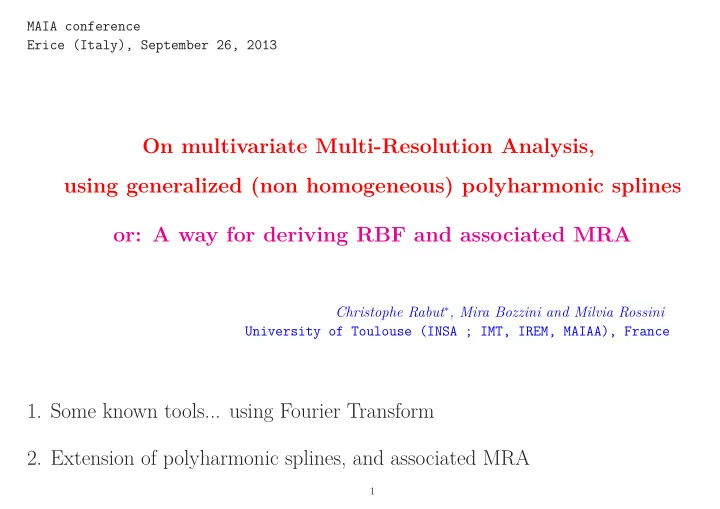
MAIA conference Erice (Italy), September 26, 2013 On multivariate Multi-Resolution Analysis, using generalized (non homogeneous) polyharmonic splines or: A way for deriving RBF and associated MRA Christophe Rabut , Mira Bozzini and Milvia


slide-1
SLIDE 1

MAIA conference Erice (Italy), September 26, 2013

On multivariate Multi-Resolution Analysis, using generalized (non homogeneous) polyharmonic splines

  • r: A way for deriving RBF and associated MRA

Christophe Rabut∗, Mira Bozzini and Milvia Rossini University of Toulouse (INSA ; IMT, IREM, MAIAA), France

  • 1. Some known tools... using Fourier Transform
  • 2. Extension of polyharmonic splines, and associated MRA

1

slide-2
SLIDE 2

Part 1: Some known tools... using Fourier Transform

2

slide-3
SLIDE 3

A word on (odd degree) polynomial splines

Definition: σm = Argmin∀i∈[1:n], f(xi)=yi

  • I

R(f (m)(x))2 dx = ⇒ σm(x) =

  • i=1:n λi |x − xi|2m−1 + pm−1(x)

with ∀q∈ I Pm−1 ,

  • i=1:n λiq(xi) = 0 and pm−1 ∈ I

Pm−1 “Radial basis functions”: writing um(x) = 1 2(m!) |x|2m−1 σm(x) =

  • i=1:n µi um(x − xi) + qm−1(x)

(same constraints on µ and qm−1) Derivative and Fourier Transform: E(um) := (−1)m u(2m)

m

= Dirac

  • um(ω) =

1 ω2m

3

slide-4
SLIDE 4

... and on associated functions

“Basic spline”, or “B-spline”: ϕm = (−1)mδ2mum

  • ϕm(ω) = | sin ω|2m

|ω|2m “Lagrangian spline”, or “L-spline”: Lm(0) = 1 ; ∀j ∈Z Z\{0}, Lm(j) = 0 Lm =

  • j∈Z

Z Lm(j/2) Lm(2 • −j)

; ϕm =

  • j∈Z

Z ϕm(j) Lm(• − j)

  • Lm(ω) =
  • ϕm(ω)
  • ℓ∈Z

Z

  • ϕm(ω − 2πℓ) =
  • ϕm(ω)
  • j∈Z

Z ϕm(j) exp(−i j ω) =

ω−2m

  • ℓ∈Z

Z(ω − 2πℓ)−2m

Semi-orthogonal wavelet: ψm = (−1)m D2mL2m (to be normalized)

  • ψm(ω) = ω2m
  • L2m(ω) =

ω−2m

  • ℓ∈Z

Z(ω − 2πℓ)−4m

Orthogonal wavelet:

  • ψ⊥(ω) =
  • ψ(ω)
  • ℓ∈Z

Z(

  • ψ(|ω − 2πℓ|))2 =

ω−2m

  • ℓ∈Z

Z(ω − 2πℓ)−4m

4

slide-5
SLIDE 5

Linear case

B-spline L-spline psi-spline

−3 −2 −1 1 2 3 0.1 0.2 0.3 0.4 0.5 0.6 0.7 0.8 0.9 1 function B ; norm(B) = 0.408 κ = (0 ) ; γ = (1 ) ; −5 −4 −3 −2 −1 1 2 3 4 5 −0.2 0.2 0.4 0.6 0.8 1 function L ; norm(L) = 0.41 κ = (0 ) ; γ = (1 ) ; −5 −4 −3 −2 −1 1 2 3 4 5 −1.5 −1 −0.5 0.5 1 1.5 2 2.5 3 function psi ; norm(psi) = 1 κ = (0 ) ; γ = (1 ) ;

psi-ortho psi-hat psi-ortho-hat

−5 −4 −3 −2 −1 1 2 3 4 5 0.5 1 1.5 2 2.5 3 3.5 function psiortho ; norm(psiortho) = 1 κ = (0 ) ; γ = (1 ) ; −30 −20 −10 10 20 30 2 4 6 8 10 12 function psihat κ = (0 ) ; γ = (1 ) ; −30 −20 −10 10 20 30 0.1 0.2 0.3 0.4 0.5 0.6 0.7 0.8 0.9 1 function psiortho

hat

κ = (0 ) ; γ = (1 ) ;

5

slide-6
SLIDE 6

6

slide-7
SLIDE 7

Cubic case

B-spline L-spline psi-spline

−3 −2 −1 1 2 3 0.1 0.2 0.3 0.4 0.5 0.6 function B ; norm(B) = 0.346 κ = (0 0 ) ; γ = (1 1 ) ; −5 −4 −3 −2 −1 1 2 3 4 5 −0.2 0.2 0.4 0.6 0.8 1 function L ; norm(L) = 0.467 κ = (0 0 ) ; γ = (1 1 ) ; −5 −4 −3 −2 −1 1 2 3 4 5 −1.5 −1 −0.5 0.5 1 1.5 2 function psi ; norm(psi) = 1 κ = (0 0 ) ; γ = (1 1 ) ;

psi-ortho psi-hat psi-ortho-hat

−5 −4 −3 −2 −1 1 2 3 4 5 −0.5 0.5 1 1.5 2 2.5 3 function psiortho ; norm(psiortho) = 1 κ = (0 0 ) ; γ = (1 1 ) ; −30 −20 −10 10 20 30 100 200 300 400 500 600 function psihat κ = (0 0 ) ; γ = (1 1 ) ; −30 −20 −10 10 20 30 0.1 0.2 0.3 0.4 0.5 0.6 0.7 0.8 0.9 1 function psiortho

hat

κ = (0 0 ) ; γ = (1 1 ) ;

7

slide-8
SLIDE 8

8

slide-9
SLIDE 9

Use of the associated functions (translation invariant spaces)

  • y is defined by

y(ω) =

  • j∈Z

Z yj exp(−i j ω).

B-spline approximation of vector y : (or of points Pj for B-spline curve) σm =

  • j∈Z

Z yj ϕm(• − j)

⇐ ⇒

  • σ =

y ϕm. Interpolating spline of vector y : (or Pj instead of yj for interpolating spline curve) σm =

  • j∈Z

Z yj Lm(• − j)

  • σ =

y

  • L.

Wavelet decomposition of some f ∈ L2(I R): f =

  • j∈Z

Z

  • ℓ∈Z

Z (f , ψ⊥(2ℓ • −j)) ψ⊥(2ℓ • −j)

(f , ψ⊥(2ℓ • −j)) = 2−ℓ exp(i 2−ℓj) (

  • f ,
  • ψ⊥(2−ℓ•)

9

slide-10
SLIDE 10

Spline under tension

Definition and Fourier transform σm,k = Argmin∀i∈Z

Z, f(xi)=yi

  • I

R(f (m)(x))2dx+ρ2 I R(f (k)(x))2 dx (say k < m) Eρ(u) := (−1)m D2mu + (−1)k ρ2 D2ku = Dirac ;

  • uρ(ω) =

1 ω2m + ρ2 ω2k

  • ϕρ(ω) = sin2m ω + ρ2 sin2k ω

ω2m + ρ2 ω2k

  • Lρ(ω) =

(ω2m + ρ2 ω2k)−1

  • ℓ∈Z

Z

  • (ω − 2πℓ)2m + ρ2 (ω − 2πℓ)2k

−1

  • ψρ(ω) = ω2m

L2

ρ(ω) + ρ2ω2k

L2

ρ(ω) =

  • ω2m + ρ2 ω2k

−1

  • ℓ∈Z

Z

  • (ω − 2πℓ)2m + ρ2(ω − 2πℓ)2k

−2

  • ψ⊥

ρ (ω) =

  • ω2m + ρ2 ω2k

−1

  • ℓ∈Z

Z ((ω − 2πℓ)2m + ρ2(ω − 2πℓ)2k)−2

10

slide-11
SLIDE 11

Tension splines (linear-cubic)

B-spline L-spline psi-spline

−3 −2 −1 1 2 3 0.1 0.2 0.3 0.4 0.5 0.6 0.7 0.8 0.9 function B ; norm(B) = 0.346 0.375 0.398 0.407 κ = (0 0 ) ; (0 1 ) ; (0 3 ) ; (0 10 ) ; γ = (1 1 ) ; (1 1 ) ; (1 1 ) ; (1 1 ) ; −5 −4 −3 −2 −1 1 2 3 4 5 −0.2 0.2 0.4 0.6 0.8 1 function L ; norm(L) = 0.467 0.461 0.442 0.422 κ = (0 0 ) ; (0 1 ) ; (0 3 ) ; (0 10 ) ; γ = (1 1 ) ; (1 1 ) ; (1 1 ) ; (1 1 ) ; −5 −4 −3 −2 −1 1 2 3 4 5 −1.5 −1 −0.5 0.5 1 1.5 2 2.5 3 function psi ; norm(psi) = 1 1 1 1 κ = (0 0 ) ; (0 1 ) ; (0 3 ) ; (0 10 ) ; γ = (1 1 ) ; (1 1 ) ; (1 1 ) ; (1 1 ) ;

psi-ortho psi-hat psi-ortho-hat

−5 −4 −3 −2 −1 1 2 3 4 5 −0.5 0.5 1 1.5 2 2.5 3 function psiortho ; norm(psiortho) = 1 1 1 1 κ = (0 0 ) ; (0 1 ) ; (0 3 ) ; (0 10 ) ; γ = (1 1 ) ; (1 1 ) ; (1 1 ) ; (1 1 ) ; −30 −20 −10 10 20 30 200 400 600 800 1000 1200 1400 1600 1800 function psihat κ = (0 0 ) ; (0 1 ) ; (0 3 ) ; (0 10 ) ; γ = (1 1 ) ; (1 1 ) ; (1 1 ) ; (1 1 ) ; −30 −20 −10 10 20 30 0.1 0.2 0.3 0.4 0.5 0.6 0.7 0.8 0.9 1 function psiortho

hat

κ = (0 0 ) ; (0 1 ) ; (0 3 ) ; (0 10 ) ; γ = (1 1 ) ; (1 1 ) ; (1 1 ) ; (1 1 ) ;

11

slide-12
SLIDE 12

12

slide-13
SLIDE 13

Tension splines (cubic-quintic)

B-spline L-spline psi-spline

−3 −2 −1 1 2 3 0.1 0.2 0.3 0.4 0.5 0.6 function B ; norm(B) = 0.314 0.332 0.343 0.346 κ = (0 0 0 ) ; (0 0 1 ) ; (0 0 3 ) ; (0 0 10 ) ; γ = (1 1 1 ) ; (1 1 1 ) ; (1 1 1 ) ; (1 1 1 ) ; −5 −4 −3 −2 −1 1 2 3 4 5 −0.2 0.2 0.4 0.6 0.8 1 function L ; norm(L) = 0.479 0.477 0.471 0.468 κ = (0 0 0 ) ; (0 0 1 ) ; (0 0 3 ) ; (0 0 10 ) ; γ = (1 1 1 ) ; (1 1 1 ) ; (1 1 1 ) ; (1 1 1 ) ; −5 −4 −3 −2 −1 1 2 3 4 5 −1.5 −1 −0.5 0.5 1 1.5 2 function psi ; norm(psi) = 1 1 1 1 κ = (0 0 0 ) ; (0 0 1 ) ; (0 0 3 ) ; (0 0 10 ) ; γ = (1 1 1 ) ; (1 1 1 ) ; (1 1 1 ) ; (1 1 1 ) ;

psi-ortho psi-hat psi-ortho-hat

−5 −4 −3 −2 −1 1 2 3 4 5 −0.5 0.5 1 1.5 2 2.5 3 function psiortho ; norm(psiortho) = 1 1 1 1 κ = (0 0 0 ) ; (0 0 1 ) ; (0 0 3 ) ; (0 0 10 ) ; γ = (1 1 1 ) ; (1 1 1 ) ; (1 1 1 ) ; (1 1 1 ) ; −30 −20 −10 10 20 30 1 2 3 4 5 6 7 x 10

4

function psihat κ = (0 0 0 ) ; (0 0 1 ) ; (0 0 3 ) ; (0 0 10 ) ; γ = (1 1 1 ) ; (1 1 1 ) ; (1 1 1 ) ; (1 1 1 ) ; −30 −20 −10 10 20 30 0.2 0.4 0.6 0.8 1 1.2 1.4 function psiortho

hat

κ = (0 0 0 ) ; (0 0 1 ) ; (0 0 3 ) ; (0 0 10 ) ; γ = (1 1 1 ) ; (1 1 1 ) ; (1 1 1 ) ; (1 1 1 ) ;

13

slide-14
SLIDE 14

14

slide-15
SLIDE 15

Fractional splines

Definition and Fourier transform Let s ∈ [0..1) and m ∈ I N such that α := m + s > d/2 σα = Argmin∀i∈[1:n], f(xi)=yi

  • I

R(f (α)(x))2dx = Argmin∀i∈[1:n], f(xi)=yi

  • I

R (ω2)s

  • F(f (m)(ω)

2 dω

Eα(uα) := (−1)⌊α⌋D2αuα = Dirac ;

  • uα(ω) =

1 (ω2)α uα(x) = cα|x|2α−1 if 2α − 1 is not an even integer number. uα(x) = cα|x|2α−1 ln x2 if 2α − 1 is an even integer number. (cα is some known real valued constant) They too are in some place between order 1 (linear) and order 2 (cubic) splines, but are different from splines under tension. B-spline :

  • ϕα(ω) =

   sin2 ω

ω2

   

α

15

slide-16
SLIDE 16

Fractional splines (linear-cubic)

B-spline L-spline psi-spline

−3 −2 −1 1 2 3 0.1 0.2 0.3 0.4 0.5 0.6 0.7 0.8 0.9 function B ; norm(B) = 0.408 0.384 0.365 0.346 κ = (0 0 ) ; (0 0 ) ; (0 0 ) ; (0 0 ) ; γ = (1 0 ) ; (1 0.3 ) ; (1 0.6 ) ; (1 1 ) ; −5 −4 −3 −2 −1 1 2 3 4 5 −0.2 0.2 0.4 0.6 0.8 1 function L ; norm(L) = 0.41 0.442 0.457 0.467 κ = (0 0 ) ; (0 0 ) ; (0 0 ) ; (0 0 ) ; γ = (1 0 ) ; (1 0.3 ) ; (1 0.6 ) ; (1 1 ) ; −5 −4 −3 −2 −1 1 2 3 4 5 −1.5 −1 −0.5 0.5 1 1.5 2 2.5 3 function psi ; norm(psi) = 1 1 1 1 κ = (0 0 ) ; (0 0 ) ; (0 0 ) ; (0 0 ) ; γ = (1 0 ) ; (1 0.3 ) ; (1 0.6 ) ; (1 1 ) ;

psi-ortho psi-hat psi-ortho-hat

−5 −4 −3 −2 −1 1 2 3 4 5 −0.5 0.5 1 1.5 2 2.5 3 3.5 function psiortho ; norm(psiortho) = 1 1 1 1 κ = (0 0 ) ; (0 0 ) ; (0 0 ) ; (0 0 ) ; γ = (1 0 ) ; (1 0.3 ) ; (1 0.6 ) ; (1 1 ) ; −30 −20 −10 10 20 30 100 200 300 400 500 600 function psihat κ = (0 0 ) ; (0 0 ) ; (0 0 ) ; (0 0 ) ; γ = (1 0 ) ; (1 0.3 ) ; (1 0.6 ) ; (1 1 ) ; −30 −20 −10 10 20 30 0.1 0.2 0.3 0.4 0.5 0.6 0.7 0.8 0.9 1 function psiortho

hat

κ = (0 0 ) ; (0 0 ) ; (0 0 ) ; (0 0 ) ; γ = (1 0 ) ; (1 0.3 ) ; (1 0.6 ) ; (1 1 ) ;

16

slide-17
SLIDE 17

17

slide-18
SLIDE 18

comparison tension B-splines versus fractional B-splines

−3 −2 −1 1 2 3 0.1 0.2 0.3 0.4 0.5 0.6 0.7 0.8 function B ; norm(B) = 0.37 0.384 0.391 0.365 κ = (0 0.84 ) ; (0 0 ) ; (0 2 ) ; (0 0 ) ; γ = (1 1 ) ; (1 0.3 ) ; (1 1 ) ; (1 0.6 ) ; 18

slide-19
SLIDE 19

comparison tension L-splines versus fractional L-splines

−5 −4 −3 −2 −1 1 2 3 4 5 −0.2 0.2 0.4 0.6 0.8 1 function L ; norm(L) = 0.462 0.442 0.45 0.457 κ = (0 0.84 ) ; (0 0 ) ; (0 2 ) ; (0 0 ) ; γ = (1 1 ) ; (1 0.3 ) ; (1 1 ) ; (1 0.6 ) ; 19

slide-20
SLIDE 20

(d-dimensional, real order) polyharmonic splines

Definition and expression Let s ∈ [0..1) and m ∈ I N such that α := m + s > 1/2 σα = Argmin∀i∈[1:n], f(xi)=yi

  • I

Rd Dαf(x)2 dx = Argmin∀i∈[1:n], f(xi)=yi

  • I

Rd ω2s F(Dmf)(ω)2 dx = ⇒ σα(x) =

  • i=1:n λi uα(x − xi) + pm−1(x)

with ∀q∈ I Pm−1 ,

  • i=1:n λiq(xi) = 0 and pm−1 ∈ I

Pm−1 where Eα(uα) := (−1)m ∆αuα = Dirac uα(x) = cα x2α−d if 2α − d is not an even integer number. = cα x2α−d ln x2 if 2α − d is an even integer number. Radial basis functions (no other known writing)

20

slide-21
SLIDE 21

(d-dimensional, real order) polyharmonic splines

Derivative and Fourier Transform ∆αuα = Dirac

  • uα(ω) =

1 ω2α

Polyharmonic B-spline: ϕα = ∆αuα

  • ϕα(ω) =

  sin ω2

ω2

 

α

“Lagrangian spline”, or “L-spline”:

  • Lα(ω) =

ω−2α

  • ℓ∈Z

Zd(ω − 2πℓ)−2α

Wavelets: ψα = ∆αL2α

  • ψα(ω) =
  • ω2

α

  • L2α(ω) =

(ω2)−α

  • ℓ∈Z

Zd

  • ω − 2πℓ2

−2α

ψ⊥

α (ω) =

(ω2)−α

  • ℓ∈Z

Zd((ω − 2πℓ2)−2α

21

slide-22
SLIDE 22

Biharmonic (“thin plate”) B-spline

−3 −2 −1 1 2 3 −3 −2 −1 1 2 3 −0.2 −0.1 0.1 0.2 0.3 0.4 0.5 0.6 0.7 Elementary Thin Plate B−Spline −3 −2 −1 1 2 3 −3 −2 −1 1 2 3 Elementary Thin Plate B−Spline

22

slide-23
SLIDE 23

Biharmonic (“thin plate”) L and ψ-spline

−3 −2 −1 1 2 3 −3 −2 −1 1 2 3 −0.2 0.2 0.4 0.6 0.8 1 1.2 Lagrangean function −2 −1 1 2 −2 −1 1 2 −15 −10 −5 5 10 15 20 polyharmonic wavelet

23

slide-24
SLIDE 24

Biharmonic (“thin plate”) ψ and ψ⊥-spline

24

slide-25
SLIDE 25

(d-dimensional) scaled Whittle-Matérn-Sobolev kernel

Idea Regularize the operator −∆m of polyharmonic splines via a regularization of the differential operator: instead of (−∆)m, use the operator E = (−∆ + κ2I)m, κ being some real number(“scaled” is for κ = 1). Its Fourier transform is clearly

  • E(ω) = (ω2 + κ2)m.

Associated kernel (u function) um,κ(x) =

21−m (m−1)! κd/2−m xm−d/2 Km−d/2(κ x)

where Km−d/2 is the order m − d/2 Bessel function of the third kind (note the “mythic” m − d/2 constraint, actually here for ensuring um being a continuous function and the differential operator having a meaning). Same type of functions generated.

25

slide-26
SLIDE 26

A generalisation of Whittle-Matérn kernel (1/2)

Mira Bozzini, Milvia Rossini, Robert Schaback, 2012 Idea: Mix different values of κ for each scaled iterated Laplacian operator: use E =

m

  • j=1(−∆ + κ2

jI) instead of (−∆ + κ2I)m,

We get:

  • Eκ(ω) =

m

  • j=1(ω2 + κ2

j)

The fundamental solution meets uκ(ω) =

m

  • j=1(ω2 + κ2

j)−1

and uκ is a continuous radial kernel, and is a convolution product of the Kernels u1,κj whose Fourier transform is (ω2 + κj)−1 (no computable by this way !). However we have the following explicit value uκ(x) = 21−m(−1)m−1[κ2

1/2, . . . , κ2 m/2]z

    x

√ 2z

   

1−d/2

K1−d/2(x √ 2z). To prove it we use the m-th divided difference relation : (−1)m−1 m

  • j=1(s + tj)−1 = [t1, . . . , tm]z(s + z)−1

26

slide-27
SLIDE 27

Form of some u-functions

κ = (1 2), (3 7), (2 3 4)

27

slide-28
SLIDE 28

A generalisation of Whittle-Matérn kernel (2/2)

Associated “B-spline”

  • ϕκ(ω) =

m

  • j=1

sin ω2 + κ2

j

ω2 + κ2

j

“Lagrangian function”

  • Lκ(ω) =

m

  • j=1(ω2 + κ2

j)−1

  • ℓ∈Z

Zd m

  • j=1(ω − 2πℓ2 + κ2

j)−1

Wavelets: ψκ =

  

m

  • j=1(−∆ + κj I)

   L[κ κ]

  • ψκ(ω) =

  

m

  • j=1(ω2 + κ2

j)

  

  • L[κ κ](ω) =

  

m

  • j=1(ω2 + κ2

j)

  

  • ℓ∈Z

Zd

  

m

  • j=1(ω − 2πℓ2 + κ2

j

  

ψ⊥

κ (ω) =

  

m

  • j=1(ω2 + κ2

j)

  

  • ℓ∈Z

Zd(

  

m

  • j=1(ω − 2πℓ2 + κj)

  

28

slide-29
SLIDE 29

Proof of the expression of the pre-wavelet

Theorem Let E =

m

  • j=1(−∆ + κ2

jI).

Let L2 be the Lagrangian E2-function, and let ψ = E(L2) (so

  • ψ(ω) =
  • E(ω)
  • L2(ω)).

Let ψe = ψ(2 • +e) = (E(L2))(2 • +e) where e ∈ {0, 1}d\0d. Then ψe is orthogonal to any cardinal E-function. So ψe is a pre-wavelet (semi-orthogonal wavelet). Proof Let σ =

  • j∈Z

Zd λj u(• − j) be a cardinal E-function (u is such that E(u) = Dirac).

Then : (σ , ψe) = (σ , E(L2(2 • +e) ) = (E(σ) , L2(2 • +e) ) = (

  • j∈Z

Zd λj E(u(• − j)) , L2(2 • +e) )

= (

  • j∈Z

Zd λj Diracj , L2(2 • +e) )

=

  • j∈Z

Zd λj L2(2j + e)

= 0. Actually an even more general property (quite general E, and also for scattered data Lagrangean function L2 and pre-wavelet ψ = E(L2)).

29

slide-30
SLIDE 30

Part 2: A proposal for a global extension of polyharmonic splines: functions generated by the differential operator E = m

  • i=1(−∆ + κ2

jI)αj

30

slide-31
SLIDE 31

The proposed generalization of polyharmonic splines

Idea: We want both “tension” and “continuous choice of the order”. So we choose polyharmonic splines

  • regularized by the (extended) Whittle-Matérn coefficients (for tension),
  • generalized by real exponents, (for continuous choice of the order and of the shape).

So : Eκ,α =

m

  • i=1(−∆ + κ2

jI)αj

Since the differential operator is a mix of the (−∆ + κ2

jI)αj, the obtained functions

will be a kind of mix of the fractional regularized polyharmonic splines. We get (with the condition

m

  • j=1 αj > d/2)
  • Eκ,α(ω) =

m

  • i=1(ω2 + κ2

j)αj

The fundamental u solution is a radial function which meets

  • uκ,α(ω) =

m

  • j=1(ω2 + κ2

j)−αj

31

slide-32
SLIDE 32

Associated functions

Associated “B-function”

  • ϕκ,α(ω) =
  • Eκ,α(sin ω)
  • Eκ,α(ω)

=

m

  • j=1( sin ω2 + κ2

j)αj m

  • i=1(ω2 + κ2

j)αj

“Lagrangian function”

  • Lκ,α(ω) =

m

  • j=1(ω2 + κ2

j)−αj

  • ℓ∈Z

Zd m

  • j=1(ω − 2πℓ2 + κ2

j)−αj

Wavelets: ψκ,α =

  

m

  • j=1(−∆ + κ2

j I)αj

   L[κ κ;α α]

  • ψκ,α(ω) =

  

m

  • j=1(ω2 + κ2

j)αj

  

  • L[κ κ α α](ω) =

  

m

  • j=1(ω2 + κ2

j)αj

  

−1

  • ℓ∈Z

Zd

  

m

  • j=1(ω − 2πℓ2 + κ2

j)αj

  

−2

  • ψ⊥

κ,α(ω) =

(

  • E(ω))−1
  • ℓ∈Z

Zd |

  • E(ω − 2πℓ)|−2 =

  

m

  • j=1(ω2 + κ2

j)αj

  

−1

  • ℓ∈Z

Zd

  

m

  • j=1(ω − 2πℓ2 + κj)αj

  

−2

32

slide-33
SLIDE 33

Examples of B- and L- functions

B-function L-function κ = (1 2) κ = (3 7)

33

slide-34
SLIDE 34

34

slide-35
SLIDE 35

Examples of ψ- and ψ⊥ functions

ψ-function ψ⊥ function κ = (1 2) κ = (3 7)

35

slide-36
SLIDE 36

Minimization property, when all αj are integer

Let γ be such that

m

  • i=0 γi xi =

m

  • j=1(x + κ2

j).

γi is positive and is the sum of all product of m − i different κ2

j.

In particular : γ0 =

m

  • j=1 κ2

j,

γ1 =

m

  • i=1
  • j=i κ2

j,

γm−1 =

m

  • j=1 κ2

j,

γm = 1 ; γj > 0. Let Hκ : (f , g)κ =

  • I

Rd

m

  • j=0 γj (Djf · Djg)

and |f|κ =

  

  • I

Rd

m

  • j=0 γj Djf2

  

1 2

Theorem Let A be a set of elements in I Rd, and (ya)a∈A some associated real numbers. If A is an infinite set, suppose furthermore that there exists f ∈ Hκ such that ∀a∈A , f(a) = ya. Then the set of all functions f in Hκ meeting ∀a∈A , f(a) = ya has a unique element, denoted σA,κ with minimal (semi-)norm |f|κ. Besides, there exist real numbers (λa)a∈A such that σA,y meets the relation E(σA,y) =

  • a∈A λaδa,

so σA,y =

  • a∈A λauκ(x − a) + pℓ−1 ,

where ℓ is the number of κj being 0 and pℓ−1 is some polynomial in I Pℓ−1.

36

slide-37
SLIDE 37

Role and influence of κ : tension coefficients

Theorem (direct consequence of previous theorem) Let σA be in the form σA =

  • a∈A λauκ(• − a) + pℓ−1 (1),

and let y = (ya)a∈A such that ya = σA(a). Then σA minimizes |f|κ on all the functions f ∈ Hκ such that ∀a∈A , f(a) = ya. Discussion Since |f|κ =

  

  • I

Rd

m

  • j=0 γj Djf2

  

1 2 , we see that any function in the form (1)

minimizes a quantity which is a linear combination of various polyharmonic semi- norms, the weights of the linear combination being the γj, which are connected to the κj by the relation

m

  • i=0 γi xi =

m

  • j=1(x + κ2

j).

Since it is known that a polyharmonic spline is all the more oscillating than its

  • rder is high, we can interpret γj as tension coefficients, giving all the more tension

than j is small. Intuition of the impact of a vector κ is quite easy when all but one κj are zero, but is not so easy otherwise.

37

slide-38
SLIDE 38

Role and influence of real valued αj’s

Very easy when only one αj is non integer and when the associated κj is zero : we have real order polyharmonic splines under tension, with tension parameters as explained above for integer αj’s. As said before, we know that real order polyharmonic splines are somewhere between the polyharmonic spline of the integer part of the order and of the integer part plus 1. Otherwise, we need work directly on the Fourier transform of E, and the minimized quantity is less intuitive. There is still work to do to improve intuition about that.

38

slide-39
SLIDE 39

Two remarks

On B-functions Note that for (one dimensional) polynomial splines, the B-spline is non-negative. This is NOT true for many other “B-functions”, as some tension B-splines, polyhar- monic B-splines and all their d-dimensional extensions. We claim that the important property is NOT non-negativity, but “positive definite functions, as they all are since

  • ϕ is non-negative (in all extensions we showed here).

On the strategy Starting on the differential operator and/or its Fourier transform is an interesting way to work on, and gives other possibilities, depending on what we want to obtain. An operator involving iterated Laplacian operator will give radial basis functions. Of course appropriate properties for having a MRA have to be checked. For example if we want “something between quintic and linear” we can use κ = (0 ρ1 ρ2) (which gives E = D6 + (ρ2

1 + ρ2 2)D4 + ρ2 1ρ2 2D2 in one dimension) and so

get

  • E(ω) = −ω6 + (ρ2

1 + ρ2 2)ω4 − ρ2 1ρ2 2ω2 (or equivalent with ∆ and ω2 in many

dimensions), but we also can try to minimize

  • I

R(f (3)(x))2+ρ2(f ′(x))2dx, which gives E = D6 + ρ2D2 and

  • E(ω) = −ω6 − ρ2ω2 (or equivalent with ∆ and ω2 in many

dimensions), which is not included in the presented extension (not done !).

39

slide-40
SLIDE 40

Computational considerations

Extensive use of the fast Fourier transform All the functions are given by their Fourier transform. The whole computation is done via FFT and IFFT. For the basis functions (ϕ, ψ, ψ⊥, L: sampling the Fourier transform of the function, and then IFFT of the so-obtained (d-dimensional) vector. the longest computation is for computing the sample of the Fourier transform of the functions. For spline functions in the form

  • i∈Z

Zd yj B(• − j h), we compute

y(ω) (via the FFT), and then we compute IFFT( y

  • B). Note that this is no more complicated for any

type of extension presented here. As usual, there are some side effects for boundly supported vectors or functions.

40

slide-41
SLIDE 41

Extension to scattered data analysis

Surprisingly this is possible, still by using this type of kernel. However everything is not yet done. The main difficulty is to choose the appropriate points close to the point where we want to discretize the derivatives. But we can define the basis functions (one for each centre !) via the Fourier transform, and go on pretty well. However this need still work theoretical as well as numerical... Besides there are some true normalization problems

41

slide-42
SLIDE 42

A classical test : Lena

We use the associated filters on one Lena’s eye :

42

slide-43
SLIDE 43

and obtain :

κ = (1 2) κ = (3 7)

43

slide-44
SLIDE 44

Enjoy your reseach, Enjoy your life, ...and take care !

44

slide-45
SLIDE 45

Some curves for κ = [0; .5; 1; 2]

−3 −2 −1 1 2 3 0.2 0.4 0.6 0.8 1 1.2 1.4 1.6 1.8 2 function B ; norm(B) = 0.408 0.432 0.471 0.558 κ = (0 ) ; (0.5 ) ; (1 ) ; (2 ) ; γ = (1 ) ; (1 ) ; (1 ) ; (1 ) ; −5 −4 −3 −2 −1 1 2 3 4 5 −0.2 0.2 0.4 0.6 0.8 1 function L ; norm(L) = 0.41 0.386 0.337 0.256 κ = (0 ) ; (0.5 ) ; (1 ) ; (2 ) ; γ = (1 ) ; (1 ) ; (1 ) ; (1 ) ; −5 −4 −3 −2 −1 1 2 3 4 5 −1 1 2 3 4 function psi ; norm(psi) = 1 1 1 1 κ = (0 ) ; (0.5 ) ; (1 ) ; (2 ) ; γ = (1 ) ; (1 ) ; (1 ) ; (1 ) ; −5 −4 −3 −2 −1 1 2 3 4 5 0.5 1 1.5 2 2.5 3 3.5 4 function psiortho ; norm(psiortho) = 1 1 1 1 κ = (0 ) ; (0.5 ) ; (1 ) ; (2 ) ; γ = (1 ) ; (1 ) ; (1 ) ; (1 ) ;

45