SLIDE 1
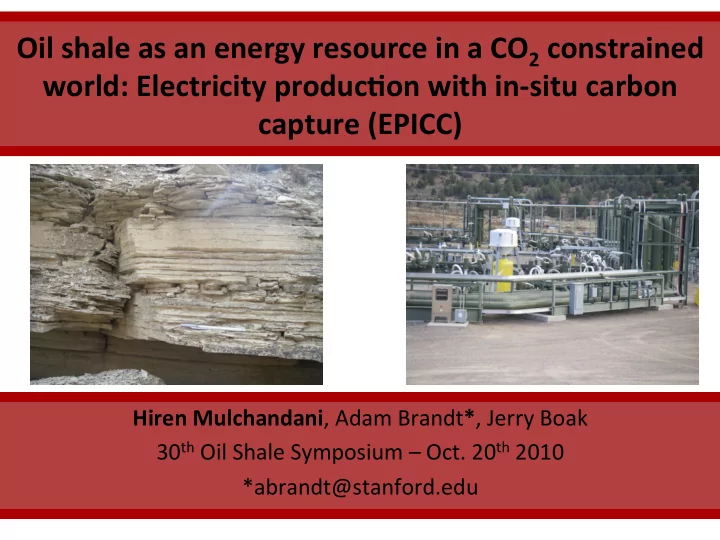
Oil ¡shale ¡as ¡an ¡energy ¡resource ¡in ¡a ¡CO2 ¡constrained ¡ world: ¡Electricity ¡produc8on ¡with ¡in-‑situ ¡carbon ¡ capture ¡(EPICC) ¡
Hiren ¡Mulchandani, ¡Adam ¡Brandt*, ¡Jerry ¡Boak ¡ 30th ¡Oil ¡Shale ¡Symposium ¡– ¡Oct. ¡20th ¡2010 ¡ ¡ *abrandt@stanford.edu ¡
SLIDE 2 De Description o n of proble lem m
low p progress to to comme mmerciali lize
l sha hale le
ntial C l CO2 cons nstraint nt i in n future future
De Description o n of solu lution n
hema matic di diag agram ram
Case descriptions ns
Result lts
Temperature plo lot
bala lanc nce plo lots
nergy y bala lanc nce p plo lots
Di Discussion
n of a a GF GFC
n of gas a and nd li liquid compone nent nts o
the he o
h pressure
ng c cha har behi hind nd
Conc nclu lusions ns
y ratios
2 ¡
Outline ¡
SLIDE 3
- Current ¡rate ¡of ¡oil ¡shale ¡development ¡slow ¡ ¡
- In-‑situ ¡oil ¡shale ¡development ¡sIll ¡at ¡RD&D ¡stage ¡
- New ¡ideas ¡needed ¡to ¡jolt ¡industry ¡(need ¡to ¡get ¡
no8ced!) ¡
- PotenIal ¡for ¡CO2 ¡limitaIons ¡in ¡future ¡very ¡high ¡
The ¡problem.. ¡
3 ¡
SLIDE 4
- EPICC ¡= ¡Electricity ¡ProducIon ¡with ¡In-‑Situ ¡Carbon ¡Capture ¡
- Rearranging ¡chemical ¡processes ¡to ¡opImize ¡the ¡system ¡
(turn ¡it ¡“inside ¡out”) ¡
– QuesIon: ¡What ¡is ¡the ¡best ¡way ¡to ¡turn ¡chemical ¡energy ¡from ¡ shale ¡into ¡rota5onal ¡mo5on ¡of ¡vehicle ¡wheels? ¡
One ¡proposed ¡soluIon ¡-‑ ¡EPICC ¡
4 ¡ Re Resource Heat s source Ene nergy y carri carrier er Conversion t n to work k Waste he heat from m conversion n Li Liqui uids ds production n Chemical energy in shale Thermal or electrical energy from fuels Liquid fuel Automobile engine To atmosphere EPIC ICC Chemical energy in shale Waste heat Electricity In situ fuel cell To shale formation
SLIDE 5
EPICC ¡system ¡diagram ¡
5 ¡
SLIDE 6
- In ¡situ ¡electricity ¡generaIon ¡converts ¡chemical ¡energy ¡
to ¡work ¡(electricity) ¡where ¡waste ¡heat ¡is ¡useful ¡ ¡
– System ¡could ¡be ¡similar ¡to ¡“geothermic ¡fuel ¡cells” ¡proposed ¡ by ¡Independent ¡Energy ¡Partners, ¡Inc. ¡
- Product ¡gases ¡are ¡high ¡value, ¡low ¡carbon ¡stream ¡
– H2, ¡CH4, ¡CO, ¡CO2 ¡ – Most ¡carbon ¡is ¡leY ¡in ¡ground ¡as ¡char ¡
- SeparaIon ¡could ¡occur ¡in ¡subsurface ¡
– In ¡situ ¡“bathtub ¡ring” ¡of ¡condensaIon ¡products ¡could ¡work ¡ in ¡favor ¡ – If ¡not, ¡surface ¡separaIon ¡and ¡reinjecIon ¡of ¡liquids ¡unIl ¡ coked ¡
Key ¡aspects ¡of ¡system ¡
6 ¡
SLIDE 7
- Three ¡types ¡of ¡species ¡– ¡iniIal ¡reactants, ¡
intermediate ¡species ¡and ¡final ¡products ¡
- First ¡order ¡kineIc ¡model ¡based ¡on ¡literature ¡
– Burnham ¡and ¡Braun ¡(1985) ¡ – Carbonate ¡decomposiIon ¡from ¡Campbell ¡(1978) ¡ – Mineral ¡dehydraIon ¡from ¡Camp ¡(1987) ¡
- “Stock ¡and ¡flow” ¡model ¡
- Oil ¡cracking ¡included ¡
- Oil ¡boiling ¡not ¡accounted ¡for ¡(pressure ¡effects ¡not ¡in ¡
model) ¡
STAN/DOS ¡Modeling ¡Method ¡
7 ¡
SLIDE 8 ReacIons ¡included ¡
8 ¡
Spe Specie ies ¡ Re Reaction ¡ ¡ ¡ Nahc hcoli lite ¡ 2NaHCO3 →Na2CO3 + H2O + CO2
¡
Calc lcite ¡ CaCO3 → CaO + CO2 ¡ Do Dolo lomi mite ¡ CaMg(CO3)2 → MgO + CaCO3 + CO2 ¡ Bitume men/ n/ Ke Kerogen ¡ 100 CH1.50N0.025O0.05 → 5.3 CH1.56N0.021O0.01 + 74.2 CH1.56N0.021O0.021 + 14.7 CH0.63N0.056O0.02 + 0.3 CO + 1.0 H2 + 4.2 CH4 + 1.0 H2 + 1.3 CO2
¡
Prima mary d y decomposition r n reactions ns Second ndary r y reactions ns
Spe Specie ies ¡ Re Reaction ¡ Prima mary c y cha har ¡ 100 CH0.63N0.05O0.02 → 94.5 CH0.23N0.03O0.02 + 5.5 CH4 + 6.4 H2 + 2.2 NH3 ¡ Second ndary c y cha har ¡ 100 CH0.23N0.03O0.02 → 100 CH0.1N0.03O0.02 + 8.0 H2 ¡ Oil c l cracki king ng ¡ Oili → Oil j < i + Primary char + CH4 + CO +H2
¡
SLIDE 9
STAN/DOS ¡Modeling ¡scheme ¡
9 ¡
Energy input (externally purchased natural gas) Is the Temperature 393 K? Energy is absorbed to boil the free water Energy is used to cause the reactions Energy is used to heat the rock Temperature of the rock is updated YES NO
SLIDE 10
- 1000 ¡kg ¡of ¡shale ¡
- Base ¡case: ¡
¡ ¡ ¡ ¡ ¡-‑ ¡ ¡ ¡ ¡ ¡Uniform ¡temperature ¡(no ¡heat ¡transfer ¡limitaIon) ¡ ¡
STAN/DOS ¡details ¡
10 ¡
Ine Inert mi mine neral ( l (%) ¡ Nahc hcoli lite (%) (%) ¡ Calc lcite (%) (%) ¡ Do Dolo lomi mite (%) (%) ¡ Bitume men n (%) (%) ¡ Kerogen n (%) (%) ¡ Bound nd water ( (%) ¡ Fr Free water ( (%) ¡ Total l (%) (%) ¡ Stand ndard case case ¡
47.1 ¡ 2 ¡ 12 ¡ 15 ¡ 0.9 ¡ 18 ¡ 0.25 ¡ 4.75 ¡ 100 ¡
High h kerogen n cont ntent nt ¡
39.75 ¡ 2 ¡ 12 ¡ 15 ¡ 1.25 ¡ 25 25 ¡ 0.25 ¡ 4.75 ¡ 100 ¡
Lo Low w kerogen n cont ntent nt ¡
55.5 ¡ 2 ¡ 12 ¡ 15 ¡ 0.5 ¡ 10 10 ¡ 0.25 ¡ 4.75 ¡ 100 ¡
High h wa water cont ntent nt ¡
42.1 ¡ 2 ¡ 12 ¡ 15 ¡ 0.9 ¡ 18 ¡ 0.5 .5 ¡ 9.5 ¡ 100 ¡
Low w water cont ntent nt ¡
49.6 ¡ 2 ¡ 12 ¡ 15 ¡ 0.9 ¡ 18 ¡ 0. 0.125 125 ¡ 2.375 ¡ 100 ¡
SLIDE 11
Results ¡– ¡non-‑bounding ¡case ¡
11 ¡
SLIDE 12
Results ¡– ¡non-‑bounding ¡case ¡
12 ¡
SLIDE 13 Energy ¡RaIos ¡ ¡
13 ¡
3 2
NER NER ¡ (3)/(1+2) (3)/(1+2) ¡ EER EER ¡ (3)/(2) (3)/(2) ¡
1
SLIDE 14
Results ¡– ¡Energy ¡contents ¡
14 ¡
Case Case ¡ Ini Initial e l ene nergy y cont ntent nt ( (MJ) ¡ Extract Extracted ed ene nergy ( y (MJ) ¡ Ene nergy le y left behi hind nd ( (MJ) ¡ Extraction e n efficienc ncy ( y (%) ¡ Stand ndard ¡ 7806 ¡ 3109 ¡ 4697 ¡ 39.8 ¡ High k h kerogen ¡ 10841 ¡ 3353 ¡ 7488 ¡ 30.9 ¡ Low k kerogen ¡ 4337 ¡ 1922 ¡ 2415 ¡ 44.3 ¡ High w h water ¡ 7806 ¡ 2723 ¡ 5080 ¡ 34.9 ¡ Low w water ¡ 7806 ¡ 3274 ¡ 4532 ¡ 41.9 ¡
Extraction e n efficienc ncy y ≈ 4 40 % % i in s n stand ndard c case
SLIDE 15
Case Case ¡ EER EER ¡ NER NER ¡ CO CO2 i int ntens nsity y (g C CO2/MJ e ele lectricity) y) ¡ ¡ ¡ ¡ ¡ Stand ndard ¡ 1.12 ¡ 0.49 ¡ 52.4 ¡ High k h kerogen ¡ 1.17 ¡ 0.49 ¡ 49.1 ¡ Low k kerogen ¡ 0.87 ¡ 0.48 ¡ 89.8 ¡ High w h water ¡ 1.04 ¡ 0.49 ¡ 54.9 ¡ Low w water ¡ 1.15 ¡ 0.49 ¡ 52.0 ¡
Results ¡– ¡Energy ¡raIos ¡
15 ¡
CO CO2 i int ntens nsity o y of e ele lectricity y ≈ ½ C CCGT i in s n stand ndard c case
SLIDE 16
- Unclear ¡if ¡model ¡(Burnham ¡and ¡Braun) ¡can ¡be ¡
extended ¡to ¡this ¡regime ¡
- Reliable ¡operaIon ¡of ¡a ¡GFC ¡unknown ¡
- EffecIve ¡separaIon ¡of ¡liquids ¡and ¡gases ¡in ¡sub-‑
surface ¡un-‑tested ¡
- Fracturing ¡of ¡rock ¡possible ¡due ¡to ¡pressure ¡buildup ¡
(pressure ¡not ¡modeled) ¡
- Opportunity ¡cost ¡of ¡leaving ¡char ¡underground ¡
PotenIal ¡difficulIes ¡
16 ¡
SLIDE 17 17 ¡
Conclusions ¡
- Shown ¡proof-‑of-‑concept ¡for ¡EPICC ¡through ¡STAN/
DOS ¡
- Can ¡yield ¡extracIon ¡efficiency ¡of ¡31 ¡– ¡45 ¡% ¡
- Can ¡yield ¡NER’s ¡between ¡ ¡0.44 ¡– ¡0.88 ¡ ¡ ¡ ¡ ¡
- Can ¡yield ¡EER’s ¡between ¡0.8 ¡– ¡1.37 ¡
- Can ¡reduce ¡CO2-‑intensity ¡from ¡~ ¡120 ¡g ¡CO2/MJ ¡e ¡(gas ¡
turbine) ¡to ¡between ¡52-‑90 ¡g ¡CO2/MJ ¡e ¡ ¡(EPICC) ¡
- Concept ¡is ¡worthy ¡of ¡addiIonal ¡modeling ¡(heat ¡
transfer ¡and ¡fluid ¡flow) ¡
SLIDE 18
- Amendees ¡of ¡30th ¡Oil ¡Shale ¡Symposium ¡
- Co-‑author: ¡Adam ¡Brandt ¡
- Sponsor: ¡Jerry ¡Boak ¡ ¡
¡ ¡
18 ¡
Thanks: ¡
SLIDE 19
Results ¡-‑ ¡bounding ¡case ¡ ¡ ¡
19 ¡
Block 1 Block 4
SLIDE 20
Results ¡– ¡bounding ¡case ¡(cont.) ¡
20 ¡
Block 1 Block 4