Constant Pressure Retorting of Oil Shale Earl D. Mattson, Carl D. - - PowerPoint PPT Presentation

constant pressure retorting of oil shale
SMART_READER_LITE
LIVE PREVIEW

Constant Pressure Retorting of Oil Shale Earl D. Mattson, Carl D. - - PowerPoint PPT Presentation

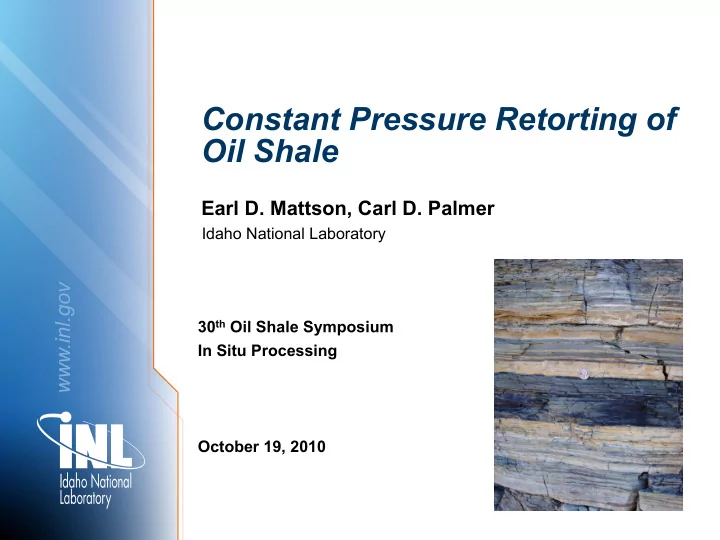
Constant Pressure Retorting of Oil Shale Earl D. Mattson, Carl D. Palmer Idaho National Laboratory www.inl.gov 30 th Oil Shale Symposium In Situ Processing October 19, 2010 Objective : Conduct laboratory constant back pressure oil shale


slide-1
SLIDE 1

www.inl.gov

Constant Pressure Retorting of Oil Shale

Earl D. Mattson, Carl D. Palmer

30th Oil Shale Symposium In Situ Processing October 19, 2010 Idaho National Laboratory
slide-2
SLIDE 2

Objective: Conduct laboratory constant back pressure oil shale retorting experiments to evaluate the effects of process variables (gas pressure and temperature)

  • n produced fluids.

Approach: Retort 150 g crushed oil shale samples in a high pressure/temperature vessel under isothermal and constant pressure conditions. Compare quantity and quality of produced oil, gas, and spent shale.

slide-3
SLIDE 3

Heat Heat

Product

Retort Gas/Liquid Pressure Energy Input + Time (Temperature Distribution)

Major In Situ Controls

slide-4
SLIDE 4

Constant Pressure Laboratory Set-up

shale

References Bae, 69 Noble et al. 81, 82 Burnham et al. 82 Yang and Sohn, 85

Max Temp 600°C, Max Pressure 600 psi

slide-5
SLIDE 5

TGA Results – Raw vs Retorted Shale

  • 10°C per min
  • Nitrogen purge
  • Ambient to 575°C
  • < 1 mm particle size

~15% wt loss ~2% wt loss Retorted Raw

Decomposition Temperature Ranges Kerogen Bitumen Dolomite/Calcite

slide-6
SLIDE 6

Temperature Effects

t = exp(13901*(1/(T+273))-16.61)

slide-7
SLIDE 7

Results as Function of Temperature

Pressure = 200 psi Time = 144, 24, 4 hrs Higher Temperature

  • More oil generated
  • More gas generated
  • More mass removed
slide-8
SLIDE 8

Oil Quality

Increasing Temperature

slide-9
SLIDE 9

TGA Results – Effect of Temperature

Lower retorting temperature => less mass removal

slide-10
SLIDE 10

Variable Back Pressure Tests

  • Crushed oil shale
  • Isothermal (500°C)
  • 4 hr testing
  • Variable Back Pressure

– 25 to 540 psi

Pressure Control

slide-11
SLIDE 11

Results as Function of Back Pressure

Temp = 500°C Time = 24 hrs @ Higher Back Pressure

  • Less oil generated
  • Approximately same gas
  • More mass removed
slide-12
SLIDE 12

Transport vs Decomposition Kinetics Gas Sorption

Sequential Sampling Results Retort Pressure 540 psi Four samples after finished Lighter gases tend to adsorb to spent shale Methane ~3X increase Ethane ~2X increase

slide-13
SLIDE 13

Oil Quality

Increasing Pressure

slide-14
SLIDE 14

TGA Results – Effect of Pressure

greater gas back pressure => change in distribution

slide-15
SLIDE 15

Water Invasion

  • Fisher Assay type test
  • Ramp and Soak (500°C)
  • ~2 hr testing
  • Back Pressure 25 psi
  • With and with/out water addition
slide-16
SLIDE 16

Fischer Assay

  • Container type
  • Container size (L)
  • Sample mass (g)
  • Sample size (mesh)
  • Ramp rate (oC/min)
  • Backpressure (psig)
  • Alum.
  • 1/3
  • 95 (+/-10)
  • 8
  • 12
  • SS
  • 1
  • 218.8
  • 4-10
  • ~7
  • 20-30

Reported FA INL “FA”

slide-17
SLIDE 17

FA Results

  • Red – no water
  • Blue – 2 ml/min
slide-18
SLIDE 18

FA - Comparison

w/o H2O w/ H2O

slide-19
SLIDE 19

Gas Chromatograph Results – FA Comparison

w/o H2O w/ H2O No difference in oil quality

slide-20
SLIDE 20

TGA Results – FA Comparison

slide-21
SLIDE 21

Summary Comparison of pressure controlled laboratory results

  • Const. Pressure – Var. Temperature (200 psi, 350-500°C)

– At higher retorting temperatures – Possible issue with reaction kinetics

– More oil generated – More gas generated – More mass removed – Slightly better quality

  • Const. Temperature – Var. Back Pressure (500°C, 25-540 psi)

– At higher back pressures

– Less oil generated – Approximately same gas volume – Less mass removal – Better quality

slide-22
SLIDE 22

Summary (cont.)

  • Transport issues at high pressure

– Spent shale appears to adsorb gases similar to CBM – CO2 storage (~0.04 lbs CO2 per ton shale per psi)

  • Water Intrusion Effects

– Fisher Assay Results

– More oil generated ?? – Same amount of gas generated – Same amount of mass removed – Distribution of kerogen and bitumen may be different (TGA) – No difference in oil quality – More H2 and CO2 produced with H2O addition

  • These preliminary results suggest

– Operate in situ retorts at lower back pressure without

water