Deep belowground biomass & Net Primary Productivity in a coffee - - PowerPoint PPT Presentation

deep belowground biomass net primary productivity in a
SMART_READER_LITE
LIVE PREVIEW

Deep belowground biomass & Net Primary Productivity in a coffee - - PowerPoint PPT Presentation

Deep belowground biomass & Net Primary Productivity in a coffee agroforestry system of Costa Rica Elsa Defrenet, Olivier Roupsard, Fabien Charbonnier, Alejandra Barquero, Karel van den Meersche, Diego Robelo, Christophe Jourdan Context


slide-1
SLIDE 1

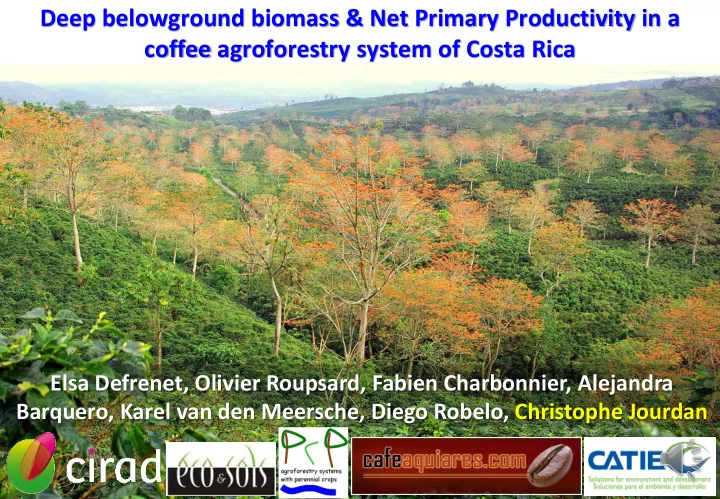
Deep belowground biomass & Net Primary Productivity in a coffee agroforestry system of Costa Rica

Elsa Defrenet, Olivier Roupsard, Fabien Charbonnier, Alejandra Barquero, Karel van den Meersche, Diego Robelo, Christophe Jourdan
slide-2
SLIDE 2

Context

  • Perennial plantations deal with climate changes, thus

challenging sustainable plant productivity

  • NPP plays a key role in functioning, production and C

sequestration of ecosystems

  • Studies on bNPP and root dynamics over long period are

rather scarce

  • Most root studies are limited to the topsoil
  • Few studies on coffee NPP and none on coffee root

dynamics and productivity on the whole rooting profile

2

slide-3
SLIDE 3

Coffee root system

3

slide-4
SLIDE 4
  • Estimate the total coffee root biomass, down to the root front
  • Evaluate the bNPP on the whole rooting profile of coffee

plantations

– Root perennial structures – Fine root production

  • Calculate the fine root turnover rate
  • Characterize the effect of plant competition on these

parameters due to structure of plantations:

– between coffee trees: planting rows vs inter-rows – between coffee and shade trees

  • Characterize the effect of soil depth

Objectives

4

slide-5
SLIDE 5

NPP = Gvisible + DR + L + Ex + P

Gvisible = visible growth; ∆R = Variation of Reserves; L = Mortality or litter production; Ex = Exportation; P = Pruning

Net Primary Productivity (NPP)

bNPP

5

slide-6
SLIDE 6
  • Central Costa Rica (3014mm precipitations) tropical humid

climate with only 3 « drier » months (Feb.-April) with less than 200mm/month

  • Aquiares farm (700 ha, 750-1400 m a.s.l.), 40 y old coffee

plantations with native shade trees

  • Andisol with high allophane and OM contents, high

infiltrability, high stone content

  • Coffea arabica L., 1.4 m x 1.1 m, 6300 plants ha-1
  • Shade trees (Erythrina sp.) density of 7.4 trees ha-1, 20m high,

15% canopy projection on coffee plots

Study site and plant material

6

slide-7
SLIDE 7

7

Voronoi polygon

Stump

150 cm 0-10 cm 10-30 cm

Wall profile within the planting row Wall profile within the inter-row

¼ of Voronoi Voronoi polygon Row

Compensation

12 plants (6 full sun – 6 shade) Extrapolation to root front – 4 m deep

Root biomass estimation method

1.6m²

slide-8
SLIDE 8

8

Sequential Coring sampling design

2 studied effects:

  • Distance to shade tree (full sun; shade);
  • Sampling position (row; inter-row)

10 plants (5 full sun – 5 shade) Decision Matrix and Max-Min calculation methods

N

Voronoï polygon

Row Inter-row

Coffee plant

SEQUENTIAL CORING Sun coffee plants Shade plants Eddy flux Tower 50 m

1 2 9 1 6 1 2 9 1 6

0-30 cm soil sampling  0 – 4 m (extr.) Core Diam.: 8 cm

slide-9
SLIDE 9

Total Root biomass 0 - 4 m

9 9

55% 30cm

slide-10
SLIDE 10

Plant compartment compartment Biomass (t ha-1) Belowground Tap root 9.1 (50%) Coarse and mediuem roots 6.0 (33%) Total perennial roots 15.1 (83%) Fine roots 3.0 (17%) Total Belowground 18.1 (34%) Aboveground Perennial parts (stumps only) 21.2 Pruned branches and fruits 14,4 Total Aboveground 35,6 (66%)

Total Root Biomass 0 - 4 m

Total root biomass amounts 34% of total plant biomass, likely a consequence of shoot prunning every 5 years No significant differences between sun and shade coffee root biomass

10

slide-11
SLIDE 11

11

Fine root biomass dynamics (0 – 30 cm)

wet period « drier » period

LAI =4.4 mleaf² msoil

  • ²

LAI =2.2 mleaf² msoil

  • ²

x2

Fine root biomass fluctuated seasonally 2-fold, similarly to LAI, but with a strong competition between roots and fruits

Fruit loading

slide-12
SLIDE 12

Method FR NPP Global plot T ha-1 y-1 FR NPP Row T ha-1 y-1 FR NPP Inter-row T ha-1 y-1 FR Turnover y-1 FR Lifespan y Decision Matrix Fairley & Alexander, 1985 1.64 2.14 1.14 0.72 1.39 Max-Min Nadelhoffer et al, 1985 1.38 1.93 0.96 0.85 1.18

Fine root NPP on the topsoil (0 - 30 cm)

FR NPP in the Row > Inter-row by 2 fold, likely a consequence

  • f OM & nutrient concentration patches under coffee plants.

No significant differences between both methods

12

x2

slide-13
SLIDE 13

13

Tap root: 0.8 t ha-1y-1 Stumps: 1.8 t ha-1y-1 Coarse roots: 0.2 t ha-1y-1 Medium roots: 0.3 t ha-1y-1

Total bNPP: 3.5 t ha-1y-1

bNPP - whole rooting profile (0 - 4 m)

Fine roots: 2.2 t ha-1y-1

63%

Total perennial roots: 1.3 t ha-1y-1

37%

Total aNPP 13.5 t ha-1y-1

Total NPP: 17 t ha-1y-1

slide-14
SLIDE 14
  • Deep root biomass and productivity frequently forgotten;

first coffee root biomass estimates on whole rooting profile

  • 2 times more root biomass located in the row than inter-row
  • No significant effect of shade trees on coffee root

distribution

  • 8% of coffee root biomass below 1.5m deep, fine roots

exclusively

  • High value of bNPP, particularly fine roots (twice more than

perennial roots)

  • Low value of fine root turnover rate (0.7 y-1)

High potential for C sequestration in this agroforestry ecosystem

14

Main conclusions

slide-15
SLIDE 15

15

… and thank you for your kind attention Many thanks to my colleagues…