Off-shore operations to Helidecks- Thales Capabilities Briefing to - - PowerPoint PPT Presentation

off shore operations to helidecks thales capabilities
SMART_READER_LITE
LIVE PREVIEW

Off-shore operations to Helidecks- Thales Capabilities Briefing to - - PowerPoint PPT Presentation

Off-shore operations to Helidecks- Thales Capabilities Briefing to HSRMC 75 th Meeting DAVID THORNDYCRAFT & KIERAN SMITH THALES AVIONICS FLX Company Confidential www.thalesgroup.com Introduction- The Problem Approach to helidecks are


slide-1
SLIDE 1

www.thalesgroup.com

Company Confidential

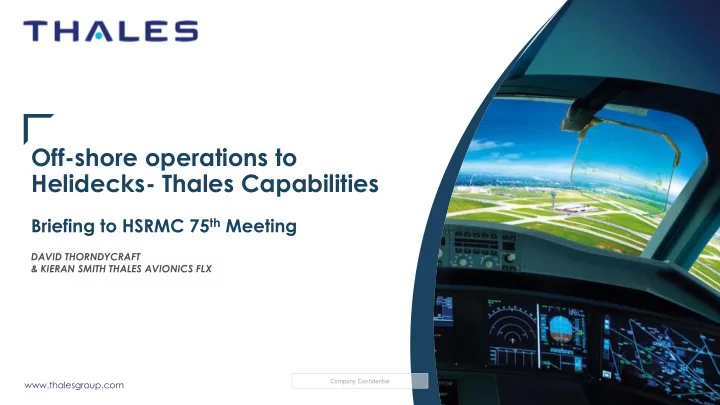
Off-shore operations to Helidecks- Thales Capabilities

Briefing to HSRMC 75th Meeting

DAVID THORNDYCRAFT & KIERAN SMITH THALES AVIONICS FLX
slide-2
SLIDE 2

2

Company Confidential

Introduction- The Problem

▌ Approach to helidecks are difficult

at night and/or in poor visibility conditions leading to:

Erroneously executed approaches Mistaken identity CFIT accidents Accidents whilst on deck

slide-3
SLIDE 3

3

Company Confidential

AAIB reports-1

▌ Example: AW139 G-VINB 2017 Solution provides real time identification of helideck and

information such as ‘Unmanned’ that would have prompted commander that all was not as it should have been. Removes confirmation bias*.

▌ Example: S-92A G-VINL 2014 ‘A Case of Mistaken Identity’, conformal image/ident

marking of helideck not matching the mistaken helideck would have cued pilot, however 3D flight path would have delivered pilot to IAF correctly in the first place! *Confirmation bias occurs from the direct influence of desire on beliefs!

slide-4
SLIDE 4

4

Company Confidential

AAIB reports-2

▌ Example: AS-332 L2 Super Puma G-WNSB 2013 Extract:- ‘The operator’s SOP for this type of approach was not clearly defined and the pilots had not developed a shared, unambiguous understanding of how the approach was to be flown.’ 4 Fatalities Avoidable using 3D flight path guidance (loss of flightpath below MDA)and monitoring

  • f a/c energy state
slide-5
SLIDE 5

5

Company Confidential

AAIB reports-3

▌ Example: AS-332 L2 Super Puma G-BKZE 2001 Extract:- It is recommended that UKOOA revise their Guidelines for the Management of Offshore Helideck Operations to include a requirement for significant changes in environmental conditions, particularly wind speed and relative wind direction, to be communicated the pilot of a helicopter when parked, with rotors turning, on a helideck.

slide-6
SLIDE 6

6

Company Confidential

Helideck Operations -1

▌Accidents can be caused by:

Poor Situational Awareness (SA) and high Mental Workload in final approach, hover and landing stage Difficulties in acquiring the helideck lighting patterns amongst the extensive other lit areas in vicinity Determining the ideal approach path (conflict of variables including wind over deck (WOD), position of obstacles) Judging and controlling the closure rate of the aircraft to the helideck in the final approach phase Determining and controlling the aircraft’s position in relation to the marked touchdown marking circle Determining and controlling the descent rate using information from the surrounding environment (limited visual cues) ‘Black Hole’ approach illusions

slide-7
SLIDE 7

7

Company Confidential

Helideck Operations -2

▌In DVE:

Visual references are confused and can be misinterpreted Depth perception is degraded Rate of closure cues are poor because optical flow cues are degraded Missed approach and recovery complicated by poor awareness of

  • bstacles and safety corridors
  • Pilot descending below MDH
  • Weather Radar not calibrated
  • Approach too close to rig

–Horizontal minima now changed

  • Approach below deck height

–Vertical Minima now revised

  • Miscommunication between crew
  • Quality of Met Data on approach

–Crew breaking minima

Initial Approach Fix

Summary from UK CAA: Confidential Human Factors Incident Reporting Programme (CHIRP) -Hazards

slide-8
SLIDE 8

8

Company Confidential

Requirements synthesis

▌Navigation and Guidance

Low latency data from helideck to a/c via datalink ‘On-condition’ delivery to IAF (Initial Approach Fix) :- ‘The key to a good ship approach/landing is a good set-up’

▌Pilotage

Generation and display of ideal approach profile from IAF to helideck Display of aircraft flight vector in relationship to ideal approach profile Monitoring of performance all the way to hover point (particularly when using autopilot modes) Warnings of departures from adequate performance Maintenance of normal Visual Cueing at all stages of approach

  • However these cues may be subject to degradation at any stage therefore supplementary

cues have to co-exist in a similar cognitive frame

▌General

Minimal impact on existing avionics (Certification, costs, maintenance)

slide-9
SLIDE 9

9

Company Confidential

Thales Capabilities-1

▌Navigation and Guidance

Automatic Dependant Surveillance-Broadcast (ADS-B) with Phase Enhancement (PE) to provide accurate, geolocated, centre of helideck and additional information (WOD, obstacles, deck layout, approach path) On board Mission Planning – 2D tablet display for long term SA and 3D ‘head-up eyes out’ HMD display for medium/short term SA

▌Pilotage

Display of aircraft state and 3D Conformal approach guidance displayed in colour ‘heads-up eyes out’ using an ‘Add On Mission’ system Trusted decision making approach path generation/ performance monitoring (Think Tank Maths (TTM) Trusted Reasoning Architecture (TRA)

Examples of conformal Flightpath symbology (TopMax picture courtesy Thales HeA) and Pathway-in-Sky automatic Approach Profile guidance presented on an HMD (courtesy of QinetiQ)

slide-10
SLIDE 10

10

Company Confidential

Thales Capabilities 2-HADS

▌Helicopter Approach Departure System (HADS)- Helideck

component

ACSS NGT-9000R ADS-B Transmitter WAAS/SBAS GPS providing accurate geolocation Helideck sensors (wind direction, speed, gusts, motion (if applicable) Helideck layout and obstruction database

  • System transmits 1090 MHz + Phase Enhancement (PE) to provide additional

information.

▌HADS Aircraft component ACSS NGT-9000R ADS-B Receiver with PE Helideck Database Interface to a/c systems and display systems (using Add-On Mission)

slide-11
SLIDE 11

11

Company Confidential

Project LuCy – MVP

▌ Add-On Mission Concept – to provide in-cockpit mission capability through the means of

Helmet Mounted / Head Worn Displays (HMD/HWDs)

Wide range of implementations and levels of integration

▌ Traditionally highly integrated cockpit solutions are one of Thales core businesses

Requirement for High DAL High Cost

▌ Project LuCy was set up to develop a MVP (Minimum Viable Product) using an innovative

approach

▌ MVP Targeted at:

Customer who demands modern Situational Awareness (SA) functionality Displayed ‘Eyes-out’ At low cost (retrofit market)

slide-12
SLIDE 12

12

Company Confidential

LuCy – System Overview

Scorpion HMD Lu Module

  • Pos + Att
  • Wifi, 3G/4G

Cy Module

  • Head dirn.
  • Image gen.

Tracker

  • Inertial
  • Optical

Battery Pack Airbox ACANS (or alternate)

slide-13
SLIDE 13

13

Company Confidential

LuCy – Features and Specifications

▌ Main Function of LuCy – Display of geolocalized

information:

Display of Points of Interest (POIs) Off-screen representations Line of Sight sharing

▌ Other types of geolocalized info can easily be

accommodated:

  • Eg. Waypoints, shapes/polylines

Via the API

▌ Basic Specifications:

Registration Accuracy: 2º Targeting Accuracy: 2º Line of Sight POI Battery Life: 6 Hours Total System Weight: 2.4kg approx

Increases situational awareness and reduces pilot workload by combining the elements of mission, eyes-out and an autonomous navigation solution with little to no cockpit integration effort

slide-14
SLIDE 14

14

Company Confidential

Helicopter Navigation and Guidance

▌ Decisioning support system to assist and augment the actions of a

pilot during approach and landing on a helideck – Real-time monitoring of helideck, a/c and pilot conditions – Optimal approach trajectory based on current conditions

▌ Throughmonitoring and assessment of atmospherics to rapidly

identify when a change in action is required

▌ Interaction with pilot through “explainable decisions”

– Instruction on trajectories to take or actions to perform – “Human level” explanation available

Thales Solution-Human Factors

Think Tank Maths (TTM) Ltd Trusted Reasoning Architecture (TRA)

TRA Dynamic Framework – Beyond Rule Based Decisioning

▌ TRA system incorporates historical and current data

– Initial platform built using historical data – Dynamic library updates as new circumstances are encountered

▌ Identification of 'critical factors' associated to incidents – interdependencies between weather, a/c condition, pilot action etc ▌ Avoid overwhelming user by identification and relaying of aspects of data relevant to action change ▌ Multi-scale decisioning in critical situations – rapid initial decision followed by later secondary refined decision, as circumstances allow

slide-15
SLIDE 15

15

Company Confidential

Decision Making and Explainable Guidance

▌ Real-time monitoring and decision making

– System incorporates historical data from prior flights – Current data from helideck, a/c and pilot – Appropriate action or flight path identified and refined

▌ Flexible dynamic system beyond 'rule based decisioning'

– Continuous updating and refinement of “Dynamic Library” – Assess impact of a/c and helideck conditions on flight plan – Identify 'critical factors' in incidents for improved early warning

▌ Augmented pilot/system interaction

– Avoid overwhelming pilot with irrelevant or unclear data – Atmospherics and high-level goals used to explain decisions

Thales Solution-Human Factors

Think Tank Maths (TTM) Ltd Trusted Reasoning Architecture (TRA)

Reduced Pilot Workload Through Trust

▌ Pilot can prompt the creation or modification of a flight plan or action list by inputing or updating high level goals ▌ When a critical flight change is necessary the pilot is informed, provided with a course of action and can request an explanation ▌ General pilot feedback regarding potentially critical inter-dependencies between flight trajectories, pilot action and environmentals

slide-16
SLIDE 16

16

Company Confidential

HMI Development-Crawley CDO Rig

▌ Integration of Thales DFCS incl Flight Director ▌ Single/Dual seat capability ▌ NVIS compatibility and the ability to simulate

Low Ambient Light conditions

▌ Integration of Scorpion and TopOwl displays

and head trackers (optical and magnetic)

▌ Rapid prototyping of display concepts ▌ Integration of ship and helideck models in

visual database

▌ Thales would like to extend an open invitation

to come and see the ‘Rig’

slide-17
SLIDE 17

17

Company Confidential

Why Thales?

▌ ACSS* HADS provides unique capability in providing PE overlay onto ADS-B. ▌ Current flight trials conducted in France using ‘Topmax’ for 3D and 4D flight path

guidance including helideck approaches

▌ Add-On Mission concept for providing modern HMI in an easy to integrate low cost

package

▌ Current Thales Avionics On board Mission Planner (OMPs) can easily be adapted to

generate 3D conformal flight path guidance

▌ Crawley ‘Rig’ can be used for HMI development ▌ Access to SMEs (Off shore operations/Certification) ▌ Tie-in with Think Tank Maths to provide ‘expert’ decision making would also be

unique.

*ACSS is a joint venture Thales and L3

slide-18
SLIDE 18

18

Company Confidential

To Summarise

▌ Thales Avionics believe that a high

TRL system can be proposed to aid

  • perations to offshore helidecks to

reduce accidents based on the following capabilities:

ADS-B with PE data link to provide low latency helideck geolocation + other parameters to a/c Use of Add-on Mission system to provide 3D flightpath guidance derived from Mission Planner routes HMI developed using bespoke in-house Rig Intelligent Approach path generation using a decision making toolset (e.g Think Tank Maths Trusted Reasoning Architecture)