Observation of top quark production Observation of top quark - - PowerPoint PPT Presentation

observation of top quark production observation of top
SMART_READER_LITE
LIVE PREVIEW

Observation of top quark production Observation of top quark - - PowerPoint PPT Presentation

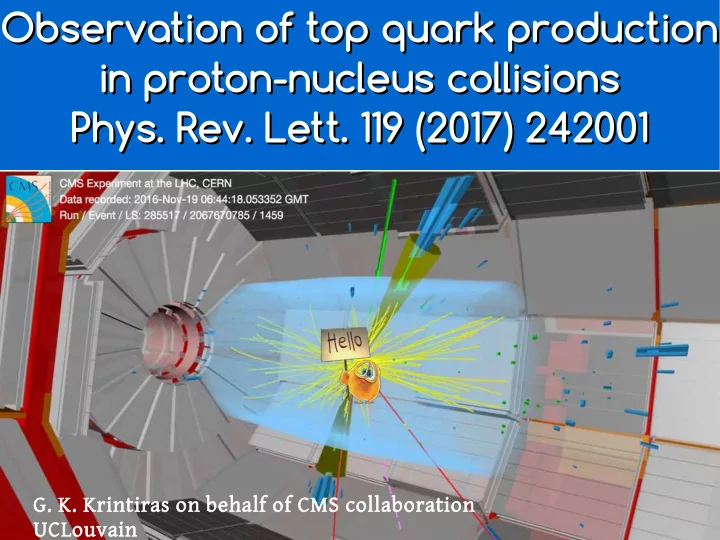
Observation of top quark production Observation of top quark production in proton-nucleus collisions in proton-nucleus collisions Phys. Rev. Lett. 119 (2017) 242001 Phys. Rev. Lett. 119 (2017) 242001 G. K. Krintiras on behalf of CMS


slide-1
SLIDE 1

Observation of top quark production Observation of top quark production in proton-nucleus collisions in proton-nucleus collisions

  • Phys. Rev. Lett. 119 (2017) 242001
  • Phys. Rev. Lett. 119 (2017) 242001
  • G. K. Krintiras on behalf of CMS collaboration
  • G. K. Krintiras on behalf of CMS collaboration

UCLouvain

slide-2
SLIDE 2

Observation of top quark production Observation of top quark production in proton-nucleus collisions in proton-nucleus collisions

  • Phys. Rev. Lett. 119 (2017) 242001
  • Phys. Rev. Lett. 119 (2017) 242001
  • G. K. Krintiras on behalf of CMS collaboration

How we ended up having the HL request already fulfilled ? There was any major concern to address ? What we have learned ?

slide-3
SLIDE 3

3

Throwing a bullet through an apple... Throwing a bullet through an apple... Why Why ? ?

  • Oct. 2012

Initially only thought to give answers on hot questions about cold QCD matter The first collisions of unequal species (pPb) @ LHC revealed surprises signs similar to those of the Quark-Gluon Plasma (QGP) interest exploded (the 5th most cited CMS paper in PLB !)

  • Phys. Lett. B 718, 795 (2013)

AA – Make a QGP pp – Establish the baseline pA –Control initial state effects → can only alter incoming wavefunction

“traditional” Heavy-Ion (HION) playbook

slide-4
SLIDE 4

4

Throwing a bullet through an apple... Throwing a bullet through an apple... How How ? ?

Initially only thought to give answers on hot questions about cold QCD matter The first collisions of unequal species (pPb) @ LHC revealed surprises signs similar to those of the Quark-Gluon Plasma (QGP) interest exploded (the 5th most cited CMS paper in PLB !)

×10 increase pPb int. Luminosity (Lint )

Ideally LHC is meant for equal colliding species its “two-in-one” magnet design gave birth to “cogging” ( O.o ? ) no preceding design ( != BNL RHIC)

A lower (!) limit on the achieved energy (√sNN)

proton beam displacement

J.M. Jowett, C. Carli; EPAC (2006)

2013: √sNN =5.02 TeV 2016: √sNN =8.16 TeV

Interest + ingenuity ⇒ Lint =174±9 nb-1 (!)

slide-5
SLIDE 5

5

The first search analysis for tt in nuclear collisions ! The first search analysis for tt in nuclear collisions !

l+jets : t t → bW bW → b l b jj' + missing momentum (MET) i.e., crucial to search for the lepton (l= e,μ) & non-b jets (a.k.a. the light jets j,j') j,j' jets are paired based on their proximity in (η,φ) space (minΔR separation) → to construct the variable of interest; here the mjj' inv. mass

1 triggered l (l=e,μ) + 0 extra leptons (offline) + 4 jets clustered with anti-kt (R=0.4) + systematic uncertainties excludes null > 5σ ?

main backgrounds (bkg.) from W+jets and QCD multijet production Combined fit

  • ver 2 × 3 = 6

categories

(at least 2b) N (mjj') = N(bkg.)*[P(W)+f(QCD)*P(QCD)] + N(signal)*P(signal), f∈[0,1]

slide-6
SLIDE 6

6

The data-driven The data-driven bkg.

  • bkg. modeling

modeling

EW processes (W+jets, also DY) modeled with PYTHIA (v.6.424, tune Z2*) pN → W + X (N=p,n) i.e., a mixture of pp and pn interactions – this is crucial Landau parameterization found as a proper description (hint: combinatorics) also supported from POWHEG (v2) interfaced with CT14+EPPS16 effects from nuclear modifications inferred in-situ All samples are tuned to reproduce the global pPb event properties All samples are tuned to reproduce the global pPb event properties QCD multijet process extracted from failed iso (ID) control region in μ(e)+jets channel kernel parameterization (hint: non trivial behavior for fake/non prompt l) pre-fit normalization from low-MET (< 20 GeV) events

1l4j0b 1l4j1b 1l4j2b

p r e

  • f

i t p r e

  • f

i t

slide-7
SLIDE 7

7

Measuring the tt production cross section ( Measuring the tt production cross section (l+jets l+jets) )

Basic ingredients: acceptance (A) and efficiency (ε)

A = 0.060±0.002(tot) (0.056±0.002(tot) ) in μ(e)+jets channel

determined @ NLO with POWHEG (v2) in the fiducial region ε = 0.91±0.04(tot) (0.63±0.03(tot) ) in μ(e)+jets channel measured in data with “tag-and-probe” method (Z boson candle) Background completely determined from data ! Background completely determined from data ! Total number of signal (S) events in all 6 cats. : S = 710 ± 130(tot) combination dominated by μ+jets channel

σtt = 45±8(tot) nb dσtt / σtt = 17 % (!) Lint =174 nb-1

1l4j0b 1l4j1b 1l4j2b

p

  • s

t

  • f

i t p

  • s

t

  • f

i t

slide-8
SLIDE 8

8

To further support the consistency with the production of top quarks the inv. mass of jj'b triplet (hadronic top mass) is plotted b jet candidate with the highest b-tag discriminator value the minimum difference to inv. mass of lνb triplet (leptonic top mass) is considered signal and bkg. contribution scaled to post-fit mjj' values

An “alternative” to the Bayesian posterior An “alternative” to the Bayesian posterior

Even a peak is reconstructed close to top mass ! Even a peak is reconstructed close to top mass !

1l4j0b 1l4j1b 1l4j2b

p

  • s

t

  • f

i t p

  • s

t

  • f

i t

1l4j0b

slide-9
SLIDE 9

9

Up-to-date compilation: Up-to-date compilation: 4 4 √s √sNN

NN

&

& 2 2 systems @ LHC ! systems @ LHC !

First experimental observation of the top quark in nuclear collisions σtt measured in two independent decay channels i.e., μ,e+jets μ,e+jets dσtt / σtt = 17% in the l+jets l+jets combination consistent with the scaled pp data as well as pQCD calculations Minimally relies on assumptions from MC simulation paves the way for the study in AA collisions

slide-10
SLIDE 10

10

CERN Courier, Nov. 2017 PRL Physics Synopsis, Dec. 2017

slide-11
SLIDE 11

11

slide-12
SLIDE 12

12

The null hypothesis is excluded at a level of >5σ taking into account syst. unc. by: the observed variation of the likelihood as a function of the POI PLR from pseudo-data generated from the background-only model

The statistical significance of the measurement The statistical significance of the measurement

Indeed, the first observation of top quarks in pPb ! Indeed, the first observation of top quarks in pPb !

slide-13
SLIDE 13

13

The The signal signal modeling modeling

tt process modeled with PYTHIA (v.6.424, tune Z2*) pN → tt + X (N=p,n) i.e., a mixture of pp and pn interactions – not crucial effects from nuclear modifications studied with POWHEG (v2) interfaced with CT14+EPPS16 split the total contribution in a resonant (left Fig.) and a non resonant (right Fig.) part resonant: both j,j' (reco) matched with a light flavor parton (truth) proximity of j,j' in (η,φ) reproduces a crucial feature

j,j' tested pairing criteria

Parameterized with a CB+gamma Parameterized with a asym. Gaussian+Landau

1l4j2b 1l4j2b

slide-14
SLIDE 14

14

Measuring the tt production cross section ( Measuring the tt production cross section (μ

μ,e+jets

,e+jets) )

σtt = 44±3(stat)±8(syst) nb

e+jets hampered more by bkg. contamination less precise than μ+jets i.e., dσtt / σtt = 23 % vs 18 % crucial consistency check

μ μ+jets: σtt = 56±4(stat)±13(syst) nb e e+jets:

1e4j2b 1e4j1b 1e4j0b 1μ4j0b 1μ4j1b 1μ4j2b

p

  • s

t

  • f

i t p

  • s

t

  • f

i t p

  • s

t

  • f

i t p

  • s

t

  • f

i t

slide-15
SLIDE 15

15

The fit procedure in detail The fit procedure in detail

In order to ensure stability of the complex fit procedure N(bkg.) floats with N(QCD) constrained with μ, σ from low-MET normalization N(signal) floats with event category coupling based on εb., the latter constrained with μ from simulation and conservative σ : N4j2b= εbεb N(signal), N4j1b= 2 εb(1-εb) N(signal), N4j0b= (1-εb)(1-εb) N(signal)

N (mjj') = N(bkg.)*[P(W)+f(QCD)*P(QCD)] + N(signal)*P(signal), f∈[0,1]

In order to evaluate the uncertainty on the signal yields profiling of the likelihood is performed over the full set Θ of nuisances N(bkg.), f(QCD), MPV and width of Landau εb

A, ε, Lint

JES effect on mjj'

slide-16
SLIDE 16

16

Splitting uncertainty in a stat & syst component Splitting uncertainty in a stat & syst component

Neither trivial nor unique task stat: fix nuisances to post-fit values and refit with floating σtt syst: √ ( tot – stat ) effect of identified sources for systematic variations fix all other nuisances to post-fit values and refit within ±1σ syst != quadratic sum of the effects (hint: mind the correlations)

2 2

Careful treatment of UE dependence Careful treatment of UE dependence

1μ4j2b

slide-17
SLIDE 17

17

The leptonic top mass The leptonic top mass

The longitudinal ν momentum from the 4-momentum conservation in the W(lν) vertex assuming as W boson inv. mass the world average of 80.4 GeV ambiguities raised as two real solutions: the one which minimizes |pz,ν-pz,l| imaginary solutions: real part of the quadratic equation in pz,ν

1l4j0b 1l4j1b 1l4j2b

p r e

  • f

i t p r e

  • f

i t

slide-18
SLIDE 18

18

Theoretical setup for cross section calculation Theoretical setup for cross section calculation

Rely on the two fundamental concepts of QCD factorization (calculable) and universality (input from PDFs) σpA = A × σpp (A=208 for Pb isotope @ LHC) MCFM (v8.0, nproc = 141) NLO event calculator with state-of-the-art (n)PDFs bound nucleons' PDF: EPPS16 NLO ; baseline free proton PDF: CT14 NLO nPDF net effects result in a small +4% modification (RpPb) of σtt nPDF PDF uncertainty from the provided 56+40 eigenvalues → ⊗ 9% full calculation repeated with CT10+EPS09 combination considering the 52+32 error sets → 7% QCD scales choice: μR = μF = 172.5 GeV scale variations by halving/doubling the μR, μF → 3% k-factor (NLO → NNLO ) obtained with TOP++

σtt = 59.0±5.3(PDF) (scale) nb +1.6

  • 2.1

CT14+EPPS16 σtt = 57.5 (PDF) (scale) nb CT10+EPS09 +4.3

  • 3.3
  • 2.0

+1.5

Lead

@ √sNN =8.16 TeV

NNLO+NNLL NNLO+NNLL