Objectives The Y Combinator Understand how to allow functions to - - PowerPoint PPT Presentation

objectives the y combinator
SMART_READER_LITE
LIVE PREVIEW

Objectives The Y Combinator Understand how to allow functions to - - PowerPoint PPT Presentation

f n = f (n+1) Objectives To Infjnity and Beyond Further Reading Objectives To Infjnity and Beyond Further Reading Objectives The Y Combinator Understand how to allow functions to call themselves even when they dont have names.


slide-1
SLIDE 1

Objectives To Infjnity and Beyond Further Reading

The Y Combinator

  • Dr. Mattox Beckman

University of Illinois at Urbana-Champaign Department of Computer Science

Objectives To Infjnity and Beyond Further Reading

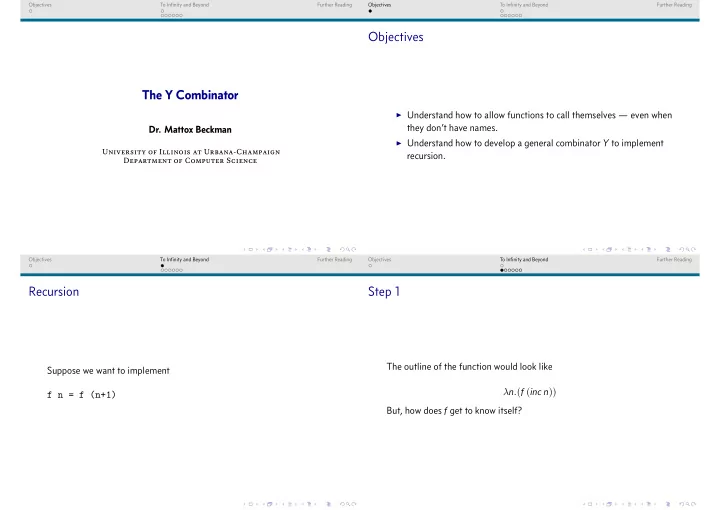
Objectives

◮ Understand how to allow functions to call themselves — even when

they don’t have names.

◮ Understand how to develop a general combinator Y to implement

recursion.

Objectives To Infjnity and Beyond Further Reading

Recursion

Suppose we want to implement f n = f (n+1)

Objectives To Infjnity and Beyond Further Reading

Step 1

The outline of the function would look like λn.(f (inc n)) But, how does f get to know itself?

slide-2
SLIDE 2

Objectives To Infjnity and Beyond Further Reading

Step 2

Maybe we can tell f by having it take it’s own name as a parameter. λf.λn.(f (inc n)) So then we pass a copy of f to itself... (λf.λn.(f (inc n))) (λf.λn.(f (inc n))) But now f must pass itself into itself... so we have (λf.λn.((f f) (inc n))) (λf.λn.((f f) (inc n)))

Objectives To Infjnity and Beyond Further Reading

Expanding a Church Numeral

◮ Consider how this is similar to the operation of Church numerals.

((f5 f) x) → (f ((f4 f) x)) → (f (f ((f3 f) x))) → (f (f (f ((f2 f) x)))) → (f (f (f (f (f x))))) So... ((fn f) x) → (f ((fn−1 f) x)) What would it look like to have an f∞?

Objectives To Infjnity and Beyond Further Reading

The Y Combinator

Consider this pattern: ((f∞ f) x) → (f ((f∞ f) x))

◮ What can you tell about f? About f∞? ◮ Defjnition: combinator = higher order function that produces its

result only though function application.

◮ The problem with the above function is that there’s no way out.

How can we stop the function when we are done?

Objectives To Infjnity and Beyond Further Reading

Coding the Y Combinator

(Y f) → f (Y f) So... Y = λf.(λy.f (y y)) λy.f (y y)) The function f must take (Y f) as an argument. (Y F) = (λf.(λy.f (y y)) λy.f (y y)) F = (λy.F (y y)) λy.F (y y) = F ((λy.F (y y))λy.F (y y)) = F (Y F)

slide-3
SLIDE 3

Objectives To Infjnity and Beyond Further Reading

Example

1 fact n = 2

if n < 1 then 1

3

else n * (fact (n-1)) In λ-calculus: λf.λn. if n < 1 then 1 else n ∗ (f (n − 1)) Then we have: Y fact → λn. if n < 1 then 1 else n ∗ ((Y fact) (n − 1))

Objectives To Infjnity and Beyond Further Reading

Further Reading

◮ You can use λ-calculus to represent itself using these techniques.

You already have everything you need to do it. You can see the details in Torben Æ. Mogensen’s paper Effjcient Self-Interpretations in lambda Calculus, in the Journal of Functional Programming v2 n3.