Objectives Combinator Parsing Show how to build complex parsers by - - PowerPoint PPT Presentation

objectives combinator parsing
SMART_READER_LITE
LIVE PREVIEW

Objectives Combinator Parsing Show how to build complex parsers by - - PowerPoint PPT Presentation

Introduction Choices and Recursion Repeating and Composing Introduction Choices and Recursion Repeating and Composing Objectives Combinator Parsing Show how to build complex parsers by composing simpler parsers. Dr. Mattox Beckman


slide-1
SLIDE 1

Introduction Choices and Recursion Repeating and Composing

Combinator Parsing

  • Dr. Mattox Beckman

University of Illinois at Urbana-Champaign Department of Computer Science

Introduction Choices and Recursion Repeating and Composing

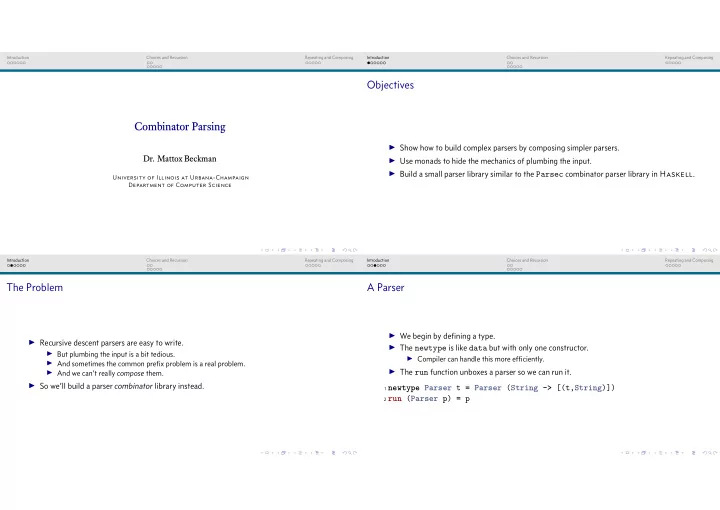
Objectives

◮ Show how to build complex parsers by composing simpler parsers. ◮ Use monads to hide the mechanics of plumbing the input. ◮ Build a small parser library similar to the Parsec combinator parser library in Haskell.

Introduction Choices and Recursion Repeating and Composing

The Problem

◮ Recursive descent parsers are easy to write.

◮ But plumbing the input is a bit tedious. ◮ And sometimes the common prefjx problem is a real problem. ◮ And we can’t really compose them.

◮ So we’ll build a parser combinator library instead.

Introduction Choices and Recursion Repeating and Composing

A Parser

◮ We begin by defjning a type. ◮ The newtype is like data but with only one constructor.

◮ Compiler can handle this more effjciently.

◮ The run function unboxes a parser so we can run it.

1 newtype Parser t = Parser (String -> [(t,String)]) 2 run (Parser p) = p

slide-2
SLIDE 2

Introduction Choices and Recursion Repeating and Composing

Our First Parser: Parsing a Character

The char Parser

1 char s = 2

Parser (\inp -> case inp of

3

(x:xs) | s == x

  • > [(x,xs)]

4

  • therwise
  • > [])

◮ Single quotes are for single characters. ◮ Double quotes are for strings (lists of characters). Main> run (char 'a') "asdf" [('a',"sdf")] Main> run (char 'a') "qwert" []

Introduction Choices and Recursion Repeating and Composing

Predicates and Parsers

◮ oneOf takes a list of characters and succeeds if the input is one of them. ◮ In real life you might want to build a lookup table.

1 oneOf xx = 2

Parser (\inp -> case inp of

3

(s:ss) | s `elem` xx -> [(s,ss)]

4

  • therwise
  • > [])

5 6 digit = oneOf ['0'..'9']

Main> run (oneOf "asb") "sb" [('s',"b")] Main> run (oneOf "asb") "xsb" [] Main> run digit "42" [('4',"2")]

Introduction Choices and Recursion Repeating and Composing

Making It a Higher Order Function

◮ sat takes a predicate that it can run on the character. ◮ Compare with oneOf.

1 oneOf xx = 2

Parser (\inp -> case inp of

3

(s:ss) | s `elem` xx -> [(s,ss)]

4

  • therwise
  • > [])

5 6 sat pred = 7

Parser (\inp -> case inp of

8

(s:ss) | pred s

  • > [(s,ss)]

9

  • therwise
  • > [])

10 11 digit = sat (\x -> x >= '0' && x <= '9') Introduction Choices and Recursion Repeating and Composing

Adding a Choice Operator

◮ We want to compose two parsers together. ◮ If the fjrst fails, we will try the second.

1 (Parser p1) <|> (Parser p2) = 2

Parser (\inp -> take 1 $ p1 inp ++ p2 inp) Main> run (digit <|> (char 'a')) "12ab" [('1',"2ab")] Main> run (digit <|> (char 'a')) "a2ab" [('a',"2ab")] Main> run (digit <|> (char 'a')) "xa2ab" []

slide-3
SLIDE 3

Introduction Choices and Recursion Repeating and Composing

Recursion

◮ Come and see the plumbing inherent in the system!

1 rstring [] = Parser (\inp -> [([],inp)]) 2 rstring (s:ss) = Parser (\inp -> 3

case run (char s) inp of

4

[(c,r1)] -> case run (rstring ss) r1 of

5

[(cs,rr)] -> [(c:cs,rr)]

6

_ -> []

7

_

  • > [])

> run (rstring "Arthur Dent") "Arthur Dent" [("Arthur Dent","")] ◮ We have created a parser using recursion, but this is painful. ◮ What operation do you know that unpacks a data structure, propagates success cases, and aborts computation after a failure?

Introduction Choices and Recursion Repeating and Composing

Enter the Monad – Functor

1 instance Functor Parser where 2

fmap f (Parser p1) =

3

Parser (\inp -> [(f t, s) |

4

(t,s) <- p1 inp])

5 6 sdi :: Parser Integer 7 sdi = Parser (\inp -> case run digit inp of 8

[(d, dd)] -> [(read [d], dd)]

9

  • therwise -> [])

◮ sdi = “single digit integer,” not “strategic defense initiative” Main> run sdi "123" [(1,"23")] Main> run (fmap (+1) sdi) "123" [(2,"23")]

Introduction Choices and Recursion Repeating and Composing

Enter the Monad – Applicative

1 instance Applicative Parser where 2

pure a = Parser (\inp -> [(a,inp)])

3

(Parser p1) <*> (Parser p2) =

4

Parser (\inp -> [(v1 v2, ss2) |

5

(v1,ss1) <- p1 inp,

6

(v2,ss2) <- p2 ss1]) Main> run ( (+) <$> sdi <*> sdi) "456" [(9,"6")]

Introduction Choices and Recursion Repeating and Composing

Enter the Monad

◮ Remember that f takes data from the fjrst parser and returns a new parser.

1 instance Monad Parser where 2

(Parser p) >>= f =

3

Parser (\inp -> concat [run (f v) inp'

4

| (v,inp') <- p inp]) Main> run (sdi >>= (\x -> sdi >>= (\y -> return $ x + y))) "8675309" [(14,"75309")] Main> run (do x <- sdi y <- sdi return $ x + y }) "123" [(3,"3")]

slide-4
SLIDE 4

Introduction Choices and Recursion Repeating and Composing

Recursion, Revisited

◮ Using do notation, we can really clean up our code.

Before

1 rstring [] = Parser (\inp -> [([],inp)]) 2 rstring (s:ss) = Parser (\inp -> 3

case run (char s) inp of

4

[(c,r1)] -> case run (rstring ss) r1 of

5

[(cs,rr)] -> [(c:cs,rr)]

6

_ -> []

7

_

  • > [])

Introduction Choices and Recursion Repeating and Composing

Recursion, Revisited

◮ Using do notation, we can really clean up our code.

After

1 string [] = Parser (\inp -> [([],inp)]) 2 string (s:ss) = do v <- char s 3

vv <- string ss

4

return $ v:vv

Introduction Choices and Recursion Repeating and Composing

Many and Many1

1 many p = next <|> return "" 2

where next = do v <- p

3

vv <- many p

4

return (v:vv)

5 6 many1 p = do v <- p 7

vv <- many p

8

return (v:vv)

9 10 spaces = many (oneOf " ") Introduction Choices and Recursion Repeating and Composing

Returning a Type

1 data Exp = IntExp Integer 2

| OpExp String Exp Exp

3

deriving Show

4 5 int :: Parser Exp 6 int = do digits <- many1 digit 7

spaces

8

return (IntExp $ read digits) Main> run int "1234 567" [(IntExp 1234,"567")] Main> run (many int) "10 20 30 40" [([IntExp 10,IntExp 20,IntExp 30,IntExp 40],"")]

slide-5
SLIDE 5

Introduction Choices and Recursion Repeating and Composing

Operators

1 oper o = do v <- string o 2

spaces

3

return $ OpExp v

4 chainl1 p op = p >>= rest 5

where rest x = do o <- op

6

v <- p

7

rest (o x v)

8

<|> return x

9 expr = chainl1 term (oper "+") 10 term = int <|> parens expr

Main> run expr "10 + 20 + 30" [(OpExp "+" (OpExp "+" (IntExp 10) (IntExp 20)) (IntExp 30),"")] Main> run expr "10 + (20 + 30)" [(OpExp "+" (IntExp 10) (OpExp "+" (IntExp 20) (IntExp 30)),"")]

Introduction Choices and Recursion Repeating and Composing

Longer Example

1 expr = disj `chainl1` orOp 2 disj = conj `chainl1` andOp 3 conj = arith `chainl1` compOp 4 arith = term `chainl1` addOp 5 term = factor `chainl1` mulOp 6 factor = atom 7 atom = intExp 8

<|> ifExp

9

<|> try boolExp

10

<|> funExp

11

<|> appExp

12

<|> letExp

13

<|> varExp

14

<|> parens expr

Introduction Choices and Recursion Repeating and Composing

Longer Example, II

1 letExp = do try $ symbol "let" 2

symbol "["

3

params <- many $ do v <- var

4

e <- expr

5

return (v,e)

6

symbol "]"

7

body <- expr

8

symbol "end"

9

return $ LetExp params body ◮ The try allows for backtracking. ◮ There are many packages: parsec, attoparsec, and megaparsec.