Objectives LL Parsing The topic for this lecture is a kind of - - PowerPoint PPT Presentation

objectives ll parsing
SMART_READER_LITE
LIVE PREVIEW

Objectives LL Parsing The topic for this lecture is a kind of - - PowerPoint PPT Presentation

2 * 3 4 + + 2 * 3 4 Introduction LL Parsing Breaking LL Parsers Introduction LL Parsing Breaking LL Parsers Objectives LL Parsing The topic for this lecture is a kind of grammar that works well with recursive-descent parsing. Classify


slide-1
SLIDE 1

Introduction LL Parsing Breaking LL Parsers

LL Parsing

  • Dr. Mattox Beckman

University of Illinois at Urbana-Champaign Department of Computer Science

Introduction LL Parsing Breaking LL Parsers

Objectives

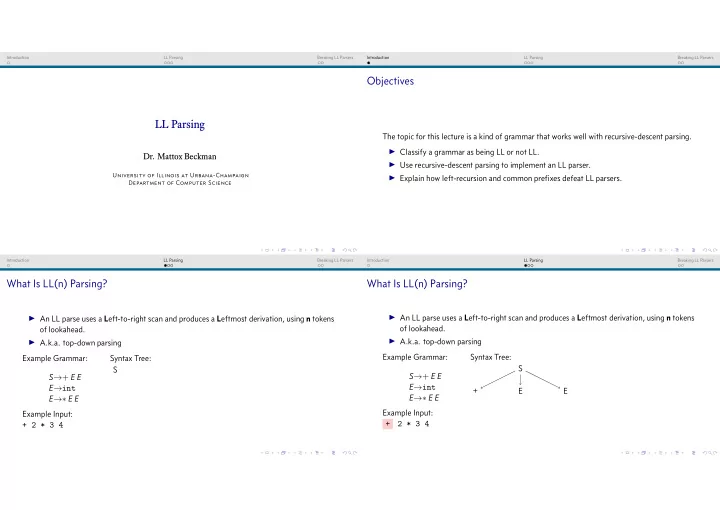
The topic for this lecture is a kind of grammar that works well with recursive-descent parsing. ◮ Classify a grammar as being LL or not LL. ◮ Use recursive-descent parsing to implement an LL parser. ◮ Explain how left-recursion and common prefjxes defeat LL parsers.

Introduction LL Parsing Breaking LL Parsers

What Is LL(n) Parsing?

◮ An LL parse uses a Left-to-right scan and produces a Leftmost derivation, using n tokens

  • f lookahead.

◮ A.k.a. top-down parsing Example Grammar: S→+ E E E→int E→∗ E E Example Input: + 2 * 3 4 Syntax Tree: S

Introduction LL Parsing Breaking LL Parsers

What Is LL(n) Parsing?

◮ An LL parse uses a Left-to-right scan and produces a Leftmost derivation, using n tokens

  • f lookahead.

◮ A.k.a. top-down parsing Example Grammar: S→+ E E E→int E→∗ E E Example Input: + 2 * 3 4 Syntax Tree: S + E E

slide-2
SLIDE 2

Introduction LL Parsing Breaking LL Parsers

What Is LL(n) Parsing?

◮ An LL parse uses a Left-to-right scan and produces a Leftmost derivation, using n tokens

  • f lookahead.

◮ A.k.a. top-down parsing Example Grammar: S→+ E E E→int E→∗ E E Example Input: + 2 * 3 4 Syntax Tree: S + E 2 E

Introduction LL Parsing Breaking LL Parsers

What Is LL(n) Parsing?

◮ An LL parse uses a Left-to-right scan and produces a Leftmost derivation, using n tokens

  • f lookahead.

◮ A.k.a. top-down parsing Example Grammar: S→+ E E E→int E→∗ E E Example Input: + 2 * 3 4 Syntax Tree: S + E 2 E * E E

Introduction LL Parsing Breaking LL Parsers

What Is LL(n) Parsing?

◮ An LL parse uses a Left-to-right scan and produces a Leftmost derivation, using n tokens

  • f lookahead.

◮ A.k.a. top-down parsing Example Grammar: S→+ E E E→int E→∗ E E Example Input: + 2 * 3 4 Syntax Tree: S + E 2 E * E 3 E

Introduction LL Parsing Breaking LL Parsers

What Is LL(n) Parsing?

◮ An LL parse uses a Left-to-right scan and produces a Leftmost derivation, using n tokens

  • f lookahead.

◮ A.k.a. top-down parsing Example Grammar: S→+ E E E→int E→∗ E E Example Input: + 2 * 3 4 Syntax Tree: S + E 2 E * E 3 E 4

slide-3
SLIDE 3

Introduction LL Parsing Breaking LL Parsers

How to Implement It

Interpreting a Production

◮ Think of a production as a function defjnition. ◮ The LHS is the function being defjned. ◮ Terminals on RHS are commands to consume input. ◮ Nonterminals on RHS are subroutine calls. ◮ For each production, make a function of type [String] -> (Tree,[String]).

◮ Input is a list of tokens. ◮ Output is a syntax tree and remaining tokens.

◮ Of course, you need to create a type to represent your tree.

Introduction LL Parsing Breaking LL Parsers

Things to Notice

Key Point – Prediction

◮ Each function immediately checks the fjrst token of the input string to see what to do next.

1 getE [] = undefined 2 getE ('*':xs) = 3

let e1,r1 = getE xs

4

e2,r2 = getE r1

5

in (ETimes e1 e2, r2)

6 getE .... -- other code follows Introduction LL Parsing Breaking LL Parsers

Left Recursion

Left Recursion Is Bad

◮ A rule like E → E + E would cause an infjnite loop.

1 getE xx = 2

let e1,r1 = getE xx

3

('+':r2) = r1

4

e2,r3 = getE r2

5

in (EPlus e1 e2, r3)

Introduction LL Parsing Breaking LL Parsers

Rules with Common Prefjxes

Common Prefjxes Are Bad

◮ A pair of rules rule like E → − E | − E E would confuse the function. Which version of the rule should be used?

1 getE ('-':xs) = ... -- unary rule 2 getE ('-':xs) = ... -- binary rule

◮ NB: Common prefjxes must be for the same nonterminal. E.g., E → x A and S → x B do not count as common prefjxes.