Objectives Glomerular Diseases in Primary Care Discuss diagnosis of - - PDF document

objectives glomerular diseases in primary care
SMART_READER_LITE
LIVE PREVIEW

Objectives Glomerular Diseases in Primary Care Discuss diagnosis of - - PDF document

11/6/2016 Objectives Glomerular Diseases in Primary Care Discuss diagnosis of glomerular diseases Sadiq Ahmed, MD, FACP, FASN Identify Nephritic and Nephrotic syndromes Associate Professor of Medicine Division of Nephrology Bone & Mineral


slide-1
SLIDE 1

11/6/2016 1

Glomerular Diseases in Primary Care

Sadiq Ahmed, MD, FACP, FASN

Associate Professor of Medicine Division of Nephrology Bone & Mineral Metabolism University of Kentucky

Objectives

Discuss diagnosis of glomerular diseases Identify Nephritic and Nephrotic syndromes Review clinical features, diagnosis and treatment of glomerular emergency or RPGN

Glomerulonephritis

Asymptomatic Microscopic Hematuria Nephritic Syndrome

Acute glomerulonephritis Rapidly progressive glomerulonephritis Chronic glomerulonephritis

Nephrotic Syndrome

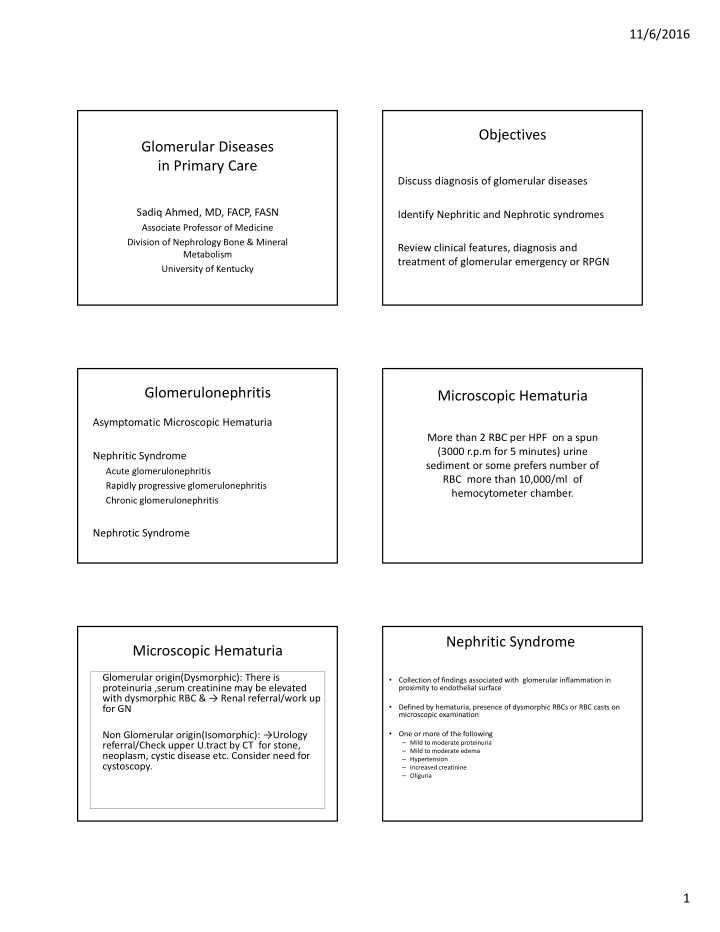
Microscopic Hematuria

More than 2 RBC per HPF on a spun (3000 r.p.m for 5 minutes) urine sediment or some prefers number of RBC more than 10,000/ml of hemocytometer chamber.

Microscopic Hematuria

Glomerular origin(Dysmorphic): There is proteinuria ,serum creatinine may be elevated with dysmorphic RBC & → Renal referral/work up for GN Non Glomerular origin(Isomorphic): →Urology referral/Check upper U.tract by CT for stone, neoplasm, cystic disease etc. Consider need for cystoscopy.

Nephritic Syndrome

  • Collection of findings associated with glomerular inflammation in

proximity to endothelial surface

  • Defined by hematuria, presence of dysmorphic RBCs or RBC casts on

microscopic examination

  • One or more of the following

– Mild to moderate proteinuria – Mild to moderate edema – Hypertension – Increased creatinine – Oliguria

slide-2
SLIDE 2

11/6/2016 2

Figure 25.7a

Clinical differences : Nephrotic vs Nephritic

Nephrotic syndrome Nephritic syndrome

Proteinuria

Gross >3.5GM Moderate < 3GM

Serum Albumin

Reduced Normal or mild reduction

Hematuria

Absent or trace Bland urine sediment Marked RBC cast /dysmorphic Active urine sediment

Edema

Marked Moderate

Lipids

Marked elevation Minimal elevation /normal

Urine volume

Normal /reduced Reduced

Nephrotic Syndrome

Minimal change disease FSGS Membranous Nephropathy Diabetic Nephropathy Amyloidosis Class V Lupus Nephritis

Nephritic syndrome

  • Post infectious GN
  • Lupus Nephritis class II, III,IV
  • RPGN
  • Anti‐GBM
  • Immune complex crescentic GN
  • Pauci immune. ANCA + crescentic necrotizing GN
  • IgA nephritis & HSP
  • MPGN I,II,III
slide-3
SLIDE 3

11/6/2016 3

Clinical Clues to Glomerular Diseases

Hematuria, Foamy urine , Elevation of Cr

  • Pulmonary infection / Infiltrate / Hemoptysis
  • Hepatitis B, C & HIV infections
  • Arthralgia
  • Skin Rash
  • Volume over load / new onset edema
  • New onset Hypertension
  • Diseases – Endocarditis, Shunt infection, SLE,

Lymphoproliferative disorders etc

  • IVDU

Tests for Glomerular Diseases

  • CBC with diff, Renal panel, UA & Urine Protein and Creatinine

Ratio

  • C3, C4, Ch50
  • ASO titre
  • ANA, Anti Double Stranded DNA
  • ANCA ( C‐ANCA, P‐ANCA)
  • Anti GBM Antibodies
  • Serum Protein Electrophoresis, Serum Protein IF, Free light chain

assay

  • Hep‐B, C and HIV

RPGN

Clinical condition that evolve with rapidly progressive decline in renal function and characterized by an inflammatory process that results in the formation of cellular crescents & called crescentic glomerulonephritis. This is glomerular emergency.

Clinical presentation of RPGN

  • Rapid loss of renal function
  • Active urinary sediment
  • Oliguria
  • Hematuria/Proteinuria

How Crescents are formed?

Glomerular crescent formation is an etiologically nonspecific response to glomerular capillary rupture due to acute inflammatory injury

  • Rupture of GBM → spillage of inflam. mediators
  • Neutrophil margination
  • Karyorrhexis
  • Thrombosis
  • Fibrin exudation
  • Epithelial response

RPGN

slide-4
SLIDE 4

11/6/2016 4

Electron microscopy of RPGN

RPGN:Case

65 YO W male presents to the ER with 3 weeks history of arthralgia and fatigue & URI. On exam. BP is 150/80 and there is a petechial rash visible in lower extremities and also 1+ edema. Hb is 9.4gm/dl, Creatinine 5.8mg/dl Urinalysis shows 20‐ 50 RBC/hpf & 1+ protein CxR showed bilateral infiltrate.

RPGN:Case

What is the most likely cause of his renal failure?

  • A. Anti GBM disease
  • B. Lupus nephritiis
  • C. Henoch Schoenlein

purpura with crescentic GN

  • D. Cryoglobulinemia
  • E. ANCA associated

vasculitis

3 major Immunopathologic categories

  • f crescentic GN
  • Type I

– Anti‐GBM crescentic GN

  • Type II

– Immune complex crescentic GN

  • Post infectious, SLE, IgA, MPGN, Fibrillary
  • Type III

– Pauci‐immune crescentic GN – 80% ANCA positive

Crescentic GN and Systemic Vasculitis

75% of patients with ANCA GN have some sort of systemic small vessel vasculitis. GPA,MPA or EGPA 50‐60% patients with Anti GBM disease have pulmonary cappillaritis Immune complex crescentic GN has the lowest frequency of systemic vasculitis. HSP, Cryoglobulinemic GN etc.

ANCA test methodology

  • Iimmunofluroscnce technique

– On ethanol fixed neutrophils PR3‐ANCA causes a charecteristic cytoplasmic granular centrally accentuated immunofluroscence pattern called cANCA while MPO‐ ANCA causes a perinuclear pattern called pANCA

  • Antigen specific testing

– Antigen type (PR3 or MPO) is determined through antigen‐ specific methods. More specific

  • ELISA or capture ELISA
  • Bead based multiplex assay
  • Appropriate paring is important for definitive DX

– cANCA with PR3‐ANCA & pANCA with MPO‐ANCA

slide-5
SLIDE 5

11/6/2016 5

C‐ANCA. Cytoplasmic granular centrally accentuated Imm.fluoroscent pattern‐ PR3 P‐ANCA. Perinuclear Imm. fluoroscent pattern‐ MPO

Differential Dx of ANCA disease

Cleveland clinic journal of Medicine Supp.3,V 79, Nov.2012

GPA MPA EGPA ENT Necrotizing None Allergic Lung Nodule, Cavity, Infiltrate Infiltrate Allergy, Asthma Kidney ++++ ++++ ++ Nerve ++ +++ ++++ Granuloma +++++ None ++++ Eosinophil None None ++++ Skin ++ ++++ ++++ ANCA 80‐95% PR3 5‐20% MPO 0‐20% negative 40‐80% MPO 35% PR3 0‐20% negative 40% MPO 35% PR3 Up to 60% negative

Treatment of ANCA Vasculitis

  • Pulse steroids 1 GM daily for 3 days followed by

Prednisone 1 mg / Kg daily

  • Cyclophosphamide or Rituximab
  • Plasmapheresis
  • Diffuse Alveolar hemorrhage
  • Severe Renal failure

Types of Crescentic GN in consecutive Renal Biopsies in Univ. of North Carolina

RPGN Type I: Goodpasture’s Syndrome

  • Anti‐GBM antibody‐induced disease.
  • Cells accumulate in Bowman’s space, form

crescents.

  • The Goodpasture antigen is a peptide within the

noncollagenous portion of the α3‐chain of collagen type IV.

  • What triggers the formation of these antibodies

is unclear

  • There is linear deposition of antibodies and

complement components along the GBM.

RPGN Type I: Goodpasture’s Syndrome

The anti‐GBM antibodies cross‐ react with pulmonary alveolar basement membranes to produce the clinical picture of pulmonary hemorrhage associated with renal failure.

slide-6
SLIDE 6

11/6/2016 6

Treatment of Good Pastures Syndrome

  • Plasmapheresis daily ASAP
  • Pulse Steroids 1 GM daily for 3 days and then 1

mg / Kg daily

  • Cyclophosphamide IV or PO

Frequency of crescents in different types of glomerular diseases in University of North Carolina.

Kidney International, Vol 63 (2003) pp.1164‐1177

Numbers % with any crescents % with >50% crescents Average % of crescents Anti‐GBM 105 97.1 84.8 77 ANCA GN 181 89.5 50.3 49 Lupus‐III & IV 784 56.5 12.9 31 HSP 31 61.3 9.7 27 IgA 853 32.5 4 21 Post‐infectious 120 33.3 3.3 19 Type I MPGN 307 23.8 4.6 25 Type II MPGN 16 43.8 18.8 48 Fibrillary GN 101 22.8 5 26

  • Mon. Ig dep. dx

54 5.6 13 TMA 251 5.6 0.9 20 Membranous 1092 3.2 0.1 15

RPGN

Which type of glomerulonephritis usually do not present as RPGN ?

  • A. IgA nephritis
  • B. Lupus nephritis
  • C. Fibrillary GN
  • D. FSGS

IgA nephropathy

Autoimmune systemic disease –kidneys are bystanders Defective glycosylation of IgA1 fraction with with galactose deficiency 75% of patients with IgA nephropathy has galactose deficient IgA1 level above 90th percentile

Glomerular and tubular injury by immune complexes containing containing pathogenic IgA1

Watt Rj, Julian BA, New Eng. J Med 2013;368;2402‐2414

slide-7
SLIDE 7

11/6/2016 7

IgA Nephropathy

  • In USA IgA nephropathy is the commonest

glomerular disease

  • In adults 1 case per 100,000
  • In children 0.5 case per 100,000
  • 10 times more common in Japan

Clinical outcome of IgA nephropathy

  • Variable clinical course
  • 96% 20 years renal survival if risk factors are

absent

  • Risk factors for dialysis or death are

– Urine protein > 1GM – Hypertension BP > 140/90 – Severity of the histologic lesion – Reduced renal function at the time of diagnosis

  • N Engl J Med 2013; 368:2402‐2414

Treatment of IgA Nephropathy

KDIGO: Kidney Int Suppl 2012;2:S209‐S217

Recommendation:

  • ACEI/ARB if urine protein 0.5 to 1gm/day
  • 6 month of steroids If urine protein > 1 gm after 3‐6m
  • f ACEI/ARB and GFR > 50
  • Fish oil

BP Target:

  • <130/80 if urine protein <1 g/day but <125/75 if >1

g/day

Rx of IgA with rapidly declining GFR

  • Steroid + Cyclophosphamide for crescentic IgA

(>50% glomeruli with crescents) with rapid deterioration in GFR

  • Supportive care if kidney biopsy shows acute

tubular injury and intratubular erythrocyte casts

Rx of IgA without proven benefit

KDIGO: Kidney Int Suppl 2012;2:S209‐S217

  • Steroids + Cyclophosphamide or Azathioprine, unless

crescentic IgA with rapid decline in GFR

  • Immunosuppressive Rx with GFR of <30 unless

crescentic IgA nephropathy with rapid decline in GFR

  • MMF
  • Antiplatelet agents
  • Tonsillectomy

Case: In Hospital

49 YO W obese male with DM & HTN is admitted with fever, chronic diabetic foot ulcer complicated by MRSA osteomyelitis. He became hypotensive and dehydrated but now improved with IVFs. He is on vancomycin. He received IV contrast 10 days ago for a CT scan. Exam is unremarkable except bandaged Rt foot and bilateral lower extremities edema. Labs: Creatinine 2.8 ( was 1.3 6 days ago), Serum albumin 2.9, C3 is low but C4 normal. UA: ++ protein on dip and 23 RBC / HPF

slide-8
SLIDE 8

11/6/2016 8 Case: In Hospital

What is the cause of Renal Failure?

  • A. AKI ‐ ATN from

infection/sepsis & hypotension

  • B. Vancomycin

Nephrotoxicity.

  • C. Contrast Induced

Nephropathy

  • D. Glomerulonephritis

Infection related Glomerulonephritis

  • APIGN

– APSGN( Acute Post Strep GN) – Staph , GNR, Treponema, Salmonella, Brucella, Mycoplasma, Legionella, Borrelia, Bartonella, Coxeella

  • Current Active Infection

– Endocarditis, Shunt infection, Hepatitis C Acute Diffuse Proliferative Glomerulonephritis

  • Acute post‐strep GN is the most

common cause of this reaction pattern.

  • Produces nephritic syndrome 2

weeks after a resp. or skin infection with "nephritogenic strain" of group A, beta‐hemolytic streptococci.

  • There is deposition of circulating

immune complexes which fix complement and attract PMN's.

Acute Diffuse Proliferative Glomerulonephritis

  • There is swelling &

proliferation endothelial cells

  • This chokes off their blood

supply, making the gloms hypercellular and bloodless

  • This explains the oliguria,

edema, and hypertension

  • Deposits of circulating

immune complexes fix complement and attract neutrophils

Acute Diffuse Proliferative Glomerulonephritis

  • Immunofluorescence: coarse

granular deposits containing immunoglobulin and complement.

  • Electron microscopy: granules

are large, dense, hump‐shaped deposits located subepithelially (i.e., on the epithelial side of the GBM).

Acute Diffuse Proliferative GN: Post‐strep. GN Outcome

  • Children: 95% recover
  • Adults:

– Usually good prognosis. – Some develops rapidly progressive disease, chronic renal failure may cause ESRD

slide-9
SLIDE 9

11/6/2016 9

Systemic Lupus Erythematosus

  • The kidney is a frequent target
  • f injury in SLE.
  • Mechanism of injury is

immune complex deposition in mesangium, endothelium & glomerular basement membranes

  • Other forms of injury may

include a thrombotic process involving the glomerular capillaries & extraglomerular vasculature, thought to be caused by antiphospholipid antibodies.

Systemic Lupus Erythematosus

  • Antinuclear antibody, an

antibody to nucleosomal DNA‐ histone complexes, is very sensitive but not specific.

  • Anti‐ds (double stranded) DNA

is more specific for lupus. This test may correlate with the degree of activity of lupus, in general,and with the level of nephritis.

  • Antiphospholipid antibody is

present in 30% of patients with

  • SLE. This is associated with

thromboembolic complications.

WHO Classification of Lupus Nephritis

Class I

Minimal or no detectable abnormalities , rare, seen in renal biopsies from less than 5% of SLE patients.

Class II

Mesangial lupus glomerulonephritis

Class III

Focal proliferative glomerulonephritis

Class IV

Diffuse proliferative glomerulonephritis

Class V

Membranous glomerulonephritis

None of these patterns are specific for lupus

Pulmonary‐ Renal Syndrome

  • Goodpasture’s disease
  • Granulomatous polyangiitis
  • Microscopic polyangiitis
  • SLE
  • Cryoglobulinemia
  • ARF with pulmonary edema/embolism/pna

Thank You For Your Attention