
SLIDE 1
Object-Level Reinforcement Learning
William Agnew Pedro Domingos
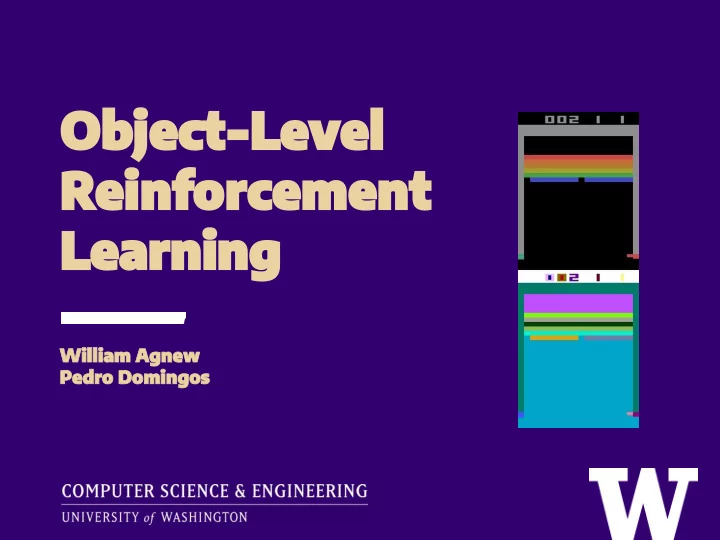
Object-Level Reinforcement Learning William Agnew Pedro Domingos - - PowerPoint PPT Presentation
Object-Level Reinforcement Learning William Agnew Pedro Domingos Outline > Motivation Deep RL Algorithms are Incredibly Sample Inefficient > Our Approach Unsupervised Learning of Object-Level Representations Object Dynamics
William Agnew Pedro Domingos
> Motivation
– Deep RL Algorithms are Incredibly Sample Inefficient
> Our Approach
– Unsupervised Learning of Object-Level Representations – Object Dynamics Modelling – Estimating Reward and Value Function with a Linear Regressor – Planning with UCT
> Results
– Atari Games – Interpretability – Transfer Learning
> Deep RL algorithms achieve great performance > But at the cost of many samples:
– DQN[1] trained on 50 million frames, or 38 days of gameplay
> Samples can be very expensive; ex. robots > Humans learn to play these games in mere minutes > Can we do better?
> How do humans learn and act in physical environments?
– View the world in terms of objects – Model object dynamics – Use dynamics to plan
> Current state of the art: neural network outputs actions from current state
– Reinventing objects, modelling, and planning all with a neural network
> Can we make a RL agent that explicitly does this?
> We use a small number of powerful yet general principles to develop an object-level agent:
– The world may be represented and modelled in terms of
– All else equal, simpler representations are more accurate (Ockham’s razor)
> Our agent uses these principals to:
– Learn an object-level world representation from pixels with no supervision – Learn predictive object dynamics models – Learn state-action value and rewards with a simple and interpretable approximator – Plan best actions using predictive models and value/reward approximators
> How do we learn a mapping from pixels to objects with no supervision? > Segmentation algorithms can over- or undersegment
> We can oversegment without losing information > But the state representation may be very large
> How can well tell if two segments are part of the same object? > Two segments are part of the same object if they behave in the same way
> Use a simple algorithm to produce an
> Simple and fallible object tracking > Train models on segment dynamics > Combine segments > Represent state as object absolute and relative positions, velocities, accelerations, and estimated contacts
> Model object acceleration at each timestep > One model per object, per dimension > Discretize accelerations, use multiclass classifiers to output a probability distribution
> Also learn when and where objects will appear/disappear
> Monte Carlo estimation of state-action values from experiences > Fit a linear regressor from object-level representation to state-action value or reward > Value functions for most takes in physical world can be easily represented as a linear combination of collisions and relative positions
– Go to an object – Touch an object – Avoid an object
> A linear regression on object-level features is readily interpretable-we can easily understand the learned policy > Object-level representation is also easy to reason about > Reinforcement learner won’t have bad edge case behavior on known states (known objects), recognizes when it has encountered new states (new
> Given a model of the world and an estimator for state-action value and reward, how do we choose the best next action to take? > Use UCT to find the best future action, approximating playouts with the value estimator > Similar approach as used in AlphaGo[2]
Evaluation methodology and DQN data from [3]
Object Pair Ball-Paddle Ball-Background Paddle-Background Vertical Dimension 0.020
0.101 Horizontal Dimension
0.003 0.029
Linear state value estimator weights on object pair relative distance
> We developed a model-based reinforcement learner that is over two orders of magnitude more sample efficient than DQN while achieving comperable performance > Our agent achieves vastly better results than DQN
> Our agent is also interpretable > Modelling and planning are well studied fields: we believe this paradigm will extend well to more complex domains
1. Mnih, Volodymyr, et al. "Human-level control through deep reinforcement learning." Nature 518.7540 (2015): 529. 2. Silver, D., Huang, A., Maddison, C. J., Guez, A., Sifre, L., Van Den Driessche, G., ... & Dieleman, S. (2016). Mastering the game of Go with deep neural networks and tree search. nature, 529(7587), 484-489. 3. Machado, Marlos C., et al. "Revisiting the Arcade Learning Environment: Evaluation Protocols and Open Problems for General Agents." arXiv preprint arXiv:1709.06009 (2017).