
SLIDE 1
Marvella E. Ford, PhD Associate Director, Hollings Cancer Center Cancer Disparities Program Professor, Department of Public Health Sciences, MUSC
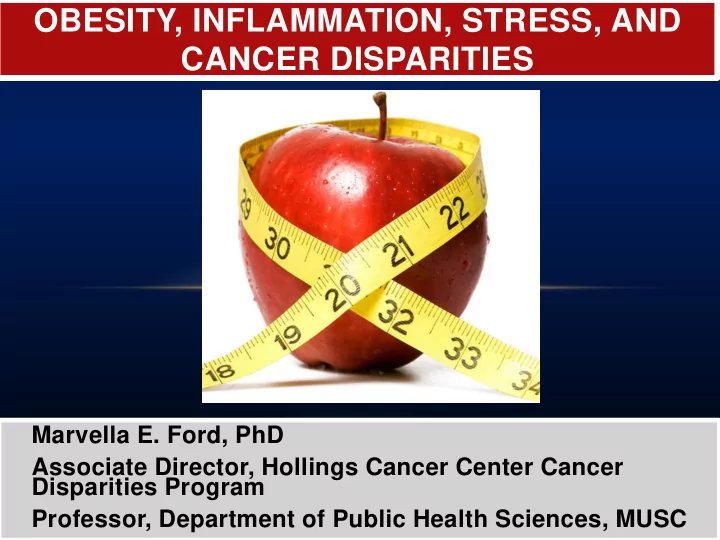
OBESITY, INFLAMMATION, STRESS, AND CANCER DISPARITIES Marvella E. - - PowerPoint PPT Presentation
OBESITY, INFLAMMATION, STRESS, AND CANCER DISPARITIES Marvella E. Ford, PhD Associate Director, Hollings Cancer Center Cancer Disparities Program Professor, Department of Public Health Sciences, MUSC Presentation Outline Part I
Marvella E. Ford, PhD Associate Director, Hollings Cancer Center Cancer Disparities Program Professor, Department of Public Health Sciences, MUSC
US
South Carolina: MUSC Hollings Cancer Center Cancer Disparities Program
inflammatory cytokines
chronic diseases, such as cancer (as well as diabetes and cardiovascular disease)
ward off disease, researchers find
February 3, 2011
2015 Estimates
2012 Estimates
Source: Surveillance, and End Results Program, 2012
Hispanic Epidemiological Paradox
Support
acculturated in US
2013 Estimates
Female Breast Cancer Incidence Rates by State, 2010
http://www.cdc.gov/cancer/breast/statistics/state.htm
Female Breast Cancer Death Rates by State, 2010
http://www.cdc.gov/cancer/breast/statistics/state.htm
Prostate Cancer Incidence Rates by State, 2010
http://www.cdc.gov/cancer/prostate/statistics/state.htm
Prostate Cancer Death Rates by State, 2010
http://www.cdc.gov/cancer/prostate/statistics/state.htm
Age-adjusted percentage of adults aged ≥20 years with diagnosed diabetes, 2007
MMWR 58:1259-1263, 2009
Age-adjusted percentage of adults aged ≥20 years who are
MMWR 58:1259-1263, 2009
Counties in the top and bottom two quintiles of both diabetes and
MMWR 58:1259-1263, 2009
http://nccd.cdc.gov/DHDSPAtlas/viewer.aspx?state=SC
http://nccd.cdc.gov/DHDSPAtlas/viewer.aspx?state=SC
Racial Differences in Health Outcomes as a Combination of Socio-cultural and Genetic Factors
Genetic Variants
Socio-Cultural Factors Genetic Factors
Diet Physical Activity Environmental Exposure Psychosocial Stress
H E A L T H
Williams et al. 2010. Race, SES, and Health. Ann NY Acad. Sci 2010;1186:69-101.
Social- Environmental Factors Susceptibility to Disease Access to Health Care Health Disparities
Relationships among Structural Life Inequalities, Chronic Stress, Negative Behaviors, and Physical and Mental Health Disparities
Structural Life Inequalities
Physical Health Disparities Chronic Stressors/Stress Behaviors Mental Health Disparities
http://www.cdc.gov/dhdsp/maps/social_determinants_maps.htm
Disparities Program
1. Conduct cancer disparities activities with partners in South Carolina (SC) 2. Develop specific, targeted research interventions to reduce cancer disparities 3. Increase the number of investigators in SC who conduct cancer disparities research
Objective 1: Conduct Cancer Disparities Activities with Partners in South Carolina
Education and Awareness
An evidence-based 4-hour dynamic, hands-on session using a “Train the Trainer” model developed by the South Carolina Cancer Alliance
Example: Cancer Education Guide (CEG) Training Seminar
Objective 1: Conduct Cancer Disparities Activities with Partners in South Carolina
CEG Training Sites
CEG Service Delivery Area
Objective 2: Develop Specific, Targeted Research Interventions to Reduce Cancer Disparities
Initiatives
Objective 2: Develop Specific, Targeted Research Interventions to Reduce Cancer Disparities
small Cell Lung Cancer (NSCLC)
5RO1MD005892-04 (MPIs: Ford and Esnaola)
barriers to surgical cancer care and improving rates among African Americans with early stage NSCLC
5P20CA15707104 (PIs: Ford and Salley)
research study
Cancer
5R21CA152865 (PI: Ford, Co-Is: Zapka and Sterba)(ended 8/31/14)
in guideline-based post-treatment surveillance and care.
Objective 3: Increase the Number of Investigators in SC Who Conduct Cancer Disparities Research
Summer Training Program in Prostate Cancer Research (PI: Ford, Coordinator: Cannady)
Research Training in Breast and Prostate Cancer Research (PI: Ford, Coordinator: Cannady)
Health Disparities (Chair: Ford, Co-Chair: Greene, Coordinator: Cannady)
DoD Collaborative Undergraduate HBCU Student Summer Training Program in Prostate Cancer Research
Objective 3: Increase the Number of Investigators in SC Who Conduct Cancer Disparities Research
Summer Undergraduate Research Program (SURP)
Objective 3: Increase the Number of Investigators in SC Who Conduct Cancer Disparities Research
Student Forum of the National Conference on Health Disparities
Objective 1: Conduct Cancer Disparities Activities with Partners in South Carolina Objective 2: Develop Specific, Targeted Research Interventions to Reduce Cancer Disparities Objective 3: Increase the Number of Investigators in SC Who Conduct Cancer Disparities Research
Cancer Disparities Cancer Control Cancer Genes & Molecular Regulation Developmental Therapeutics Cancer Immunology
Courtesy of the Sidney Kimmel Cancer Center
Eliminate Cancer Disparities
Disparities Program
1. Conduct cancer disparities activities with partners in South Carolina (SC) 2. Develop specific, targeted research interventions to reduce cancer disparities 3. Increase the number of investigators in SC who conduct cancer disparities research
Objective 1: Conduct Cancer Disparities Activities with Partners in South Carolina
Education and Awareness
An evidence-based 4-hour dynamic, hands-on session using a “Train the Trainer” model developed by the South Carolina Cancer Alliance
Example: Cancer Education Guide (CEG) Training Seminar
Objective 1: Conduct Cancer Disparities Activities with Partners in South Carolina
CEG Training Sites
CEG Service Delivery Area
Objective 2: Develop Specific, Targeted Research Interventions to Reduce Cancer Disparities
Initiatives
Objective 2: Develop Specific, Targeted Research Interventions to Reduce Cancer Disparities
small Cell Lung Cancer (NSCLC)
5RO1MD005892-04 (MPIs: Ford and Esnaola)
barriers to surgical cancer care and improving rates among African Americans with early stage NSCLC
5P20CA15707104 (PIs: Ford and Salley)
research study
Cancer
5R21CA152865 (PI: Ford, Co-Is: Zapka and Sterba)(ended 8/31/14)
in guideline-based post-treatment surveillance and care.
Objective 3: Increase the Number of Investigators in SC Who Conduct Cancer Disparities Research
Summer Training Program in Prostate Cancer Research (PI: Ford, Coordinator: Cannady)
Research Training in Breast and Prostate Cancer Research (PI: Ford, Coordinator: Cannady)
Health Disparities (Chair: Ford, Co-Chair: Greene, Coordinator: Cannady)
DoD Collaborative Undergraduate HBCU Student Summer Training Program in Prostate Cancer Research
Objective 3: Increase the Number of Investigators in SC Who Conduct Cancer Disparities Research
Summer Undergraduate Research Program (SURP)
Objective 3: Increase the Number of Investigators in SC Who Conduct Cancer Disparities Research
Curriculum (daily classes)
Objective 3: Increase the Number of Investigators in SC Who Conduct Cancer Disparities Research
Student Forum of the National Conference on Health Disparities
Objective 1: Conduct Cancer Disparities Activities with Partners in South Carolina Objective 2: Develop Specific, Targeted Research Interventions to Reduce Cancer Disparities Objective 3: Increase the Number of Investigators in SC Who Conduct Cancer Disparities Research
Cancer Disparities Cancer Control Cancer Genes & Molecular Regulation Developmental Therapeutics Cancer Immunology
Courtesy of the Sidney Kimmel Cancer Center
Eliminate Cancer Disparities
Disparities Program
1. Conduct cancer disparities activities with partners in South Carolina (SC) 2. Develop specific, targeted research interventions to reduce cancer disparities 3. Increase the number of investigators in SC who conduct cancer disparities research
Objective 1: Conduct Cancer Disparities Activities with Partners in South Carolina
Education and Awareness
An evidence-based 4-hour dynamic, hands-on session using a “Train the Trainer” model developed by the South Carolina Cancer Alliance
Example: Cancer Education Guide (CEG) Training Seminar
Objective 1: Conduct Cancer Disparities Activities with Partners in South Carolina
CEG Training Sites
CEG Service Delivery Area
Objective 2: Develop Specific, Targeted Research Interventions to Reduce Cancer Disparities
Initiatives
Objective 2: Develop Specific, Targeted Research Interventions to Reduce Cancer Disparities
Americans with Non-small Cell Lung Cancer (NSCLC)
5RO1MD005892-04 (MPIs: Ford and Esnaola)
reducing potential barriers to surgical cancer care and improving rates among African Americans with early stage NSCLC
Objective 2: Develop Specific, Targeted Research Interventions to Reduce Cancer Disparities
5P20CA15707104 (PIs: Ford and Salley)
cancer genetic research study
Objective 2: Develop Specific, Targeted Research Interventions to Reduce Cancer Disparities
Treatment for Colon Cancer
5R21CA152865 (PI: Ford, Co-Is: Zapka and Sterba)(ended 8/31/14)
cancer survivors in guideline-based post-treatment surveillance and care.
Objective 3: Increase the Number of Investigators in SC Who Conduct Cancer Disparities Research
Summer Training Program in Prostate Cancer Research (PI: Ford, Coordinator: Cannady)
Research Training in Breast and Prostate Cancer Research (PI: Ford, Coordinator: Cannady)
Health Disparities (Chair: Ford, Co-Chair: Greene, Coordinator: Cannady)
DoD Collaborative Undergraduate HBCU Student Summer Training Program in Prostate Cancer Research
Objective 3: Increase the Number of Investigators in SC Who Conduct Cancer Disparities Research
Summer Undergraduate Research Program (SURP)
Objective 3: Increase the Number of Investigators in SC Who Conduct Cancer Disparities Research
Curriculum (daily classes)
Objective 3: Increase the Number of Investigators in SC Who Conduct Cancer Disparities Research
Student Forum of the National Conference on Health Disparities
Objective 1: Conduct Cancer Disparities Activities with Partners in South Carolina Objective 2: Develop Specific, Targeted Research Interventions to Reduce Cancer Disparities Objective 3: Increase the Number of Investigators in SC Who Conduct Cancer Disparities Research
Cancer Disparities Cancer Control Cancer Genes & Molecular Regulation Developmental Therapeutics Cancer Immunology
Courtesy of the Sidney Kimmel Cancer Center
Eliminate Cancer Disparities