SLIDE 1 Obe Obell Internatio ll International S nal SA
Nautical activities and water sports are attracting an increasing number of participants, many of who are nature lovers that seek out unspoilt natural harbours. Unfortunately these beauty spots are by definition unequipped with even basic amenities and are therefore at risk
- f being irreparably damaged by the visitors. One major source of damage is irresponsible
yachtsmen who simply dispose of their waste by throwing it overboard. The accumulation of this waste is not just a visual eyesore; it also poses a serious threat to the ecology and wildlife
- f both the coastline and the deep sea.
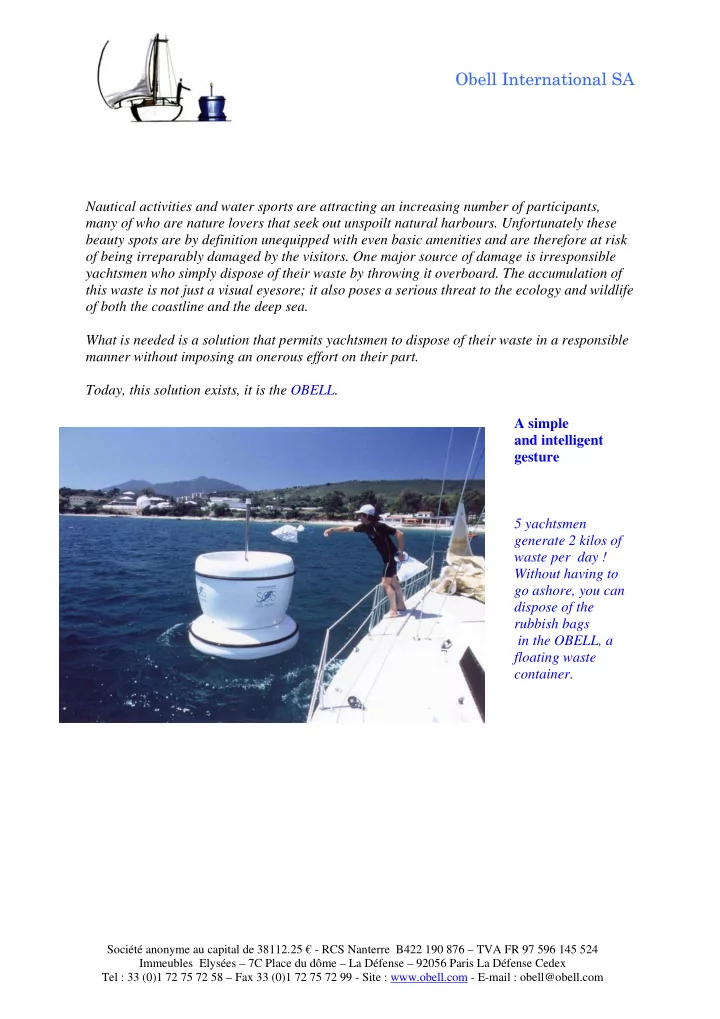
What is needed is a solution that permits yachtsmen to dispose of their waste in a responsible manner without imposing an onerous effort on their part. Today, this solution exists, it is the OBELL. A simple and intelligent gesture 5 yachtsmen generate 2 kilos of waste per day ! Without having to go ashore, you can dispose of the rubbish bags in the OBELL, a floating waste container.
Société anonyme au capital de 38112.25 € - RCS Nanterre B422 190 876 – TVA FR 97 596 145 524 Immeubles Elysées – 7C Place du dôme – La Défense – 92056 Paris La Défense Cedex Tel : 33 (0)1 72 75 72 58 – Fax 33 (0)1 72 75 72 99 - Site : www.obell.com - E-mail : obell@obell.com
SLIDE 2 Obe Obell Internatio ll International S nal SA
A lack of good citizenship and environmental responsibility An unfortunate side effect of almost every human endeavour is the production of waste that has to be disposed of. The problems associated with toxic and nuclear waste are often brought to the publics’ attention along with the deteriorating state of our seas and oceans. This is particularly the case along coastlines close to densely populated and industrialised areas, such as the Mediterranean and Baltic Sea. Seamen, both professional and leisure yachtsmen, have the tendency to exhibit an irresponsible behaviour that they would not exhibit on land. They dispose of their waste no matter where, without thinking about the consequences of their actions, which seem to be insignificant to them – out of sight, out of mind –. Campaigns to raise awareness of the environmental problems and to encourage people to pay more respect towards environment are becoming more numerous, but they have still a long way to go before they attain the desired results – making people think globally but act locally. To achieve a clean environment, the easiest way to make yachtsmen more responsible is to place containers to collect their waste at the very places where they sail and moor. Simple actions with dramatic consequences Pollution due to solid waste mainly originates from the general easy-going feeling that has turned the coastline and the sea into a disorderly dumping ground. The remote and sometimes even preserved locations are especially prone to the accumulation of plastic packaging, tins, glass and PET bottles, and a large collection of undesirable waste. It is unfortunate, but the lack of good citizenship regarding the waste often found on land is even worse at sea. During the high season in France, more than 4 million yachtsmen need to dispose of their rubbish on a daily basis. Every year, the air patrols flying along the coastlines report rapidly increasing volumes of waste but are helpless and can only notice this unacceptable situation. Specifically during summer, drifts of waste will be floating in the open seas and at the mercy of the
- currents. Numerous creeks, bays and even harbour zones display the sad scene of piles of
varied garbage (most of all plastic bags) mainly as a result of yachting. This waste, when not laid along the coastline by the current, floats on the surface being progressively covered by weed until it eventually sinks. Below the surface, sea animals often confuse these greenish masses with food and eat them. Then they die of suffocation or intestinal obstruction. Thousand of sea-turtles, dolphins, sharks and other fishes are victims of this outrageous situation every year.
Société anonyme au capital de 38112.25 € - RCS Nanterre B422 190 876 – TVA FR 97 596 145 524 Immeubles Elysées – 7C Place du dôme – La Défense – 92056 Paris La Défense Cedex Tel : 33 (0)1 72 75 72 58 – Fax 33 (0)1 72 75 72 99 - Site : www.obell.com - E-mail : obell@obell.com
SLIDE 3 Obe Obell Internatio ll International S nal SA
Floating waste bins OBELL offers an intelligent solution with its Champagne cork shaped floating waste bin. The OBELL is shaped like this famous cork for the following reasons :the wide base insures the floatability as well as the stability and the high and tapered neck enables an easy waste
- collection. Located at port entrances and other places visited by yachtsmen, with 2.20 metres
diameter for 200 kilos gross weight, their 1,200 litres capacity allows to collect the waste of about 100 yachts. The 1,200 litres capacity is made up of six 200 litres compartments meaning that, should future laws oblige, OBELL can be used for selective waste sorting as
- well. Hundreds of OBELL are already in use. Very tough tests confirmed OBELL’s high
stability under bad weather. OBELL resists to winds up to 150 kph, to currents up to 4 knots and to a swell of up to 2 metres. Night security is also assured: an autonomous light beacon warns sailors about the position of the obstacle. The waste bag collection is also simple and
- economical. One man aboard a light boat can do it without any special skills or training. The
fact that you have to replace only six 200 litres bags avoids the use of complicated and expensive lifting equipment.
Société anonyme au capital de 38112.25 € - RCS Nanterre B422 190 876 – TVA FR 97 596 145 524 Immeubles Elysées – 7C Place du dôme – La Défense – 92056 Paris La Défense Cedex Tel : 33 (0)1 72 75 72 58 – Fax 33 (0)1 72 75 72 99 - Site : www.obell.com - E-mail : obell@obell.com
SLIDE 4 Obe Obell Internatio ll International S nal SA OBELL dimensions and data
Diameter: 2.20 m Hull height: 1.85 m Height above water level: 1.65 m Overall height: 2.65 m Capacity: 1,200 l Gross weight: 200 kg Hull material: composite Anchorage system Fastener Stainless steel Chain 14 mm ∅ links Dead weight (Dolphin) 1,500 kg Markings Battery operated beacon recharged by solar cells Dynamic behaviour while in use Unsinkable, even under extreme conditions Proven stability limits Wind up to 150 kph Current up to 4 kts Swell up to 2 m Key points Key features of OBELL:
- simple and easy to use and without risks for yachtsmen when they dispose of rubbish
- specific and easy mooring facility for waste collection boat
- simple cleaning and maintenance of waste container
- impossible for normal leisure yachts to moor along OBELL
- impossible to be used as a pontoon by swimmers
Société anonyme au capital de 38112.25 € - RCS Nanterre B422 190 876 – TVA FR 97 596 145 524 Immeubles Elysées – 7C Place du dôme – La Défense – 92056 Paris La Défense Cedex Tel : 33 (0)1 72 75 72 58 – Fax 33 (0)1 72 75 72 99 - Site : www.obell.com - E-mail : obell@obell.com
SLIDE 5 Obe Obell Internatio ll International S nal SA
Love and leave a clean sea environment !
What is OBELL?
- OBELL in a few words
- Why have OBELL in a harbour environment?
- Pictures of OBELL
- Types of anchoring
- Selective waste sorting
Société anonyme au capital de 38112.25 € - RCS Nanterre B422 190 876 – TVA FR 97 596 145 524 Immeubles Elysées – 7C Place du dôme – La Défense – 92056 Paris La Défense Cedex Tel : 33 (0)1 72 75 72 58 – Fax 33 (0)1 72 75 72 99 - Site : www.obell.com - E-mail : obell@obell.com
SLIDE 6 Obe Obell Internatio ll International S nal SA OBELL in a few words
OBELL is a 2.20 metres diameter buoy, measuring 1.65 metres above sea level and which can contain the waste of 80 to 120 yachts. OBELL is moored by a chain boom, an anchoring screw or a dead weight (dolphin), and can be installed either in natural harbours or in organised anchorages, in ports or in port entrances. OBELL allows yachtsmen to dispose of their rubbish without having to go ashore or to store the waste onboard for too long. In addition to preserving a clean sea environment, OBELL has many positive features:
- OBELL is the first floating waste bin for yachtsmen rubbish. A real innovation,
OBELL is protected by an international patent.
- OBELL is an efficient mean for waste collection and protects the coastline and marine
- ecology. OBELL solves the problems of pollution from yachtsmen.
- The positive comments concerning OBELL’s industrial design, its usefulness and
integration in the natural habitat are numerous (yachtsmen, environmental specialists, authorities…)
- Easy installation of OBELL means that it can be installed in all different places at sea
and the environmental impacts with a cleaner environment are immediately fulfilled.
- Made up of six spaces for 200 litres bag, OBELL also allows for selective waste
sorting if required. With each full bag weighing around 30 kilos maximum, it takes
- nly about 5 minutes for a person on a light boat to conduct the collection of the
loaded waste bags.
- OBELL contributes to develop local employment, qualified (divers for installing the
OBELL) as well as non-qualified labour (running the OBELL does not require any specific skill but only a limited training).
- Built of composite material, OBELL is very solid and almost no maintenance is
required.
- With its clean and large cork looking shape, the OBELL can be a great publicity and
information board for campaigns on environmental responsibility and local laws. It can even be used as advertising or sponsoring space generating incomes for permanent
- r temporary commercials.
- OBELL is recommended by many national and international organizations linked to
the environment, sea or boating.
- OBELL can be accounted in administrative budgets under the heading of
« environment » and/or « waste ».
- OBELL can benefit from subsidies granted by the governemnt, or even by private
- rganizations, regional parliaments, local authorities, environmental agencies, water
services, etc
Société anonyme au capital de 38112.25 € - RCS Nanterre B422 190 876 – TVA FR 97 596 145 524 Immeubles Elysées – 7C Place du dôme – La Défense – 92056 Paris La Défense Cedex Tel : 33 (0)1 72 75 72 58 – Fax 33 (0)1 72 75 72 99 - Site : www.obell.com - E-mail : obell@obell.com
SLIDE 7
Obe Obell Internatio ll International S nal SA
Today OBELL enjoys support and partnership with following entities in France: Nicolas Hulot Foundation (French journalist with great influence on media, well-known for his unconditional commitment to the environment) FEEE – Blue Flag Europe Higher council for boating CEDRE (Center for research, documentation and experimentation on pollutants) « Mer & Littoral » (Sea & Coastline) magazine Eco Maires (Ecological Mayors) association SOS Grand Bleu (Association for protection of dolphins and whales)
Société anonyme au capital de 38112.25 € - RCS Nanterre B422 190 876 – TVA FR 97 596 145 524 Immeubles Elysées – 7C Place du dôme – La Défense – 92056 Paris La Défense Cedex Tel : 33 (0)1 72 75 72 58 – Fax 33 (0)1 72 75 72 99 - Site : www.obell.com - E-mail : obell@obell.com
SLIDE 8 Obe Obell Internatio ll International S nal SA Why have OBELL in a harbour environment?
Originally OBELL was designed to be installed in the natural beauty spots away from the
- rganised ports and marinas. These natural harbours, whose unspoilt and untamed nature is
very attractive to yachtsmen, are soiled by those who do not want and/or can not keep their waste onboard. Ports are generally equipped with containers for rubbish, specific dumping grounds and personnel dedicated for the collection of boating waste. The existence of this infrastructure is the main reason why the initial development of OBELL was focused on providing organised waste disposal away from the ports and marinas. However, during the numerous initial tests, port managers expressed a very high interest for
- OBELL. These new potential partners showed a strong motivation for the device.
Their main arguments in favour of OBELL were:
- Public image is the main and most frequently mentioned argument. Harbour
managers, like other tourism professionals, put an important emphasis on the first impression that visiting yachtsmen will have when entering a port with an OBELL which can distinguish one harbour from other competing ports.
- Besides the immediate functionality of waste collection, there will be a favourable
association to the port, the neighbouring town and region. Praising press releases confirm this unambiguous fact. Some have quoted OBELL as “very trendy”.
- OBELL is without a doubt a highly appreciated and convenient solution for
- yachtsmen. It avoids for them to go ashore in distant locations in order to dispose of
the waste. The yachtsmen quickly get accustomed to this new and practical waste solution.
- During the high season, popular ports can not provide for enough spaces for visiting
- boats. While waiting for mooring places in the harbours, the boats will temporarily be
moored at the port entrances. While waiting for proper mooring facilities in the harbour the yachtsmen may dispose of the rubbish by throwing it overboard and it ends up floating with the water currents. OBELL contributes to preserving a clean sea environment in and around harbours by reducing the pollution of the seas with undesirable effects such as ingestion of fauna or bags trapped in boat propellers.
- Having full occupancy of boats in the harbours is on one side the aim of the harbour
masters, but on the other side it creates problems linked to waste disposal and
- handling. All rubbish collection efforts may seem in vain when waste piles up and
become potential health hazards. OBELL allows for an efficient waste collection and preserves a clean sea environment. The waste collection can be organised at fixed times and coordinated with local onshore waste collection companies.
Société anonyme au capital de 38112.25 € - RCS Nanterre B422 190 876 – TVA FR 97 596 145 524 Immeubles Elysées – 7C Place du dôme – La Défense – 92056 Paris La Défense Cedex Tel : 33 (0)1 72 75 72 58 – Fax 33 (0)1 72 75 72 99 - Site : www.obell.com - E-mail : obell@obell.com
SLIDE 9 Obe Obell Internatio ll International S nal SA
- When using OBELL in ports another advantage was made apparent: by installing it in
different locations in the port it was used as a signpost for communication to yachtsmen, which improved the overall management of the harbour area.
- Ports are becoming increasingly conscious of their environmental responsibilities and
taking steps to be certified with local and internationally recognised environmental
- labels. The installation of OBELL is encouraged by several important organisations:
Fondation Nicolas Hulot pour la Nature et pour l’Homme (Nicolas Hulot Foundation for Nature and Mankind), SOS Mer Propre (SOS Clean Sea), FEEE – Blue Flag Europe (European Foundation for Environmental Education), Fondation France Nature Environnement, SOS Grand Bleu, Eco Maires (Ecological Mayors) association, Conseil supérieur de la Navigation de Plaisance et des Sports Nautiques (Higher Council for boating), Délégation Régionales au Tourisme (Regional Tourists Commissions), DIREN (Regional environmental Agencies), CEDRE (Center for research, documentation and experimentation on pollutants)…
- In addition to the purposes of waste collection and due to its numerous advantages,
OBELL creates interest among port managers. The installation of OBELL has only a small and relatively insignificant impact on waste handling budgets. As regards the daily waste handling efforts, each port has at least a small boat as well as maintenance staff and there are therefore no significant investments to be made. The waste handling collection needs to be organised in a way that includes the OBELL with the waste handling plan of the onshore collection points. A small increase of the harbour fee would be sufficient to cover the initial investment of the OBELL. Additionally an investment in OBELL is likely to be made with subsidies from organisations linked to environment, waste management and tourism. In France these subsidies are given by the regional and local councils, water agencies, regional environmental agencies, etc. To date, OBELL benefits from subsidy rates of up to 80% !
Société anonyme au capital de 38112.25 € - RCS Nanterre B422 190 876 – TVA FR 97 596 145 524 Immeubles Elysées – 7C Place du dôme – La Défense – 92056 Paris La Défense Cedex Tel : 33 (0)1 72 75 72 58 – Fax 33 (0)1 72 75 72 99 - Site : www.obell.com - E-mail : obell@obell.com
SLIDE 10 Obe Obell Internatio ll International S nal SA OBELL in use
Nicolas Hulot testing the OBELL functionalities OBELL is installed easily and successfully, in
…as well as in natural harbour environments… …and in port entrances
Société anonyme au capital de 38112.25 € - RCS Nanterre B422 190 876 – TVA FR 97 596 145 524 Immeubles Elysées – 7C Place du dôme – La Défense – 92056 Paris La Défense Cedex Tel : 33 (0)1 72 75 72 58 – Fax 33 (0)1 72 75 72 99 - Site : www.obell.com - E-mail : obell@obell.com
SLIDE 11
Obe Obell Internatio ll International S nal SA Types of anchoring
Standard anchoring line 1,200 kg dead-weight or anchoring screw or harbour boom For 8 to 12 m depth, cable length =2.5 x water depth Ballast of 80 kg Ballast suspended from the central fastener at a depth of 1.5m
Cable of 12 mm ∅ links
The anchoring cable must resist against a force of 675 kg. The dead-weight must have a minimum « immersed » weight of 675 kg, that corresponds to 1,125 kg out of water. The cable length will depend on the depth of the site and the local conditions (swell). Other kinds of anchoring lines are possible, enabling to reduce the swing radius and/or to protect the sea bed from any friction caused by the cable.
Société anonyme au capital de 38112.25 € - RCS Nanterre B422 190 876 – TVA FR 97 596 145 524 Immeubles Elysées – 7C Place du dôme – La Défense – 92056 Paris La Défense Cedex Tel : 33 (0)1 72 75 72 58 – Fax 33 (0)1 72 75 72 99 - Site : www.obell.com - E-mail : obell@obell.com
SLIDE 12
Obe Obell Internatio ll International S nal SA
Swing radius according to mooring type
Example: 10 meters depth
Surface radius = 22 metres Traditional anchoring line with dead-weight
23 m cable of 12 mm ∅ links 2 m dormant cable of 20mm ∅
Example: 10 metres depth
Surface radius = 10 metres
14 m cable of 12 mm ∅ links
« Harmony » anchoring line with float
Float Anchoring screw
Société anonyme au capital de 38112.25 € - RCS Nanterre B422 190 876 – TVA FR 97 596 145 524 Immeubles Elysées – 7C Place du dôme – La Défense – 92056 Paris La Défense Cedex Tel : 33 (0)1 72 75 72 58 – Fax 33 (0)1 72 75 72 99 - Site : www.obell.com - E-mail : obell@obell.com
SLIDE 13
Obe Obell Internatio ll International S nal SA Selective waste sorting
OBELL considered prevailing laws or evolution of regulations regarding waste management and selective sorting in different compartments when developing the floating waste bin. OBELL has 6 different compartments of 200 litres bags each. Small signs and pictures can be put on each compartment to indicate where to dispose of the sorted waste (paper, plastics, PET, metal, glass...) There is no demand currently for such solutions due to the lack or restrictive legislations. Additionally, it is possibly difficult to do selective waste sorting on yachts considering the general case with limited space onboard for this purpose.
Société anonyme au capital de 38112.25 € - RCS Nanterre B422 190 876 – TVA FR 97 596 145 524 Immeubles Elysées – 7C Place du dôme – La Défense – 92056 Paris La Défense Cedex Tel : 33 (0)1 72 75 72 58 – Fax 33 (0)1 72 75 72 99 - Site : www.obell.com - E-mail : obell@obell.com
SLIDE 14 Obe Obell Internatio ll International S nal SA Press article in « La Lettre de Sea-River » (French Fresh and Sea Water Magazine)
MACRO WASTE INVADE THE SEAS IFREMER (French Research Institute for the Exploitation of the Sea) published a study in 1998 regarding the pollution of the seas due to macro waste. Messrs Jean-Marie Demange and Renaud Muselier (French MPs) addressed the questions raised to parliament on problems of waste on the sea beds and the potential of recovering this waste to the Minister of Environment in February 1999. Dominique Voynet (French Minister of Environment at that time) answered in May 2001 that « recovery of submerged macro waste was technically possible ». She mentioned several regional activities that receive government aid and which strive to prevent this type of pollution. Dominique Voynet clearly stated that « fighting against pollution caused by macro waste needs to be organised at national level, as well as at European and international level », but that « the founding of a spotting network within the framework of the European Litter project […] forms a first step towards international co-
A FRIGHTENING OBSERVATION IFREMER have made some startling and frightening observations on the state of the sea-beds since the institute started its research activities in 1992. « For the North Sea, 150 million rubbish items are polluting the sea-bed. For the Bay of Biscay, one made an estimate of 50 million garbage lying on a depth between 0 and 50 metres ». In the Mediterranean, the sea bed is covered by « 300 million » rubbish items. There must be « at least 40 million rubbish items that are polluting the sea bed between 0 and 200m depth» of the Adriatic Sea. According to IFREMER, these macro waste pollutants are primarily consisting of plastic waste (between 60 and 95% depending on the sites). In smaller quantities, glass objects (bottles…), metal objects (cans…), pieces of fabric or leather can also be found. In some areas, waste from fishing activities is found (threads, rigging, pieces of fishing nets…). This macro waste ends up polluting the beaches, water surfaces, sea-beds and are more abundant in the river openings, near densely populated areas and in popular tourist regions along the coastline. As regards the marine ecology, the piling up of waste on the sea-beds is a threat to the deep sea ecological system, preventing the development of flora and fauna. Most of this waste degrades very slowly and are modifying the benthic environment causing the death by choking and strangling of sea species, such as tortoises, cetaceans, tuna fish, etc. According to IFREMER, the accumulation of waste is “causing a significant amount of deaths”. The financial impact of this pollution is also significant considering cleaning of beaches and repairs of fishing nets. Additionally floating canvasses or nets caught in propellers or air intakes can cause boat accidents and injuries on beaches due to glass and metal waste.
Société anonyme au capital de 38112.25 € - RCS Nanterre B422 190 876 – TVA FR 97 596 145 524 Immeubles Elysées – 7C Place du dôme – La Défense – 92056 Paris La Défense Cedex Tel : 33 (0)1 72 75 72 58 – Fax 33 (0)1 72 75 72 99 - Site : www.obell.com - E-mail : obell@obell.com
SLIDE 15 Obe Obell Internatio ll International S nal SA
The issues of waste in the sea and on the sea-beds are complicated. Numerous data is still missing for scientists to be able to estimate the exact impacts of the pollution. New techniques and tools (Victor 6000) already allow making rubbish lying at depths of 2’000 metres and more visible to the eye. This will certainly allow for us to have a better view on the state of the sea-beds but this will not solve the general problem of the pollution of the
- seas. According to Mr François Galagani who is responsible for the project « contaminated
sites » at IFREMER’s department for coast environment, « solving the general problem of the sea waste is absolutely impossible. We should rather act on the sources ». According to him,
- ne of the solutions will probably be the availability of more bio degradable products in
future.
Société anonyme au capital de 38112.25 € - RCS Nanterre B422 190 876 – TVA FR 97 596 145 524 Immeubles Elysées – 7C Place du dôme – La Défense – 92056 Paris La Défense Cedex Tel : 33 (0)1 72 75 72 58 – Fax 33 (0)1 72 75 72 99 - Site : www.obell.com - E-mail : obell@obell.com