NZISM Bimonthly Meeting 3.00 pm Welcome Tea and coffee 3.05 pm - - PowerPoint PPT Presentation

nzism bimonthly meeting
SMART_READER_LITE
LIVE PREVIEW

NZISM Bimonthly Meeting 3.00 pm Welcome Tea and coffee 3.05 pm - - PowerPoint PPT Presentation

NZISM Bimonthly Meeting 3.00 pm Welcome Tea and coffee 3.05 pm Traffic Management Overview Cat Hancock NCC Road Maintenance Manager 3.30 pm Asbestos Liaison Protocol Jennie Kuzman / Nikola Bass 3.40 pm Events Management and Drones Nikola Bass


slide-1
SLIDE 1

NZISM Bimonthly Meeting

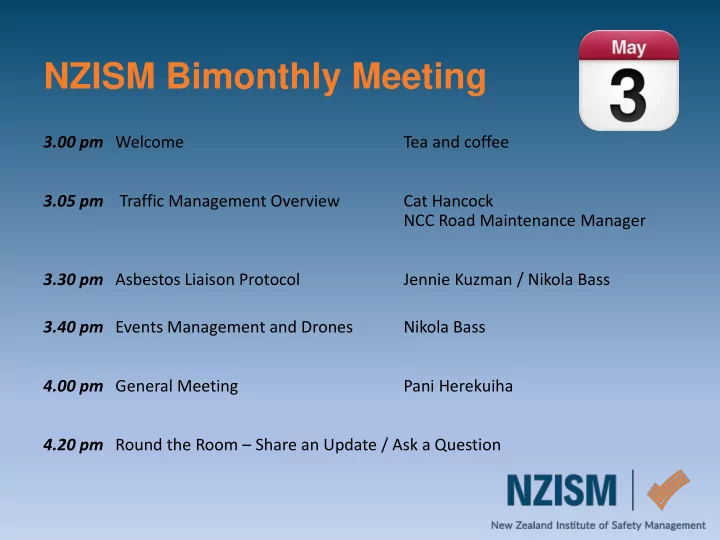
3.00 pm Welcome Tea and coffee 3.05 pm Traffic Management Overview Cat Hancock NCC Road Maintenance Manager 3.30 pm Asbestos Liaison Protocol Jennie Kuzman / Nikola Bass 3.40 pm Events Management and Drones Nikola Bass 4.00 pm General Meeting Pani Herekuiha 4.20 pm Round the Room – Share an Update / Ask a Question

slide-2
SLIDE 2

Traffic Management A Presentation to the NZISM

Presented by Cat Hancock Transportation Operations Coordinator Napier City Council 3 May 2019

slide-3
SLIDE 3

Traffic Management

  • What role do Councils play?

“Road Control Authority”

  • To ensure activities are conducted safely
  • Ensure works are coordinated
  • Ensure all groups are treated equally
  • Responsible for appointing a Corridor Manager and Traffic

Management Coordinators (TMC)

slide-4
SLIDE 4

Corridor Manager

  • Implement requirements of the New Zealand Utilities Advisory

Group (NZUAG)

  • Set special conditions for their network e.g. rules are paving

stones

  • Agrees the corridors for utilities to use
  • Acts as a neutral party to all Utility Operators
slide-5
SLIDE 5

Traffic Management Coordinator

  • Meets with Utilities regularly to discuss forward works (road

works and events)

  • Approves Traffic Management Plans from Contractors and Event

Organizers that have been prepared in accordance with the Code of Practice for Temporary Traffic Management (COPTTM)

  • Ensures that areas where different groups want to “be” at the

same time is coordinated.

  • Monitors works on the road corridor
  • Checks that Temporary Speed Limits (TSLs) are appropriate
slide-6
SLIDE 6

Who Needs Traffic Management?

slide-7
SLIDE 7

Who needs TM?

  • Water Meter Readers
  • Fence/Building Painters
  • Gardeners
  • Events using the footpaths or roads
  • Street Markets
  • Contractor working on roads for utilities or maintenance
  • Trucks Delivering goods stopped on the road
  • Farmers moving stock along the road
  • Hedge Trimmers
slide-8
SLIDE 8

COPTTM Changes

  • Going Forward - Site Traffic Management Superviser (STMS)

and Traffic Controller (TC) training will become more

  • comprehensive. A framework is proposed by NZTA to cover

training and field-competencies. (May 2019 – roadshow throughout NZ)

  • Changes to how we work on Road where the speed limit is

greater than 65 kph on State Highways and possibly Local Authority roads.

  • Requirements for Contractors to report to the road control

authorities saying where they are on a weekly and daily basis

slide-9
SLIDE 9

What can we do to make the roads safe for road workers?

  • Obey the temporary speed restrictions ourselves
  • Go back to your organizations and ask your drivers to obey the

TSL on our roads

  • Does your company allow workers to speed in company cars?
  • What is the consequence if they do?
  • Have you done your due diligence as a PCBU in this area?
slide-10
SLIDE 10

Questions?

Thank you, from the Roadworks community, for an opportunity to talk about our working environment.

slide-11
SLIDE 11

NZISM Bimonthly Meeting

3.00 pm Welcome Tea and coffee 3.05 pm Traffic Management Overview Cat Hancock NCC Road Maintenance Manager 3.30 pm Asbestos Liaison Protocol Jennie Kuzman / Nikola Bass 3.40 pm Events Management and Drones Nikola Bass 4.00 pm General Meeting Pani Herekuiha 4.20 pm Round the Room – Share an Update / Ask a Question

slide-12
SLIDE 12

Events Management

slide-13
SLIDE 13

PCBU Responsibility

  • To prevent harm to all people at work.
  • This includes a duty of care to all people in, or in the

vicinity of work – such as

  • Contractors and subcontractors
  • Customers and clients
  • Volunteers

Principle Objective of the Health and Safety at Work Act 2015

slide-14
SLIDE 14

Events Approach

  • Identify Responsibilities: Who looks after what
  • Identify Risks: What is the event planned and

what is the risk associated.

  • Audit and Safety Observations: Audit high

percentage of the large events, Random selection

  • f events.
slide-15
SLIDE 15

Risk Levels

  • Low Risk: General park users, without

introducing equipment e.g. wedding photography

  • Medium Risk: Smaller events with public paying

to participate or large numbers of people gathering e.g. Gypsy Fair, Targa Rally

  • High Risk: High numbers, high impact events e.g.

Horse of the Year.

slide-16
SLIDE 16

Trigger Areas

slide-17
SLIDE 17

Risk Assessment Areas

  • 1. Event Participants – i.e. age / experience /

suitability, accessibility needs, refreshments, lost children facilities, animals

  • 2. Grounds – i.e. duck ponds, trees, playgrounds
  • 3. Staff/Contractors/Volunteers – i.e. Briefings,

responsibilities, refreshments, training

  • 4. Entertainment, Electrical, Sound and Lighting –

i.e. registered tradesman, isolation required, tripping hazards, bouncy castles, amusement rides, vendors/catering

slide-18
SLIDE 18

Risk Assessment Areas

  • 5. Set-up/Pack-down – i.e. what safety is in place

while event site is a working site i.e. moving vehicles, first aid, forklift activity

  • 6. Traffic Management & Parking – i.e. traffic

management plan, signage, marshals, route, pedestrian management

  • 7. Vehicle Management – i.e. speed, access to site

for emergency vehicles, pedestrian access. Note- maximum vehicle speed in mall is 5kph.

slide-19
SLIDE 19

Risk Assessment Areas

  • 8. Crowd Control – i.e. fencing/barricades, alcohol,

protection of property

  • 9. Security – i.e. protection of pedestrians,

spectators, employees, pack in and pack out activities, Security/Police

  • 10. Emergency Procedures – i.e. bomb threat, fire,

earthquake, hazardous substances

  • 11. Environmental Effects on People – i.e. effect of

wind/rain and UV protection, extreme weather conditions - cancellation/postponement strategy

slide-20
SLIDE 20
slide-21
SLIDE 21

Drones in Hastings District

slide-22
SLIDE 22

Drones and Helicopters

  • do not fly closer than ten metres to the boundary of Council

controlled land and private property without the permission

  • f that land owner/occupier; and
  • avoid distraction to the road user and to ensure the safety
  • f the operator. It is prohibited to fly over roads of any class

unless a Traffic Management Plan (TMP) has been submitted in accordance with the Code of Practice for Temporary Traffic Management (CoPTTM). The appropriate TMP must be applied for and approved prior to the

  • peration. Traffic Management to be supplied by an

approved traffic management provider only; and

  • those certified to Part 102 ONLY can fly in road reserve.
  • apply to the Council for permission for any events, via the

event organiser;

slide-23
SLIDE 23
slide-24
SLIDE 24

Any Questions?

slide-25
SLIDE 25

NZISM Bimonthly Meeting

3.00 pm Welcome Tea and coffee 3.05 pm Traffic Management Overview Cat Hancock NCC Road Maintenance Manager 3.30 pm Asbestos Liaison Protocol Jennie Kuzman / Nikola Bass 3.40 pm Events Management and Drones Nikola Bass 4.00 pm General Meeting Pani Herekuiha 4.20 pm Round the Room – Share an Update / Ask a Question