
SLIDE 1
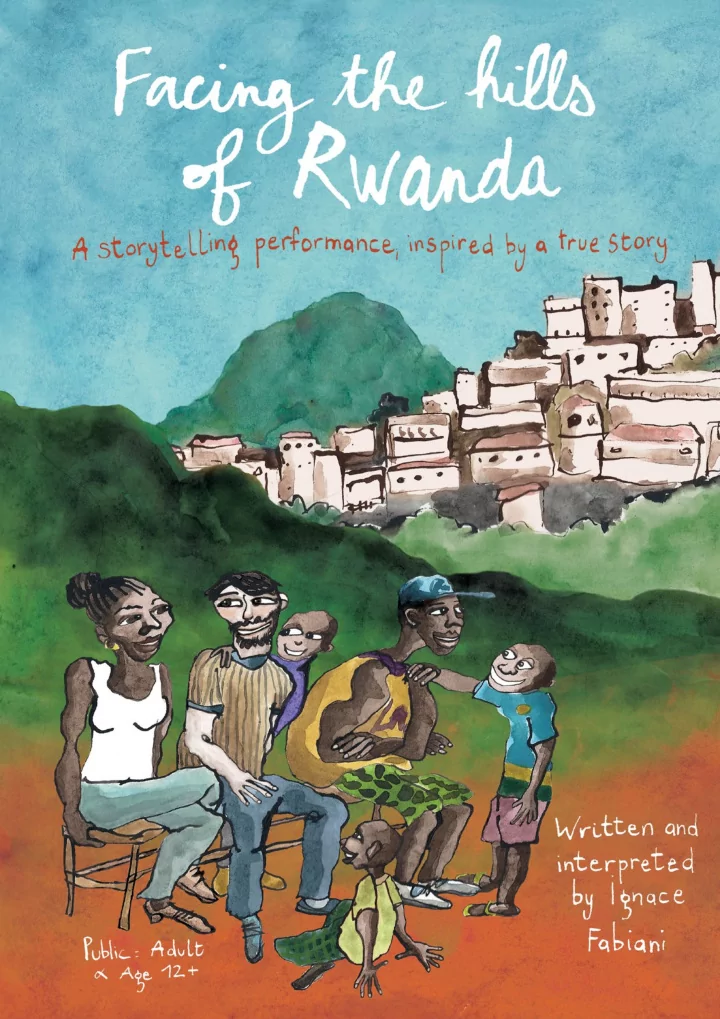
Nyir'ubwenge aruta nyir'uburyo. The wise man is more gifted than - - PDF document
Nyir'ubwenge aruta nyir'uburyo. The wise man is more gifted than the rich man. A Rwandan Proverb 2 Storytelling performance 2019 creation A storytelling performance that takes us on a journey by Ignace Fabiani to discover the
A Rwandan Proverb
2
Public Adults & Ages 12+ Timing 1h10
The show can be followed by a discussion with the audience about the artistic proposal but also about the history of Rwanda and the situation of the country today. Written and interpreted by Ignace Fabiani Directed by Juan Antonio Martinez y Carrion
3
Joseph, a 24-year-old French, goes to Kigali for 6 months to work with young people living
multitude of engaging characters add color to the narrative: an energetic rapper who learned English by watching Bollywood movies, an educator always full of hope and projects who survived the genocide, a proverb-loving night watchman who never leaves his classy jacket and toreador mustache, an orphan girl who now pilots a drone… Thanks to these endearing characters whom Joseph wants to know, to understand, we discover little bits of Rwanda’s history! Simple and unadorned, the staging brings us to the borderline between storytelling and reading. The actor-storyteller, alone on stage, tells us this unique story and takes us on a journey to
sound ambiences recorded in Kigali and songs that punctuate the show. « Facing the hills of Rwanda » can come to life in various places in an intimate atmosphere... Theaters, living rooms, libraries, festivals, high schools, yurts...
A Rwandan Proverb
4
I like the simplicity with which you paint the scenery of Rwanda. Smells, colors, sounds... I was there with you. Should be prescribed to candidates who want to work in an NGO! Raph
For a Rwandan citizen, this show is really exciting. You have managed to paint a realistic portrait
Rwanda! And I laughed a lot with the Rwandan proverbs… Murakoze cyane!
Alexia
It was sweet sitting on that wooden bench in Kigali with you for an hour. Martine
We travel from laughter to tears, then from laughter to wonder! Well done.
Jonathan
This tale makes us discover a country we can’t forget! Your words make the atmosphere and questions
Françoise Congratulations on this show! I appreciated the progression of the text, which brings us fjrst in the atmosphere of this youth centre with the everyday life of these kids, before talking about the genocide and all the sufgering it has caused. And now the rise of hope today! Marie-Cécile
5
At 17, he’s the youngster who speaks the best French among the inhabitants of the center. At the same time reserved and enthusiastic, he’s become my offjcial guide. Medium-sized, shaved head, he has an elegant face with a scar just above his left
with yellow crocs. In June, he’ll complete his last year of primary school; at the age
during the genocide when he was only 2 years old. But when he talks about them, he prefers to say that they now live in the United States and that one day he’ll join them ! At the age of 10, he left his mother and his village to come to Kigali. Looking for work, looking for a life. After 4 years on the streets, he landed here in the Inzu Center, and managed to get back to school. When he speaks French he’s a little shy, hesitant. But when he speaks Kinyarwanda, he’s almost authoritarian. With the young people who live in the center, clearly he’s the boss. The director of the Inzu Center. Small, charming, with a smiling and energetic
I had some pretty heated discussions with Beatrice about the «role» I was going to play in the youth center. In our fjrst exchanges before my arrival, I had explained that after some tough experiences in Togo and India, I was coming to Rwanda, fjrst to meet these young people. By email, Beatrice had said yes. But now that I’m here, she would still like me to do something... I don’t know... at least some accounting,
Like Innocent, she cannot imagine that a white man doesn’t really want to do anything “useful”, “efgective”... Despite
positive, smiling and blooming. Modeste, the night watchman, told me yesterday that she has a painful history, having herself survived the 1994 genocide, during which she lost many family members, including her husband. A 15-year-old youngster who loves music. Everyone calls him Snoop because he’s always dressed up like Snoop Doggy Dog. Cap or bandana, rings and basketball jersey too wide... He’s even growing a small goatee. He speaks bad French, preferring the English of his idol. The
Shakespeare’s language. For several years, he’s been attending Bollywood movies in a little “shed cinema”. These are in Hindi, with English subtitles. And a person next to the TV, gradually translates them into
coming with a notebook, copying the words on the screen and linking them to the translator’s words...
6
His offjcial role is between a guard and a night educator, unoffjcially I’d say between wiseman and madman. Half Congolese, half Rwandan, he’s very tall with a small mustache that makes him look like a bull-
classy jacket, he’s a colorful character with whom I immediately hooked up. We spend
lorful French. He loves to quote Rwandan proverbs from behind the bundles : “Even the crowing rooster was one day an egg.” A tall, athletic young woman, with very short hair, who lived herself 4 years on the street before being coming to the Inzu
designer. Modeste talks about Marie-Ange: ‘‘Can you imagine that this girl was living in the street ten years ago? If you see her today, you can’t believe it. Marie-Ange was here when the center was created in 1999. She was 14 years old. Now she has her own communication agency! Her own house. A husband, one child, and even... a fence !”
7
Rwanda is a country which has fascinated me for more than 15 years ! First, through the reading
Rwanda for «real» by going to Kigali to do my end of school internship in a center that welcomed young people living on the streets. A very enriching and demanding experience through which I discovered the daily ingenuity
Inspired by my personal experience, I created this show « Facing the hills of Rwanda », that immerses us in this astonishing country, the paradoxes of which I seek to capture. The ambition of this story is talk about the com- plex reality of Rwanda, its bright and dark sides. To share the diffjcult legacy of the genocide, but also to show the depth of what we can learn from Rwandans. By telling the inspiring story of some survivors who despite their history are lea- ders of peace and change in their community. By showing how this resilience has something universal to teach us. By testifying to the conta- gious curiosity of many young Rwandans who, despite their precarious situation, believe in their future! This theatrical project also questions the role of young Westerners who want to “help develop” Africa at all costs... « Facing the hills of Rwanda » is nourished by my experience with the young people I met in Kigali, the emotions I shared with them, my passion to understand the issues and the complexity of situations in order to share them in a nuanced way... I went back to Rwanda in 2009, then a third time in 2017, to feel the current temperature of the country and record the sounds for this show. Today I feel the need to bring these life stories, words, testimonies on stage. For the public it could be an opportunity to take a step aside, to try to put on the other’s glasses, to connect with alterity. My humble hope is to take the spectator on a journey from which we can both come back home transformed!
8
9
Just the text, the story and being a part of it. Just the breath and the voice of the storyteller rather than an actor «on stage»... Getting rid of the unnecessary emphasis and giving the spoken word its evocative force. Getting rid of the idea of occupying the stage... or reinventing it as we go along. Refocusing on the strength of a story that tries to speak the unspeakable... Making us love these characters whose silence and resilience beat the rhythm of life being rebuilt... Keeping our Western memory alert and awake... Keeping the tragic at bay with the strength of humour... Letting the storyteller’s eyes rest on us, and touch us with simplicity. Telling the stories of women, children, men from Rwanda; but through them, talking about all the genocides, leaving a trace and continuing at all costs to believe in humanity ! Welcome to Ignace Fabiani’s hills of Rwanda. Listen to the music of his words that mark the rebirth of a country... despite everything...
10
Since 2011, Ignace Fabiani has been working regularly as an actor in the Artifmette theatre company (based in Barraux, Isère, France). There, he has created two shows with Claire Davienne:
The Buddies Downstairs. Chronicles of daily-life in the low-income housing estate Magnolia Ben and Charlotte decide to move to a low-income housing project to experience the famous « social mixity and diversity ». The account
isn’t often heard in the media, and echoes the words of the poet Guimaraes Rosa, « Telling, is resisting ». A show between theatre and storytelling, woven with words and music, inspired by a true story. « Thank you for this testimony of life in the heart of a low-income housing project, a territory that has become so symbolic, even part of
respectful perspective, without any literary efgects, searching for your
that we could also be ours and thus reveals itself so precious. » À Mots Découverts (an organization that accompanies playwriting) A voice and cello duet created from a book by contemporary poet Christian Bobin. This intimate performance speaks of everyday life, of death, of our ways of resisting. It is a waltz where the words dance with the music... This show has been played over a 100 times in various places: festivals of Avignon and Aurillac, theaters, libraries, in Quebec... « Thanks for the lively company of your words and the chello. And for the smiles that you brought to the listeners lips. » Christian Bobin MORE INFORMATIONS ABOUT THESE SHOWS:
11
CREDITS Illustrations: Marine Faure Photos: François Philipponeau, Werner Braun and Ignace Fabiani Page layout: Émile Ricard
A Rwandan Proverb