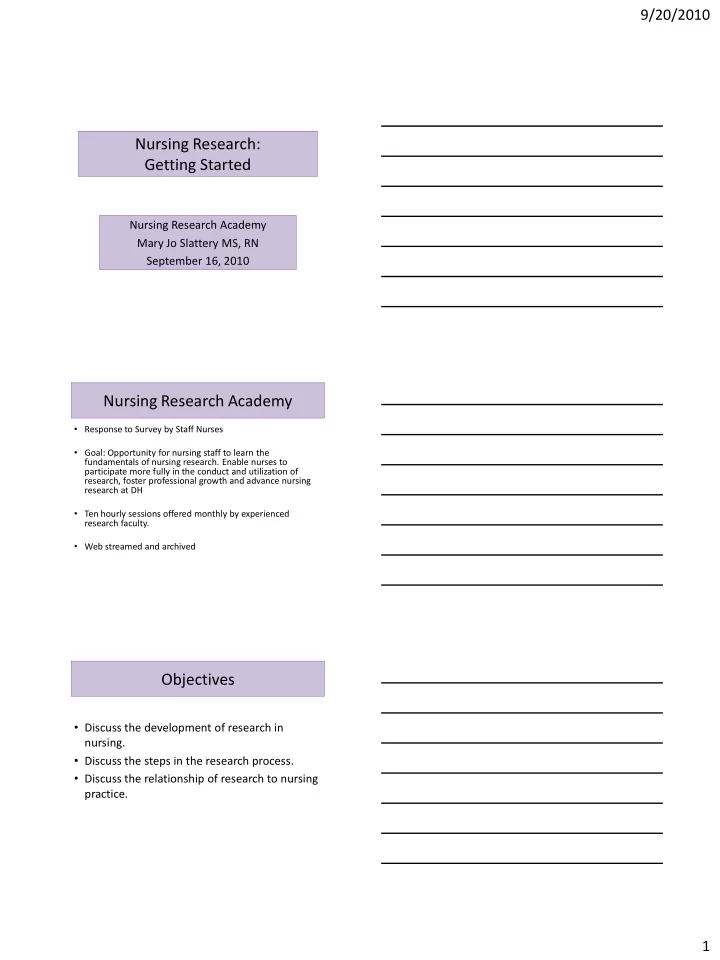
Nursing Research: Getting Started Nursing Research Academy Mary Jo - - PDF document

nursing research getting started
SMART_READER_LITE
LIVE PREVIEW

Nursing Research: Getting Started Nursing Research Academy Mary Jo - - PDF document

9/20/2010 Nursing Research: Getting Started Nursing Research Academy Mary Jo Slattery MS, RN September 16, 2010 Nursing Research Academy Response to Survey by Staff Nurses Goal: Opportunity for nursing staff to learn the fundamentals


slide-1
SLIDE 1

9/20/2010 1

Nursing Research: Getting Started

Nursing Research Academy Mary Jo Slattery MS, RN September 16, 2010

Nursing Research Academy

  • Response to Survey by Staff Nurses
  • Goal: Opportunity for nursing staff to learn the

fundamentals of nursing research. Enable nurses to participate more fully in the conduct and utilization of research, foster professional growth and advance nursing research at DH

  • Ten hourly sessions offered monthly by experienced

research faculty.

  • Web streamed and archived

Objectives

  • Discuss the development of research in

nursing.

  • Discuss the steps in the research process.
  • Discuss the relationship of research to nursing

practice.

slide-2
SLIDE 2

9/20/2010 2

What is Nursing Research?

  • Systematic inquiry designed to develop

knowledge about issues of importance to the nursing profession.

(Polit & Beck, 2008)

Research vs. QI

  • Quality Improvement:

– systematic, data-guides activities designed to bring about immediate improvement in particular settings – Plan, Do , Study Act methodology – Examples:

  • Nurse sensitive indicators – NDNQI
  • Performance measures
  • Compliance checks

Evidence-Based Practice

  • Conscious use/ integration of the best

research evidence with clinical expertise and patient preferences in nursing practice.

  • Examples-

– Use of Evidence based standards from a professional organization – Pressure ulcer prevention protocol

slide-3
SLIDE 3

9/20/2010 3 Areas of Focus for Nursing Research

  • Clinical Practice:

Understanding human responses Determining the best interventions to promote health, prevent illness and manage illness

  • Nursing education
  • Administration
  • Health Services
  • Nurses characteristics and roles
  • Informatics

Importance of Nursing Research

  • Broad support for evidence based practice

– Provides strong evidence to inform nurses decisions and actions – Practice changes based on evidence

  • Builds a body of scientific knowledge for the nursing

profession

  • Nurses are in a unique position to ask clinically relevant

questions

  • Improves patient outcomes

Examples of Research Studies

  • The effect of a standardized heart failure

education and discharge protocol on patient

  • utcomes.
  • Effects of Nursing rounds on patients’ call light

use, satisfaction, and safety [27 units- 14 hospitals, 1 & 2 hour rounds]

slide-4
SLIDE 4

9/20/2010 4 Where Did We Come From and Where are We Going?

Florence Nightingale (1820-1910)

Florence Nightingale (1820-1910)

Research Trends

  • Nightingale –

– “Notes on Nursing” describes environmental factors that promote well being

  • 1900 to 1960s-

– educational training of nurses

  • 1970s-

– Improvement in client care – 1976- first article (Stetler & Marram) on assessing research for application in practice settings.

  • 1980s-

– Nursing groups with priorities, start of EBM

slide-5
SLIDE 5

9/20/2010 5

  • 1990s- National Center for Nursing Research

elevated to Institute (NINR)

  • Future directions-

– Promotion of excellence in nursing science – Heightened focus on EBP – More rigorous methods – Greater emphasis on systematic reviews – Expanded local research in health care settings – Multidisciplinary collaboration

Research Trends

National Institute of Nursing Research Priorities & Funding

  • Advances in nursing science

– Symptom management

  • Care management of patients during illness and

recovery

  • Reduction of risks for disease and disability
  • Promoting healthy lifestyles
  • Improving quality of life with chronic illness
  • Care for individuals at end-of-life
  • Palliative care

Professional Expectations for Research

  • The registered nurse integrates research

findings into practice.

– Utilizes the best available evidence, including research findings to guide practice decisions – Actively participates in research activities at various levels of nurse’s education and position

(ANA Scope and Standards of Practice, 2010

slide-6
SLIDE 6

9/20/2010 6 Professional Expectations for Research

  • Advanced Practice Registered Nurse:

– Contributes to nursing knowledge by conducting

  • r synthesizing research that discovers, examines,

and evaluates knowledge, theories, criteria, and creative approaches to improve healthcare. – Formally disseminates research findings through activities, such as presentations, publications, consultation, and journal clubs.

(ANA Scope and Standards of Practice, 2010

Getting Started

  • Inspiration
  • Passion
  • QI data
  • Organizational imperatives
slide-7
SLIDE 7

9/20/2010 7

Sources of Evidence in Nursing

  • Tradition and authority
  • Clinical experience, trial & error, intuition
  • Logical reasoning
  • Assembled information

– Benchmarking – Cost – QI and Risk Management data – Disciplined research

Research Process Overview

Phase 5 Utilizing Research Phase 1 Selecting & Defining the Problem Phase 2 Selecting a Research Design Phase 3 Methods Phase 4 Data Analysis

Fain, J. (2009)

Research Process Overview

Phase 5 Utilizing Research Phase 1 Selecting & Defining the Problem Phase 2 Selecting a Research Design Phase 3 Methods Phase 4 Data Analysis

Identify Problem and Purpose statement Review of Related Literature Identifying Pertinent Variables Formulating Research Questions and Hypotheses Fain, J. (2009)

slide-8
SLIDE 8

9/20/2010 8 Research Process Overview

Phase 5 Utilizing Research Phase 1 Selecting & Defining the Problem Phase 2 Selecting a Research Design Phase 3 Methods Phase 4 Data Analysis

Identify Problem and Purpose statement Review of Related Literature Identifying Pertinent Variables Formulating Research Questions and Hypotheses Identifying Sample and Setting Defining All Measurements Fain, J. (2009)

Research Process Overview

Phase 5 Utilizing Research Phase 1 Selecting & Defining the Problem Phase 2 Selecting a Research Design Phase 3 Methods Phase 4 Data Analysis

Identify Problem and Purpose statement Review of Related Literature Identifying Pertinent Variables Formulating Research Questions and Hypotheses Identifying Sample and Setting Defining All Measurements Data Collection Methods Fain, J. (2009)

Research Process Overview

Phase 5 Utilizing Research Phase 1 Selecting & Defining the Problem Phase 2 Selecting a Research Design Phase 3 Methods Phase 4 Data Analysis

Identify Problem and Purpose statement Review of Related Literature Identifying Pertinent Variables Formulating Research Questions and Hypotheses Identifying Sample and Setting Defining All Measurements Data Collection Methods Interpreting Findings Analyzing Data Fain, J. (2009)

slide-9
SLIDE 9

9/20/2010 9 Research Process Overview

Phase 5 Utilizing Research Phase 1 Selecting & Defining the Problem Phase 2 Selecting a Research Design Phase 3 Methods Phase 4 Data Analysis

Identify Problem and Purpose statement Review of Related Literature Identifying Pertinent Variables Formulating Research Questions and Hypotheses Identifying Sample and Setting Defining All Measurements Data Collection Methods Interpreting Findings Analyzing Data Disseminating Research Findings Fain, J. (2009)

Translating Research into Practice Research and Evidence Based Practice

slide-10
SLIDE 10

9/20/2010 10 Evidence Based Practice Models

Discovery Summary Translation Integration Evaluation

Quality of Research Evidence

slide-11
SLIDE 11

9/20/2010 11

Conclusion

  • Nurses can engage in research with any level
  • f academic preparation.
  • Nurses can engage in research at any point

along the continuum- from consumer to researcher.

  • Research provides the foundation for evidence

based practice and improved patient

  • utcomes.

Questions ?? References

  • American Nurses Association. (2010). Scope and standards of

nursing practice. Silver Spring: American Nurses Association.

  • Burns, N. & Grove, S. (2009). The practice of nursing research:

Appraisal, synthesis, and generation of evidence. (6th ed.). St Louis: Saunders Elsevier.

  • Fain, J. A. (2009). Reading, understanding, and applying nursing

research.(3d ed.).Philadelphia: F.A.Davis.

  • Melnyk, B. & Fineout-Overholt, E. (2005). Evidence-based practice

in nursing & healthcare. Philadelphia: Lippincott, Williams & Wilkins.

  • Polit, D.F.& Beck, C.T. (2008). Nursing research: Generating and

assessing evidence for nursing practice (5th ed.). Philadelphia. Lippincott, Williams & Wilkins.