
SLIDE 1
Transactions
- f
the Korean Nuclear Society Virtual Spring Meeting
Changes of Mechanical Properties after 3-Years Thermal Ageing at 900oC of Alloy 617
Woo-Gon Kima, I.N.C. Kusumab, Sah Injina, Seon-Jin Kimb, Eung-Seon Kima, Min-Hwan Kima
a Korea Atomic Energy Research Institute, 989-111 Daedeok-daero, Yuseong-gu, Daejeon, Korea, 305-353, bPukyong National University, 100 Yongdang-dong, Nam-gu, Busan, 608-739 *Corresponding author: wgkim@kaeri.re.kr
- 1. Introduction
A Very High Temperature Reactor (VHTR) system is a gas-cooled reactor with operation goal of producing hydrogen at temperature up to 900-1000oC, pressure up to 7 MPa, and design life up to 60 years. Alloy 617 is identified as one of the candidate materials in the Gen- IV reactor systems for component because of its excellent mechanical properties and corrosion resistance at the temperature range of 760 to 1000oC [1- 5]. During long-term service at the high temperatures, metallic materials inevitably undergo aging processes which result in microstructure evolution and changes in mechanical properties. To develop design guidelines for Alloy 617, a mechanistic understanding on the aging effects, which would arise during long-term and high- temperature exposure, becomes very important [1,6]. However, the design guideline of mechanical properties
- n long-term aging such as tensile and creep properties
was not given from some elevated temperature design (ETD) codes: ASME code, RCC-MRx, or elsewhere. Therefore, to establish a design guideline on thermal aging effects of Alloy 617, experimental aging data should be sufficiently prepared, and its mechanical behavior for thermal aging should be understood well. In this study, changes of mechanical properties such as hardness, tension, and creep behaviors after 3-years (y) thermal ageing at 900oC of Alloy 617 were investigated in comparison with the unaged (or virgin)
- material. A series of creep tests was conducted with
different applied stress levels at 900oC. Oxidation layer and micro-hardness for the aged samples were
- measured. Crept microstructures were observed and
discussed.
- 2. Methods and Results
2.1 Experimental procedures Commercial grade nickel-based superalloy, Alloy 617 (brand name: Haynes 617) of a hot-rolled plate with a thickness of 25.9mm (1.020 inch) was used for this study. Chemical compositions are given as (wt,%), Al: 1.06, B: <0.002, C: 0.08, Co: 12.3, Cr: 22.2, Cu: 0.0268, Fe: 0.9496, Mn: 0.0295, Mo: 9.5, Ni: 53.11, P: 0.003, S: <0.002, Si: 0.0841, Ti: 0.41. The thermal aging specimens were prepared with the rectangular blocks of 26 mm in height, 42 mm in width, and 90 mm in length. The blocks were constantly maintained for 3y (26,280 h) in the box furnace. After thermal aging, the blocks were taken out from the box furnace, and the tension and creep test specimens were cut by electric discharge machine (EDM) from the blocks. The dimension of the tensile specimens was a plate type of 2.0 mm in thickness and 6.25 mm in width of gage
- length. The tensile tests were performed at the
temperatures of R.T., 400, 600, 700, 800, 850, 900, and 950oC with the strain rate of 5.85E-04 (1/s). The dimension of the creep specimens was a cylindrical form of 30 mm in gauge length and 6 mm in diameter. The creep tests were performed under different applied stress levels at 900oC. The creep strain data with elapsed times was taken automatically by a personal computer through an extensometer attached to the creep
- specimens. The creep curves with variations were
- btained, and the minimum creep rate was obtained by
calculating the secondary creep stage from the strain– time creep curves. 2.2 Changes of tensile and creep rupture properties After 3y-thermal aging at 900oC, the high- temperature tensile properties and creep rupture properties were investigated. The creep test results of the aged material were compared with those of the unaged (virgin) results using various creep plots.
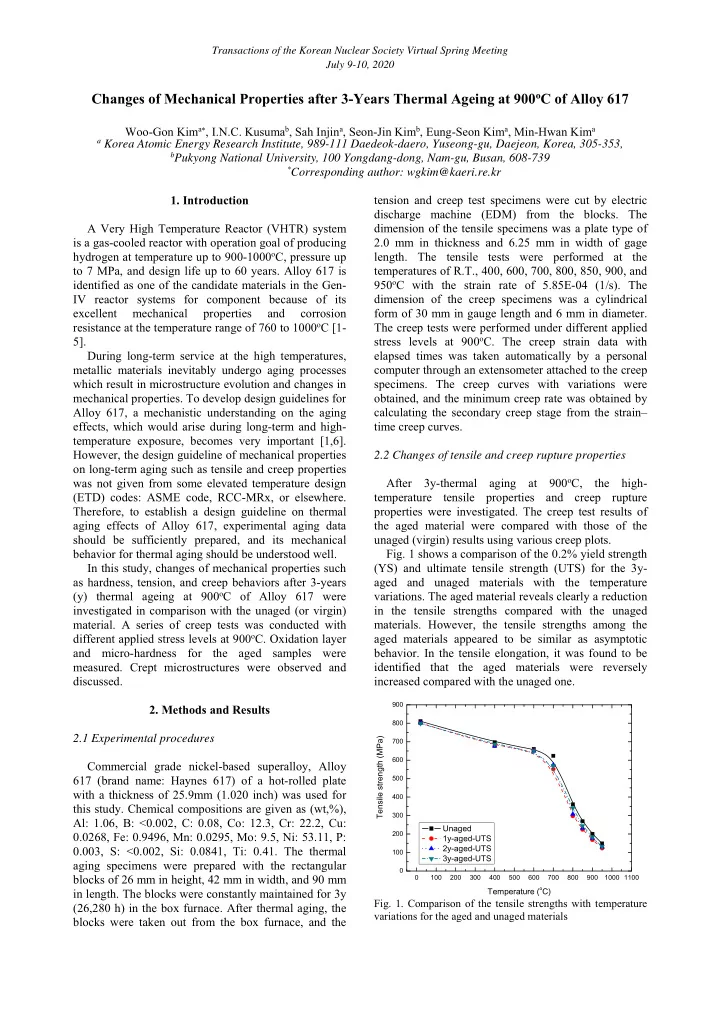
- Fig. 1 shows a comparison of the 0.2% yield strength
(YS) and ultimate tensile strength (UTS) for the 3y- aged and unaged materials with the temperature
- variations. The aged material reveals clearly a reduction
in the tensile strengths compared with the unaged
- materials. However, the tensile strengths among the
aged materials appeared to be similar as asymptotic
- behavior. In the tensile elongation, it was found to be
identified that the aged materials were reversely increased compared with the unaged one.
100 200 300 400 500 600 700 800 900 1000 1100 100 200 300 400 500 600 700 800 900
Unaged 1y-aged-UTS 2y-aged-UTS 3y-aged-UTS Tensile strength (MPa) Temperature (
- C)
- Fig. 1. Comparison of the tensile strengths with temperature