
SLIDE 1
The New COMEFRI COMEFRI Plenum Wheel:
NPA NPA
AL
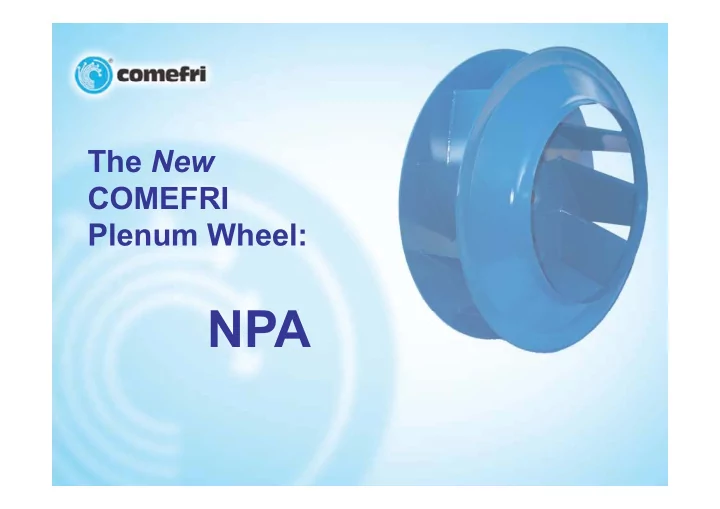
NPA NPA AL NPA PLENUM FAN NPA PLENUM FAN AL UNPARALLELED - - PowerPoint PPT Presentation
The New COMEFRI COMEFRI Plenum Wheel: NPA NPA AL NPA PLENUM FAN NPA PLENUM FAN AL UNPARALLELED FLEXIBILITY: - DIFFERENT MOTOR SIZES ON THE SAME FRAME DIFFERENT MOTOR SIZES ON THE SAME FRAME - ONE STRUCTURE FOR THREE IMPELLER TYPES NPA
AL
AL
UNPARALLELED FLEXIBILITY:
DIFFERENT MOTOR SIZES ON THE SAME FRAME
NPA NPL
A WELDED STRUCTURE TO
TE
A WELDED STRUCTURE TO ACHIEVE VERY LOW VIBRATION LEVELS AS DEMANDED BY THE RELEVANT ISO STANDARDS .
AL
AL
AL
AL
AL
AL
2 000
Wheel Performance . @ 1500 rpm
1 500 e [Pa] 1 000 Static Pressure NPA 710 500 NPL 710 5000 10000 15000 20000 25000 30000 35000 40000 Air Volume [m3/h]
AL
90 100
Wheel Performance . @ 1500 rpm
80 90 cy % 60 70 Static efficien NPA 710 50 NPL 710 40 5000 10000 15000 20000 25000 30000 35000 Air Volume [m3/h]
AL
The new NPA wheel is therefore capable of delivering higher air volumes than the delivering higher air volumes than the corresponding size NPL fan, whilst maintaining very high efficiency levels In turn significant very high efficiency levels. In turn, significant improvements are obtained in acoustic performance through the utilisation of Airfoil performance, through the utilisation of Airfoil blades. NPA is therefore a perfect choice for NPA is therefore a perfect choice for acoustically sensitive projects.
AL
F i thi t l t’ id Focusing on this aspect, let’s now consider a typical Air Handling Unit manufacturer’s i t requirement:
D li d i l 20 000 3/h
Static pressure : 1400 Pa
AL
2 000
Requested performance: V = 20000 m3/h P = 1400 Pa st.
1 500 [Pa]
P 1400 Pa st.
1 000 Static Pressure 500 NPA 710 @1437 rpm NPL 710 @ 1494 rpm 5000 10000 15000 20000 25000 30000 35000 40000 Delivered Air Volume [m3/h]
AL
90 100
Requested Performance: V = 20.000 m3/h P = 1400 Pa st.
60 70 80 y % 40 50 60 Static efficiency NPA 710 @ 1437 rpm 10 20 30 NPL 710 @ 1494 rpm 5000 10000 15000 20000 25000 30000 35000 Delivered Air Volume [m3/h]
AL
100 102
Required performance: V = 20.000 m3/h P = 1400 Pa st.
98 100 utlet [ dB(A)] 94 96 Power level at Ou 90 92 Sound P NPA 710 @ 1437 rpm NPL 710 @ 1494 rpm 88 5000 10000 15000 20000 25000 30000 35000 40000 Delivered Air Volume [cmh]
AL
AL
AL
AL
AL
Fan Efficiency (continued) Fan Efficiency (continued)
Between a small (250 mm) and a larger (1400 mm) diameter impeller, the results show differences of up to 6 - 8 points in maximum efficiency. The same impeller, when running at maximum allowable speed and when running at 33% of max speed, can show p g p , differences of up to 4 points on the measured efficiency. These two effects combined, can result in over 10 points difference.
AL
Fan Efficiency (continued) Fan Efficiency (continued)
Oth f t t d t d l th l l f Other manufacturers tend to declare the same level of efficiency on their complete fan range and choose to say nothing about the relationship between size, efficiency nothing about the relationship between size, efficiency and speed.
AL
DIN 24 166 d d h h f ll i i d i i f
Parameter Limit of deviation for:
DIN 24 166 standard has the following maximum deviations, for each “class of tolerance”:
Parameter Limit of deviation for:
Class 1 Class 2 Volume flow rate, V +/- 2,5 % +/- 5 % Pressure increase, p +/- 2,5 % +/- 5 % Power, P + 3 % + 8 % Efficiency
Efficiency , 2 % 5 % Sound Power Level , Lw (A-weighted) + 3 dB + 4 dB
All published COMEFRI performance data are in line with Class 1 tolerance.
AL
Noise Noise
Another important aspect is the published fan noise data. The majority of fan noise is generated by the wheel and its main contributory factor is the ‘blade tone’, or ‘tonal noise’, at a well fi i i ( “ i f ”) defined spectrum position (the so-called “blade passing frequency”). Blade passing frequency = (z x n)/60 Where: z = number of blades n = wheel revolutions per minute n wheel revolutions, per minute
AL
Noise (continued) ( ) Th f it i b l t l it l th t t l i b Therefore, it is absolutely vital that tonal noise be considered to enable an accurate calculation of th bi t i l l !! the ambient noise level !!
AL
Noise (continued) ( )
This graph represents the difference between octave band spectrums, with and without Tonal Noise, ba d spect u s, w t a d w t out
calculated for a blade tone of 250 Hz:
105 105
4 dB of difference on the total value, th t i
100 93 90 95 100 105
Octave band Values [dB]
102 95 100 105
more than twice the level !!!
84 88 93 93 90 85 81 84 88 90 85 81 77 80 85 90 98 80 85 90 Total Noise value [dB] 81 77 70 75 63 125 250 500 1000 2000 4000 8000
{Hz]
70 75 Without Tonal Noise With Tonal Noise
AL
{Hz]
Noise (continued) Some manufacturers, however, publish their sound data without the tonal noise included. This approach is misleading, so that other manufacturers
... “without removing the blade frequency”, or “the octave band spectrum includes blade frequency”!!!
COMEFRI consistently publishes the full noise levels, blade frequency included.
AL
Choose the winner !!!
AL