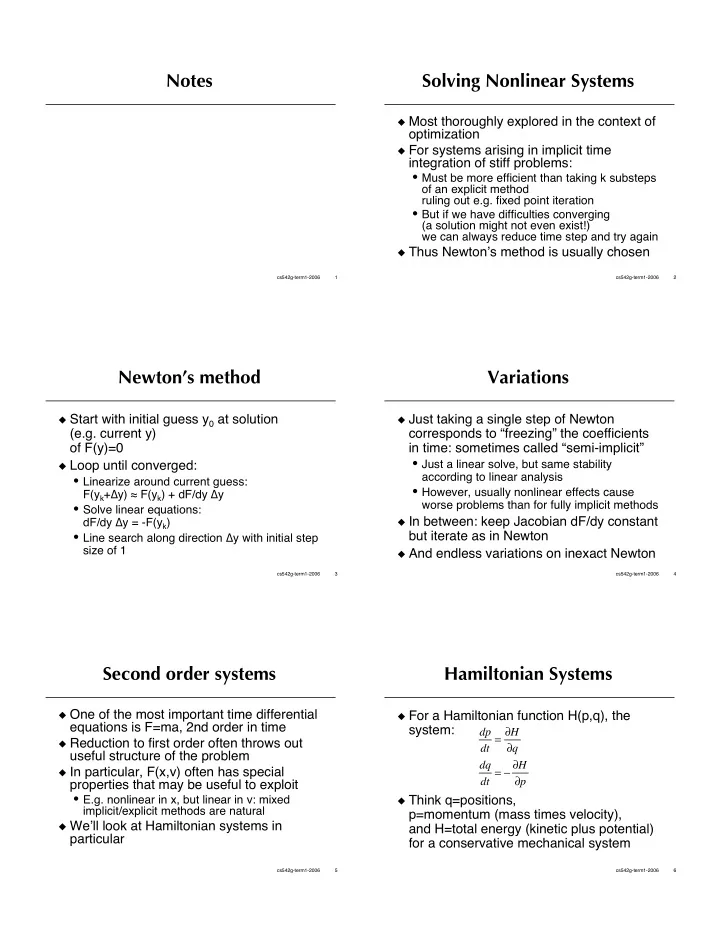

SLIDE 1
1 cs542g-term1-2006
Notes
2 cs542g-term1-2006
Solving Nonlinear Systems
Most thoroughly explored in the context of
- ptimization
For systems arising in implicit time
integration of stiff problems:
- Must be more efficient than taking k substeps
- f an explicit method
ruling out e.g. fixed point iteration
- But if we have difficulties converging
(a solution might not even exist!) we can always reduce time step and try again
Thus Newtons method is usually chosen
3 cs542g-term1-2006
Newton’s method
Start with initial guess y0 at solution
(e.g. current y)
- f F(y)=0
Loop until converged:
- Linearize around current guess:
F(yk+y) F(yk) + dF/dy y
- Solve linear equations:
dF/dy y = -F(yk)
- Line search along direction y with initial step
size of 1
4 cs542g-term1-2006
Variations
Just taking a single step of Newton
corresponds to “freezing” the coefficients in time: sometimes called “semi-implicit”
- Just a linear solve, but same stability
according to linear analysis
- However, usually nonlinear effects cause
worse problems than for fully implicit methods
In between: keep Jacobian dF/dy constant
but iterate as in Newton
And endless variations on inexact Newton
5 cs542g-term1-2006
Second order systems
One of the most important time differential
equations is F=ma, 2nd order in time
Reduction to first order often throws out
useful structure of the problem
In particular, F(x,v) often has special
properties that may be useful to exploit
- E.g. nonlinear in x, but linear in v: mixed
implicit/explicit methods are natural
Well look at Hamiltonian systems in
particular
6 cs542g-term1-2006