Notes Rigid Collision Algorithms Use the same collision response - - PDF document

notes rigid collision algorithms
SMART_READER_LITE
LIVE PREVIEW

Notes Rigid Collision Algorithms Use the same collision response - - PDF document

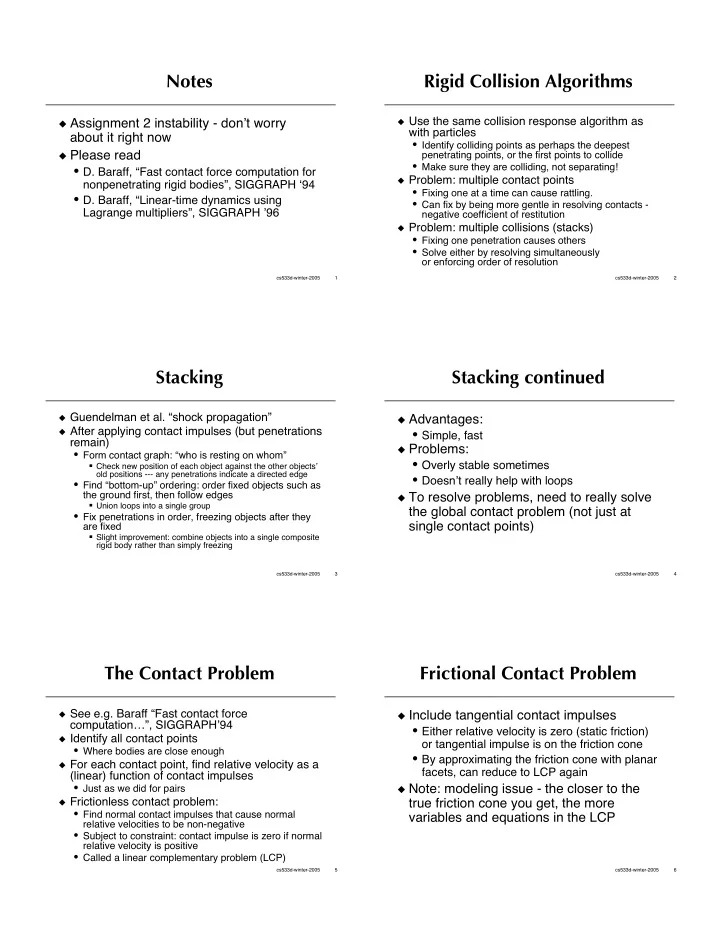
Notes Rigid Collision Algorithms Use the same collision response algorithm as Assignment 2 instability - dont worry with particles about it right now Identify colliding points as perhaps the deepest Please read penetrating


slide-1
SLIDE 1

1 cs533d-winter-2005

Notes

Assignment 2 instability - don’t worry

about it right now

Please read

  • D. Baraff, “Fast contact force computation for

nonpenetrating rigid bodies”, SIGGRAPH ‘94

  • D. Baraff, “Linear-time dynamics using

Lagrange multipliers”, SIGGRAPH ’96

2 cs533d-winter-2005

Rigid Collision Algorithms

Use the same collision response algorithm as

with particles

  • Identify colliding points as perhaps the deepest

penetrating points, or the first points to collide

  • Make sure they are colliding, not separating!

Problem: multiple contact points

  • Fixing one at a time can cause rattling.
  • Can fix by being more gentle in resolving contacts -

negative coefficient of restitution

Problem: multiple collisions (stacks)

  • Fixing one penetration causes others
  • Solve either by resolving simultaneously
  • r enforcing order of resolution

3 cs533d-winter-2005

Stacking

Guendelman et al. “shock propagation” After applying contact impulses (but penetrations

remain)

  • Form contact graph: “who is resting on whom”

Check new position of each object against the other objects’

  • ld positions --- any penetrations indicate a directed edge
  • Find “bottom-up” ordering: order fixed objects such as

the ground first, then follow edges

Union loops into a single group

  • Fix penetrations in order, freezing objects after they

are fixed

Slight improvement: combine objects into a single composite

rigid body rather than simply freezing

4 cs533d-winter-2005

Stacking continued

Advantages:

  • Simple, fast

Problems:

  • Overly stable sometimes
  • Doesn’t really help with loops

To resolve problems, need to really solve

the global contact problem (not just at single contact points)

5 cs533d-winter-2005

The Contact Problem

See e.g. Baraff “Fast contact force

computation…”, SIGGRAPH’94

Identify all contact points

  • Where bodies are close enough

For each contact point, find relative velocity as a

(linear) function of contact impulses

  • Just as we did for pairs

Frictionless contact problem:

  • Find normal contact impulses that cause normal

relative velocities to be non-negative

  • Subject to constraint: contact impulse is zero if normal

relative velocity is positive

  • Called a linear complementary problem (LCP)

6 cs533d-winter-2005

Frictional Contact Problem

Include tangential contact impulses

  • Either relative velocity is zero (static friction)
  • r tangential impulse is on the friction cone
  • By approximating the friction cone with planar

facets, can reduce to LCP again

Note: modeling issue - the closer to the

true friction cone you get, the more variables and equations in the LCP

slide-2
SLIDE 2

7 cs533d-winter-2005

Constrained Dynamics

8 cs533d-winter-2005

Constrained Dynamics

We just dealt with one constraint: rigid

motion only

More general constraints on motion are

useful too

  • E.g. articulated rigid bodies, gears, scripting

part of the motion, …

Same basic issue: modeling the constraint

forces

  • Principle of virtual work - constraint forces

shouldn’t influence the unconstrained part of the motion

9 cs533d-winter-2005

Three major approaches

“Soft” constraint forces (penalty terms)

  • Like repulsions

Solve explicitly for unknown constraint

forces (lagrange multipliers)

  • Closely related: projection methods

Solve in terms of reduced number of

degrees of freedom (generalized coordinates)

10 cs533d-winter-2005

Equality constraints

Generally, want motion to satisfy C(x,v)=0

  • C is a vector of constraints

Inequalities also possible - C(x,v)0 - but let’s

ignore for now

  • Generalizes notion of contact forces
  • Also can do things like joint limits, etc.
  • Generally need to solve with heavy-duty optimization,

may run into NP-hard problems

  • One approach: figure out or guess which constraints

are “active” (equalities) and just do regular equality constraints, maybe iterating

11 cs533d-winter-2005

Soft Constraints

First assume C=C(x)

  • No velocity dependence

We won’t exactly satisfy constraint, but will add

some force to not stray too far

  • Just like repulsion forces for contact/collision

First try:

  • define a potential energy minimized when C(x)=0
  • C(x) might already fit the bill, if not use
  • Just like hyper-elasticity!

E = 1

2 KCTC

12 cs533d-winter-2005

Potential force

We’ll use the gradient of the potential as a

force:

This is just a generalized spring pulling the

system back to constraint

But what do undamped springs do?

F = E x

  • T

= K C x

  • T

C

slide-3
SLIDE 3

13 cs533d-winter-2005

Rayleigh Damping

Need to add damping force that doesn’t

damp valid motion of the system

Rayleigh damping:

  • Damping force proportional to the negative

rate of change of C(x)

No damping valid motions that don’t change C(x)

  • Damping force parallel to elastic force

This is exactly what we want to damp Fd = D C x

  • T

˙ C = D C x

  • T C

x v

14 cs533d-winter-2005

Issues

Need to pick K and D

  • Don’t want oscillation - critical damping
  • If K and D are very large, could be expensive

(especially if C is nonlinear)

  • If K and D are too small, constraint will be grossly

violated

Big issue: the more the applied forces try to

violate constraint, the more it is violated…

  • Ideally want K and D to be a function of the applied

forces

15 cs533d-winter-2005

Pseudo-time Stepping

Alternative: simulate all the applied force

dynamics for a time step

Then simulate soft constraints in pseudo-time

  • No other forces at work, just the constraints
  • “Real” time is not advanced
  • Keep going until at equilibrium
  • Non-conflicting constraints will be satisfied
  • Balance found between conflicting constraints
  • Doesn’t really matter how big K and D are (adjust the

pseudo-time steps accordingly)

16 cs533d-winter-2005

Issues

Still can be slow

  • Particularly if there are lots of adjoining

constraints

Could be improved with implicit time steps

  • Get to equilibrium as fast as possible…

This will come up again…

17 cs533d-winter-2005

Constraint forces

Idea: constraints will be satisfied because

Ftotal=Fapplied+Fconstraint

Have to decide on form for Fconstraint [example: y=0] We have too much freedom… Need to specify the problem better

18 cs533d-winter-2005

Virtual work

Assume for now C=C(x) Require that all the (real) work done in the

system is by the applied forces

  • The constraint forces do no work

Work is Fc•x

  • So pick the constraint forces to be perpendicular to all

valid velocities

  • The valid velocities are along isocontours of C(x)
  • Perpendicular to them is the gradient:

So we take C x

T

Fc = C x

  • T
slide-4
SLIDE 4

19 cs533d-winter-2005

What is ?

Say C(x)=0 at start, want it to remain 0 Take derivative: Take another to get to accelerations Plug in F=ma, set equal to 0 ˙ C (x) = C x ˙ x = C x v = 0 ˙ ˙ C (x) = ˙ C x ˙ x + ˙ C v ˙ v = ˙ C x v + C x ˙ v = 0 ˙ C x v + C x M1 Fa + Fc

( )

( ) = 0

20 cs533d-winter-2005

Finding constraint forces

Rearranging gives: Plug in the form we chose for constraint force: Note: SPD matrix!

C x M1Fc = C x M1Fa ˙ C x v C x M1 C x

T

  • = C

x M1Fa ˙ C x v

21 cs533d-winter-2005

Modified equations of motion

So can write down (exact) differential equations

  • f motion with constraint force

Could run our standard solvers on it Problem: drift

  • We make numerical errors, both in the regular

dynamics and the constraints!

We’ll just add “stabilization”: additional soft

constraint forces to keep us from going too far

  • Don’t worry about K and D in this context!
  • Don’t include them in formula for - this is

post-processing to correct drift

22 cs533d-winter-2005

Velocity constraints

How do we handle C(v)=0? Take time derivative as before: And again apply principle of virtual work just like

before:

And end up solving:

C v ˙ v = 0

Fc = C v

  • T
  • C

v M1 C v

T

  • = C

v M1Fa

23 cs533d-winter-2005

J notation

Both from C(x)=0 and two time derivatives, and

C(v)=0 and one time derivative, get constraint force equation: (J is for Jacobian)

We assume Fc=JT This gives SPD system for : JM-1JT =b

JM1Fc = JM 1Fa c

24 cs533d-winter-2005

Discrete projection method

It’s a little ugly to have to add even more stuff for

dealing with drift - and still isn’t exactly on constraint

Instead go to discrete view

(treat numerical errors as applied forces too)

After a time step (or a few), calculate constraint

impulse to get us back

  • Similar to what we did with collision and contact

Can still have soft or regular constraint forces for

better accuracy…

slide-5
SLIDE 5

25 cs533d-winter-2005

The algorithm

Time integration takes us over t from (xn, vn) to

(xn+1, vn+1)

We want to add an impulse

vn+1= vn+1 + M-1i xn+1= xn+1 + t M-1i such that new x and v satisfy constraint: C(xn+1, vn+1)=0

In general C is nonlinear: difficult to solve

  • But if we’re not too far from constraint, can linearize

and still be accurate

26 cs533d-winter-2005

The constraint impulse

Plug in changes in x and v: Using principle of virtual work:

where

0 = C xn+1,vn+1

( ) C xn+1

,vn+1

  • (

) + C

x n+1

  • x + C

v n+1

  • v

t C x M1i + C v M1i = Cn+1

  • t C

x + C v

  • M1i = Cn+1
  • i = JT

J = t C x + C v

27 cs533d-winter-2005

Projection

We’re solving JM-1JT=-C

  • Same matrix again - particularly in limit

In case where C is linear, we actually are

projecting out part of motion that violates the constraint

28 cs533d-winter-2005

Nonlinear C

We can accept we won’t exactly get back to

constraint

  • But notice we don’t drift too badly: every time step we

do try to get back the entire way

Or we can iterate, just like Newton

  • Keep applying corrective impulses until close enough

to satisfying constraint

This is very much like running soft constraint

forces in pseudo-time with implicit steps, except now we know exactly the best parameters