
SLIDE 1
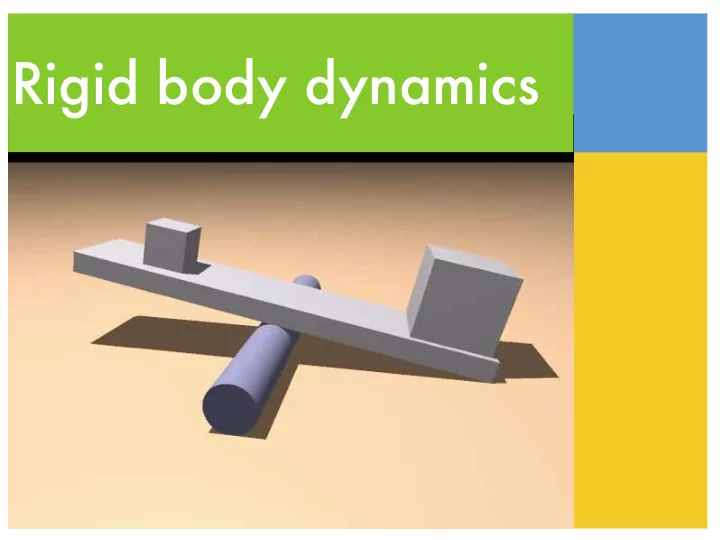
Rigid body dynamics Rigid body simulation Once we consider an - - PowerPoint PPT Presentation
Rigid body dynamics Rigid body simulation Once we consider an object with spatial extent, particle system simulation is no longer sufficient Rigid body simulation Unconstrained system no contact Constrained system collision
Once we consider an object with spatial extent, particle system simulation is no longer sufficient
Performance is important!
Control is difficult!
Y(t) = x(t) v(t)
˙ Y(t) =
f(t)/m
Position Linear velocity Mass Linear momentum Force Orientation Angular velocity Inertia tensor Angular momentum Torque Translation Rotation
Translation of the body
x(t) = x y z
Rotation of the body
R(t) = rxx ryx rzx rxy ryy rzy rxz ryz rzz
and are called spatial variables of a rigid body x(t) R(t)
Body space
x0 y0 r0i z0
A fixed and unchanged space where the shape of a rigid body is defined The geometric center of the rigid body lies at the origin of the body space
x0 y0 z0 r0i
World space Body space
x y z
x0 y0 r0i z0 x(t) R(t)
What are the world coordinates of an arbitrary point r0i on the body?
Use x(t) and R(t) to transform the body space into world space
ri(t) = x(t) + R(t)r0i
x0 y0 z0 r0i
World space
x y z
x(t) R(t)
Consider the x-axis in body space, (1, 0, 0), what is the direction of this vector in world space at time t?
R(t) 1 = rxx rxy rxz which is the first column of R(t)
R(t) represents the directions of x, y, and z axes of the body space in world space at time t
v(t) = ˙ x(t)
Since is the position of the center of mass in world space, is the velocity of the center of mass in world space
˙ x(t) x(t)
Direction of ?
ω(t)
Magnitude of ?
|ω(t)|
We describe that spin as angular velocity, a vector ω(t) Using this representation, any movement of COM is due to the linear velocity. Angular velocity only spins the object around COM.
Linear position and velocity are related by v(t) = d
dtx(t)
How are angular position (orientation) and velocity related?
How are and related?
R(t) ω(t)
Hint:
a
b
= |ω(t) × b| = ω(t) × b + ω(t) × a
˙ c
ω(t)
c
Consider a vector at time t specified in world space, how do we represent in terms of ω(t) c(t) ˙ c(t) |˙ c(t)| = |b||ω(t)| ˙ c(t) = ω(t) × b ˙ c(t) = ω(t) × c(t)
Given the physical meaning of , what does each column of mean?
R(t) ˙ R(t)
At time t, the direction of x-axis of the rigid body in world space is the first column of
rxx rxy rxz
R(t)
At time t, what is the derivative of the first column
R(t)
˙ rxx rxy rxz = ω(t) × rxx rxy rxz
˙ R(t) = ω(t) × rxx rxy rxz ω(t) × ryx ryy ryz ω(t) × rzx rzy rzz
This is the relation between angular velocity and the
We can use a trick to simplify this expression
Consider two 3 by 1 vectors: a and b, the cross product of them is
a × b = aybz − byaz −axbz + bxaz axby − bxay
Given a, let’s define a* to be a skew symmetric matrix
−az ay az −ax −ay ax
then
a∗b = −az ay az −ax −ay ax bx by bz = a × b
˙ R(t) = ω(t)∗ rxx rxy rxz ω(t)∗ ryx ryy ryz ω(t)∗ rzx rzy rzz = ω(t)∗R(t) ˙ R = ω(t)∗R(t)
Matrix relation:
˙ R(t) = ω(t) × rxx rxy rxz ω(t) × ryx ryy ryz ω(t) × rzx rzy rzz
Vector relation: ˙
c(t) = ω(t) × c(t)
ri(t) = x(t) + R(t)r0i
angular component linear component
= ω∗(R(t)r0i + x(t) − x(t)) + v(t) ˙ r(t) = d dtr(t) = ω∗R(t)r0i + v(t) = ω∗(ri(t) − x(t)) + v(t) ˙ ri(t) = ω × (ri(t) − x(t)) + v(t)
˙ ri(t) = ω × (ri(t) − x(t)) + v(t)
ω(t) × (ri(t) − x(t)) v(t) v(t) ˙ ri(t)
x y z
ri (t) x0 y0 z0 x(t)
ω(t)
Center of mass in world space miri(t) M
M =
N
mi
Mass The mass of the i-th particle is mi What about center of mass in body space? (0, 0, 0)
Proof that the center of mass at time t in word space is x(t)
miri(t) M = = x(t)
Inertia tensor describes how the mass of a rigid body is distributed relative to the center of mass I(t) depends on the orientation of a body, but not the translation For an actual implementation, we replace the finite sum with the integrals over a body’s volume in world space r′
i = ri(t) − x(t)
I = X
i
2 6 4 mi(r
02
iy + r
02
iz)
−mir0
ixr0 iy
−mir0
ixr0 iz
−mir0
iyr0 ix
mi(r
02
ix + r
02
iz)
−mir0
iyr0 iz
−mir0
izr0 ix
−mir0
izr0 iy
mi(r
02
ix + r
02
iy)
3 7 5
I(t) = R(t)IbodyR(t)T Ibody =
mi((rT
0ir0i)1 − r0irT 0i)
Pre-compute Ibody that does not vary over time
I(t) =
i r′ i)1 − r′ ir′T i )
=
=
0ir0i)R(t)T 1 − R(t)r0irT 0iR(t)T )
= R(t)
0ir0i)1 − r0irT 0i)
I(t) = X mir0T
i r0 i
2 4 1 1 1 3 5 − 2 4 mir02
ix
mir0
ixr0 iy
mir0
ixr0 iz
mir0
iyr0 ix
mir02
iy
mir0
iyr0 iz
mir0
izr0 ix
mir0
izr0 iy
mir02
iz
3 5
I(t) = R(t)IbodyR(t)T Ibody =
mi((rT
0ir0i)1 − r0irT 0i)
Pre-compute Ibody that does not vary over time
I(t) =
i r′ i)1 − r′ ir′T i )
=
=
0ir0i)R(t)T 1 − R(t)r0irT 0iR(t)T )
= R(t)
0ir0i)1 − r0irT 0i)
I(t) = X mir0T
i r0 i
2 4 1 1 1 3 5 − 2 4 mir02
ix
mir0
ixr0 iy
mir0
ixr0 iz
mir0
iyr0 ix
mir02
iy
mir0
iyr0 iz
mir0
izr0 ix
mir0
izr0 iy
mir02
iz
3 5
accurate
requires volume test
representation
F · ds =
D
(∇ × F) · da
Fi(t) denotes the total force from external forces acting
F(t) =
Fi(t)
ri (t) x0 y0 z0 x(t)
Fi(t)
x y z
τ(t) =
(ri(t) − x(t)) × Fi(t)
τ(t) = (ri(t) − x(t)) × Fi(t)
forces acted on the body
the forces over the body
relative to the center of mass?
P(t) =
mi ˙ ri(t) =
miv(t) + ω(t) ×
mi(ri(t) − x(t)) = Mv(t)
Total linear moment of the rigid body is the same as if the body was simply a particle with mass M and velocity v(t)
Similar to linear momentum, angular momentum is defined as
L(t) = I(t)ω(t)
Does L(t) depend on the translational effect x(t)? Does L(t) depend on the rotational effect R(t)? What about P(t)?
˙ P(t) = M ˙ v(t) = F(t) ˙ L(t) = τ(t)
Change in linear momentum is equivalent to the total forces acting on the rigid body The relation between angular momentum and the total torque is analogous to the linear case
Proof
˙ L(t) = τ(t) =
i × Fi
−
i ˙
r′∗
i
i r′∗ i
ω = τ
i mi( ˙
v − ˙ r′∗
i ω − r′∗ i ˙
ω) −
i Fi = 0
mi¨ ri − Fi = mi( ˙ v − ˙ r′∗
i ω − r′∗ i ˙
ω) − Fi = 0
i r′∗ i =
i r′ i)1 − r′ ir′T i ) = I(t)
−
i ˙
r′∗
i
ω = τ ˙ I(t) = d dt
i r′∗ i =
i ˙
r′∗
i − mi˙
r′∗
i r′∗ i
˙ I(t)ω + I(t) ˙ ω = d dt(I(t)ω) = ˙ L(t) = τ
F F
What is the direction of acceleration?
Y(t) = x(t) R(t) P(t) L(t)
v(t) = P(t) M I(t) = R(t)IbodyR(t)T ω(t) = I(t)−1L(t)
d dtY(t) = v(t) ω(t)∗R(t) F(t) τ(t)
Constants: M and Ibody
position
linear momentum angular momentum
quaternion, it is easily correctable by renormalizing the quaternion to unit length
v1 w2 v2
w1v2 + w2v1 + v1 × v2
q1(q2q3) = (q1q2)q3
need to compute time derivative of quaternion
q = w x y z R(q) = 1 − 2y2 − 2z2 2xy + 2wz 2xz − 2wy 2xy − 2wz 1 − 2x2 − 2z2 2yz + 2wx 2xz + 2wy 2yz − 2wx 1 − 2x2 − 2y2 1
Y(t) = x(t) R(t) P(t) L(t)
v(t) = P(t) M I(t) = R(t)IbodyR(t)T ω(t) = I(t)−1L(t)
d dtY(t) = v(t) ω(t)∗R(t) F(t) τ(t)
Constants: M and Ibody
position
linear momentum angular momentum
Y(t) = x(t) R(t) P(t) L(t)
v(t) = P(t) M I(t) = R(t)IbodyR(t)T ω(t) = I(t)−1L(t)
d dtY(t) = v(t) ω(t)∗R(t) F(t) τ(t)
Constants: M and Ibody
position
linear momentum angular momentum
˙ q(t) = 1 2ω(t)q(t) ˙ q(t) q(t) R(t) = quatToMatrix(q(t))
q(t) = w x y z ˙ q(t) = 1 2 ω(t)
quaternion multiplication
Consider a 3D sphere with radius 1m, mass 1kg, and inertia Ibody. The initial linear and angular velocity are both zero. The initial position and the initial
and an initial push F applied at point p. Note that F is only applied for one time step at t0. If we use Explicit Euler method with time step h to integrate , what are the position and the orientation of the sphere at t2? Use the actual numbers defined as below to compute your solution (except for g and h).
x0 2 , y0 2 , −z0 2
2 , −y0 2 , z0 2
y z
Ibody = M 12 y2
0 + z2
x2
0 + z2
x2
0 + y2
x y z
(−3, 0, 2)
F
(3, 0, 2)
F
x y z
(−3, 0, 2)
F
(3, 0, 2)
F
energy = 0
F
10 sec later energy = 0
F F
energy = 1
2MvT v
Suppose a force F acts on the block at the center
acting on the block, the body will only acquire linear velocity v after 10 seconds. The kinetic energy will be
1 2MvT v
Now, consider the same force acting off-center to the body for 10
after 10 seconds is the same v. However, the block will also pick up some angular velocity ω. The kinetic energy will be
1 2MvT v + 1 2ωT Iω
If identical forces push the block in both cases, how can the energy of the block be different?