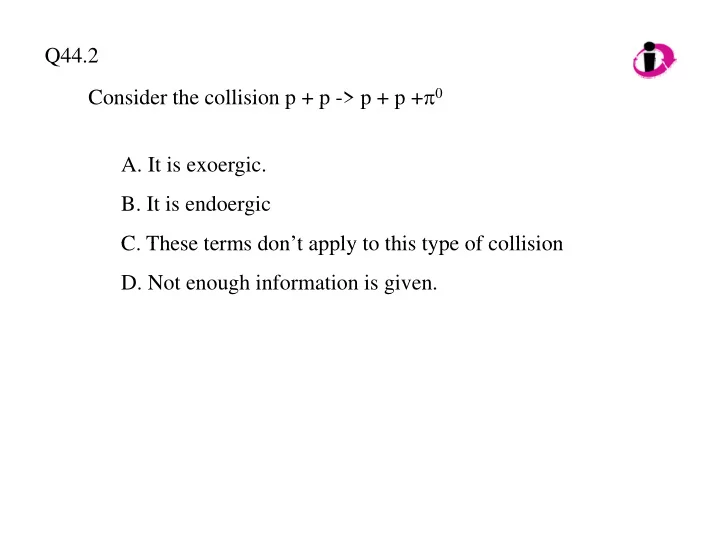
SLIDE 1 Q44.2 Consider the collision p + p -> p + p +0 Consider the collision p + p p + p +
g
C These terms don’t apply to this type of collision
- C. These terms don t apply to this type of collision
- D. Not enough information is given.
SLIDE 2 Q44.2 Which collision has the largest available energy? Which collision has the largest available energy?
- A. A 50 GeV electron hitting a positron at rest.
g p
- B. A 50 GeV positron hitting an electron at rest.
C A 25 GeV electron hitting a 25 GeV positron traveling
- C. A 25 GeV electron hitting a 25 GeV positron traveling
in the other direction. D They all have the same available energy
- D. They all have the same available energy.
- E. A and B.
SLIDE 3
Stanford Linear Accelerator Center two miles long Electrons - positions 1962: Contract execution and start of accelerator construction 1966: Construction completed and research begins 1967: 20 GeV electron beam achieved 1967: 20-GeV electron beam achieved 1968: First evidence discovered for quarks 1974: Discovery of psi particle 1976: Discovery of charm quark and tau lepton y q p
SLIDE 4
International Linear Collider 31 km long, 500 GeV
SLIDE 5 I ti f th l t 1931 Invention of the cyclotron 1931
11-inch diameter 1 MeV protons 27-inch diameter 1932 (80 ton magnet) (80 ton magnet) 3.6 MeV protons
SLIDE 6
Tevatron, at Fermilab In Illinois 1985 6.3 km in circumference 1 TeV proton-antiproton
SLIDE 7 Q44.2 Which of the following is true? Which of the following is true?
- A. It is not practical to make a larger accelerator than
p g the Tevatron.
- B. It is possible but it costs too much.
- C. It is possible and practical, but plans have been
deferred to the distant future.
- D. A larger accelerator than the Tevatron has already
been built.
SLIDE 8
Large Hadron Collider CERN, Switzerland/France project begun 1995 27 km in circumference 7 TeV proton-antiproton
SLIDE 9
Large Hadron Collider
Souped up Microwave Ovens ½ nanogram in Beam – Souped up Microwave Ovens 1232 Super Conducting Dipole Magnets Kinetic Energy of High Speed TGV . Train between Geneva-Paris
SLIDE 10
SLIDE 11
SLIDE 12
SLIDE 13
SLIDE 14
Rutgers at the LHC: faculty
EXPERIMENT: Yuri Gershtein, Eva Halkiadakis, Amit Lath, Steve Schnetzer, Sunil Somalwar THEORY: Tom Banks, Greg Moore, Sasha Zamalodchikov, Emanuel Diaconescu, Daniel Friedan S i L k M tt St l S tt Th D id Shih Sergei Lukyanov, Matt Strassler, Scott Thomas, David Shih,
SLIDE 15
Rutgers at the LHC
Yuri Gershtein, Eva Halkiadakis, Amit Lath, Steve Schnetzer, Sunil Somalwar, Tom Banks, David Shih, Greg Moore, Sasha Zamalodchikov, Emanuel Diaconescu, Daniel Friedan, Sergei Lukyanov, Matt Strassler, S tt Th B b St J h D h k Pi t J
Faculty + Physicists:
Scott Thomas, Bob Stone, John Doroshenko, Pieter Jacques
Postdocs:
Richard Gray, Dan Dugan, Dean Hidas, Can Kilic, Adam Falkowski, Olexei Atramentov , Daniel Jafferis, Alexey Litvinov, Samuel Monnier, Daniel Roggenkamp, Wu-Yen Chuang, Dieter van den Bleeken gg p g
Students:
Keith Rose, Dmitry Hits, Anthony Barker, Shruti Panwalkar, Rishi Patel, Claudia Seitz, Daryl Hare, Tim Lou, Lindsay Winter, Gautam Jain, David DeMair, Ed Ronan, Richard Bavier, Jorge Chavez, Ian LaFlotte AJ Richards Yue Zhao Michael Park Evgeny Andriyash LaFlotte, AJ Richards, Yue Zhao, Michael Park, Evgeny Andriyash, Jose Jukenvich, Guang Pan, Robert Schabinger, Patrick Zywicki, Emmanuel Contreras, Christian Contreras , Sean Yeager, Eric Williams, Alex Sood
SLIDE 16
SLIDE 17
SLIDE 18 The most energetic cosmic g ray ever found was detected over Utah in 1991 and carried an energy of 300 billion billion electron 300 billion billion electron volts (3 times 10 to the 20th power). It was detected by the University of Utah's
- riginal Fly's Eye
- bservatory, which was built
at Dugway during 1980- 1981 and improved in 1986 1981 and improved in 1986. A better observatory was constructed during 1994- 1999 and named the High Resolution Fly's Eye.
SLIDE 19
LHC starts up
SLIDE 20 CMS animation of the high-energy collisions at 7 TeV on 30th March 2010
reconstruct reaction from particle debris from collision
C S a at o
g e e gy co s o s at e
a c 0 0