SLIDE 1
SLIDE 2
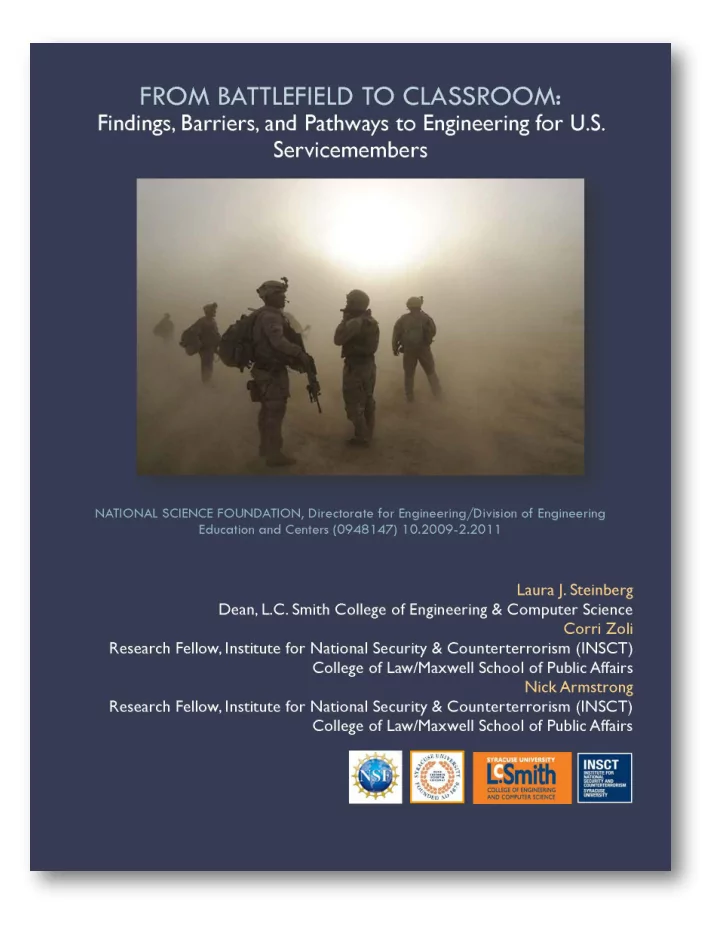
Note on Image: Sgt. 1st Class Lance Amsden, platoon sergeant for the 1st Platoon, Company C, 1st Battalion, 501st Infantry Regiment, 4th Brigade Combat Team (Airborne), 25th Infantry Division, watches as CH-47 Chinook helicopters circle above during a dust storm at Forward Operating Base Kushamond, Afghanistan, during preparation for an air assault mission. Note on Authors: Laura J. Steinberg, Ph.D. Dean, LC Smith College of Engineering and Computer Science Syracuse University 223 Link Hall Syracuse, NY 13244-1240 315-443-4341(phone) 315-443-4936 (fax) ljs@syr.edu Corri Zoli, Ph.D. Assistant Research Professor Institute for National Security and Counterterrorism (INSCT) Maxwell School of Citizenship and Public Affairs Syracuse University College of Law 541F White Hall Syracuse University, Syracuse, NY 13244-1030 (tel) 315.443.4523 | (fax) 315.443.9643 cbzoli@syr.edu Nicholas J. Armstrong National Security Research Fellow Institute for National Security and Counterterrorism (INSCT) Maxwell School of Citizenship and Public Affairs Syracuse University College of Law 402 MacNaughton Hall Syracuse University, Syracuse, NY 13244 (p) 315-443-2033 | (f) 315-443-9643 narmstro@maxwell.syr.edu Note on the Report: This Report is a DRAFT of preliminary findings. Please contact the authors if you wish to reproduce or disseminate this material: citation is permissible, so long as it is noted that the work cited is a draft of research findings.
SLIDE 3
Contents
1.0 Project Background and Overview…………………………………………………………………………....1 1.1 Five Initial Assumptions…………………………………………………………………………………………………..1 1.2 Post-9/11 Veterans Educational Assistance Act of 2008……………………………………………………….2 1.3 Veterans “By the Numbers”: Implications for Higher Education and Engineering……………………..3 1.4 Why is this Research Important? Lessons Learned from the Original 1944 GI Bill……………………..4 2.0 Study Design and Approach…………………………………………………………………………………….6 2.1 Interdisciplinary Research Team………………………………………………………………………………………6 2.2 Existing Studies and Research Literature…………………………………………………………………………...7 2.3 Veteran’s Education and Engineering: Research Questions…………………………………………………..9 2.4 Coordinated Data Collection and Mixed Methods……………………………………………………………….9 3.0 Preliminary Findings: Five Broad Categories………………………………………………………………11 3.1 Engineering Aspirations and Military Servicepersons as Postsecondary Students: The ‘Bad News’………………………………………………………………………………………………………………………..11 3.2 Veteran Student Needs and Supports in the Academic Environment: Veteran Recommendations……………………………………………………………………………………………………….12 3.3 Military Culture and Traits: Predictors of Academic Needs and Success?.....................................13 3.4 Pathways: Educational and Career………………………………………………………………………………….13 4.0 Recommendations: Future Directions In Research & Questions We Are Left With………………14 4.1 How to Contend with Barriers for Veterans in the Postsecondary Education and Engineering Contexts?....................................................................................................................................14 4.2 Some Potential Problems: A Daunting Amount of Work for Universities?....................................14 4.3 Additional Research Needed/Future Questions…………………………………………………………………15 5.0 Summary Discussion Points and Findings………………………………………………………………….16 5.1 National Science Foundation Veterans’ Education in Science and Engineering Meeting Presentation Slides, Washington, DC (15 March 2011): Appendix A….……………………………………………………..16
SLIDE 4
5.2 “Success Stories”: Establishing a Compendium of Advice for Integrating Veterans into Higher Education………………………………………….………………………………………………………………………..16 5.3 Outreach/Recruitment: Defining a New Approach to Veterans Education……………………………..17 5.4 Veterans as Student: Respectfully Identifying Needs…………………………………………………………17 5.5 Evaluation Strategies: Evaluating the Evaluators ………………………………………………………………19
SLIDE 5 1
1.0 PROJECT BACKGROUND AND OVERVIEW In this section, we provide background, premises, and aggregate results from our ongoing data collection efforts, supported by the National Science Foundation Support (NSF), begun in September
- 2009. Our data comprises active duty servicemembers and veterans in their educational aspirations,
including their intentions to use their Post-9/11 GI Bill (and Yellow Ribbon Program) educational benefit, particularly with respect to the fields of science, technology, engineering, and mathematics (STEM). Our work was initially framed from the point of view of higher educational institutions and the needs of decision-makers, such as university engineering deans, to estimate and plan for the projected 2-3 million veterans to use their Post-9/11 GI Bill benefits in the years following the bill’s
- implementation. After initial discussions, we quickly realized the scarcity of data on servicepersons’
educational aspirations and intentions, and, thus, the critical importance of thinking about higher education from the point of view of servicemembers themselves. We also discovered, given the often limited interest in pursuing degrees in engineering and the STEM fields more generally, that a more holistic approach to higher education and what it means to servicemembers was in order. Our research results thus reflect the continuing evolution and refinement of our research questions. 1.1 Five Initial Assumptions: Our research began with five initial assumptions, many of which still hold after two years of research:1 First, women and men of the U.S. armed forces, once they leave the services, are a potential critical resource for U.S. technical capacity in the private sector but also in government. Many servicepersons have been immersed in technical activities in their military jobs, possess an abundance of technical training, have familiarity with cutting-edge technologies and equipment, and, thus, have the potential to form the backbone of U.S. engineering and technology innovation in the near future. Second, the unprecedented diversity of the U.S. armed forces offers the potential for an amazingly diverse pipeline for higher education institutions in general and for engineering in particular. Third, universities are currently at a critical juncture in which newly expanded veterans’ benefits enables higher education to serve those who have served and for both parties—universities and veterans—to gain valuable experiences from the presence of veterans on campus made possible by the new GI Bill.
1 One of the first conversations about this critical need area occurred in 2009 with a working group called
together by the Division of Engineering Education and Centers of NSF to discuss the ramifications of the Post 9/11 GI Bill for Engineering Education. The group reached a number of conclusions: (1.) Recognize the need for special pathways for veterans in STEM; (2.) NSF recommended a $100 million program to support these pathways and include year-round programming, establishing specialized support services, and industry-university partnerships; (3.) Data collection and interpretation is needed to insure that funding for these activities is correctly targeted, including data on the number of GIs likely to undertake STEM education. See National Science Foundation (2009), Veterans’ Education for Engineering and Science: Report of the National Science Foundation Workshop on Enhancing the Post 9/11 Veterans Educational Benefit, McLean, VA (13 April 2009).
SLIDE 6 2
Fourth, the Post-9/11 GI Bill education benefit—if utilized wisely—offers taxpayers the potential to realize a powerful investment with a transformative effect on the U.S. economy, much like the
- riginal 1944 GI Bill: not only in training the nation’s workforce and solidifying the middle class, but
in enhancing the higher education infrastructure with new curricula, programs, courses, research, teaching, equipment, etc. Fifth, we recognize the opportunity to maximize the long history of collaboration between the STEM fields and U.S. government defense sectors, a partnership in innovation in technical research, U.S. economic growth, and U.S. global competitiveness, which also aids in national security. 1.2 Post-9/11 Veterans Educational Assistance Act of 2008 Much of our research depends upon the passage of the Post-9/11 Veterans Educational Assistance Act
- f 2008 (passed on June 30, 2008; active 1 August 2009), otherwise known as the Post-9/11 GI Bill.2
The Post-9/11 GI Bill is the largest expansion of veterans’ education benefits since the original GI Bill in 1944 and a significantly larger investment than the 1985 Montgomery GI Bill in which beneficiaries must have served at least three years and contributed $1,200.00 in their own funds to receive the benefit. By contrast, all servicemembers (including reservists) who served a minimum of 90 days active duty (after 9/10/2001) are eligible for Post-9/11 GI Bill educational benefits, which cover up to 36 months at an average of $458 p/credit hour. The new GI Bill thus funds 100 percent of a public 4- year undergraduate education for those who have served three years active duty.3 Moreover, in the
2 Title V of Supplemental Appropriations Act of 2008, Pub.L. 110-252, H.R. 2642, an Act of Congress
which became law on June 30, 2008: act amended Part III of Title 38, United States Code, to include a new Chapter 33, expanding educational benefits for military veterans who have served since September 11, 2001. Previous bills were Chapter 30 (1984-2008) Montgomery GI Bill, Active Duty (MGIB), including a 1:8 buy up option adding 5400.00 dollars to total entitlement; Montgomery G.I. Bill (Chapter 31) vocational rehabilitation program serving eligible active duty servicemembers and veterans with service-connected disabilities; Veterans Educational Assistance Program (VEAP) for active duty servicepersons entering between 1977-1985 on a 1:2 ratio for degree and certificate programs, training, apprenticeship, correspondence courses; Chapter 35 Survivors' and Dependents' Educational Assistance Program (DEA) provides up to 45 months of education benefits to eligible dependents of disabled, injured, killed veterans; Chapter 1606/Montgomery GI Bill, Selected Reserve (MGIB-SR) available to all military branch reserve components, Army National Guard and Air National Guard; Chapter 1607 Reserve Educational Assistance Program (REAP) available to all reservists who, after 9.11. 2001 complete 90 days
- r more of active duty service "in support of contingency operations" (i.e., provides reservists returning from
active duty with up to 80% of Chapter 30 GI Bill benefits as long as they remain active in reserves).
3 For a discussion of the Post 9/11 GI Bill, see U.S. Department of Veterans Affairs, available at
<http://www.gibill.va.gov/>. For a discussion of new “Upcoming Changes to The Post-9/11 GI-Bill,” see U.S. Department of Veterans Affairs, http://www.gibill.va.gov/benefits/post_911_gibill/Post911_changes.html.The changes in Chapter 33 benefits/Post-9/11 Veterans Education Assistance Improvements Act of 2010 recently signed into law (effective 1 Aug 2009, payable 1 Oct 2011) include: (1.) Expands Ch. 33 benefits to active duty National Guard under title 32 USC for organizing, administering, recruiting, instructing, or training Guard; or under section 502(f) for the purpose of responding to a national emergency; (2.) Effective 1 Aug 2011, simplifies tuition and fee rates for veterans and transferees attending public schools; creates a national maximum for those enrolled in a private or foreign school; prorates housing allowance by student’s rate of pursuit; break or interval pay is no longer payable under any VA education benefit; allows reimbursement for multiple “licenses or certifications”; reimbursement of fees paid to take national exams used for admission to an institution of higher learning (e.g., SAT, LSAT); allows those eligible for both Vocational Rehabilitation and Employment (chapter 31) benefits and Post-9/11 GI Bill (chapter 33) benefits to choose the Post-9/11 GI Bill’s monthly housing allowance
SLIDE 7 3
progressive recognition that military service has repercussions for family members’ higher education plans, the benefit is transferable to dependents (i.e., a spouse, children) under certain service agreements (i.e., agreeing to serve 10 years). An equally innovative aspect of current educational benefits for servicepersons is the Yellow Ribbon matching program in which private universities attempt to make up the difference between what the GI Bill pays for the highest public in-state undergraduate tuition and fees. If tuition and fees at a private institution, graduate school, or an out-of-state school exceed the public university rate, a Yellow Ribbon participating university agrees to cover those differences. Higher education institutions voluntarily enter into a Yellow Ribbon Agreement with the Department of Veterans Affairs (VA) and choose the amount to be contributed.4 The Post-9/11 GI Bill has lowered the financial barriers for servicepersons seeking higher education and, in turn, encouraged higher education institutions to better focus on the needs of returning veterans, as well as increasing educational services and outreach efforts specific to this constituency. 1.3 Veterans “By the Numbers”: Implications for Higher Education and Engineering U.S. federal agencies predict that over the next five years approximately two to three million separated soldiers, largely from the Iraq and Afghanistan campaigns, will transition out of the services.5 We have provided some of the following estimations of this population for orientation:
- There are 22.8 million total veterans (as of 9.30.2010);6
- There are approximately 5.5 million Gulf War veterans (service from 2 August 1990 to present);7
- There are approximately 2.5 million (post 9/11, actually 9.30.2001 service) veterans;8
- There are approximately 1.5 active duty military personnel today (as of 30 September 2010).9
instead of the chapter 31 subsistence allowance; (3.) Effective 1 Oct 2011: Allows students to use Post-9/11 GI Bill for: non-college degree programs, on-the-job and apprenticeship training, correspondence training, and flight programs; pays a monthly benefit amount prorated based on time in program and up to $83 per month for books and supplies; pays actual net costs for in-state tuition and fees assessed by school or $10,000, whichever is less; housing allowance now payable to students (other than those on active duty) enrolled solely in distance learning; allows active duty students to receive a books and supplies stipend; (4.) School Certifying Officials: reporting fees paid to schools increases from $7 to $12 and $11 to $15 per student per year; standard college degree programs
- ffered at accredited public and private-not-for-profit schools are deemed already approved for VA Education
Benefits.
4 For a discussion of the Yellow Ribbon Program see United States Department of Veterans Affairs,
Yellow Ribbon Program, available at <http://www.gibill.va.gov/gi_bill_info/ch33/yellow_ribbon.htm>.
5 See National Center for Education Statistics (2009), Issues Tables: A Profile of Military Service Members
and Veterans Enrolled in Post-Secondary Education in 2007-2008 (NCES 2008-182). Washington, D.C.: Radford, A. W., Wun, J., & Weko, T.
6 See the U.S. Census Bureau, Statistical Abstract of the United States (2011), Table 518, Veterans by
Selected Period of Service, and State (2009), data taken from Department of Veterans Affairs, Office of the Actuary, Veteran Population Projections Model (VetPop2007), Table 5L.
7 See the U.S. Census Bureau, Statistical Abstract of the United States (2011), Table 518, Veterans by
Selected Period of Service, and State (2009).
8 See the U.S. Department of Veterans Affairs, Office of the Actuary, Veteran Population Projections
Model, VetPop2007, Table 10L, Veterans 2000-2036 by Gulf War Service, Age, Gender, Period.
SLIDE 8 4 Some implications for higher education and engineering education are:
- 1. Universities and academic leaders need to predict the numbers of servicepersons and veterans likely
to attend their programs, develop means and mechanisms to understand veteran needs, and begin to plan and develop programs and supports for them;
- 2. There is a tremendous diversity of talent—particularly technical training and in diverse backgrounds—
represented in the all-volunteer force which, post-service, will be directed toward such traditional fields as law enforcement and criminology, business and finance programs, etc., unless academic leaders help veterans understand the educational and career possibilities in the STEM fields and in engineering;
- 3. A significant barrier and challenge in recruiting veterans for the STEM fields and for engineering is a
lack of familiarity on the part of this population with higher educational institutions, a lack of familiarity by higher educational institutions about veterans educational preferences and needs and, in turn, a lack of knowledge among veterans about how their training and technical capacity might translate into an engineering/STEM degree program.
- 4. Without a clear and decisive role by academic leaders in industry and governmental partnerships, this
moment may amount to a lost opportunity for universities to integrate veterans into higher education in ways that help innovate universities, make links between STEM education and defense research, and bring STEM recipients into government and public leadership positions. 1.4 Why is this Research Important? Lessons Learned from the 1944 GI Bill: We know that the first 1944 GI Bill increased educational and training opportunities, strengthened and expanded the U.S. postwar economy particularly in STEM, and delivered us the so-called “Greatest Generation.” More specifically, World War II veterans formed the backbone of this modernizing era in which the United States became both a technological powerhouse at home and a global superpower
- abroad. Edward Humes in Over Here: How the GI Bill Transformed the American Dream, notes that 14
Nobel Prize winners, 91,000 scientists, 67,000 doctors, and 450,000 engineers, not to mention many
- ther educated professionals, got their start with GI Bill benefits. In the GI Bill’s peak year of 1947,
veterans accounted for 49 percent of college admissions, and by the GI Bill’s end in 1956, 7.8 million of 16 million veterans had completed education or training programs. If veterans themselves were the most direct beneficiaries of these public expenditures, U.S. society quickly reaped the benefits in several pivotal economic and social trends: the democratization and increased inclusivity of universities; the conversion to a nation of home-owners; the expansion of the middle class from 10 to 30 percent; increased global competitive edge for the United States, and the pronounced role for STEM innovation in U.S. economic superiority. It is important to remember, however, that these developments required two linked mechanisms: (1.) the historic 1944 GI Bill which educated nearly 8 million veterans and (2.) the
9 See U.S. Department of Defense, Active Duty Military (ADS) Personnel by Rank/Grade. The total
number of military personnel is over 3.5 million strong, including Active Duty military personnel (1,387,674); DHS’s Active Duty Coast Guard members (41,362); DoD Ready Reserve and DHS Coast Guard Reserve members (1,080,617); and DoD appropriated and nonappropriated-fund civilian personnel (835,739). DoD’s Active Duty and DHS’s Coast Guard Active Duty members comprise the largest portion of the military force (40.3%), supplemented by Ready Reserve members (30.4%) and DoD civilian personnel (23.5%).
SLIDE 9
5
availability of meaningful educational and professional pathways for students. We also recognize that we are not alone in these linked endeavors. The National Science Foundation, the Veterans Affairs Department, the American Council on Education (ACE), as well as researchers at many universities and at RAND are in the process of making significant strides to understand and aid in servicepersons’ educational needs.
SLIDE 10 6
2.0 STUDY DESIGN AND APPROACH: Higher educational institutions often approach the issue of veterans education in traditional and unidirectional ways, asking how universities might offer supports for incoming veteran students. Only recently have universities begun to consider how veterans may make significant contributions to college and to university campuses. We have, therefore, approached this subject dialectically as a multi-directional issue, asking what we can offer veterans, but also contemplating what veterans can
- ffer university campuses.
We have already learned in our preliminary findings that veterans’ contributions are potentially extremely significant in such areas as civic duty in action, a form of what we call “scholarship in action” at Syracuse University; leadership skills; discipline; real world experience; a commitment to excellence; an ability to persevere and to be resilient; agility in teamwork; frankness about vulnerabilities and mistakes and needing supports (i.e., PTSD); diversity of experience and backgrounds from, indisputably, the most diverse institution in the country, etc. 2.1 Interdisciplinary Research Team: Dean Laura Steinberg’s experiences as a member of the NSF Veteran’s Education working group and her role as an engineering dean made it patently clear that one of the most pressing questions for research in this critical need area is: how the engineering education establishment would respond to servicepersons’ educational needs and aspirations. In gathering an interdisciplinary research team, we identified why interdisciplinarity was so important to this particular research area, especially in methodological design and analysis of findings. For some time the NSF has recognized the need to bring engineering and social science researchers and educators together. The point was never simply to position engineers and social scientists to separately address problems in engineering, the pipeline, for instance, but to build collaborative research teams able to mount a synthetic research framework adept at integrating multiple disciplinary perspectives into design and analysis. Such a working model, at its core, assumes engagement, debate, and dialogue across very different approaches to common problems. Our interdisciplinary operating approach has been able to freshen and broaden our understanding of veteran’s education by appealing to and drawing from an expansive body of studies in such areas as education, curriculum, and program development; leadership, policy and public affairs, military culture, demographics, and service personnel, and others. Additionally, different perspectives interpret the same data, the same findings, in different ways: what might appear to be simple lack of interest in engineering, for instance, turned out to be a problem of translation and educational literacy. It is also critical to note that as we develop veteran’s education programs we will need social scientists to help us study them and to raise new research questions: now that veterans are enrolling, are they succeeding, etc? Team Participants include faculty members from three different Colleges at Syracuse University: L.C. Smith College of Engineering & Computer Science, the Maxwell School of Public Affairs, and the School
SLIDE 11 7
- Laura J. Steinberg, Professor of Civil and Environmental Engineering and Public Administration,
Maxwell School of Citizenship and Public Affairs
- Corri Zoli, Assistant Research Professor at the Institute for National Security and
Counterterrorism (INSCT), joint appointment in the Maxwell School of Citizenship and Public Affairs and the College of Law, with expertise in qualitative methods, study design, focus interviews, and analysis
- Tim Eatman, Assistant Professor of Higher Education, College of Education, with expertise in
educational theory and pedagogy
- Yingyi Ma, Assistant Professor of Sociology, Maxwell, with expertise in statistical analysis
- James Henderson, Assistant Professor of Bioengineering at LCS, with expertise in engineering
education Our team also included several Graduate Assistants and research consultants:
- Nicholas Armstrong, INSCT Research Fellow, social science ABD/PhD candidate, West Point
graduate (w/ engineering degree), US Army Ranger (attached to 10th Mountain Division), Artillery officer in Bosnia, Iraq, and Afghanistan
- Dawn Johnson, Assistant Professor in Higher Education, research focused on underrepresented
students in undergraduate STEM majors
- Ann Sheedy, LMSW, ABD, Child and Family Studies, College of Human Ecology
- Nicholas Santella, Ph.D. Geology
- Greg Nelson, Masters of Public Administration Candidate, Maxwell School of Public Affairs.
Please see the Appendices for our Advisory Board and our Military Professional Consulting Group of graduate student servicepersons on campus. 2.2 Existing Studies and Research Literature: Surprising little data at the national level and across the military service branches exists that investigates and understands active and separated servicepersons’ educational intentions, aspirations, and needs. In fact, very little information exists even among the federal agencies responsible for veterans’ educational benefits about the type of academic degree programs that veterans choose, their retention in such programs, their degree completion rates, their post-degree career routes, as well as
- ther relevant items. More specifically, Veterans Affairs (VA) does not collect this data. The U.S.
Census Bureau and Labor Department do not collect this data. Nor does the Department of Defense (DoD), Defense Manpower Data Center (DMDC), under the Office of the Secretary of Defense, or the DoD Personnel and Procurement Statistics collect this data—at least as it is available in the public
- domain. Moreover, there is even less data on servicepersons and veterans’ experiences with the new
Post-9/11 GI Bill. Some emergent research has begun to conduct initial forays into understanding veterans’ educational goals, needs, and programs of study, but many of these new studies have drawn fairly
SLIDE 12 8
conventional conclusions or are not addressing STEM issues proper.10 For instance, the American Council on Education (ACE) recently tasked RAND researchers to examine veterans students’ experiences using Post-9/11 GI Bill educational benefits during its first year of activation (the study period was February—August 2010), as well as the bill’s implementation challenges. The ACE Report found that college students reported that Post-9/11 Bill benefits motivated them to return to school; that student veterans faced transition challenges, which were somewhat ameliorated by connecting with fellow veterans; and that these students also faced administrative and course credit challenges. The ACE Report also found that universities could better train their own staff to deal with the GI Bill and to create veteran campus communities. Perhaps, some of the most innovative areas of study in veterans education include research on PTSD/Health and Traumatic Brain Injury (/TBI)11 and post-service transition.12 Likewise, the emergence
- f veterans advocacy programs on and off campuses—including the Iraq and Afghanistan Veterans of
America (IAVA) and the Student Veterans’ Association (SVA)—are extremely interesting developments in their own right and are beginning to garner interest from both the academic and veterans support communities. The NSF-sponsored research on “Veterans Education for Engineering and Science,” spearheaded by Sue Kemnitzer, Deputy Director, Engineering Education and Centers Division Directorate for Engineering, will likely offer significant new research in this area.13
10 See Jennifer L. Steele, Nicholas Salcedo, and James Coley, How Military Veterans Are Using the Post-
9/11 GI Bill and Adapting to Life in College, RAND (2010); Jennifer L. Steele, Nicholas Salcedo, and James Coley (2010), Military Veterans’ Experiences Using the Post-9/11 GI Bill and Pursuing Postsecondary Education, ACE/Lumina. Note that researchers found that the Post-9/11 GI Bill influenced higher education choices of some eligible service members, veterans, and dependents who took part in the study in these ways: 24% of respondents said new GI Bill had driven their decision to enroll in higher education; 18% said it had driven their choice of institution; 38% of respondents had difficulty in understanding their GI Bill benefit options.
11 See L. Jaycox and T. Tanielian, ed., Invisible Wounds of War (Santa Monica, CA: RAND Corporation,
2008).
12 See D. DiRamio, R. Ackerman, and R. Mitchell, “From Combat to Campus: Voices of Student-
Veterans,” NASPA Journal, 2008, 45(1), 73–102; Robert Ackerman, David DiRamio, Regina L. Garza Mitchell (2009), “Transitions: Combat Veterans as College Students,” New Directions For Student Services, No. 126: 5-14;
13 Some program awards include the following: Military Veterans Engineering Education Initiative Planning
Grant, Pennsylvania State University; Battlefield Perceptions of Engineering: An Institutional Response to Absent Pathways and Missing Engineering Students, Syracuse University; Transforming Military Veterans Experiences in Engineering, Texas A&M University; Engineering Veteran Pathways, University of Kentucky Research Foundation; San Diego SERVICE (Success in Engineering for Recent Veterans through Internship and Career Experience), San Diego State University Foundation; Veterans in Engineering Education Initiative, Eastern Washington University; Implementation of a Pilot Program for Successfully Transitioning Veterans Entering STEM, Mississippi State University; VetEngrProject, University of Washington; From Defense to Degree: Accelerating Engineering Degree Opportunities for Military Veterans, Kansas State University; Experiential Learning for Veterans in Assistive Technology and Engineering (ELeVATE), University of Pittsburgh; Connecting Veterans to Customized Engineering Education, University of San Diego; Soldier to Engineer: Planning VCU's Pathway, Virginia Commonwealth University; VETERANS@VT: A Program for Recruiting, Transitioning, and Supporting Veterans to Graduate Programs in Engineering and Beyond to Civilian Careers, Virginia Polytechnic Institute and State University; A Planning Grant Proposal for Transitioning America's Veterans to STEM Academic Programs, Mississippi State University; Development of Expandable and Sustainable Accelerated Masters Degree Programs in Engineering for Post 9/11 Veterans, VA University of Virginia; Transitioning Troops to Engineers: From Military Experience to a
SLIDE 13 9
2.3 Veteran’s Education and Engineering: Our Research Questions In many respects, this project’s overarching goal is to translate veteran technical talent into engineering educational and career pathways. In order to do this, we needed to learn a great deal more about this untapped technical talent pool using both quantitative and qualitative methods to develop a rich and specific sense of servicepersons’ educational intentions, aspirations, goals, and needs. Our research
- bjectives or questions were thus as follows:
1) Do U.S. active duty servicepersons and separated veterans have an interest in using their Post- 9/11 GI Bill benefits to pursue engineering education? 2) What are their aspirations for engineering fields and career trajectories? 3) What are their needs once they arrive at universities to pursue technical degrees? 4) How we might support them in these endeavors? The purpose of gathering information sources necessary to learn more about veterans’ educational goals and needs was to design and develop custom education programming, including program modules and priorities, supportive systems, and university-industry partnerships for professional development. 2.4 Coordinated Data Collection and Mixed Methods: Our research methodology prioritized three different data sources and a mixed methods approach for conducting data collection and analysis. These included: (1.) primary historical and statistical sources from the public record, including Department of Defense (DOD) reports;14 (2.) online survey
Civilian Engineering Career, San Diego State University Foundation; Bridge to the Future for GIs: Crucial Education for Operation Rebuild America, Georgia Institute of Technology.
14 There are several key sources for population information regarding the armed services at the federal
agency level and among research institutes. Some examples include: the National Center for Veterans Analysis and Statistics (VA Benefits & Health Care Utilization); the U.S. Census Bureau (Statistical Abstract of the United States 2009); the U.S. Bureau of Labor Statistics (Employment Situation of Veterans, Employment Characteristics
- f Gulf War-Era II Veterans in 2006: a Visual Essay); the Office of the Undersecretary of Defense, Personnel and
Readiness’s yearly reports, Population Representation in the Military Services and Military Personnel Statistics, and other data collected at the Manpower Research and Data Analysis Center (MARDAC); periodic reports to Congressional Requesters from the U.S. Government Accountability Office (Military Personnel: Reporting Additional Servicemember Demographics Could Enhance Congressional Oversight, Sept 2005); the Population Reference Bureau’s (PRB) Population Bulletin: America’s Military Population (Dec 2004); RAND reports (The Evolution of the All-Volunteer Force: History and Analysis, 2006) etc. For educational and workforce data in science and engineering, the NSF National Science Board, Division of Science Resources Statistics (SRS), offers the consistent, high-quality standard that includes a detailed range of reports, notably, the annual Science and Engineering Indicators. In the case of collected population information on servicemembers, no research has attempted to synthesize population and demographic data from the various sources, or to analyze this information in ways that offer conclusions relevant for higher education, planning purposes, and critical issues identification in science and engineering. Moreover, the descriptive educational content of the military population sources is extremely limited—typically addressing only educational background (i.e., high school diploma) and degree levels among the various active duty and veteran military ranks and branches, or servicemembers currently using pre-Post 9/11 GI Bill educational benefits. Neither DOD, the VA, nor the Department of Labor specifically collect and report information on educational degree programs that veterans enter and complete. While there is aggregate data on military occupational specialty, no attempts have been made to correlate that
SLIDE 14 10
instruments developed by the research team; and (3.) a coordinated focus group strategy and approach that designs various questionnaire-based interview and discussion sessions, tailored to diverse demographic populations. Focus group interviews: To date we have visited four U.S. base installations (Fort Drum, Joint Base: McGuire, Dix, Lakehurst) for active duty respondents, and conducted several focus group sessions with SU and local college students (3 sessions at SU; 1 session at OCC), resulting in approximately 200+ unique data points. We are planning additional focus groups for the near future. We specifically requested a mix of respondents in their rank, background, job experience (i.e. military
- ccupational specialty), but with as much technical density in training and experience as possible.
Online survey data: Our online survey is currently being pushed out through the VA’s point of contacts with the capacity to reach approximately 10,000 emailed respondents. To date we have approximately 1200 respondents.
information to educational program and degree choices that servicemembers ultimately make, distinguish between undergraduate and graduate study, or examine how they fare in these programs. There is one interesting, recent exception: the US Department of Education’s “Issue Tables: A Profile of Military Servicemembers and Veterans Enrolled in Postsecondary Education in 2007–08,” describes military servicemembers and veterans enrolled in undergraduate education at institutions eligible for Title IV federal funding for financial aid from 2007–2008, just prior to the Post-9/11 Veterans Educational Assistance Act’s implementation (Radford and Wun 2009). The Report draws its data from the National Postsecondary Student Aid Study (NPSAS), a program focused on how students finance their education. From this source, the Report’s explicit purpose was to offer “baseline data” for comparing currently enrolled military undergraduates with their “future counterparts who will enroll.” For instance, during the 2007–08 academic year some 660,000 undergraduates were veterans, constituting about 3 percent of all undergraduates, and about 215,000 (or 1 percent of all undergraduates that year) were military ADR servicemembers. About 329,000 or 38 percent of all military undergraduates used veterans’ education benefits during the 2007–08 academic year—a number that analysts expect to rise (though no one has predicted how much) with the new, more generous Post-9//11 Bill. Still, we do not know the correlation between servicemembers’ occupational category and veteran and ADR undergraduates and graduate students’ choice of educational degree program and discipline; nor do we have any basis to make estimations about projected academic discipline interest area, major, or minor, given military training sector. Moreover, we have virtually no equivalent information with respect to veteran and ADR graduate study and degree programs.
SLIDE 15 11
3.0 FINDINGS: 5 BROAD CATEGORIES In this section we briefly describe—and elaborate some follow-up analysis on—our most pertinent
- findings. We should say by way of caveats, these preliminary findings and our analysis of them are
based on focus group results, which will ultimately be supplemented by survey data results. This means that in large part our respondents are active duty servicepersons with a much smaller population of veterans interviewed. Moreover, we also want to emphasize that there are very significant differences between enlisted personnel and officers when it comes to higher education profiles and aspirations. Officers are by and large very well educated; the vast majority interviewed had undergraduate degrees and many either were in the process of or interested in pursuing graduate degrees with their GI Bill benefits. By contrast, higher education was not necessarily a value for enlisted soldiers, particularly in the U.S. Army: often they were interested in associates, technical, trade, and training certifications—not undergraduate degrees proper. There was also a service branch aspect to this distinction: U.S. Air Force officers interviewed often had graduate degrees as well, and there was also a different literacy about engineering between officers and enlisted personnel and across the branches. Air force officers, for instance, were more interested in engineering and/or technical degrees. Last, by and large most
- fficers identified an interest in pursuing an MBA—not an MS.
3.1 Engineering Aspirations and Military Servicepersons as Postsecondary Students: The ‘Bad News’ 1) The “bad news” is that servicepersons are not generally interested in going into engineering. Moreover, servicepersons were not generally focused on engineering and did not understand how the academy defines and teaches engineering or what an engineering career might look like. 2) Furthermore, military operational specialty (Army: MOS)—which often means lots of technical training—does not correlate well with technical educational aspirations, specifically engineering, or career goals. Instead, servicepersons also reported that they often disliked their MOS; that what they were trained for did not turn out to be their job; and that they liked neither their job nor their MOS. 3) Education is not necessarily a universal value and, in fact, there was a significant distinction about postsecondary education in terms of enlisted and officer personnel. 4) There was a general lack of consciousness about their technical expertise, capacity, and training 5) Many servicepersons were being streamlined or tracked into very traditional academic and job sectors i.e., law enforcement We have begun to describe these findings in terms of a “missing literacy” and understanding about what it means to be an engineer, what an engineering degree or career entails, and how servicepersons’s own technical training may in many cases qualify them for first and second year engineering coursework. We have also realized that we need to approach potential engineering educational aspirations in terms of STEM fields—and technical training—more broadly.
SLIDE 16 12
3.2 Veteran Student Needs in the Academic Environment: Veteran Recommendations We provide below some of the more interesting recommendations that were presented to us from interviewees in the process of contemplating higher education. These included: 1) Significant anxieties about campus climate and campus life: Runs the gamut from:
- anger management issues
- how to deal with civilians who have been handed everything and complain ad nauseam
- how to deal with people who don’t take their jobs (i.e., school) seriously
- how to compete w/ students fresh out of high school when they’ve been away from studies
for years
- how to connect with those with vastly different experiences
- how to explain how you can love your country so much that you’re willing to risk your life
for it to those who would never do the same thing 2) Presume that all veterans have some element of PTSD; we must note here how amazingly forthright servicepersons were about discussing it and how much the U.S. Army had obviously taken a strong, de-stigmatizing stance on this. 3) Servicepersons had definite opinions about what kind of climate, curriculum, learning style and structure they preferred—much of which mimics military structure, culture, and training habits
- No large survey classes
- Would often prefer not to have to come to campus—i.e. online/distance learning classes
preferred
- Hands-on learning
- Field trips
- Faculty members who understood/were veterans
- Wanted to be networked with veteran colleagues
- Wanted to maintain a low profile on campus
- Support services for health/stress management issues
- Preferred military friendly campuses w/ depth of understanding of what it meant to be a
member of the military (campuses near bases) 4) Strong opinions about online learning. 5) Need/ desire for structure – facility with working within it 6) Understand military training classes and mimic those: short duration (2-6 weeks); specific
- bjectives; leverage existing military skills sets (team work, discipline, work ethic, perseverance)
7) Concerns about time-frame for completing a degree and whether they would like the occupation they ended up with: “shadowing programs” specific to veterans (i.e., bring your military serviceperson to work day) 8) Desired: internships as part of the curriculum; close education-industry partnerships; opportunity to interview/get to know practicing professionals (i.e., engineers) before entering degree program 9) Wanted universities (program specific) to do outreach programs at bases—by the time they were separated it was too late. 10) Inexpensive health care for students and their families.
SLIDE 17 13
3.3 Military Culture and Traits: Predictors of Academic Needs and Success? All the focus group moderators departed sessions with an overwhelming sense of the talent of the all- volunteer force and their possession of military-inculcated traits and skill sets which would be highly desirable to virtually any industry sector and to their academic success, more specifically. Some of these “traits” included:
- All aspects of teamwork: team-playing, teambuilding, esprit du corps
- Leadership: tremendous training, literacy, knowledge, models, peer critique, a whole
developmental apparatus which is second to none
- Discipline: ability to prioritize, achieve under austere circumstances, get a job done under duress,
bracket emotions, put organizational mission and rules above all else, obviously even personal safety
- Perseverance
- Pursuit of excellence: a belief that they were ‘a cut above’; this had interesting inter-branch
competitive dynamics to it; Army felt that they were the ‘boots on the ground’ servicemembers really fighting this war; Air Force was seeing it from birds’ eye view of aircraft
- Interpersonal, self-expression, communication skills
- Tremendous respect for diversity (Equal Opportunity Programs)—egalitarian institution
- Leadership/ Self-Efficiency: civic duty/commitment, leadership development, tried and tested
leadership skills We found these traits particularly interesting because they had definite promise for further research as potential predictors of success in the academic context and, further, presented significant examples of contributions servicepersons could make to campuses. 3.4 Pathways: Educational and Career In many respects engineering and the STEM fields more generally are at a disadvantage for attracting
- servicepersons. Existing pathways to postsecondary education are established, and they do not tend
toward engineering. There are additional problems: credits are difficult to transfer from training or Associates degrees; there is little online training in engineering available during the period in service; servicepersons are inculcated with a training, job-occupation, short course approach to education that does not necessarily prepare them to pursue an engineering degree. Yet, the armed forces represent an enormously diverse and talented population within the typical college age group. If universities and engineering programs do not recruit veterans and recognize their value others will, notably, MBA programs (officers); technical training and traditional (i.e., law enforcement) programs for enlisted personnel. In many respects, this is also true for online/for profit universities (see the most recent GAO Report). In fact, may servicepersons start learning in the military to do online courses which sets them up to travel along a certain educational pathway, thus, raising the question is online education a barrier itself to education/engineering? While the GI Bill offers enormous benefits, enlisted personnel are often doing a ‘costs-benefits’ analysis and worrying about whether the end results of a 4 year commitment to an undergraduate degree will reap them better rewards than a technical training course for a specific occupation (truck mechanic, radiologist) or a law enforcement course.
SLIDE 18 14
4.0 RECOMMENDATIONS: Additional Needed Research and Questions We are Left With In this section we consider how to contend with the barriers and challenges for servicepersons and veterans in the postsecondary higher education and engineering contexts, particularly as these problems here are multifaceted? 4.1 How to Contend with Barriers for Veterans in the Postsecondary Education and Engineering Contexts? Some potential avenues for productive programming and pathways forward include: (1.) Modularize higher education on the model of military training framework and provide hands-on experiences (emphasize inductive reasoning): certifications, short courses, year by year curriculum
- vs. 4 year commitment. Consider partnering with 2-year/community colleges to do this
(2.) How to mitigate campus climate concerns?
- Create academic visiting professorships for military instructors (1, 2 year, including MS levels,
from West Point, etc.): rotate them in for 2 years for MS teaching
- Ensure there is inexpensive health care available to students and their families
(3.) Universities/colleges need to take responsibility for educating veterans/servicepersons on educational opportunities, Post 9/11 GI bill/Yellow Ribbon, programs, degrees, supports, etc. Don’t assume the VA can do this... (4.) Servicepersons are thirsty for understanding the difference in quality and content between colleges/universities, degrees, online degrees, etc. Knowledge of academia is extremely limited and limiting:
- Help them understand how to get the education they need in the military to transfer into STEM
programs
- For engineering, must educate on how academia defines and teaches engineering
(5.) Universities must prioritize at all levels understanding, leveraging, and publicizing what student veterans can offer to campus life and the professions long-term:
- The WISE model is relevant for researching problems of a targeted/supported community (i.e.,
longitudinal studies, attrition, etc.); understanding how targeted population and its diversity is helpful for other students (i.e., diversity, women).
- Leadership development and skill-sets in particular.
4.2 Some Potential Problems: A Daunting Amount of Work for Universities? There is great hope in the academy and across government and industry sectors that U.S. military servicepersons and veterans will take advantage of their Post 9/11 GI Bill education benefits to pursue higher education, including technical degrees, to help address the national need for STEM talent. Our data suggests, however, that interest in pursuing engineering degrees by servicepersons and veterans is surprisingly weak, and that many service members often fail to make the connection between their military training, experiences, and skill-sets and the engineering profession. Additionally, the very prospect of college leaves veterans facing a multitude of challenges. While our focus group participants provided many ideas about how universities might prepare for educating veterans and for enabling
SLIDE 19
15
their successful passage through a demanding curriculum, the question is: are universities up to this daunting task? Indeed, the result of servicepersons’ input is nothing short of a new mission for engineering education and academic leadership, stronger links between US government and investment in postsecondary educational infrastructure, clarity about the challenges that academia is currently facing, and future insights to what it will take to retain our global competitive edge. 4.3 Additional Research Needed/Future Questions: As Universities succeed in integrating servicepersons into university life, STEM, engineering, we can ask: (1.) Who is the veteran student? (2.) Conduct attrition/degree completion studies on veterans (3.) Determine variables/predictors of success (4.) Do veterans offer a different take on diversity? Does diversifying higher education with veteran inclusion begin to transform universities in ways we may not be able to predict or as of yet understand? (5.) Does creating a pipeline for veterans in the STEM field offer the potential to remedy well-known leadership deficits in engineering at the public and private sector levels?
SLIDE 20 16
5.0 SUMMARY DISCUSSION POINTS AND FINDINGS 5.1 National Science Foundation, Veterans’ Education in Science and Engineering Meeting, Washington, DC (15 March 2011): See Appendix A (below). 5.2 “Success Stories”: Establishing a Compendium of Advice for Success in Integrating Veterans into Higher Education and Engineering 1) “Missing Data”: Without a doubt our biggest “success” is in the discovery and realization that we are collecting relatively if not completely unique data regarding servicepersons’ educational
- aspirations. See 3.1 Existing Studies and Research Literature (below), including note 13. It was really
a surprise how little data—at the national level and across the military branches—existed investigating servicepersons’ (active, separated) educational aspirations, degree programs, completion information, post-degree career routes. Those who are not collecting this data include: Veterans Affairs (VA); US Census Bureau/Labor Department; DoD, Defense Manpower Data Center (DMDC) at the Office of the Secretary of Defense or DoD Personnel & Procurement Statistics; Department of Education. In fact there is even less existing data on servicepersons and veterans’ experiences with the new Post-9/11 GI Bill, with the recent ACE/Rand (2010) Report, amounting to an exception (though it is based on very limited data and reaches conventional conclusions).
- Having said that, this peculiar gap raises more questions than we have yet been able to
answer: why doesn’t the VA or DoD in particular want to know this information?
- Would it be wise for NSF or other data-collections services to add aspects of these factors
which we have discovered to their annual inquiry and surveys? 2) “Change of Viewpoint:” A second success story reoriented a key aspect of our methodological point
- f view—from academia proper to servicepersons’ perceptions and hopes for educational
- attainment. When we began doing the focus group interviews we fully expected a correlation
between technical aptitude and training and interest in STEM fields. What we found, instead, was very little correlation and, in fact, probably the greatest predictor of interest in the STEM fields, particularly engineering, was whether a servicemember was an officer or enlisted person. Even then, however, technical training on the part of officers did not necessarily translate into long-term interest in engineering—either at the level of obtaining a higher degree or a career in engineering. What we have found is a lack of understanding and literacy about what it means to be an engineer at the degree level and at the level of career pursuits. In certain respects this was a ‘hard’ or disappointing discovery. But the price of it was amazing first-hand knowledge and very forthright points of views from respondents. In the process of dialogue we got incredibly rich information from active duty servicepersons about their fears, anxieties, worries, and challenges for postsecondary education. 3) “Veterans Hungry for information about educational and subsequent career opportunities”: A second dimension of the “up close and personal” experience of focus group interviews, when they
SLIDE 21 17
are done well, resulted in a far greater appreciation on our part for how hungry servicepersons are, especially enlisted personnel, for what we might consider elemental information about postsecondary education. First, there was the issue of really understanding and feeling empowered to take advantage of the rich educational benefits of the Post 9/11 GI Bill. After we increasingly found that servicepersons had confused idea about benefits we began to routinely ask at the start
- f the interview how many felt well-briefed on their benefits. We would get about 50/50 in positive
response; but when it came to the Yellow Ribbon program the vast majority of respondents had little reliable or usable information. Likewise, they had very basic questions about which institutions to attend, the differences between universities of different types (private, public, regional, community college). This became particularly obvious when they would ask us questions about “for profit” educational management companies—there was clearly a lot of anxiety and concern there. Additionally, participants did not always have a basic understanding of the degree process, why and how a degree might be more useful than a certificate, etc. at a very basic level they did not necessarily understand how their abilities could be enhanced and their career and personal ambitions met via the hard-earned benefits they are eligible for through the GI Bill. 5.3 Outreach/Recruitment: Defining a New Approach to Veterans Education Our results (see 3.3 Veteran Student Needs and Supports in the Academic Environment: Veteran Recommendations, below) offer a lot of new information about recruitment and outreach efforts on the part of colleges and universities, which we can discuss. But we wanted to raise the point for discussion about a somewhat unique approach that we have gleaned through our data collection process: Higher educational institutions often approach the issue of veterans education in traditional and unidirectional ways, asking how universities might offer supports for incoming veteran students, instead of considering how veterans may make significant contributions to college and university campuses. In this respect, we have approached this subject dialectically as a multi-directional issue, asking what we can offer veterans, but also contemplating what veterans can offer university campuses. We have already learned in our preliminary findings that veterans contributions are potentially extremely significant in such areas as civic duty in action, a form
- f what we call “scholarship in action” at Syracuse University; leadership skills; discipline; real world
experience; a commitment to excellence; an ability to persevere and to be resilient; agility in teamwork; frankness about vulnerabilities and mistakes and needing supports (i.e., PTSD); diversity of experience and backgrounds from, indisputably, the most diverse institution in the country, etc. 5.4 Veterans as Student: Respectfully Identifying Needs We have an enormous amount of data on student needs. When we were here in January delivering our first presentation, we mentioned that we had just begun aggregating focus group servicepersons’ recommendations and it amounted to 30+ single-spaced pages of recommendations. Below are same sample discussions from those documents by servicepersons discussing their needs.
- 1. Advisement Strategies:
SLIDE 22 18
“When I went to college, there was a chart that they had, year one – cover this courses, year two – cover those courses. I don’t know if there’s something like that and if so, if it would be beneficial – to me it was just ok, I finished that class, great, I could just see the progress. So, you know, even if it takes ten or fifteen years, two or three, but you know you stay the course this long, you know, it’s a little more realistic, more tangible to see where are you now rather than…I have all this class, you know, and you actually, you know, you can capture all the things you need, uh, for a specific degree. You know. Again, I don’t know if there is something like that and if so, would it help?” (McGuire Air Force Base, 5/11/10).
- 2. Physical Rehab Options:
“General resources that are always available. A lot of soldiers have problems with their knees, joints, things, back and such. I think there should be resources available to help soldiers that might need it. Maybe some health and fitness programs would be useful in those situations” (Drum, PM, 3/17/2010).
- 3. Physical/Emotional Support Options
- 4. Advocacy:
“I think there needs to be an advocacy program in place because, you know. With fifteen years from now, when everybody’s dependents or whatever starts coming up and I guess it’s gonna be a smooth trickle until then and then it’ll blow up into a huge amount of people. There’s got to be an advocacy program in place, especially with some schools – like Loyola, for four years we fought them every single day because they were counting our, I guess our stipend, as taxable income that can be included towards your tuition. Well no, my book stipend is supposed to go to books, not supposed to pretend that I’m going to give it to you for tuition. And same with like your monthly stipend. So, If there’s – we fought with them for four years and it never got fixed, so there’s some – I can see those as being issues”(McGuire Air Force Base, 5/11/10).
- 5. Consider Military Experience:
“You spend this much time in the Army In this position, your authorized to take this test, and if they university wants to grant with an Associate’s degree in practical leadership or practical management. Make that an option if you've spent five years in active duty in such and such rank than you have the
- ption of taking this test. Give them credit for that or include their credits to make it an Associate’s
- degree. I know when I transferred it was only because I had an Associate’s degree and had so many
- credits. Without an Associate’s degree, they take significantly less” (Drum, 3/17/2010).
- 6. Civic Duty Seminar
- 7. Discreetly Acknowledge Soldier's Civic Service
- 8. Universities Develop Relationships With Military Bases
- 9. Educate Academia about the Military
SLIDE 23 19
- 10. Value Hands On Training From Military Experience:
5.5 Evaluation Strategies: Evaluating the Evaluators Our project did not have a large evaluation component because we were not designing a program and then evaluating it. However, what we would like to introduce into debate comes from a recent interesting article and set of the questions raised by Peterson (2010) in an online article at Psychology Today: why don't universities have large populations of veterans and how do we do self-assessment to make real sense of that? 15 Apparently at the time his article was written Harvard's undergraduate study body included only two veterans, as did Yale, whereas Princeton and Williams College each enrolled zero veterans. These campuses represented some of the highest-ranked liberal arts colleges, according to US News & World Reports. Peterson notes: “I hope the information was wrong, but I fear not because the writer did a careful job contacting colleges and universities for the pertinent information… Said another way, given that these sorts of schools likely enroll international students from Israel, South Korea, Brazil, China, Germany, Norway, Switzerland, and other nations requiring some form of military service for all young men and in some cases young women, it is quite likely that the elite colleges and universities in the United States have many more international veterans in their student bodies than those of the homegrown variety. What's going on? Perhaps some veterans. . . have not set their sights on these sorts of schools for financial
- reasons. . . Perhaps some injured veterans or those with family responsibilities cannot attend school
full-time. . .Or perhaps some of these veterans are not receiving the best advice about the next chapter in their lives.. . Or maybe the elite schools are not being aggressive enough in seeking out and welcoming veterans. Are they full participants in the Yellow Ribbon Program? Do they have recruitment programs? Do they treat what veteran applicants might have done in high school years ago as if it were comparable to what non-veteran applicants did scant months ago? Do they ignore the significance of military experience in their admissions decisions? Do they have support groups for student veterans? A school
- fficial at one elite college was quoted in the blog entry to the effect that a school attended mainly by
18-21 year olds would not be "particularly attractive to veterans." Well, whose problem is that? I'm old enough to remember similar statements being made with respect to women, and to ethnic minorities, and to first-generation college students.. .[T]he obvious lesson is that concerted outreach by colleges and universities to under-represented groups is not a "favor" to those in such groups as much as something that benefits everyone.
15 Christopher Peters0n, “Veteran Enrollment in Elite US Colleges and Universities: Supporting the troops
requires more than a lapel pin,” Psychology Today: The Good Life Blog, 18 November 2010, <http://www.psychologytoday.com/blog/the-good-life/201011/veteran-enrollment-in-elite-us-colleges-and- universities>. See the article by Wick Sloane, “Veterans Day 2010,” at Inside Higher Ed, 9 November 2010, <http://www.insidehighered.com/views/sloane/sloane39#Comments>.