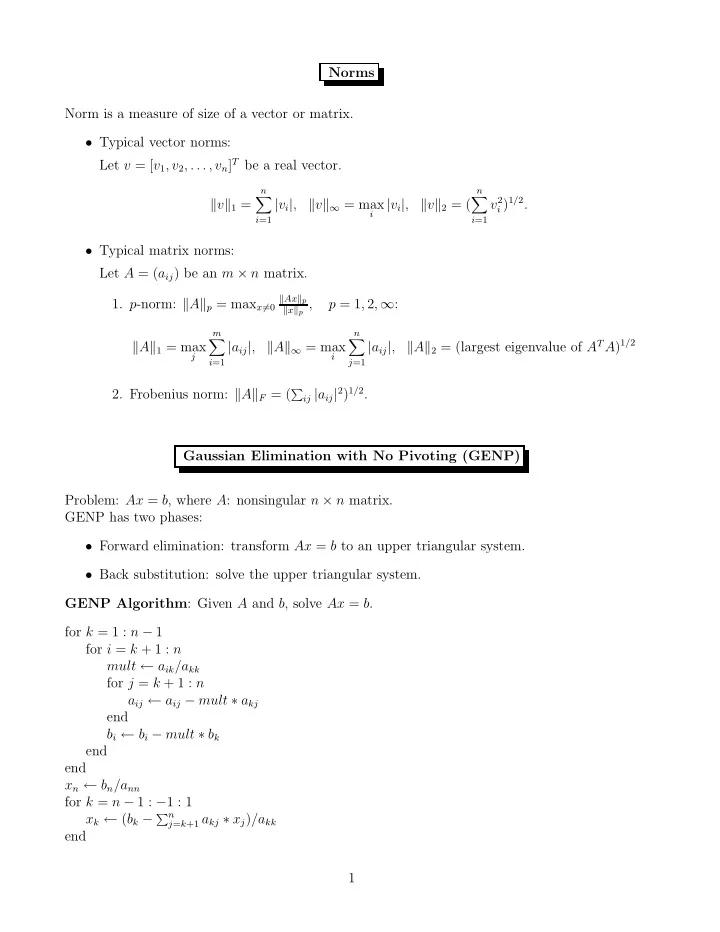
SLIDE 1 Norms Norm is a measure of size of a vector or matrix.
Let v = [v1, v2, . . . , vn]T be a real vector. v1 =
n
|vi|, v∞ = max
i
|vi|, v2 = (
n
v2
i )1/2.
Let A = (aij) be an m × n matrix.
Axp xp ,
p = 1, 2, ∞: A1 = max
j m
|aij|, A∞ = max
i n
|aij|, A2 = (largest eigenvalue of ATA)1/2
- 2. Frobenius norm: AF = (
ij |aij|2)1/2.
Gaussian Elimination with No Pivoting (GENP) Problem: Ax = b, where A: nonsingular n × n matrix. GENP has two phases:
- Forward elimination: transform Ax = b to an upper triangular system.
- Back substitution: solve the upper triangular system.
GENP Algorithm: Given A and b, solve Ax = b. for k = 1 : n − 1 for i = k + 1 : n mult ← aik/akk for j = k + 1 : n aij ← aij − mult ∗ akj end bi ← bi − mult ∗ bk end end xn ← bn/ann for k = n − 1 : −1 : 1 xk ← (bk − n
j=k+1 akj ∗ xj)/akk
end 1
SLIDE 2 Cost of GENP 1 flop = 1 elementary operation: +, −, ∗, or /. GENP costs 2
3n3 flops (lower order terms are ignored).
MATLAB file genp.m for solving Ax = b function x = genp(A,b) % genp.m Gaussian elimination with no pivoting % % input: A is an n x n nonsingular matrix % b is an n x 1 vector % output: x is the solution of Ax=b. % n = length(b); for k = 1:n-1 for i = k+1:n mult = A(i,k)/A(k,k); A(i,k+1:n) = A(i,k+1:n)-mult*A(k,k+1:n); b(i) = b(i) - mult*b(k); end end x = zeros(n,1); x(n) = b(n)/A(n,n); for k = n-1:-1:1 x(k) = (b(k) - A(k,k+1:n)*x(k+1:n))/A(k,k); end Note: It can be shown that GENP actually produces the so called LU factorization: A = LU where L is an n × n unit lower triangular matrix and U is an n × n upper triangular matrix, see Chap 8 of Cheney & Kincaid. Once the LU factorization is available, we can solve two triangular systems Ly = b and Ux = y to obtain the solution x. Gaussian Elimination with Partial Pivoting (GEPP) Problem: Ax = b, where A: nonsingular n × n matrix. The difficulties with GENP: In the k’th step of forward elimination,
- if akk = 0, GENP will break down.
- if akk is (relatively) small, i.e., some multipliers (in magnitude) ≫ 1, then GENP will
usually (not always) give unnecessary poor results. 2
SLIDE 3
In order to overcome the difficulties, in the k’th step of forward elimination, we choose the largest element from akk, ak+1,k, . . . , ank as a pivot element, |aqk| = max{|akk|, |ak+1,k|, . . . , |ank|} (say) then interchange row k and row q of A, and interchange bk and bq as well. This process is called partial pivoting. The resulting algorithm is called GEPP. GEPP Algorithm: Given A and b, solve Ax = b. for k = 1 : n − 1 determine q such that |aqk| = max{|akk|, |ak+1,k|, . . ., |ank|} for j = k : n do interchange: akj ↔ aqj end do interchange: bk ↔ bq for i = k + 1 : n mult ← aik/akk for j = k + 1 : n aij ← aij − mult ∗ akj end bi ← bi − mult ∗ bk end end xn ← bn/ann for k = n − 1 : −1 : 1 xk ← (bk − n
j=k+1 akj ∗ xj)/akk
end Cost: 2
3n3 flops + 1 2n2 comparisons.
MATLAB file gepp.m for solving Ax = b function x = gepp(A,b) % genp.m GE with partial pivoting % input: A is an n x n nonsingular matrix % b is an n x 1 vector % output: x is the solution of Ax=b. n = length(b); for k = 1:n-1 [maxval, maxindex] = max(abs(A(k:n,k))); q = maxindex+k-1; if maxval == 0, error(’A is singular’), end A([k,q],k:n) = A([q,k],k:n); b([k,q]) = b([q,k]); for i = k+1:n 3
SLIDE 4 mult = A(i,k)/A(k,k); A(i,k+1:n) = A(i,k+1:n)-mult*A(k,k+1:n); b(i) = b(i) - mult*b(k); end; end; x = zeros(n,1); x(n) = b(n)/A(n,n); for k = n-1:-1:1 x(k) = (b(k) - A(k,k+1:n)*x(k+1:n))/A(k,k); end Note: It can be shown that GEPP actually produces the so called LU factorization with partial pivoting: PA = LU where P is a permutation matrix, L is an n × n unit lower triangular matrix, and U is an n × n upper triangular matrix, cf. Chap 8 of Cheney & Kincaid. Once this factorization is available, we can solve two triangular systems Ly = Pb and Ux = y to obtain the solution x. Some Theoretical Results about GEPP Let xc is the computed solution of Ax = b by an algorithm. Define the residual vector r = b − Axc.
- We can show that if we use GEPP, then the computed solution xc satisfies
(A + E)xc = b, (1) where usually E ≈ ǫA, (2) with ǫ being the machine epsilon. So xc exactly solves a nearby problem. We say GEPP is usually numerically stable
- If (1) and (2) hold, we can show
r < ∼ ǫA·xc, xc − x x < ∼ ǫA·A−1, where κ(A) = A·A−1 is called the condition number of Ax = b. Here ( · can be · 1, · 2, or · ∞) Note:
- The size of residual is usually relatively small compared with the product of the size of A
and the size of xc. 4
SLIDE 5
- Let ǫ ≈ 10−t and κ(A) ≈ 10p. Then usually xc has approximately t − p accurate decimal
- digits. If κ(A) is large, we say the problem Ax = b is ill-conditioned.
The accuracy of a computed solution depends on (i) the stability of the algorithm (ii) the condition number of the problem. Solving Tridiagonal Systems by GENP Algorithm for solving
d1 c1 a1 d2 c2 ... ... ... an−2 dn−1 cn−1 an−1 dn
x1 x2 . . . xn−1 xn
=
b1 b2 . . . bn−1 bn
for i = 2 : n mult ← ai−1/di−1 di ← di − mult ∗ ci−1 bi ← bi − mult ∗ bi−1 end xn ← bn/dn for i = n − 1 : −1 : 1 xi ← (bi − ci ∗ xi+1)/di end Cost: 8n flops. Storage: store only ai, ci, di and bi by using 4 1-dimensional arrays. Do not use a 2-dimensional array to store the whole matrix. Diagonally Dominant Matrices Def: Let A = (aij)n×n. A is strictly diagonally dominant by column if |ajj| >
n
|aij|, j = 1 : n. A is strictly diagonally dominant by row if |aii| >
n
|aij|, i = 1 : n. We can show
- if a tridiagonal A is strictly diagonally dominant by column, then partial pivoting is not
needed, i.e., GENP and GEPP will give the same results. (exercise)
- if a tridiagonal A is strictly diagonally dominant by row, then GENP will not fail (see
C&K, pp. 282-283). 5