NORMAL-/SHEAR-DECOHESIVE DAMAGE OF ADHESIVELY BONDED JOINTS AT - - PDF document

normal shear decohesive damage of adhesively bonded
SMART_READER_LITE
LIVE PREVIEW

NORMAL-/SHEAR-DECOHESIVE DAMAGE OF ADHESIVELY BONDED JOINTS AT - - PDF document

18 TH INTERNATIONAL CONFERENCE ON COMPOSITE MATERIALS NORMAL-/SHEAR-DECOHESIVE DAMAGE OF ADHESIVELY BONDED JOINTS AT ROOM/CRYOGENIC TEMPERATURES C. S. Lee 1 , J. M. Lee 1 * 1 Dept. of Naval Architecture and Ocean Engineering, Pusan National


slide-1
SLIDE 1

18TH INTERNATIONAL CONFERENCE ON COMPOSITE MATERIALS

1 Introduction It is well known that an adhesively bonded joints (ABJ) is fabricated using a combination of two or more (non-) metallic materials and adhesives. The ABJ is frequently adopted in various industrial structures, especially cryogenic industrial fields because of its superior material advantages, such as excellent bonding capacity, thermal barring capability, light weight, and ease of fabrication [1]. In order to design/manufacture the robust the ABJ, the mechanical behavior (i.e., nonlinear material behavior) of the ABJ under room/cryogenic temperatures must be evaluated in terms of decohesive damage incidents regarding to normal/shear loadings. In the present study, therefore, a series of pull-off and lap-shear tests are performed for the ABJ. Mechanical properties as well as the decohesive damage phenomenon are summarized in a quantitative manner. On the basis

  • f the insights obtained from the experiments, a

temperature-dependent constitutive model is proposed using a modification of the Ramberg– Osgood equation. 2 Experimental Apparatus and Results 2.1 Experimental Apparatus A series of pull-off and lap-shear tests for two types

  • f adhesives used for the fabrication of the ABJ

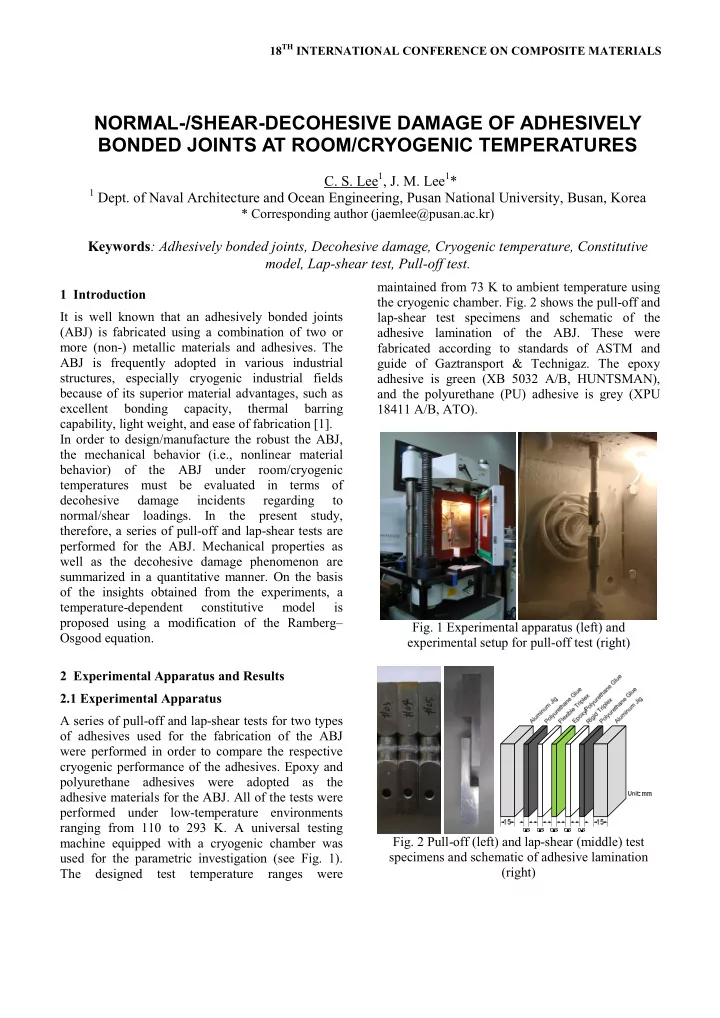
were performed in order to compare the respective cryogenic performance of the adhesives. Epoxy and polyurethane adhesives were adopted as the adhesive materials for the ABJ. All of the tests were performed under low-temperature environments ranging from 110 to 293 K. A universal testing machine equipped with a cryogenic chamber was used for the parametric investigation (see Fig. 1). The designed test temperature ranges were maintained from 73 K to ambient temperature using the cryogenic chamber. Fig. 2 shows the pull-off and lap-shear test specimens and schematic of the adhesive lamination of the ABJ. These were fabricated according to standards of ASTM and guide of Gaztransport & Technigaz. The epoxy adhesive is green (XB 5032 A/B, HUNTSMAN), and the polyurethane (PU) adhesive is grey (XPU 18411 A/B, ATO).

  • Fig. 1 Experimental apparatus (left) and

experimental setup for pull-off test (right)

  • Fig. 2 Pull-off (left) and lap-shear (middle) test

specimens and schematic of adhesive lamination (right)

NORMAL-/SHEAR-DECOHESIVE DAMAGE OF ADHESIVELY BONDED JOINTS AT ROOM/CRYOGENIC TEMPERATURES

  • C. S. Lee1, J. M. Lee1*

1 Dept. of Naval Architecture and Ocean Engineering, Pusan National University, Busan, Korea

* Corresponding author (jaemlee@pusan.ac.kr)

Keywords: Adhesively bonded joints, Decohesive damage, Cryogenic temperature, Constitutive model, Lap-shear test, Pull-off test.

slide-2
SLIDE 2

2.2 Design of Experiments As previously mentioned, two types of ABJ are frequently adopted in industrial fields. The material behaviour, including the debonding failure characteristics, of these types of ABJ is the primary subject of this paper. The two types of lamination structures are described in Table 1. The test scenarios were categorised into pull-off and lap- shear cases, and they are summarised in Tables 2 and 3. Each test was performed under varying temperatures (293, 163, and 110 K). In order to ascertain the repeatability of the test results, the tests in each case were performed seven times. Table 1 Description of lamination types

Type of ABJ Description Type A Polyurethane + Flexible triplex + Epoxy + Rigid triplex + Polyurethane Type B Polyurethane + Flexible triplex + Polyurethane + Rigid triplex + Polyurethane

Table 2 Test case for the pull-off test

Title

  • f

test Type of ABJ Temperature (K) Adhesion area (mm2) Pull-

  • ff

test Type A 293 121.7 Type A 163 121.7 Type A 110 121.7 Type B 293 121.7 Type B 163 121.7 Type B 110 121.7

Table 3 Test case for the lap-shear test

Title

  • f

test Type of ABJ Temperature (K) Adhesion area (mm2) Lap- shear test Type A 293 2500 Type A 163 2500 Type A 110 2500 Type B 293 2500 Type B 163 2500 Type B 110 2500

2.3 Test Results and Discussion

  • Figs. 3 to 6 show the debonded surface and the stress

and strain relationship obtained from the pull-off and lap-shear tests at each temperature. In the present study, the normal and shear stresses are mean stresses, i.e., the stress is simply calculated according to applied force divided by the adhesion

  • area. The obtained test results of each adhesive

according to temperature and loading direction are discussed in Tables 4 and 5. (a) Type A, 293K (b) Type A, 163K (c) Type A, 110K (d) Type B, 2930K (e) Type B, 163K (f) Type B, 110K

  • Fig. 3 Photographs of the debonded surface of the

pull-off test specimen 3 Constitutive Model The temperature-dependent modified constitutive model which is based on Ramberg-Osgood [2] is proposed as follows:

n(T) Y Y s s

σ,τ(T) -σ ,τ (T) σ,τ(T) ε,γ= + sgn(σ,τ) E,G(T) E',G'(T) with σ,τ(T)=σ ,τ (T),

(1) where σY/τY is the normal/shear yield stress, E′/G′ is the normal/shear stress coefficient, n/m is the normal/shear softening coefficient, σs/τs is the normal/shear plastic threshold stress, and < > are Macaulay parentheses. Table 6 lists the material properties of Eq. (1).

slide-3
SLIDE 3

3 PAPER TITLE

(a) Type A, 293K (b) Type A, 163K (c) Type A, 110K (d) Type B, 293K (e) Type B, 163K (f) Type B, 110K

  • Fig. 4 Photographs of the debonded surface of the

lap-shear test specimen

0.01 0.02 0.03 0.04 0.05 Normal strain 4 8 12 16 20 Normal stress (MPa) EPOXY 293K EPOXY 163K EPOXY 110K 0.01 0.02 0.03 0.04 0.05 Normal strain 4 8 12 16 20 Normal stress (MPa) TYPE B 293K TYPE B 163K TYPE B 110K

(a) Type A (b) Type B

  • Fig. 5 Relationship between normal stress and strain

in the pull-off test

0.04 0.08 0.12 0.16 Shear strain 10 20 30 Shear stress (MPa) EPOXY 293K EPOXY 163K EPOXY 110K 0.04 0.08 0.12 0.16 Shear strain 10 20 30 Shear stress (MPa) TYPE B 293K TYPE B 163K TYPE B 110K

(a) Type A (b) Type B

  • Fig. 6 Relationship between shear stress and strain in

the lap-shear test Table 4 Obtained test results of each ABJ according to normal loading

Type of ABJ Room temperature Type A · The debonding occurred between the epoxy adhesive and the flexible/rigid triplex in approximately 50% of the cases. · Nearly half of the debonding cases occurred between the polyurethane adhesive and the flexible/rigid triplex. This means that the normal bonding strength of both adhesives is nearly the

  • same. This can be seen in Fig. 5.

· The debonded surface is very clear and there is no tearing of the epoxy adhesive. Type B · All of the debonding occurred between the polyurethane adhesive and the flexible/rigid triplex. · The debonded surface is very clear and there is no tearing of the polyurethane adhesive. Type of ABJ Cryogenic temperature Type A · All of the debonding occurred between the epoxy adhesive and the flexible/rigid triplex. This means that the normal bonding strength of polyurethane adhesive is greater than that of epoxy adhesive. · As in the room temperature case of both Type A and Type B, the debonded surface is very clear and there is no tearing of the epoxy adhesive. · It is interesting that the normal strain of Type A is almost unaffected by temperature. Only an increase of the normal stress is observed in Type A. Type B · As in the room temperature case, all of the debonding occurred between the polyurethane adhesive and the flexible/rigid triplex. · However, the debonded surface is not clear, and there is tearing of the polyurethane adhesive. It is believed that the adhesion strength of the polyurethane adhesive at cryogenic temperatures under normal loading is stronger than it is in the

  • ther cases. This can be seen in Fig. 5.

Overall discussion · As the temperature decreases, the elastic stiffness/tensile strength increases. · As the temperature decreases, the polyurethane adhesive exhibits normal strength that is higher than that of epoxy adhesive. · Epoxy adhesive gives almost equal values of normal strain for all of the test temperatures. However, the fracture strain of the polyurethane adhesive increases as the temperature decreases.

The ten temperature-dependent parameters obtained from Eq. (1) can be represented as a linearized funciont of the temperature-dependent material coefficient, as follows:

1 1 Y0 Y0 Y Y 2 2 ' ' * 3 3 T T T0 T0 4 5 5 5

E ,G a ,b E,G(T) σ ,τ σ ,τ (T) a ,b E',G'(T) = E ,G +T a ,b , σ ,τ (T) σ ,τ a ,b n,m(T) n ,m a ,b ì ü ì ü ì ü ï ï ï ï ï ï ï ï ï ï ï ï ï ï ï ï ï ï í ý í ý í ý ï ï ï ï ï ï ï ï ï ï ï ï ï ï ï ï ï ï î þ î þ î þ

(2)

slide-4
SLIDE 4

Table 5 Obtained test results of each ABJ according to shear loading

Type of ABJ Room temperature Type A · The debonding occurred between the polyurethane adhesive and the flexible/rigid triplex. From the test results, it can be inferred that the bonding capacities of the epoxy adhesive are stronger than those of the polyurethane adhesive at room temperature under shear loading. · The debonded surface was very clear and no tearing was observed. Type B · As in the Type A room temperature case, the debonding occurred between the polyurethane adhesive and the flexible/rigid triplex. From the test results of both cases at room temperature, it was found that the adhesion strength in both cases was the same. This can be seen in Fig. 6. Type of ABJ Cryogenic temperature Type A · All of the debonding occurred between the epoxy adhesive and the flexible/rigid triplex. · The debonded surface was rough, and it was especially rough at 110 K. The epoxy adhesive was frozen and broken between flexible and rigid triplexes, and the broken pieces of adhesive were attached to these triplexes. In addition, the shear stress rapidly increased. It seems that the frozen adhesive increased the bonding capacities under shear loading. · It is also interesting that the shear strain of Type A was almost unaffected by temperature, as was seen in the results of the Type A pull-off test. An increase of the shear stress was also observed in Type A. Type B · All of the debonding occurred between the polyurethane adhesive and the flexible/rigid triplex. · The debonded surface was rough, and it was especially rough at 110 K, as in the Type A cryogenic temperature case. The polyurethane adhesive was also frozen and broken between flexible and rigid triplexes, and the broken pieces

  • f adhesive were attached to these triplexes.

However, the broken pieces of the polyurethane adhesive were larger than those of the epoxy

  • adhesive. This indicates that the shear stress of the

polyurethane adhesive is larger than that of the epoxy adhesive, as shown in Fig. 6. Overall discussion · The shear elastic stiffness is almost unaffected by temperature; however, as the temperature decreases, a rapid increase of inelastic material behaviour is observed. · As the temperature decreases, the polyurethane adhesive exhibits shear strength that is higher than that of the epoxy adhesive. · Epoxy adhesive gives almost the same value of shear strain for all of the test temperatures. However, the fracture strain of the polyurethane adhesive increases as the temperature decreases, as in the result of the pull-off test.

* ROOM ABS ROOM

T-T T = , T

  • T

(3) where subscript 0 indicates the initial value of each material parameter, ai and bi are the material parameters, T* is the reference temperature, TABS is the absolute zero temperature, and TROOM is the room temperature, i.e., 293 K. Table 7 lists the material parameters of Eqs. (2) and (3). Table 6 Material properties of the ABJ

Adhesive Temp. (K) E (MPa) σY (MPa) E′ (MPa) σT (MPa) n Epoxy 293 146 4.62

  • 163

418 12.3

  • 110

440 12.6

  • PU

293 140 3.34

  • 163

324 13.1

  • 110

362 16.2

  • Adhesive

Temp. (K) G (MPa) τY (MPa) G′ (MPa) τT (MPa) m Epoxy 293 186 0.88 181 5.21 0.63 163 193 0.94 1582 9.68 0.49 110 527 1.16 1888 15.3 0.34 PU 293 108 1.14 470 5.36 0.62 163 155 1.20 1259 23.6 0.52 110 432 0.96 1434 26.7 0.48

Table 7 Material parameters of the ABJ

Adhesive E0(MPa) σY0(MPa) E′0(MPa) σT0(MPa) n0 Epoxy 157.51 4.99

  • PU

144.79 3.45

  • Adhesive

a1 a2 a3 a4 a5 Epoxy 497.16 13.62

  • PU

366.34 20.84

  • Adhesive

G0(MPa) τY0(MPa) G′0(MPa) τT0(MPa) n0 Epoxy 55.00 0.85 215.34 4.72 1.58 PU 48.75 1.17 488.99 5.92 1.62 Adhesive b1 b2 b3 b4 b5 Epoxy 197.38 0.39 2811.03 15.00 1.13 PU 140.08

  • 0.21

1586.55 35.45 0.71

Acknowledgement This research was supported by the Basic Science Research Program through the National Research Foundation of Korea (NRF) funded by the Ministry

  • f Education, Science and Technology (2011-

0004786). References

[1] R.D. Adams, J. Comyn, W.C. Wake “Structural adhesive joints in engineering”. 2nd edition, Chapman & Hill, 1997. [2] J. Lemaitre, J.L. Chaboche “Mechanics of solid materials”. 1st edition, Cambridge University Press, 1994.