
SLIDE 1
Norma Kathleen Hemming (1927-1960) and her life and times, descent - - PDF document
Norma Kathleen Hemming (1927-1960) and her life and times, descent into obscurity and rediscovery at the turn of the century Norma Kathleen Hemming (19271960) was a British author who migrated to Australia with her family in 1949 and wrote
Norma Kathleen Hemming (1927–1960) was a British author who migrated to Australia with her family in 1949 and wrote for local pulp magazine Thrills Incorporated and enthusiastically participated in the Australian fan scene. She was a founding member of the femme fan group Vertical Horizons, and wrote and acted for the SF theatrical group The Arcturian Players. Norma returned to international publishing in the late 1950s with stories in Nebula SF and New Worlds, but died at the age of 33
Early post-WWII SF Australian authors (including Frank Bryning, Wynne Whiteford and A Bertram Chandler) were published
historian Graham Stone recalls that the fi rst of her sixteen (known) stories ‘Loser Takes All’ appeared in a 1951 edition of the British magazine Science Fantasy as by N K
cult to be published in science fi ction if you were not male, or at least appeared to be male. Norma Hemming outed herself as a woman to her readership at the fi rst Australian science fi ction Convention, Sydcon 1952. University of Western Australia librarian David Medlen, in an address to local science fi ction fans in April 2009 said that convention was a catalyst for change for women in Australian fandom. “Up until that time,” he told, “many women had been unable to take out full membership to science fi ction clubs and had to ‘guests’ of male members.” At the Sydney Futurian Society Rosemary Simmons and Norma Hemming, along with male sympathisers, pushed for change. After two votes a motion was fi nally passed ”not (to) discriminate on the grounds of race, creed, party or sex”. Rosemary Simmons was fi nally party or sex party or sex elected to membership followed by Norma Hemming. Not satisfi ed with that, in the same month Rosemary Simmons, Norma Hemming and
rst Australian femme fan group and fanzine, both called Vertical Horizons. Like most fanzines it contained news and reviews but also passionate essays on being a female fan.”
(Contemporary artist Sarah Xu, whose illustrations complement some of the fi nest stories published in Australia’s fl
small press magazines, calls her fanzine Vertical Horizons in homage to Norma
www.efanzines.com). In addition to her stories Norma Hemming also wrote for newspapers, fanzines and importantly for the stage, writing Australia’s fi rst science fi ction plays. For nearly forty years after her death she was a footnote for magazine bibliographers until, in 1998, Sean McMullen and Russell Blackford produced a detailed biography
and analysis of her work in Fantasy Annual No 2, followed a year later by publication
Study of Science Fiction and Fantasy) by Russell Blackford, Van Ikin and Sean McMullen (1999). This important literary reference is a critical survey of the history of Australian science fi ction from its nineteenth century
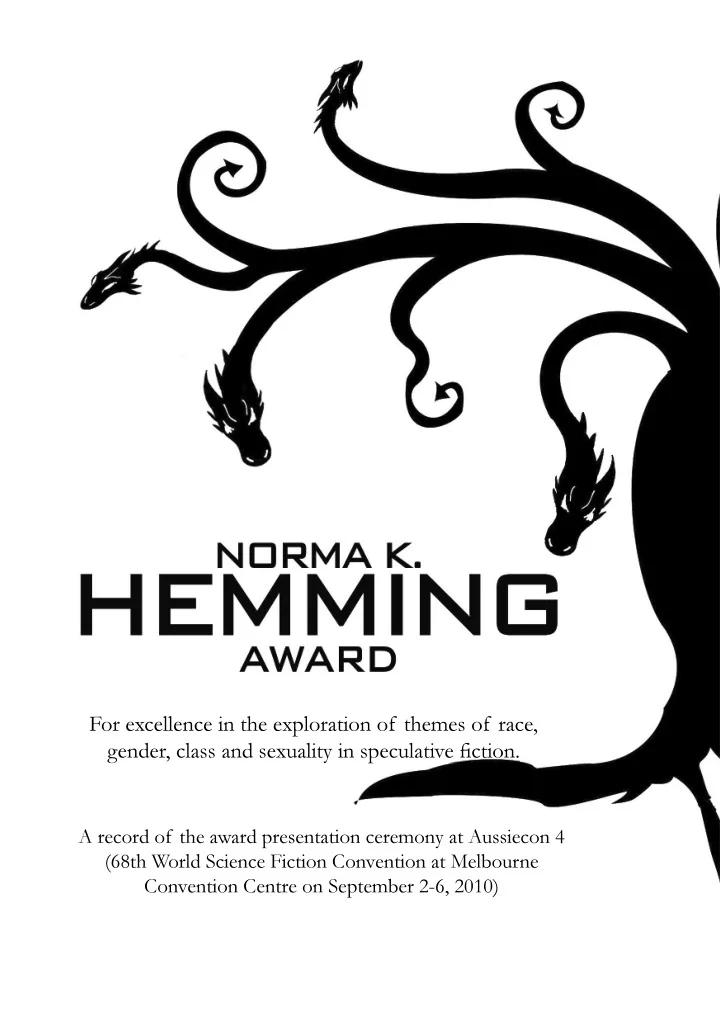
And, in 2004, Rob Gerrand selected Hemming’s ‘Debt of Lassor’ for inclusion in The Best Australian Science Fiction Writing: A Fifty Year Collection published by Black Inc A Fifty Year Collection A Fifty Year Collection (2004). The award trophy consists of a mounted glass plate with a boab tree-hydra design motif, and an inscribed crystal plinth. The circular design represents the yonic (in contrat to so many phalic award representations), the boab represents the Australian speculative fi ction landscape, the boab being uniquely fantastical in itself, and the hydra reminds us of diversity within that. The Norma K Hemming Award marks excellence in the exploration of themes of race, gender, class and sexuality:
ction and fantasy
Australian citizens, and
rst published in the calendar year preceding the year in which the award is given. The Australian Science Fiction Foundation (ASFF: http://home.vicnet.net.au/~asff/) launched this major new award at the Australian Awards Presentations ceremonies held at Aussiecon 4, the 68th World Science Fiction Convention, held in Melbourne on Friday 3rd 2–6 September 2010. The Award will not necessarily be given annually, and a selection will only be made if there is a work that meets an appropriate standard of excellence.
The inaugural Norma K Hemming Award for excellence in the exploration of themes of race, gender, class and sexuality in Australian speculative fi ction was won by the late Maria Quinn (1942–2010) for her novel The Gene Thieves published by HarperCollins-Voyager in 2009. Maria Quinn was born in 1942; sadly, she died of suddenly of leukaemia on 2nd June,
Writer in the US and Canada, she moved to a London agency as Creative Director. On returning to Australia Maria’s writing talent was put to good use as the youngest fashion editor of Vogue, the editor of House and Garden, Decorating Editor of Better Homes and Gardens and Editor and creator of Interiors Magazine. She was co- producer of the national television program Kings Kitchen, making regular on camera appearances and sat on a number of TV talk show panels including Beauty and the Beast. Maria Quinn won the 2007 Todhunter Literary Award for short story and was the recipient of a prestigious Varuna fellowship. The Gene Thieves published by Harper The Gene Thieves The Gene Thieves Voyager in 2009 was her fi rst novel
Maria’s spouse, Terry Quinn, fl ew from Sydney with Hamish – one of their two sons, who accepted the award on in memory of his mother. They and met up with Terry’s sisters Janice Brown and Denise Conroy to attend this awards ceremony. He writes… I was delighted to hear that the inaugural Norma K Hemming award will go to my recently departed wife Maria Quinn, for her novel The Gene Thieves – delighted but also so very sad that the wonderfully talented Maria will not be able to accept the award herself. My wife’s sudden death from leukaemia attracted more than a little media attention, including the Timelines Obituary in the Sydney Morning Herald, an Sydney Morning Herald Sydney Morning Herald edited version of which I reproduce here for your information.
Author who wore many creative hats On what would have been her 44th wedding anniversary, the ashes of Maria Quinn, author (The Gene Thieves), magazine The Gene Thieves The Gene Thieves editor (Australian House & Garden, Interiors editor ( editor ( ), Australian House & Garden, Interiors Australian House & Garden, Interiors television presenter and producer (King’s television presenter and producer ( television presenter and producer ( Kitchen, Good Morning Sydney) were scattered Kitchen, Good Morning Sydney Kitchen, Good Morning Sydney
‘’writers’ house’’ in the Blue Mountains.
Maria Annette Fogarty was born in Sydney
Fogarty, a businessman, and his wife, Winifred, a librarian. She was educated at Brigidine College, Randwick, and later studied interior design at the Royal College
the early 1960s at Jackson Wain in Sydney, where she was an advertising copywriter for creative director Bryce Courtney. She then worked in the United States and Canada, where she married Australian journalist and television producer, Terry Quinn, on July 4, 1966. The couple moved to London, where Maria worked as a creative director in adverting and Terry as a producer at the BBC. When the couple returned to Australia to raise a family, Maria launched her second career, this time as a magazine editor, feature writer and columnist. She was the beauty editor of Vogue, the editor of Australian House & Garden, the founding editor of Interiors Magazine and editor of the Interiors Magazine Interiors Magazine Homelovers’ series of magazine titles. Homelovers’ Homelovers’ Her television credits included being a presenter on the Nine network’s daytime current affairs program No Man’s Land and Channel 10’s Good Morning Sydney, and producing in partnership with her husband the long-running cookery show King’s Kitchen
chef’’ Bernard King. Most recently she was part of the Better Homes & Gardens show Better Homes & Gardens Better Homes & Gardens production team on Channel 7. Her long held ambition was to become an author, and her fi rst novel, The Gene Thieves, was released in March 2009 to critical acclaim. It is part science fi ction, part family drama, part mystery, part geo-political thriller, set in the near future, about a brilliant, lonely genetic scientist who is desperate for a child and must fi nd a surrogate. She was amused to see the fi rst copies
Chinese before being distributed in China, Hong Kong and Taiwan. A message left on her mobile phone the day she died was from a fi lm producer asking her to call back to
discuss the possibility of turning The Gene Thieves into a movie or television series. Thieves Thieves She won the 2007 Todhunter Literary Award for short story writing and was a recipient
Mountains writers’ retreat, once home
never made claim to being a serious poet,
writers at Varuna with her ‘3 am scribbling’, usually stuck on the fridge in the morning, unsigned. Quinn was also a big fan of the television science fi ction series Star Trek and when the actor James Doohan, who played chief engineer ‘’Scotty’’, died in 2005, his ashes were scheduled to be blasted into space at his dying request. Quinn’s tribute poem was sent to his family, who enjoyed it so much they included it with the personal effects that accompanied his ashes on board the
reach outer space and Doohan’s ashes - and the poem - plunged into the ocean. Maria Quinn is survived by Terry, children Damon and Hamish, sister Terry, daughter- in-law Sally, grandchildren Jemima, Scarlett and Riley, and her constant companion, Griffi n the dog.
Maria was a great Star Trek fan and her light hearted tribute to actor James “Scotty” Doohan when he died delighted Jim’s family – perhaps it will bring a wry smile to you as well.
Australian science fi ction fandom recognises excellence in speculative fi ction through the Australian National SF Awards (a.k.a. the ‘Ditmar Awards’), the William Atheling Jr Award for critical works and the ASFF’s Jr Award Jr Award prestigious A Bertram Chandler Award for outstanding achievement in Australian science fi
and authors groups also sponsor awards, for example the ‘Aurealis Awards’ that are recognised as complementing these major fan awards. There has been, however, no ‘feminist’
hand, has introduced awards and activities that deal specifi cally with issues of race, gender, class and sexuality, viz.
e Carl Brandon Society is dedicated to
e Carl Brandon Society
e Carl Brandon Society improving the visibility of people of colour in the speculative genres of SF, fantasy, horror and magical realism;
e James Tiptree Jr Award is an annual
e James Tiptree Jr Award
e James Tiptree Jr Award award for science fi ction or fantasy that expands or explores our understanding of gender; and
in 1988 to honour works in science fi ction, fantasy and horror that include positive explorations of gay, lesbian, bisexual or trangendered characters, themes or issues. Following representations in 2007 by Emma Hawkes of the Western Australian Science Fiction Foundation, the Norma K Hemming Award was set up at the Foundation’s annual AGM on 27 Jan 09. It is a jury award to mark excellence in the exploration of themes of race, gender, class and sexuality in the form of science fi ction and fantasy or related art work or media. To be eligible, works must be judged to be of a suffi ciently high standard, produced either in Australia or by Australian citizens and be fi rst published, released or presented in the calendar year preceding the year in which the award is given. Bill Wright was appointed ASFF awards administrator and given the task of steering it through its fi rst presentation at Aussiecon
entry form on the ASFF website.
For the inaugural award in 2010, ASFF appointed a jury panel of four fans who are also successful authors, publishers or
Blackford, writer/editor/publisher Rob Gerrand, author Tess Williams and editor Sarah Endacott.
A collection of Norma Hemming’s works Dwellers in Silence – Stories and Plays by Norma Hemming by Dr Toby Burrows, head of the Hemming Hemming scholars centre at the University of Western Australia, was launched at Aussiecon 4. Anyone who missed out on buying a copy there can order a copy online via http:// www.lulu.com/product/paperback/ dwellers-in-silence-stories-and-plays-by- norma-hemming/12032993. Ausiecon 4 is also the venue for a staged reading in the style of a radio play from the Norma Hemming play The Matriarchy of Renok, with costumed readers and retro- 1950s audiovisual imagery from artist Lewis P Morley. The play is produced and directed from an edited script by author Sean McMullen.
Twenty-fi ve entries were submitted. The nominations are…
The Cry of the Marwing The Cry of the Marwing July 2009);
2009), where she tells of the rehabilitation of a juvenile delinquent in a future where whales and dolphins converse with humans and the Whale Nation controls space travel;
World Komics, November 2009) about the adventures of Peregrine Bessett, a female dwarf who’s also Ancient Egyptian, bisexual, an interspecies lover, a naturalised Australian and black;
2009);
Gillian Polack Gillian Polack In Bad Dreams 2, Eneit Press, 2009);
Gillian Polack Gillian Polack Life Through Cellophane (novel, Eneit Press, 2009), about a middle aged spinster who’s just been sacked and thinks her life is deadly dull and boring. How wrong she is!
The Book From Baden Dark The Book From Baden Dark & Robertson, July 2009);
The Whisperer The Whisperer
Tyrant’s Blood Tyrant’s Blood
2009);
The Last Stormlord The Last Stormlord
time travel adventure yarn spanning much of recorded human history in which the female protagonist, Kannon, is left for dead as a baby in Australia’s Blue Mountains and the U.S. National Time Administration polices the time lines;
n (novel, HarperCollins, 2009);
2009)
HarperCollins-Voyager, 2009), a tale of endearingly normal human beings ensnared in a web of surrogacy and genetic engineering – part science fi ction, part family drama, part mystery, part geo-political thriller;
Press, 2009);
Ceres Nights, Twelfth Planet Press, 2009);
Planet Press, 2009);
considered by jurors because of delay occasioned by a postal glitch].
The jurors deserve the most kudos for the diligent manner in which they read all but one
ve entries for the inaugural 2010 Norma K Hemming Award (one entry not having been considered due to a Post Offi ce glitch), winnowing submissions down to a short list and choosing the winner. Thank you, too, to WA Science Fiction Foundation, Emma Hawkes and Sarah Xu; researchers David Medlen (Norma’s greatest fan), Paul Collins, Sean McMullen, Van Ikin and Russell Blackford; Sydney Futurians via Graham Stone and Doug Nicholson; and academics Helen Merrick, Dianne deBellis, Gillian Pollack, and Sarah Parker who helped to promote the award at regional SF conventions.