Nonlinear Effects in Pulsations r [km] of Rotating Neutron Stars - - PowerPoint PPT Presentation

nonlinear effects in pulsations
SMART_READER_LITE
LIVE PREVIEW

Nonlinear Effects in Pulsations r [km] of Rotating Neutron Stars - - PowerPoint PPT Presentation


slide-1
SLIDE 1
  • Max Planck Institute

for Astrophysics, Garching, Germany

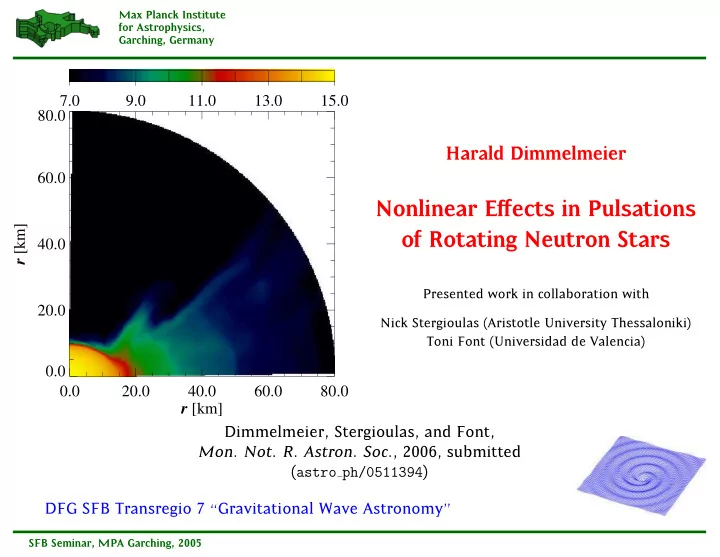
0.0 20.0 40.0 60.0 80.0 r [km] 0.0 20.0 40.0 60.0 80.0 r [km] 7.0 9.0 11.0 13.0 15.0

Harald Dimmelmeier

Nonlinear Effects in Pulsations

  • f Rotating Neutron Stars

Presented work in collaboration with Nick Stergioulas (Aristotle University Thessaloniki) Toni Font (Universidad de Valencia)

Dimmelmeier, Stergioulas, and Font,

  • Mon. Not. R. Astron. Soc., 2006, submitted

(astro ph/0511394) DFG SFB Transregio 7 “Gravitational Wave Astronomy”

SFB Seminar, MPA Garching, 2005

slide-2
SLIDE 2
  • Max Planck Institute

for Astrophysics, Garching, Germany

Introduction Pulsations of Rotating Neutron Stars

Excitation mechanisms for pulsations:

  • Rotational supernova core collapse.
  • Accretion-induced collapse.
  • Core quakes due to strong phase transitions in EoS.
  • Formation of hypermassive neutron star

(from binary neutron star merger). Potential source of detectable HF gravitational waves! Aim: Use wave signal to determine neutron star structure and constrain high density EoS. For nonrotating neutron star models: Theory of asteroseismology already exists (e.g. Andersson and Kokkotas, 1998; Benhar, Ferrari, Gualtieri, 2004).

SFB Seminar, MPA Garching, 2005

slide-3
SLIDE 3
  • Max Planck Institute

for Astrophysics, Garching, Germany

Introduction Previous Work

In spherical symmetry or slow rotation limit: Use perturbative methods to determine mode frequencies.

(used by permission of The University of Texas McDonald Observatory)

Possible since few years: Study pulsations of rotating neutron stars with fully nonlinear evolution codes.

  • Several studies in Cowling approximation

(e.g. Font et al., 2001; Yoshida et al., 2002; Stergioulas, Apostolatos, Font, 2004) Result: Frequencies in Cowling wrong by up to 100%! Hope: Use Cowling simulations to establish empirical relation for correct mode frequencies.

  • Full evolution using Cactus with GR-Hydro (Font et al., 2002).

Very limited set of models and modes (computationally expensive 3d code, no high resolution) Review article: Nick Stergioulas, “Rotating Stars in Relativity”, Living Rev. Relativity, 3, 2003, http://www.livingreviews.org/lrr-2003-3.

SFB Seminar, MPA Garching, 2005

slide-4
SLIDE 4
  • Max Planck Institute

for Astrophysics, Garching, Germany

Introduction New Nonlinear Simulations

In nonlinear codes: Excite pulsations with small amplitude perturbations, use FFT to extract mode frequencies. General advantages of nonlinear codes:

  • Can also study nonlinear phenomena

(mass-shedding-induced damping, instabilities, mode coupling, avoided crossing).

  • Can obtain information about relative mode strengths.

We use COCONUT code:

  • Full spacetime evolution (no Cowling approximation).
  • Conformal flatness approximation for 3 + 1 metric equations

(CFC – excellent and tested approximation for rotating neutron stars).

  • HRSC methods for hydrodynamic equations and spectral methods for metric equations

(Mariage des Maillages; Dimmelmeier et al., 2004).

  • Spherical polar coordinates, equidistant grid inside star (160 × 60 grid points).
  • Axisymmetry and equatorial symmetry (computationally fast).

(www.madlantern.com)

SFB Seminar, MPA Garching, 2005

slide-5
SLIDE 5
  • Max Planck Institute

for Astrophysics, Garching, Germany

Results Models and Linear Mode Frequencies

We simulated 4 sequences of equilibrium models (same as in Stergioulas, Apostolatos, Font, 2004):

  • A:

Fixed rest mass, differential rotation.

  • AU: Fixed rest mass,

uniform rotation.

  • B:

Fixed central density, differential rotation.

  • BU: Fixed central density,

uniform rotation. Example: Dependence of mode frequencies on rotation (F and H1-mode, 2f and 2p1-mode, 4p1-mode). Obvious avoided crossing between H1 and 4p1-mode! Observe also low-frequency inertial modes.

0.00 0.05 0.10 0.15 0.20 rotation rate T/|W| 0.0 1.0 2.0 3.0 4.0 5.0 mode frequency f (kHz)

differential rotation uniform rotation

Fixed rest mass sequences A and AU

H1

2p1

F

2f

i−2 i1 i2

4p1

H1

4p1

mass shedding limit for uniform rotation avoided crossing

SFB Seminar, MPA Garching, 2005

slide-6
SLIDE 6
  • Max Planck Institute

for Astrophysics, Garching, Germany

Results Comparison to Fully General Relativistic Results

Sequence BU was already simulated with Cactus GR-Hydro code (Font et al., 2002). Comparison with our results:

  • Excellent agreement for fundamental F -mode.
  • Good agreement for first overtone H1.

Close to mass-shedding limit: Cactus code runs probably have insufficient resolution or boundary problems.

0.00 0.02 0.04 0.06 0.08 rotation rate T/|W| 0.0 1.0 2.0 3.0 4.0 5.0 mode frequency f (kHz)

CFC code Cactus code

Uniformly rotating fixed central density sequence BU

H1 F Cactus code runs lack resolution and evolution time

SFB Seminar, MPA Garching, 2005

slide-7
SLIDE 7
  • Max Planck Institute

for Astrophysics, Garching, Germany

Results Comparison to Results in Cowling Approximation

For F and 2p1-mode: Cowling simulation reproduce correct rotation dependence reasonably well. But: F -mode frequencies too high by factor ∼ 2 in Cowling (∼ 1 kHz). For H1 and 2f-mode: Cowling simulations yield frequencies similar to correct ones. But: Rotation trend not clearly reproduced (dependence is small anyway).

0.0 1.0 2.0 3.0 4.0 5.0 mode frequency f (kHz)

Uniformly rotating fixed central density sequence BU

0.00 0.02 0.04 0.06 0.08 rotation rate T/|W| 0.0 1.0 2.0 3.0 4.0 5.0 mode frequency f (kHz)

CFC Cowling

F H1

2f 2p1

factor 2 difference similar rotation dependence

Idea in Font et al., 2001; Stergioulas, Apostolatos, Font, 2004: Use results from Cowling simulations and empirical relation to obtain correct frequencies!

SFB Seminar, MPA Garching, 2005

slide-8
SLIDE 8
  • Max Planck Institute

for Astrophysics, Garching, Germany

Results Failure of Empirical Relations

We have checked these empirical relations for

  • F -mode frequency in sequence BU

(Font et al., 2001) Relation yields accuracy of better than 2%!

  • F and 2f-mode frequency in sequence A

(Stergioulas, Apostolatos, Font, 2004; using information about compactness of models from Yoshida and Eriguchi, 2001). Predicted uncertainty of these relations: Few percent.

0.0 1.0 2.0 3.0 4.0 5.0 mode frequency f (kHz)

Differentially rotating fixed central density sequence B

0.00 0.05 0.10 rotation rate T/|W| 0.0 1.0 2.0 3.0 4.0 5.0 mode frequency f (kHz)

CFC Cowling

F H1

2f 2p1 4p1

different rotation dependence more than factor 2 difference

For most rapidly rotating model of sequence A: Difference of ∼ 30% for F and 2f-mode! Bottomline: Such relations must be used with caution!

SFB Seminar, MPA Garching, 2005

slide-9
SLIDE 9
  • Max Planck Institute

for Astrophysics, Garching, Germany

Results Eigenfunction Recycling

As initial perturbation to excite pulsations: Use analytic “trial” eigenfunctions (for various parity, l = 0, 2, 4). These differ from exact eigenfunction. = ⇒ They also excite unwanted modes (e.g. higher order harmonics). New approach: Use eigenfunction “recycling”!

  • Extract eigenfunction of selected mode

(at specific frequency).

  • Use extracted eigenfunction as initial

perturbation in second run (“recycling run”).

  • Convenient check:

Compare eigenfunctions from original run and recycling run.

0.0 1.0 2.0 3.0 4.0 5.0 mode frequency f (kHz)

perturbation with actual F, H1,

2f, 2p1 eigenfunction

l = 0 perturbation l = 2 perturbation l = 0 with trial eigenfunction

F H1

2p1 2f

H1

2p1 2f

F

  • ther modes

suppressed approximately equal power u n e q u a l p

  • w

e r

Can select single mode for excitation and efficiently suppress all other modes! With appropriate choice of perturbation amplitude: Get constant peak height in PSD.

SFB Seminar, MPA Garching, 2005

slide-10
SLIDE 10
  • Max Planck Institute

for Astrophysics, Garching, Germany

Results Nonlinear Harmonics

Genuine nonlinear effect: Nonlinear harmonics of linear pulsation modes (sums and differences of linear modes, including self-couplings). Recently: Such nonlinear harmonics observed in

  • scillating tori around Kerr black holes

(Zanotti et al., 2005).

0.0 1.0 2.0 3.0 4.0 5.0 mode frequency f (kHz) 10

  • 13

10

  • 12

10

  • 11

10

  • 10

10

  • 9

F

2f

H1

2p1

F +

2f

2 . 2f 3 . 2f H1 − 2 . F H1 −

2f

H1 − F

2p1 − 2f 2p1 − F

linear modes nonlinear coupled pure l = 2 modes nonlinear coupled pure l = 0 modes nonlinear coupled mixed l = 2, 0 modes

Example: Nonrotating star, excited by l = 2 trial eigenfunction. Observe also coupling of l = 0 and l = 2 modes! In linear approximation for nonrotating star: Modes of different l are orthogonal to each other. Two effects:

  • Approximate nature of l = 2 eigenfunction: l = 0 modes are also excited.
  • Nonlinear effects couple all linear modes even with different l.

Criterion to distinguish linear modes and harmonics: Scaling with perturbation amplitude.

SFB Seminar, MPA Garching, 2005

slide-11
SLIDE 11
  • Max Planck Institute

for Astrophysics, Garching, Germany

Results Nonlinear 3-Mode Couplings

Rotation effects modes differently. = ⇒ When neutron star is rotating: Presence of nonlinear harmonics opens possibility for 3-mode couplings. Modes interact when frequencies cross! Example: H1 − F -mode and 2p1-mode. Other possibility: Mode crossing with some inertial mode. This could potentially lead to resonance effects

  • r even parametric instabilities.

= ⇒ Possibly significant energy transfer between modes.

0.00 0.05 0.10 0.15 0.20 rotation rate T/|W| 0.0 1.0 2.0 3.0 4.0 5.0 mode frequency f (kHz) H1

2p1

F

2f

i−2 i1 i2 H1 − F

2p1 − 2f

frequency shift from avoided crossing

Most interesting case of energy transfer for gravitational waves: Strong oscillating, weakly radiating mode − → weakly oscillating, strongly radiating mode (suggested by Clark, 1979; Eardly, 1983). We only observe if necessary conditions are fulfilled; we perform no further studies.

SFB Seminar, MPA Garching, 2005

slide-12
SLIDE 12
  • Max Planck Institute

for Astrophysics, Garching, Germany

Results Mass-Shedding for Rapidly Rotating Neutron Stars

For small but finite pulsation amplitudes: Mass-shedding occurs in (almost) maximally rotating neutron stars.

  • In Cowling approximation (left): Mass-shedding creates extended high-entropy envelope.
  • With coupled spacetime evolution (right): Mass-shedding strongly suppressed.

0.0 20.0 40.0 60.0 80.0 r [km] 0.0 20.0 40.0 60.0 80.0 r [km] 7.0 9.0 11.0 13.0 15.0 0.0 20.0 40.0 60.0 80.0 r [km] 0.0 20.0 40.0 60.0 80.0 r [km] 7.0 9.0 11.0 13.0 15.0

We do not know exact reason for this observed mechanism!

SFB Seminar, MPA Garching, 2005

slide-13
SLIDE 13
  • Max Planck Institute

for Astrophysics, Garching, Germany

Results Mass-Shedding-Induced Damping

Mass-shedding-induced damping is another striking nonlinear effect. At each pulsation, star ejects mass into envelope. ⇒ Pulsation energy is lost, pulsation damped. If damping time scale is comparable to growth time scale of unstable modes (e.g. CFS-instability driven f or r-modes): Damping mechanism could limit mode growth. Example: l = m = 2 f-mode becomes unstable

  • nly near mass-shedding limit.

But with coupled spacetime evolution: Much longer damping time scale (not detectable in graph)! This could efficiently reduce this damping effect for unstable modes!

0.0 1.0 2.0 3.0 4.0 5.0 6.0 7.0 8.0 evolution time t (ms) 8.0 9.0 10.0 central density ρc (10

14 g cm

  • 3)

CFC Cowling

strong mass-shedding induced damping

SFB Seminar, MPA Garching, 2005

slide-14
SLIDE 14
  • Max Planck Institute

for Astrophysics, Garching, Germany

Results Gravitational Wave Power Spectrum

We also extract gravitational waves emitted by pulsations. We use Newtonian quadrupole formula (in time-integrated form). Example: Gravitational wave power spectrum for slowly rotating model from sequence A (using eigenfunction recycling technique). As expected: Quadrupolar 2f-mode is strong emitter. Observation: Small leaking of energy into 2f-mode from other modes: Creates strong contribution in signal. = ⇒ Suppress that contribution in signal processing.

0.0 1.0 2.0 3.0 4.0 5.0 frequency f (kHz) 10

4

10

5

10

6

10

7

10

8

F

2f 2p1

H1 r

  • 2 artificial fall-off

2f contribution

(fundamental quadrupolar mode)

SFB Seminar, MPA Garching, 2005

slide-15
SLIDE 15
  • Max Planck Institute

for Astrophysics, Garching, Germany

Results Detectability of Gravitational Waves

Estimate detectability prospects by interferometers (VIRGO, LIGO I, advanced LIGO): Compute (slightly detector dependent)

  • characteristic signal amplitude,
  • characteristic signal frequency,
  • signal-to-noise ratio.

0.1 1.0 frequency f (kHz) 10

  • 23

10

  • 22

10

  • 21

10

  • 20

10

  • 19

10

  • 18

characteristic GW signal amplitude hc F

2f

H1

2p1

VIRGO LIGO I advanced LIGO tunable frequency range of advanced LIGO 5% pulsation amplitude of ρc 1% pulsation amplitude of ρc

Exploit linear scaling properties:

  • Initial perturbation amplitude.
  • Pulsation amplitude during evolution.
  • Gravitational wave signal amplitude.
  • Square root of signal duration time (here 20 ms).

Can construct relation between detectability and required pulsation amplitude. Location of signals along ascending high frequency slope of detector: Dependence of mode frequency on rotation is crucial for detection.

SFB Seminar, MPA Garching, 2005