Non-conventional receivers for coherent communication Francisco - - PowerPoint PPT Presentation

non conventional receivers for
SMART_READER_LITE
LIVE PREVIEW

Non-conventional receivers for coherent communication Francisco - - PowerPoint PPT Presentation

Non-conventional receivers for coherent communication Francisco Elohim Becerra Department of Physics and Astronomy University of New Mexico, Albuquerque, NM, USA Munich Workshop on Information Theory of Optical Fiber (MIO 2018) December 6,


slide-1
SLIDE 1

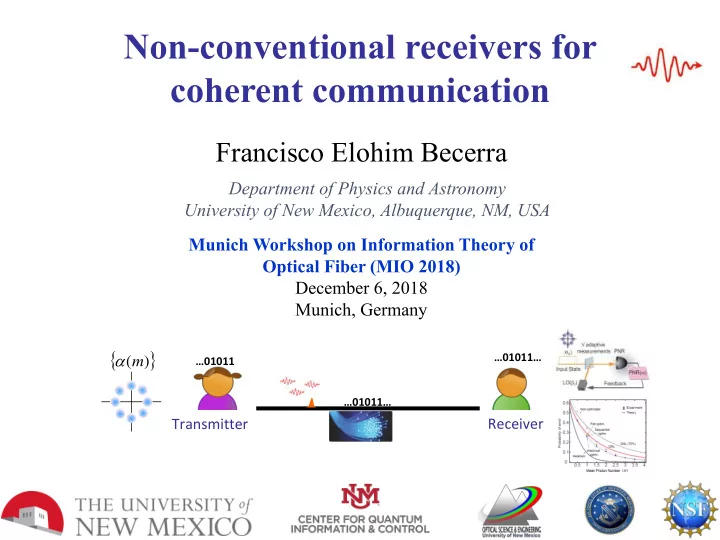
Non-conventional receivers for coherent communication

Department of Physics and Astronomy University of New Mexico, Albuquerque, NM, USA

Francisco Elohim Becerra

Munich Workshop on Information Theory of Optical Fiber (MIO 2018) December 6, 2018 Munich, Germany

…01011 … …01011… …01011…

Transmitter Receiver

 

) (m 

slide-2
SLIDE 2

Measurements in Quantum Mechanics

  • Intrinsic noise of the system limits our ability to measure
  • How can we perform better measurements? Quantum resources!
  • Increase Sensitivity (Enhanced Quantum Measurements)
  • Quantum Metrology: (continuous) parameter estimation
  • Nonorthogonal State Discrimination: Distinguish states

(from a finite known set)

  • Theoretical predictions in the 70’s
  • Experimental discrimination below the SQL (~0.2 dB) *

Only 2 coherent states

* K. Tsujino et al., PRL 106, 250503 (2011).

slide-3
SLIDE 3

Multiple Coherent States

s i

e 

Coherent state

 

 Re

 

 Im

 

1 ,.., 2 , 1 , − = M m

M m   2 =

M-ary Phase Shift Keying (PSK)

 

  − = , Signal

 

    i i Signal − − = , , ,

M=2: Binary Phase Shift Keying (BPSK) M=4: Quadrature Phase Shift Keying (QPSK)

slide-4
SLIDE 4

Multiple Coherent States

Overlap

2

1

n

Discrimination Unavoidable Errors Standard Quantum Limit (SQL) (Minimum Error by direct detection) Coherent States are Nonorthogonal Coherent state

 

 Re

 

 Im

 

1 ,.., 2 , 1 , − = M m

M m   2 =

M-ary Phase Shift Keying (PSK)

 

  − = , Signal

 

    i i Signal − − = , , ,

M=2: Binary Phase Shift Keying (BPSK) M=4: Quadrature Phase Shift Keying (QPSK)

s i

e 

slide-5
SLIDE 5

1 2 3 4 5 6 10

  • 6

10

  • 4

10

  • 2

Quantum Limit: Helstrom Bound

1 S. J. Dolinar, Research Laboratory of Electronics, MIT, Quarterly Progress Report No. 111 (1973).

Demonstration of binary receiver beyond the SQL

  • K. Tsujino et al., PRL 106, 250503 (2011).

Error Probability

Helstrom Bound

Error Probability

BPSK

Helstrom Bound

QPSK

Average Photon Number Average Photon Number

SQL SQL (Dolinar receiver1)

 

  − ,

 

    i i − − , , ,

Optimized Discrimination Strategies Optimized Discrimination Strategies

slide-6
SLIDE 6

Quantum Limit: Helstrom Boun

QPSK

5 10 15 20 10

  • 5

10

  • 4

10

  • 3

10

  • 2

10

  • 1

Error Probability

Helstrom Bound

Average Photon Number

SQL

 

    i i − − , , ,

Optimized Discrimination Strategies

slide-7
SLIDE 7

LO S

S

(Local Oscillator)

  −

     − −    =         ) ( vacuum

) ( D 

LO( )

Signal and LO with

  • rthogonal polarizations

 

) (m 

SPD

Test hypothesis 

Feed-Forward Receiver Design

(M-ary Signals)

Displacement

H V

S LO +

SPD

In Polarization

slide-8
SLIDE 8

Experimental concept

(4-ary Signals)

slide-9
SLIDE 9

Experimental Configuration

(4-ary Signals)

slide-10
SLIDE 10

Phase Preparation (50% duty cycle)

Cal. Lock Cal. Lock Pulse Cycle Time (s) Interference Interference State and LO

Signal Calibration Displacement Calibration 633 Light Pulses Region

Phase Preparation

(Vis=99.7%)

slide-11
SLIDE 11

 i −

Prepared state

Hypothesis Photon Detection Feedback Period 1 1 π 1 2 3π/2 3 3π/2 4 3π/2 5 3π/2 1 6 π/2 1 7 3π/2 8 3π/2 9 3π/2 10 3π/2

Experimental Data Sample

 i −

Decision

 

    i i − − , , ,

slide-12
SLIDE 12

Experimental Error Probability

 

    i i − − , , ,

DE=72% Vis=99.7% DE=72% Vis=99.7%

slide-13
SLIDE 13

Experimental Error Probability

 

    i i − − , , ,

DE=72% Vis=99.7% DE=72% Vis=99.7%

~0.2 dB BPSK

slide-14
SLIDE 14

Experimental Error Probability

 

    i i − − , , ,

DE=72% Vis=99.7% DE=72% Vis=99.7%

6 dB below SQL

~0.2 dB

slide-15
SLIDE 15

PNR Quantum Receiver (Theory)

 

    i i − − , , ,

slide-16
SLIDE 16

PNR Quantum Receiver (Experiment)

 

    i i − − , , ,

slide-17
SLIDE 17

Optimized Displacement Receivers

  • A. R. Ferdinand, M. T. DiMario, F. E. Becerra, npj Quantum Information 3, 43 (2017).

 

    i i − − , , , Optimized displacement

*Muller, C. and Marquardt, C., New J. Phys. 17, 032003 (2015)

slide-18
SLIDE 18

5 10 15 20 10

  • 5

10

  • 4

10

  • 3

10

  • 2

10

  • 1

Error Probability

Mean Photon Number

 

    i i − − , , ,

n

Helstrom Bound1 (QNL) Heterodyne Limit

State Discrimination: Probability of error

4-state discrimination (QPSK)

1 S. J. Dolinar, Research Lab. of Elec., MIT, Quart. Prog. Rep. No. 111 (1973).

| ۧ 𝑗𝛽 |- ۧ 𝑗𝛽 | ۧ 𝛽 |- ۧ 𝛽

Binary Phase-shift Keying (BPSK) 2 4 6 10

  • 6

10

  • 4

10

  • 2

Error Probability Mean Photon Number

(QNL) Homodyne limit

 

  − ,

Error Probability

n

Dolinar receiver1 Helstrom Bound1

  • M. T. DiMario and F. E. Becerra, Phys. Rev. Lett. 121, 023603 (2018)
  • C. Wittmann, et. al, Phys. Rev. Lett. 101, 210501 (2008).
  • K. Tsujino, et. al, Phys. Rev. Lett. 106, 250503 (2011).
  • R. S. Kennedy, MIT Technical Report No. 110 (1972).
  • M. Takeoka and M. Sasaki, Phys. Rev. A 78, 022320 (2008).

Single-shot Optimized
  • Disc. Strategies
slide-19
SLIDE 19

Non-ideal visibility degrades performance

Visibility (ξ) of Displacement characterizes noise and imperfections

  • M. T. DiMario and F. E. Becerra, Phys. Rev. Lett. 121, 023603 (2018)

[1]: C. Wittmann, et. al, Phys. Rev. Lett. 101, 210501 (2008). [2]: K. Tsujino, et. al, Phys. Rev. Lett. 106, 250503 (2011).

slide-20
SLIDE 20

|α|2

Ideal

[1] [2]

ηExp = 0.72 ξExp = 0.998

Binary state discrimination ۧ |𝛽 , ۧ | − 𝛽

Non-ideal visibility degrades performance

Visibility (ξ) of Displacement characterizes noise and imperfections

[1]: C. Wittmann, et. al, Phys. Rev. Lett. 101, 210501 (2008). [2]: K. Tsujino, et. al, Phys. Rev. Lett. 106, 250503 (2011).

  • M. T. DiMario and F. E. Becerra, Phys. Rev. Lett. 121, 023603 (2018)

On-Off Detection

slide-21
SLIDE 21

ηExp = 0.72 ξExp = 0.998

Experimental Error Probability

ηExp = 0.72 ξExp = 0.998

  • M. T. DiMario and F. E. Becerra, Phys. Rev. Lett. 121, 023603 (2018)

Binary state discrimination ۧ |𝛽 , ۧ | − 𝛽

Dark count Prob. = 3.6x10⁻³ After pulsing Prob.=1.1x10⁻²

On-Off Detection

slide-22
SLIDE 22

Dark count probability of 10-3

Phase (PSK) and Intensity OOK encoding

PNR provides robustness to dark counts

  • M. T. DiMario and F. E. Becerra, Phys. Rev. Lett. 121, 023603 (2018)`
slide-23
SLIDE 23

How To Surpass Homodyne

  • M. T. DiMario and F. E. Becerra, Phys. Rev. Lett. 121, 023603 (2018)`
slide-24
SLIDE 24

References State Discrimination

slide-25
SLIDE 25

Non

  • n-Gauss

ssian Rec Receivers for for mult ulti-state di discriminatio ion

  • Multiple state discrimination
  • Strategies surpassing the QNL
  • Photon-number resolution provides

robustness

  • Optimized strategies
  • Surpassing the QNL at all powers
  • Enhance information at low powers

) ( LO

i

N… 3 2 1 …

1 2 3 4 5 1 2 3 4 5 6 7 8 9 10 1 2 3 4 5 Feedback Period <n>
slide-26
SLIDE 26

Quantum Optics Lab

Quantum Measurements: Nonconventional Detection

Transmitter Receiver

NSF (CAREER) AFOSR (YIP)

High-Capacity Atom-Photon Interfaces

Atomic Quantum Memories

4

1

2

3

Entangled photons Entangled photons

S2 S1

Alice Bob |Alice |Bob |Bob Eve