Noi oise Red eductio ion Usi sing Stru tructures Bas ased On n - - PowerPoint PPT Presentation

noi oise red eductio ion usi sing stru tructures bas ased
SMART_READER_LITE
LIVE PREVIEW

Noi oise Red eductio ion Usi sing Stru tructures Bas ased On n - - PowerPoint PPT Presentation

Noi oise Red eductio ion Usi sing Stru tructures Bas ased On n Cou ouple led Helm elmholt ltz Res esonators Lab symbolics Mariia Krasikova 1 , Yuri Baloshin 1 , Alexey Slobozhanyuk 1 , Anton Melnikov 2 , or author photo David Powell


slide-1
SLIDE 1

Mariia Krasikova1 , Yuri Baloshin1, Alexey Slobozhanyuk1, Anton Melnikov2, David Powell3, Mikhail Petrov1 and Andrey Bogdanov1

Noi

  • ise Red

eductio ion Usi sing Stru tructures Bas ased On n Cou

  • uple

led Helm elmholt ltz Res esonators

Lab symbolics

  • r author photo

1 ITMO University, Saint Petersburg, 197101, Russia 2 Fraunhofer Institute for Photonic Microsystems IPMS, Maria-Reiche-Str. 2, 01109 Dresden, Germany 3 School of Engineering and Information Technology, University of New South Wales, Northcott Drive, Canberra, Australian Capital Territory 2600,

Australia

Introduction Infinite structure Comparison Finite 2D structure Experiment Conclusion

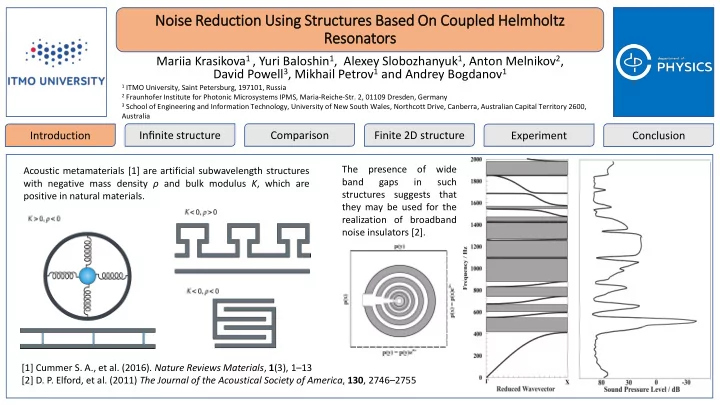
[1] Cummer S. A., et al. (2016). Nature Reviews Materials, 1(3), 1–13 [2] D. P. Elford, et al. (2011) The Journal of the Acoustical Society of America, 130, 2746–2755 Acoustic metamaterials [1] are artificial subwavelength structures with negative mass density ρ and bulk modulus K, which are positive in natural materials. The presence of wide band gaps in such structures suggests that they may be used for the realization of broadband noise insulators [2].

slide-2
SLIDE 2

Mariia Krasikova1 , Yuri Baloshin1, Alexey Slobozhanyuk1, Anton Melnikov2, David Powell3, Mikhail Petrov1 and Andrey Bogdanov1

Noi

  • ise Red

eductio ion Usi sing Stru tructures Bas ased On n Cou

  • uple

led Helm elmholt ltz Res esonators

Lab symbolics

  • r author photo

1 ITMO University, Saint Petersburg, 197101, Russia 2 Fraunhofer Institute for Photonic Microsystems IPMS, Maria-Reiche-Str. 2, 01109 Dresden, Germany 3 School of Engineering and Information Technology, University of New South Wales, Northcott Drive, Canberra, Australian Capital Territory 2600,

Australia

Introduction Infinite structure Comparison Finite 2D structure Experiment Conclusion

[3] A. Melnikov, et al. (2019) Nature Communications, 10, 1–7 (2019) [4] A.Melnikov, et al. (2020) The Journal of the Acoustical Society of America, 147, 1491–1503 Aim of this work is to develop a noise insulating structure made of rigid and lightweight elements available commercially. In particular, C-shaped coupled Helmholtz resonators [3,4] made

  • f polymer water pipes are analyzed.

One of the main goals is to reduce noise in the audible range of sound to insulate street noises. Noise level measured in a park at different distances from a road.

slide-3
SLIDE 3

Introduction Infinite structure Comparison Finite 2D structure Experiment Conclusion

Band diagram Geometry

First of all, we considered the infinite 2D structure with the following Brillouin zone:

Noi

  • ise Red

eduction Usin ing Structures Ba Based On Co Couple led He Helmholtz Res esonators

Mariia Krasikova, Yuri Baloshin, Alexey Slobozhanyuk, Anton Melnikov, David Powell, Mikhail Petrov and Andrey Bogdanov

This design allows achieving band gaps within ГX interval with a total width of about three octaves. Blue horizontal line at 1231 Hz corresponds to the Helmholtz resonance, which is an anti- symmetric mode. Presented band diagram was calculated for following parameters: L = 1.9 mm, A = 4 mm, a1 = 85 mm, a2 = 45 mm,  = 0. Outer radius of pipes was equal to 20 mm. Distance between centers of rings is 45 mm. Pipes are made of polypropylene with Young’s modulus 1.35 GPa, Poisson’s ratio 0.41 and density 900 kg/m3.

slide-4
SLIDE 4

Lab symbolics

Introduction Infinite structure Comparison Finite 2D structure Experiment Conclusion

Helmholtz resonance Geometry

First of all, we considered the infinite 2D structure with the following Brillouin zone:

Noi

  • ise Red

eduction Usin ing Structures Ba Based On Co Couple led He Helmholtz Res esonators

Mariia Krasikova, Yuri Baloshin, Alexey Slobozhanyuk, Anton Melnikov, David Powell, Mikhail Petrov and Andrey Bogdanov

Presented band diagram was calculated for following parameters: L = 1.9 mm, A = 4 mm, a1 = 85 mm, a2 = 45 mm,  = 0. Outer radius of pipes was equal to 20 mm. Distance between centers of rings is 45 mm. Pipes are made of polypropylene with Young’s modulus 1.35 GPa, Poisson’s ratio 0.41 and density 900 kg/m3. Leff is the effective length of the neck, Leff = L + 1.05A, S0 – static area of the cavity, S0 =  (Rout - L)2, c – speed of sound in resonator’s environment (air, 343 m/s) A – width of slit in a pipe

2

res eff

c A f S L  

[5] L. E. Kinsler, et al., Fundamentals of Acoustics, 4th Edition (1999). Estimated frequency of Helmholtz resonance [5] is fres ≈ 1215 Hz:

slide-5
SLIDE 5

Lab symbolics

Introduction Infinite structure Comparison Finite 2D structure Experiment Conclusion

Noi

  • ise Red

eduction Usin ing Structures Ba Based On Co Couple led He Helmholtz Res esonators

Mariia Krasikova, Yuri Baloshin, Alexey Slobozhanyuk, Anton Melnikov, David Powell, Mikhail Petrov and Andrey Bogdanov

Transmission spectrum of semi-infinite structures Band diagrams for infinite structures with different coupling

For strongly coupled rings first band gap is two times larger. All band gaps in this case coincide with band gaps for infinite structures. If resonators are faced to each other (phi = 0), total width of band gaps is larger due to additional coupling. Structure is infinite along y axis and finite along x axis (3 pairs of coupled rings or 6 single rings with slit).

slide-6
SLIDE 6

comparison of the transmission at the receiver location Comparison of the transmission at the receiver location The scheme of the numerical experiment Lab symbolics

Introduction Infinite structure Comparison Finite 2D structure Experiment Conclusion

Noi

  • ise Red

eduction Usin ing Structures Ba Based On Co Couple led He Helmholtz Res esonators

Mariia Krasikova, Yuri Baloshin, Alexey Slobozhanyuk, Anton Melnikov, David Powell, Mikhail Petrov and Andrey Bogdanov

Point source is placed 1.7 m apart the wall consisting of three layers of element’s pairs. Each layer is characterized by different values of L0, but all

  • ther parameters are the same. Then the signal, transmitted through the wall,

is analyzed at the receiver location. Distance between the port and the source is 2 m. Several cases were considered: the pipes without slits, coupled Helmholtz resonators of same S0 and three pairs of coupled resonators L01 = 1.9 mm, L02 = 3.8 mm, L03 = 5.7 mm (all other parameters are the same). Dips in transmission in this case correspond to band gaps of infinite structures.

20 log

wall air

p T p        

Transmission coefficient was calculated as pwall – the pressure created by the source in the case when there is no wall between the source and the receiver pair – the pressure in the presence of the wall

slide-7
SLIDE 7

Lab symbolics

Introduction Infinite structure Comparison Finite 2D structure Experiment Conclusion

Comparison of the experiment and simulation

Photography of the experimental setup

Noi

  • ise Red

eduction Usin ing Structures Ba Based On Co Couple led He Helmholtz Res esonators

Mariia Krasikova, Yuri Baloshin, Alexey Slobozhanyuk, Anton Melnikov, David Powell, Mikhail Petrov and Andrey Bogdanov

2 1

1 – microphone 2 – loudspeaker 3 – pipes (outer radius 20 mm, thickness 2 mm, distance between pipes 5 mm, slit 4 mm, height of pipes 50 cm) Transmission of the signal from loudspeaker throw single pipe and 1 pair of coupled resonators

3

slide-8
SLIDE 8

Lab symbolics

  • r author photo

Introduction Infinite structure Comparison Finite 2D structure Experiment Conclusion

  • 1. We have demonstrated that broadband noise insulation can be achieved with several layers of

coupled C-shaped resonators, which can be made of polymer water pipes.

  • 2. These results may become useful for the realization of simple and lightweight insulating structures.
  • 3. The ongoing research aims to validate obtained results with experimental demonstrations.

Mariia Krasikova mariia.krasikova@metalab.ifmo.ru

Noi

  • ise Red

eductio ion Usi sing Stru tructures Bas ased On n Cou

  • uple

led Helm elmholt ltz Res esonators

Mariia Krasikova1 , Yuri Baloshin1, Alexey Slobozhanyuk1, Anton Melnikov2, David Powell3, Mikhail Petrov1 and Andrey Bogdanov1

1 ITMO University, Saint Petersburg, 197101, Russia 2 Fraunhofer Institute for Photonic Microsystems IPMS, Maria-Reiche-Str. 2, 01109 Dresden, Germany 3 School of Engineering and Information Technology, University of New South Wales, Northcott Drive, Canberra, Australian Capital Territory 2600,

Australia