Tiz Tizen en based ased re remote ote contro co ntroller - - PowerPoint PPT Presentation

tiz tizen en based ased re remote ote
SMART_READER_LITE
LIVE PREVIEW

Tiz Tizen en based ased re remote ote contro co ntroller - - PowerPoint PPT Presentation

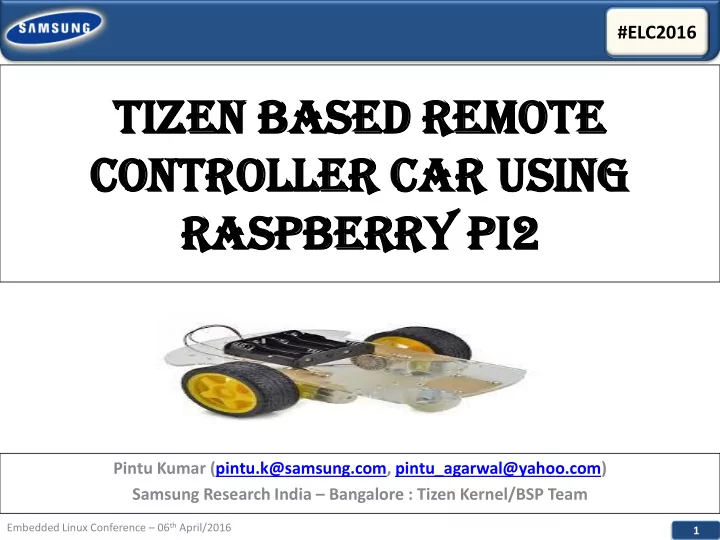
#ELC2016 Tiz Tizen en based ased re remote ote contro co ntroller ller CA CAR R usi sing ng i2 ra rasp spberry berry pi2 Pintu Kumar (pintu.k@samsung.com, pintu_agarwal@yahoo.com) Samsung Research India Bangalore : Tizen


slide-1
SLIDE 1

1 Embedded Linux Conference – 06th April/2016

#ELC2016

Tiz Tizen en based ased re remote

  • te

co contro ntroller ller CA CAR R usi sing ng ra rasp spberry berry pi2 i2

Pintu Kumar (pintu.k@samsung.com, pintu_agarwal@yahoo.com) Samsung Research India – Bangalore : Tizen Kernel/BSP Team

slide-2
SLIDE 2

2 Embedded Linux Conference – 06th April/2016

#ELC2016

CONTENT

  • INTRODUCTION
  • RASPBERRY PI2 OVERVIEW
  • TIZEN OVERVIEW
  • HARDWARE & SOFTWARE REQUIREMENTS
  • SOFTWARE CUSTOMIZATION
  • SOFTWARE SETUP & INTERFACING
  • HARDWARE INTERFACING & CONNECTIONS
  • ROBOT CONTROL MECHANISM
  • SOME RESULTS
  • CONCLUSION
  • REFERENCES
slide-3
SLIDE 3

3 Embedded Linux Conference – 06th April/2016

#ELC2016

INTRODUCTION

  • This talk is about designing a remote controller

robot (toy car) using the raspberry pi2 hardware, pi2 Linux Kernel and Tizen OS as platform.

  • In this presentation, first we will see how to

replace and boot Tizen OS on Raspberry Pi using the pre-built Tizen images. Then we will see how to setup Bluetooth, Wi-Fi on Tizen and finally see how to control a robot remotely using Tizen smart phone application.

slide-4
SLIDE 4

4 Embedded Linux Conference – 06th April/2016

#ELC2016

1 GB RAM

RASPBERRY PI2 - OVERVIEW

slide-5
SLIDE 5

5 Embedded Linux Conference – 06th April/2016

#ELC2016

  • Broadcom BCM2836 900MHz Quad Core ARM

Cortex-A7 CPU

  • 1GB RAM
  • 4 USB ports
  • 40 GPIO pins
  • Full HDMI port
  • Ethernet port
  • Combined 3.5mm audio jack and composite video
  • Camera interface (CSI)
  • Display interface (DSI)
  • Micro SD card slot
  • Video Core IV 3D graphics core

Raspberry PI2 Features

slide-6
SLIDE 6

6 Embedded Linux Conference – 06th April/2016

#ELC2016

PI2 GPIO Pins

slide-7
SLIDE 7

7 Embedded Linux Conference – 06th April/2016

#ELC2016

TIZEN OVERVIEW

slide-8
SLIDE 8

8 Embedded Linux Conference – 06th April/2016

#ELC2016

Mobile Wearable IVI Common

TIZEN

TV Camera PC/Tablet Printer Next??

  • TIZEN is the OS of everything.
  • Tizen is a multi-device OS which can support many types of profiles.
  • The current profile that are supported are:

– Mobile – Wearable – IVI – Common

  • The new profiles can be easily derived using the minimal common profile.

TIZEN Profiles

slide-9
SLIDE 9

9 Embedded Linux Conference – 06th April/2016

#ELC2016

  • Tizen is truly open source. Almost all components are

based on open source packages.

  • Uses mainline Linux Kernel
  • Uses systemd for booting
  • Uses dbus for IPC communication
  • Uses DRM/X11/Wayland for Display & Graphics
  • Uses Gstreamer for multimedia framework
  • Uses SMACK for platform security
  • Uses EFL (Enlightenment Foundation Libraries) for UI

framework

  • Provides SDB (Smart Development Bridge) for

developers.

  • Uses HTML5 for WebApps development
  • And many more….

TIZEN Features

slide-10
SLIDE 10

10 Embedded Linux Conference – 06th April/2016

#ELC2016

  • Raspberry pi 2 hardware
  • Linux PC – Ubuntu 14.04
  • Micro SD Card (8 GB)
  • Robot Chassis platform (with 2 DC motors, 2 wheels, 1 Castor wheels)
  • L293D Driver Board (1 number)
  • USB Power Bank (1 number)
  • AA size batteries (8 numbers, 12V)
  • Battery holder/case (1 number)
  • Wi-Fi USB Dongle (1 number)
  • Bluetooth USB dongle (1 number)
  • USB Web Cam (1 number)
  • A Monitor Screen (for Display purpose)
  • HDMI Cable (1 number)
  • USB keyboard & mouse
  • A Tizen Smart Phone with Tizen 2.4
  • Screws, Blots, Spacer, jumper wires etc.

HARDWARE COMPONENTS

slide-11
SLIDE 11

11 Embedded Linux Conference – 06th April/2016

#ELC2016

  • Raspberry Pi – NOOBS image
  • Tizen 3.0 common pre-built images

(alternatively Tizen pi2 pre-built image).

  • Raspberry Pi Linux Kernel 4.1.16
  • GCC ARM tool chain (arm-linux-gnueabi-gcc)
  • Tizen Yocto setup (Or, Tizen GBS Build setup)
  • Tizen 2.4 SDK software
  • Ubuntu 14.04

SOFTWARE COMPONENTS

slide-12
SLIDE 12

12 Embedded Linux Conference – 06th April/2016

#ELC2016

  • Download Raspberry pi software from:

– https://www.raspberrypi.org/downloads/

  • Extract it and install it on the SD card.
  • Boot the raspberry pi using this SD card.
  • Install the Raspbian OS and boot it till desktop.
  • At this time verify that all functionalities are

working fine on Raspberry pi image.

Raspberry PI Download

slide-13
SLIDE 13

13 Embedded Linux Conference – 06th April/2016

#ELC2016

  • Download Tizen images from:

– https://download.tizen.org/

  • Choose any one type of image from the below repo.
  • If you want to try latest release mobile profile, you can use this:

– https://download.tizen.org/releases/2.4/2.4-mobile/tizen-2.4- mobile_20151030.1/images/

  • If you want to use common profile, you can use this:

– https://download.tizen.org/snapshots/tizen/common/latest/images/

TIZEN Images Download

slide-14
SLIDE 14

14 Embedded Linux Conference – 06th April/2016

#ELC2016

  • Tizen raspberry pi 2 pre-built images:

– https://files.s-osg.org/tizen-on-rpi2/

TIZEN PI2 Images

slide-15
SLIDE 15

15 Embedded Linux Conference – 06th April/2016

#ELC2016

TIZEN Build Setup

  • GBS Build System:

– https://source.tizen.org/es/documentation/referen ce/git-build-system?langredirect=1

  • YOCTO Build System:

– https://wiki.tizen.org/wiki/Build_Tizen_with_Yocto_Pro ject – https://wiki.tizen.org/wiki/Tizen_on_Yocto_Project

https://download.tizen.org/snapshots/tizen/common/latest/repo s/arm-wayland/packages/armv7l/ Tizen 3.0 common pre-built rpms:

slide-16
SLIDE 16

16 Embedded Linux Conference – 06th April/2016

#ELC2016

  • Extract the Tizen common image on the Linux PC. It

will contain 3 images: – rootfs.img (root file system) – system-data.img (system partition: /opt) – user.img (user partition: /opt/usr)

  • Now, check the size of each image using the “du –h”

command. – # du –h *.img

  • 864M rootfs.img
  • 49M system-data.img
  • 97M user.img

TIZEN Partition Creation

slide-17
SLIDE 17

17 Embedded Linux Conference – 06th April/2016

#ELC2016

  • Use Gparted on Ubuntu to create new partitions for Tizen

images, on the SD card.

  • First erase the raspberry pi OS root partition. Do not disturb

the SETTINGS and boot partitions.

  • Then create the new partitions as follows:
slide-18
SLIDE 18

18 Embedded Linux Conference – 06th April/2016

#ELC2016

  • Make sure to run resize2fs command to resize all the

partitions. – sudo resize2fs /dev/sdb7 [rootfs partition] – sudo resize2fs /dev/sdb8 [system-data partition] – sudo resize2fs /dev/sdb9 [user partition]

  • Now, use “dd” commands in Linux to write the actual

Tizen images to the respective partitions on SD card. – sudo dd if=rootfs.img of=/dev/sdb7 bs=4M – sudo dd if=system-data.img of=/dev/sdb8 bs=4M – sudo dd if=user.img of=/dev/sdb9 bs=4M

slide-19
SLIDE 19

19 Embedded Linux Conference – 06th April/2016

#ELC2016

  • Then, remount the SD card on the Linux PC.
  • Now, using the “df –h” command, we should be

able to see all the partitions as follows:

/dev/sdb6 63M 20M 44M 32% /media/boot /dev/sdb8 196M 17M 180M 9% /media/system-data /dev/sdb5 31M 1.4M 28M 5% /media/SETTINGS /dev/sdb9 5.0G 72M 4.9G 2% /media/user /dev/sdb7 1009M 869M 132M 87% /media/rootfs

  • Now, we need to make Tizen specific changes in

raspberry pi kernel and Tizen platform to boot the image successfully on Pi2.

slide-20
SLIDE 20

20 Embedded Linux Conference – 06th April/2016

#ELC2016

  • Download Raspberry Pi Kernel (4.1.16) repo from

the following:

– git clone --depth=1 git://github.com/raspberrypi/linux

  • Build the kernel:

– make ARCH=arm -j8 CROSS_COMPILE=arm-linux-gnueabi- bcm2709_defconfig – make ARCH=arm -j8 CROSS_COMPILE=arm-linux-gnueabi-

  • Create a new defconfig for Tizen:

– # cp –f .config arch/arm/configs/tizen_pi2_defconfig

  • Enable Tizen specific kernel configurations (one by
  • ne), using:

– make ARCH=arm menuconfig

  • Each time you change the configuration, make sure

to sync with the tizen_pi2_defconfig.

TIZEN Kernel Customization

slide-21
SLIDE 21

21 Embedded Linux Conference – 06th April/2016

#ELC2016

  • Fortunately, in Raspberry Pi Kernel

(bcm2709_defconfig), most of the Tizen configs are already enabled.

  • However, we still need to enable few once as below:

CONFIG_SECURITYFS=y CONFIG_SECURITY_SMACK=y CONFIG_AUDIT=y CONFIG_DRM=y CONFIG_MEMCG=y CONFIG_MEMCG_SWAP=y CONFIG_ZRAM=y CONFIG_CGROUP_DEBUG=y CONFIG_PM_SLEEP=y CONFIG_PM_AUTOSLEEP=y

  • After enabling these configs, make sure to sync the

.config with the default tizen_pi2_defconfig again.

slide-22
SLIDE 22

22 Embedded Linux Conference – 06th April/2016

#ELC2016

  • Build the final Kernel image:

– make ARCH=arm -j8 CROSS_COMPILE=arm-linux-gnueabi- tizen_pi2_defconfig – make ARCH=arm -j8 CROSS_COMPILE=arm-linux-gnueabi-

  • Generate the device tree image:

– ./scripts/mkknlimg arch/arm/boot/zImage kernel7.img

  • Copy the kernel images to the SD card boot partition.

– cp -f kernel7.img /media/boot/ – cp -f arch/arm/boot/dts/bcm2709-rpi-2-b.dtb /media/boot/ – cp -f arch/arm/boot/dts/overlays/*.dtb /media/boot/overlays/

slide-23
SLIDE 23

23 Embedded Linux Conference – 06th April/2016

#ELC2016

  • Install the modules built by kernel:

– make ARCH=arm CROSS_COMPILE=arm-linux-gnueabi- -j8 INSTALL_MOD_PATH=../modules modules_install

  • Copy the modules & firmware to SD card rootfs folder:

– sudo cp -rf modules/lib/modules/4.1.16-v7+ /media/rootfs/lib/modules/ – sudo cp -rf modules/lib/firmware/* /media/rootfs/lib/firmware/

  • Copy the original pi2 firmware from NOOBs root folder

to the SD card Tizen rootfs folder:

– sudo cp -rf <pi2 noobs root>/lib/firmware/* /media/rootfs/lib/firmware/

slide-24
SLIDE 24

24 Embedded Linux Conference – 06th April/2016

#ELC2016

  • Update rootfs device node under Kernel command line

in SD card partition: /media/boot/cmdline.txt

– dwc_otg.lpm_enable=0 console=ttyAMA0,115200 console=tty1 root=/dev/mmcblk0p7 rootfstype=ext4 elevator=deadline fsck.repair=yes rootwait

  • Tizen uses systemd services for booting, so customize

systemd services as per your needs, under:

– /usr/lib/systemd/system/*

  • For example to boot the system till command prompt,

you can set the default.target to multi-user.target

  • At this time, you can also perform the clean up of

unnecessary services by simply deleting it and removing it dependencies.

TIZEN Platform Customization

slide-25
SLIDE 25

25 Embedded Linux Conference – 06th April/2016

#ELC2016

  • In Tizen, the getty and console services are disabled by

default.

  • We need to enable these services to get the login

prompt on the terminal.

  • To enable these services we need to modify the

following file:

– /media/rootfs/usr/lib/systemd/system-preset/90-systemd.preset

  • enable console-getty.service
  • enable console-shell.service
  • To get login prompt on Virtual Terminal (tty1), we need

to create tty1 service file:

– cd /media/rootfs/usr/lib/systemd/system/multi-user.target.wants – sudo ln –s ../getty@.service getty@tty1.service

slide-26
SLIDE 26

26 Embedded Linux Conference – 06th April/2016

#ELC2016

Power Supply Monitor Keyboard Mouse SD Card

  • Plug the SD card on the PI2 hardware.
  • Plug other required peripherals as shown below and

power on the raspberry pi.

SETUP & INTERFACING

slide-27
SLIDE 27

27 Embedded Linux Conference – 06th April/2016

#ELC2016

  • You will be able to see the console messages flowing
  • n the monitor screen.
  • If Tizen platform images are mounted successfully, you

will be able to see the following on the terminal.

Detected architecture 'arm'. Welcome to Tizen 3.0.0 (Tizen3/Common)! No hostname configured. Set hostname to <localhost>. localhost login:

User name: {root, guest} Password: tizen

Welcome to Tizen root@localhost:~# Note: User name and password can be found from .ks file. tizen-common_20160315.2_common-wayland-3parts-armv7l-odroidu3.ks

slide-28
SLIDE 28

28 Embedded Linux Conference – 06th April/2016

#ELC2016

Camera Setup

  • In raspberry pi, camera interfacing can be done in 2

ways: – Using CSI Camera Slot – Using the USB Web Cam

  • CSI Camera:

– In CSI camera slot we can directly plug a raspberry pi 5MP Camera module using the ribbon cable. – It is directly controlled by GPU and it is faster. But it requires around 128MB of system RAM reserved memory. – However, we can convert this memory to CMA if memory saving is important. – https://www.raspberrypi.org/documentation/usage/camera /README.md

slide-29
SLIDE 29

29 Embedded Linux Conference – 06th April/2016

#ELC2016

  • USB Web Camera:

– In one of the USB slot plug a webcam (Logitech Webcam) – It will create a node : /dev/video0 through which we can access it using V4L2 calls. – It does not need any reserved memory but the processing could be little slower compared to CSI camera. – Using USB you can connect any number of web cams. – https://www.raspberrypi.org/documentation/usage/webca ms/

slide-30
SLIDE 30

30 Embedded Linux Conference – 06th April/2016

#ELC2016

  • On Tizen, we can perform camera capture using the following:

– Using the standard Gstreamer commands – Using a simple V4L2 application – Using the mm_test_suite for the Tizen source code repo. – Using launch_cam.sh (only for web cam) [For Tizen 3.0]

  • Gstreamer command for single frame capture:

– gst-launch-1.0 v4l2src num-buffers=1 ! video/x-raw, format=I420, width=640, height=480, framerate=30/1 ! filesink location=/opt/usr/media/file.yuv

  • Other sample applications are available under Tizen source:

– https://review.tizen.org/git/?p=platform/core/api/camera.git;a=tree

  • MM Camcoder test suite is available under:

– https://review.tizen.org/git/?p=framework/multimedia/libmm- camcorder.git;a=tree;f=test;h=49ee5fc53d4fcb99e37a1cd5c554f0c95974f3 65;hb=HEAD

slide-31
SLIDE 31

31 Embedded Linux Conference – 06th April/2016

#ELC2016

Display/Graphics Setup

  • Tizen uses DRM (Direct Rendering Manager) &

X11/Wayland based display system.

  • Both DSI display connector or HDMI display interface

can be used.

  • The DRM support for Raspberry Pi graphics controller

VC4 is already available from Linux Kernel 4.1.16.

– Linux/driver/gpu/drm/vc4/…

  • Tizen graphics port for Raspberry Pi is already available

as part of Tizen Yocto project repo for PI2.

– https://blogs.s-osg.org/tizen-rpi2-now-supporting-3d- acceleration/

slide-32
SLIDE 32

32 Embedded Linux Conference – 06th April/2016

#ELC2016

  • To setup Bluetooth on Tizen, insert the Bluetooth USB

Dongle and perform the following steps:

a) root@localhost:~# hciconfig hci0 up b) root@localhost:~# bluetoothctl c) [bluetooth]# power on d) [bluetooth]# agent on e) [bluetooth]# scan on f) [bluetooth]# pair <scanned device MAC_ID> g) [bluetooth]# connect <MAC_ID> h) [bluetooth]# exit For more information please visit: https://wiki.tizen.org/wiki/Connecting_to_a_Smartphone_with_Blu etooth_and_Making_Phone_Calls

Bluetooth Setup

slide-33
SLIDE 33

33 Embedded Linux Conference – 06th April/2016

#ELC2016

  • In Tizen 3.0, we can configure Wi-Fi from the command

prompt using the following steps:

a) root@localhost:~# ifconfig wlan0 up b) root@localhost:~# wpa_supplicant –u –t –B –d –Dwext – f/var/log/wpa_supplicant.log c) root@localhost:~# connmanctl d) connmanctl> enable wifi e) connmanctl> agent on f) connmanctl> services

  • wifi_<wlan0_MAC_ID>_<XXXXX>_managed_psk

g) connmanctl> connect wifi_<XXXXX>_managed_psk [Enter the passphrase here] xxxxxxxx h) connmanctl> exit

Wi-Fi Setup

slide-34
SLIDE 34

34 Embedded Linux Conference – 06th April/2016

#ELC2016

  • If Wi-Fi is connected properly, an IP Address would be assigned

to wlan0 interface: https://blogs.s-osg.org/setup-wifi-raspberry-pi-2-tizen/ root@localhost~:# ifconfig wlan0: flags=4163<UP,BROADCAST,RUNNING,MULTICAST> mtu 1500 inet 192.168.43.91 netmask 255.255.255.0 broadcast 192.168.43.255 inet6 fe80::2c1:41ff:fe29:9c80 prefixlen 64 scopeid 0x20<link> ether 00:c1:41:29:9c:80 txqueuelen 1000 (Ethernet) RX packets 24 bytes 2789 (2.7 KiB) RX errors 0 dropped 0 overruns 0 frame 0 TX packets 37 bytes 5470 (5.3 KiB) TX errors 0 dropped 0 overruns 0 carrier 0 collisions 0

slide-35
SLIDE 35

35 Embedded Linux Conference – 06th April/2016

#ELC2016

HARDWARE INTERFACING

  • Assemble the Robot DIY kit (that includes: chassis, DC motors,

rubber wheels, castor wheels).

  • Attach the Raspberry Pi2 to the chassis.
  • Attach the power bank under the chassis and connect the USB

cable to it (Do not connect to RPi2 now).

  • Attach the L293D driver board to the chassis.
  • Stick the battery case on the chassis (Do not put the battery).
  • Connect the motor driver as shown in the next slide.
  • Connect the Wi-Fi, Bluetooth, Webcam to the RPi2 USB slot.
  • Temporarily connect the keyboard and monitor to do the initial

configuration and setup (Remove it once done).

  • Now, connect the power bank USB cable to the RPi2 (to power
  • n and boot the Pi2).
  • Finally, connect the battery to the battery case.
slide-36
SLIDE 36

36 Embedded Linux Conference – 06th April/2016

#ELC2016

Motor Connection with PI2

L293D Driver Board

M1 M2 +V 0V I4 I3 I2 I1 E1 E2

5V 5V 4 AA Battery Case < 12V

Raspberry Pi 2 - > GPIO Pins

DC Motor 1 DC Motor 2

slide-37
SLIDE 37

37 Embedded Linux Conference – 06th April/2016

#ELC2016

Full Model (Tizen Inside)

Raspberry Pi2 Bluetooth Power Bank Batteries AA, 12V Rx Module (RF Receiver) Wi-Fi DC Motor 2 L293D Driver Board DC Motor 1 Castor Wheel

slide-38
SLIDE 38

38 Embedded Linux Conference – 06th April/2016

#ELC2016

BT

Tizen Smart Phone (Samsung Z1)

Tizen Raspberry Pi 2

BT USB Dongle

RFCOMM (Client) RFCOMM (Server) DC Motor 1 DC Motor 2

F B R L S GPIO17 GPIO18 GPIO22 GPIO23

F => Forward L => Left B => Back R => Right S => Stop the robot Forward (F) GPIO17: 1 GPIO18: 0 GPIO22: 1 GPIO23: 0 Back (B) GPIO17: 0 GPIO18: 1 GPIO22: 0 GPIO23: 1 Left (L) GPIO17: 0 GPIO18: 0 GPIO22: 1 GPIO23: 0 Right (R) GPIO17: 1 GPIO18: 0 GPIO22: 0 GPIO23: 0 Stop (S) GPIO17: 0 GPIO18: 0 GPIO22: 0 GPIO23: 0

S F B R L

BLUETOOTH REMOTE

ROBOT CONTROL MECHANISM

slide-39
SLIDE 39

39 Embedded Linux Conference – 06th April/2016

#ELC2016

  • The devices should be already paired and connected.
  • Use Tizen Mobile 2.4 SDK to develop RFCOMM Client App.

– Reference: https://developer.tizen.org/dev-

guide/2.4/org.tizen.native.mobile.apireference/group__CAPI__NETWORK__BLUETOOTH__S OCKET__MODULE.html

  • Use Tizen CAPI to develop RFCOMM server that runs as a

Daemon to receives data from client and take action.

– Reference:

https://review.tizen.org/git/?p=framework/api/bluetooth.git;a=tree;f=test;h=e7732ccffdc8 7b0ae64c55e5486581a4b5956653;hb=HEAD

  • To control the motor, we can simple write {1,0} to the respective

GPIOs as shown in the table, using the GPIO sysfs entries.

– echo 1 > /sys/class/gpio/gpio17/value – echo 0 > /sys/class/gpio/gpio18/value – echo 1 > /sys/class/gpio/gpio22/value – echo 0 > /sys/class/gpio/gpio23/value

Forward

slide-40
SLIDE 40

40 Embedded Linux Conference – 06th April/2016

#ELC2016

  • RAM memory usage just after boot-up with Wi-Fi, Bluetooth

connected (without display) total used free shared buffers cached Mem: 973 137 835 12 6 75

  • /+ buffers/cache:

56 916 Swap: 255 255 Total: 1229 137 1091 # free -tm

RAM: 1GB (1024 MB) Reserved Memory: (1024 – 973) = 51 MB Used during boot-up: 137 MB Total Used: 51 + 137 = 188 MB Swap (ZRAM) = 256 MB (1/4th for 1GB) [Change zram size in: /etc/resourced/swap.conf]

Note: To get process wise memory usage, we can use a special command in Tizen: # memps –a

RAM Usage

slide-41
SLIDE 41

41 Embedded Linux Conference – 06th April/2016

#ELC2016 text data bss dec hex filename 8314042 690396 784004 9788442 955c1a vmlinux 8314042 690396 784004 9788442 955c1a (TOTALS) # size –t vmlinux 48M modules # du –h modules

Kernel Code Size:

Reserved Memory Details

Kernel Reserved:

# dmesg | grep –i memory Memory: 988016K/1015808K available (6123K kernel code, 527K rwdata, 1688K rodata, 448K init, 757K bss, 19600K reserved, 8192K cma-reserved) Total RAM visible to Kernel = 1015808K = 992MB Reserved for GPU = 16MB (cat /media/boot/config.txt : gpu_mem=16) Reserved memory others = 16MB ( ????) Kernel Reserved = 19600 = 19.14MB (includes kernel code & data structures)

  • Kernel code size can be reduced below 5MB.
  • Platform memory can be optimized further by analyzing memps report.
slide-42
SLIDE 42

42 Embedded Linux Conference – 06th April/2016

#ELC2016 Filesystem Size Used Avail Use% Mounted on /dev/root 945M 806M 114M 88% / devtmpfs 483M 4.0K 483M 1% /dev tmpfs 487M 4.0K 487M 1% /dev/shm tmpfs 487M 13M 475M 3% /run tmpfs 487M 487M 0% /sys/fs/cgroup tmpfs 487M 8.0K 487M 1% /tmp /dev/mmcblk0p8 180M 384K 175M 1% /opt /dev/mmcblk0p9 4.9G 14M 4.8G 1% /opt/usr tmpfs 487M 487M 0% /opt/usr/share/crash/temp tmpfs 98M 98M 0% /run/user/5001

  • ROM memory details with Tizen common 3.0 profile.
  • Rootfs size is less than 1GB. Further reduction is possible.
  • Still we have lots of space in usr partition.
  • For our use case, even 2GB storage should be enough.
  • User files can be stored in /usr/share/media/ folders.

ROM Details

slide-43
SLIDE 43

43 Embedded Linux Conference – 06th April/2016

#ELC2016

Module Size Used by rfcomm 33992 2 btusb 29353 0 bnep 10479 2 btintel 1369 1 btusb btbcm 4490 1 btusb xt_connmark 1735 0 iptable_nat 1646 0 nf_conntrack_ipv4 13237 1 nf_defrag_ipv4 1321 1 nf_conntrack_ipv4 nf_nat_ipv4 4891 1 iptable_nat nf_nat 12207 1 nf_nat_ipv4 nf_conntrack 76946 4 nf_nat,nf_nat_ipv4,xt_connmark,nf_conntrack_ipv4 xt_mark 998 0 iptable_filter 1275 0 iptable_mangle 1379 1 ip_tables 11439 3 iptable_filter,iptable_mangle,iptable_nat x_tables 13353 5 xt_mark,ip_tables,iptable_filter,xt_connmark,iptable_mangle bluetooth 324803 26 bnep,btbcm,btusb,rfcomm,btintel bcm2835_gpiomem 2973 0 bcm2835_rng 1770 0 arc4 1778 2 rt2800usb 17476 0 rt2800lib 71877 1 rt2800usb crc_ccitt 1149 1 rt2800lib rt2x00usb 8539 1 rt2800usb rt2x00lib 36483 3 rt2x00usb,rt2800lib,rt2800usb mac80211 523380 3 rt2x00lib,rt2x00usb,rt2800lib snd_bcm2835 19620 0 snd_pcm 74535 1 snd_bcm2835 snd_timer 18419 1 snd_pcm snd 52151 3 snd_bcm2835,snd_timer,snd_pcm cfg80211 403784 2 mac80211,rt2x00lib uio_pdrv_genirq 2997 0 uio 7880 1 uio_pdrv_genirq rfkill 16398 4 cfg80211,bluetooth joydev 9213 0 evdev 10421 5 sch_fq_codel 7858 2 ipv6 341361 20

Loaded Modules (lsmod)
slide-44
SLIDE 44

44 Embedded Linux Conference – 06th April/2016

#ELC2016

BENEFITS OF USING TIZEN

  • Tizen is truly a open source platform. Every component used in

Tizen is derived from open source. So we have huge flexibility to customize as per our needs.

  • Tizen uses profile concept to support new devices. So new use

case can be easily derived using one of the profile.

  • As we have seen, it is very easy to create new profile to support

future technologies.

  • With Tizen is easy to create bare minimal functionalities with

lesser foot prints.

  • Because of it’s multi-device capabilities it is possible to create

device convergence and derive new communication mechanism.

  • Finally, using the power of open h/w and open source OS, it is

easy to perform various experiments before deriving actual products.

slide-45
SLIDE 45

45 Embedded Linux Conference – 06th April/2016

#ELC2016

  • Perform various clean-ups and create a simple Robotics profile.
  • Touch screen display bring-up using DSI connector.
  • CSI camera bring-up.
  • SDB bring-up and integration in Raspberry Pi Kernel.
  • Various sensors interfacing with the robot.
  • Power consumption analysis while robot is in operation.
  • Setting up the web server and controlling robot using Wi-Fi.
  • Getting camera preview remotely on smart phone.
  • Contribute all the changes to upstream and update in Tizen wiki.

FUTURE WORK

  • Others who like to contribute can join:

– https://wiki.tizen.org/wiki/How_to_contribute_to_Tizen_on_Yocto_Project

  • Community:

– https://www.tizen.org/community/mailing-lists

slide-46
SLIDE 46

46 Embedded Linux Conference – 06th April/2016

#ELC2016

REFERENCES

  • https://www.raspberrypi.org/products/raspberry-pi-2-model-b/
  • https://wiki.tizen.org/wiki/Porting_Guide#
  • https://wiki.tizen.org/w/images/8/86/LinuxCon14_TizenCommon_20141015

.pdf

  • https://www.tizen.org/ko?langredirect=1
  • https://review.tizen.org/git/
  • https://wiki.tizen.org/wiki/Tizen_on_Yocto_Project
  • http://blogs.s-osg.org/category/tizen/
  • https://blogs.s-osg.org/tizen-on-rpi2/
  • http://events.linuxfoundation.org/sites/events/files/slides/KLF2014-

Dongkun.pdf

  • http://www.krnet.or.kr/board/data/dprogram/1784/C1-2-KRnet2013.pdf
  • https://people.csail.mit.edu/albert/bluez-intro/
  • http://diyhacking.com/diy-projects/raspberry-pi-projects/
  • http://diyhacking.com/raspberry-pi-robot/
slide-47
SLIDE 47

47 Embedded Linux Conference – 06th April/2016

#ELC2016

Thanks Thanks