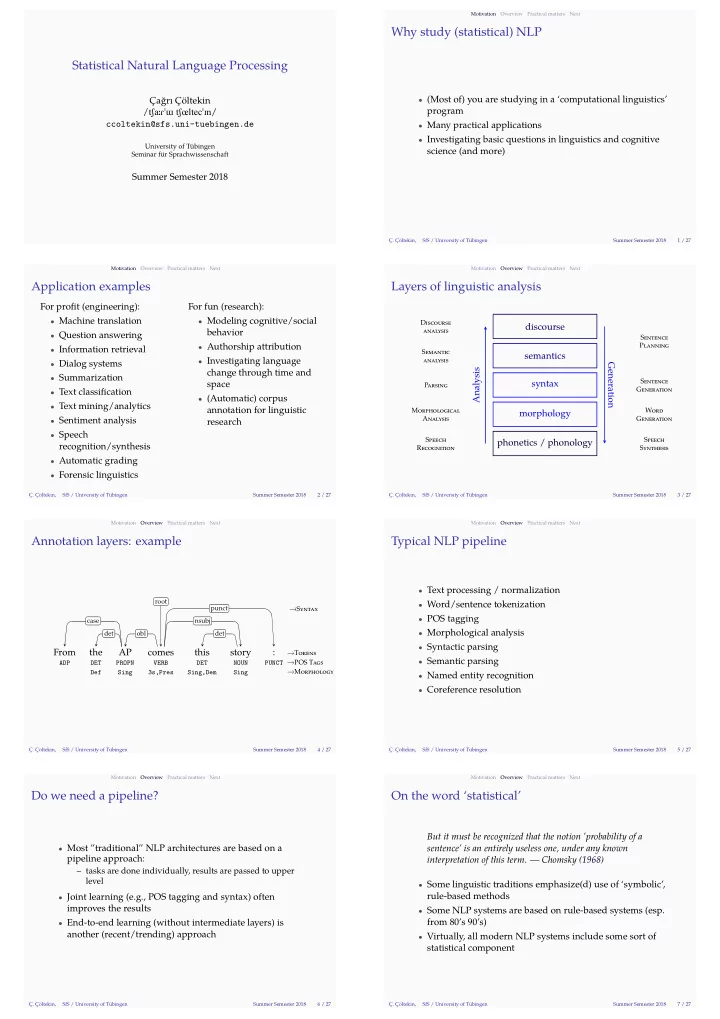
Statistical Natural Language Processing Sing DET NOUN PUNCT Def - - PDF document

statistical natural language processing
SMART_READER_LITE
LIVE PREVIEW

Statistical Natural Language Processing Sing DET NOUN PUNCT Def - - PDF document

Statistical Natural Language Processing Sing DET NOUN PUNCT Def Sing 3s,Pres Sing,Dem case PROPN det obl root det nsubj punct . ltekin, VERB DET Summer Semester 2018 Next . ltekin, SfS / University of Tbingen


slide-1
SLIDE 1

Statistical Natural Language Processing

Çağrı Çöltekin /tʃaːɾˈɯ tʃœltecˈɪn/ ccoltekin@sfs.uni-tuebingen.de

University of Tübingen Seminar für Sprachwissenschaft

Summer Semester 2018

Motivation Overview Practical matters Next

Why study (statistical) NLP

  • (Most of) you are studying in a ‘computational linguistics’

program

  • Many practical applications
  • Investigating basic questions in linguistics and cognitive

science (and more)

Ç. Çöltekin, SfS / University of Tübingen Summer Semester 2018 1 / 27 Motivation Overview Practical matters Next

Application examples

For profjt (engineering):

  • Machine translation
  • Question answering
  • Information retrieval
  • Dialog systems
  • Summarization
  • Text classifjcation
  • Text mining/analytics
  • Sentiment analysis
  • Speech

recognition/synthesis

  • Automatic grading
  • Forensic linguistics

For fun (research):

  • Modeling cognitive/social

behavior

  • Authorship attribution
  • Investigating language

change through time and space

  • (Automatic) corpus

annotation for linguistic research

Ç. Çöltekin, SfS / University of Tübingen Summer Semester 2018 2 / 27 Motivation Overview Practical matters Next

Layers of linguistic analysis

phonetics / phonology morphology syntax semantics discourse Analysis Generation

Speech Recognition Morphological Analysis Parsing Semantic analysis Discourse analysis Sentence Planning Sentence Generation Word Generation Speech Synthesis

Ç. Çöltekin, SfS / University of Tübingen Summer Semester 2018 3 / 27 Motivation Overview Practical matters Next

Annotation layers: example

From the AP comes this story :

ADP DET PROPN VERB DET NOUN PUNCT Def Sing 3s,Pres Sing,Dem Sing case det

  • bl

root det nsubj punct →Syntax →Tokens →POS Tags →Morphology

Ç. Çöltekin, SfS / University of Tübingen Summer Semester 2018 4 / 27 Motivation Overview Practical matters Next

Typical NLP pipeline

  • Text processing / normalization
  • Word/sentence tokenization
  • POS tagging
  • Morphological analysis
  • Syntactic parsing
  • Semantic parsing
  • Named entity recognition
  • Coreference resolution

Ç. Çöltekin, SfS / University of Tübingen Summer Semester 2018 5 / 27 Motivation Overview Practical matters Next

Do we need a pipeline?

  • Most ”traditional” NLP architectures are based on a

pipeline approach:

– tasks are done individually, results are passed to upper level

  • Joint learning (e.g., POS tagging and syntax) often

improves the results

  • End-to-end learning (without intermediate layers) is

another (recent/trending) approach

Ç. Çöltekin, SfS / University of Tübingen Summer Semester 2018 6 / 27 Motivation Overview Practical matters Next

On the word ‘statistical’

But it must be recognized that the notion ’probability of a sentence’ is an entirely useless one, under any known interpretation of this term. — Chomsky (1968)

  • Some linguistic traditions emphasize(d) use of ‘symbolic’,

rule-based methods

  • Some NLP systems are based on rule-based systems (esp.

from 80’s 90’s)

  • Virtually, all modern NLP systems include some sort of

statistical component

Ç. Çöltekin, SfS / University of Tübingen Summer Semester 2018 7 / 27

slide-2
SLIDE 2

Motivation Overview Practical matters Next

What is diffjcult with NLP?

  • Combinatorial problems - computational complexity
  • Ambiguity
  • Data sparseness

Ç. Çöltekin, SfS / University of Tübingen Summer Semester 2018 8 / 27 Motivation Overview Practical matters Next

NLP and computational complexity

  • How many possible parses a sentence may have?
  • How many ways can you align two (parallel) sentences?
  • How to calculate probability of sentence based on the

probabilities of words in it?

  • Many similar questions we deal with have an exponential

search space

  • Naive approaches often are computationally intractable

Ç. Çöltekin, SfS / University of Tübingen Summer Semester 2018 9 / 27 Motivation Overview Practical matters Next

NLP and ambiguity

fun with newspaper headlines

  • FARMER BILL DIES IN HOUSE
  • TEACHER STRIKES IDLE KIDS
  • SQUAD HELPS DOG BITE VICTIM
  • BAN ON NUDE DANCING ON GOVERNOR’S DESK
  • PROSTITUTES APPEAL TO POPE
  • KIDS MAKE NUTRITIOUS SNACKS
  • DRUNK GETS NINE MONTHS IN VIOLIN CASE
  • MINERS REFUSE TO WORK AFTER DEATH

Ç. Çöltekin, SfS / University of Tübingen Summer Semester 2018 10 / 27 Motivation Overview Practical matters Next

More ambiguities

we do not recognize many of them at fjrst read

  • Time fmies like an arrow;

fruit fmies like a banana.

  • Outside of a dog, a book is

a man’s best friend; inside it’s too hard to read.

  • One morning I shot an

elephant in my pajamas. How he got in my pajamas, I don’t know.

  • Don’t eat the pizza with

knife and fork ; the one with anchovies is better.

  • Hearing voices? Then

you’re not alone!

  • No parking on both sides.
  • They are canning peas.
  • My job was keeping him

alive.

  • We watched another fmy.
  • Double job pay.
  • He fed her cat food.

Ç. Çöltekin, SfS / University of Tübingen Summer Semester 2018 11 / 27 Motivation Overview Practical matters Next

Even more ambiguities

with pretty pictures

Cartoon Theories of Linguistics, SpecGram Vol CLIII, No 4, 2008. http://specgram.com/CLIII.4/school.gif Ç. Çöltekin, SfS / University of Tübingen Summer Semester 2018 12 / 27 Motivation Overview Practical matters Next

Statistical methods and data sparsity

  • Statistical methods (machine learning) are the best way we

know to deal with ambiguities

  • Even for rule-based approaches, a statistical

disambiguation component is necessary

  • Machine learning methods require (annotated) data
  • But …

Ç. Çöltekin, SfS / University of Tübingen Summer Semester 2018 13 / 27 Motivation Overview Practical matters Next

Languages are full of rare events

word frequencies in a small corpus

50 100 150 200 250 0.00 0.02 0.04 0.06 a long tail follows … rank relative frequency

Ç. Çöltekin, SfS / University of Tübingen Summer Semester 2018 14 / 27 Motivation Overview Practical matters Next

What is in this course

  • Quick introduction / refreshers on important prerequisites
  • The computational linguist’s toolbox: basic methods and

tools in NLP

  • Some applications of NLP

Ç. Çöltekin, SfS / University of Tübingen Summer Semester 2018 15 / 27

slide-3
SLIDE 3

Motivation Overview Practical matters Next

What is in this course

Preliminaries

  • Linear algebra, some concepts from calculus
  • Probability theory
  • Information theory
  • Statistical inference
  • Some topics from machine learning

– Regression & classifjcation – Sequence learning (HMMs) – Neural networks and deep learning – Unsupervised learning

Ç. Çöltekin, SfS / University of Tübingen Summer Semester 2018 16 / 27 Motivation Overview Practical matters Next

What is in this course

NLP Tools and techniques

  • Tokenization, normalization, segmentation
  • N-gram language models
  • Part of speech tagging
  • Statistical parsing
  • Distributed representations (of words, and other linguistic
  • bjects)

Ç. Çöltekin, SfS / University of Tübingen Summer Semester 2018 17 / 27 Motivation Overview Practical matters Next

What is in this course

Applications

  • Text classifjcation

– sentiment analysis – language detection – authorship attribution – …

If time allows

  • Statistical machine translation
  • Named entitiy recognition
  • Text summarization
  • Dialog systems

Ç. Çöltekin, SfS / University of Tübingen Summer Semester 2018 18 / 27 Motivation Overview Practical matters Next

What is not in this course

  • Cutting edge, latest methods & applications
  • In-depth treatment of particular topics
  • Introduction to terms / concepts from linguistics

Ç. Çöltekin, SfS / University of Tübingen Summer Semester 2018 19 / 27 Motivation Overview Practical matters Next

Logistics

  • Lectures: Mon/Fri 12:15 at Hörsaal 0.02
  • Practical sessions: Wed 10:15 at Hörsaal 0.02
  • Offjce hours: Wed 12:00-14:00 (room 1.09), or by

appointment (email ccoltekin@sfs.uni-tuebingen.de)

  • Course web page:

http://sfs.uni-tuebingen.de/~ccoltekin/courses/snlp

  • We will use GitHub classroom in this class (more on this

soon)

Ç. Çöltekin, SfS / University of Tübingen Summer Semester 2018 20 / 27 Motivation Overview Practical matters Next

Reading material

  • Daniel Jurafsky and James H. Martin (2009). Speech and Language

Processing: An Introduction to Natural Language Processing, Computational Linguistics, and Speech Recognition. second. Pearson Prentice Hall. isbn: 978-0-13-504196-3 – Draft chapters of the third edition is available at http://web.stanford.edu/~jurafsky/slp3/

  • Trevor Hastie, Robert Tibshirani, and Jerome Friedman (2009).

The Elements of Statistical Learning: Data Mining, Inference, and

  • Prediction. Second. Springer series in statistics. Springer-Verlag

New York. isbn: 9780387848587. url: http://web.stanford.edu/~hastie/ElemStatLearn/

Ç. Çöltekin, SfS / University of Tübingen Summer Semester 2018 21 / 27 Motivation Overview Practical matters Next

Grading / evaluation

  • Seven graded homework assignments (5 % each)
  • Final exam (70 %)
  • Attendance

– 5 % (bonus) if you miss only one or two classes – you lose one bonus point for each additional class you miss

  • Up to 5 % additional bonus points for Easter eggs:

– fjrst person fjnding intentional trivial mistakes in the course material gets 1 %

Ç. Çöltekin, SfS / University of Tübingen Summer Semester 2018 22 / 27 Motivation Overview Practical matters Next

Assignments

  • For distribution and submission of assignments, we will

use GitHub Classroom

  • The amount of git usage required is low, but

learning/using git well is strongly recommended

  • You are encouraged to pair up for the assignments, but you

cannot pair with the same person twice

  • Late assignments up to one week, will be graded up to half

points indicated

  • The solutions will be discussed in the tutorial session after
  • ne week from deadline

Ç. Çöltekin, SfS / University of Tübingen Summer Semester 2018 23 / 27

slide-4
SLIDE 4

Motivation Overview Practical matters Next

Assignment 0

  • Your fjrst assignment is already posted on the web page
  • You need to follow the URL on the print version of the

syllabus

  • By completing assignment 0, you will

– register for the course – have access to the non-public course material – exercise with how later assignments will work – provide some data for future exercises

  • The repository created for assignment 0 is private, and can
  • nly be accessed you and the instructors

Ç. Çöltekin, SfS / University of Tübingen Summer Semester 2018 24 / 27 Motivation Overview Practical matters Next

Practical sessions

  • Tutor: Verena Blaschke

⟨verena.blaschke@student.uni-tuebingen.de⟩

  • We will start with two sessions on Python

tutorial/refresher

  • You need to bring your own computer, make sure you have

a working Python interpreter

  • You are encouraged to ask questions about the exercises

during practical sessions

  • You are encouraged to ask questions about the assignments
  • The solutions will be discussed during tutorial sessions

Ç. Çöltekin, SfS / University of Tübingen Summer Semester 2018 25 / 27 Motivation Overview Practical matters Next

Further git/GitHub usage

  • Once you complete Assignment 0, you will be a member of

the ‘organization’ snlp2018

  • You will get access to

– private course material – assignment links – news and announcements

through the repository at https://github.com/snlp2018/snlp2018

  • Make sure to watch this repository
  • You are also encouraged to use ‘issues’ in this repository as

a place to discuss course topics, ask questions about the material and assignments

Ç. Çöltekin, SfS / University of Tübingen Summer Semester 2018 26 / 27 Motivation Overview Practical matters Next

Next

Fri (this week) a hands-on introduction to Python Mon Mathematical preliminaries (some linear algebra and bits from calculus) Wed Python tutorial (continued)

Ç. Çöltekin, SfS / University of Tübingen Summer Semester 2018 27 / 27

References / additional reading material

Bishop, Christopher M. (2006). Pattern Recognition and Machine Learning. Springer. isbn: 978-0387-31073-2. Chomsky, Noam (1968). “Quine’s empirical assumptions”. In: Synthese 19.1, pp. 53–68. doi: 10.1007/BF00568049. Hastie, Trevor, Robert Tibshirani, and Jerome Friedman (2009). The Elements of Statistical Learning: Data Mining, Inference, and Prediction. Second. Springer series in statistics. Springer-Verlag New York. isbn: 9780387848587. url: http://web.stanford.edu/~hastie/ElemStatLearn/. Jurafsky, Daniel and James H. Martin (2009). Speech and Language Processing: An Introduction to Natural Language Processing, Computational Linguistics, and Speech Recognition. second. Pearson Prentice Hall. isbn: 978-0-13-504196-3. Manning, Christopher D. and Hinrich Schütze (1999). Foundations of Statistical Natural Language Processing. MIT

  • Press. isbn: 9780262133609.

Ç. Çöltekin, SfS / University of Tübingen Summer Semester 2018 A.1