NO! Syndrome Decreased (younger Grading of concussions? Quality - - PDF document

no
SMART_READER_LITE
LIVE PREVIEW

NO! Syndrome Decreased (younger Grading of concussions? Quality - - PDF document

Sport as a Concussion Laboratory Preventing Concussion in Sport: From the Lab to the Law Neurophysiology Kevin Guskiewicz, PhD, ATC Treatment & Concussion Rehabilitation University of North Carolina at Chapel Hill Biomechanics


slide-1
SLIDE 1

1

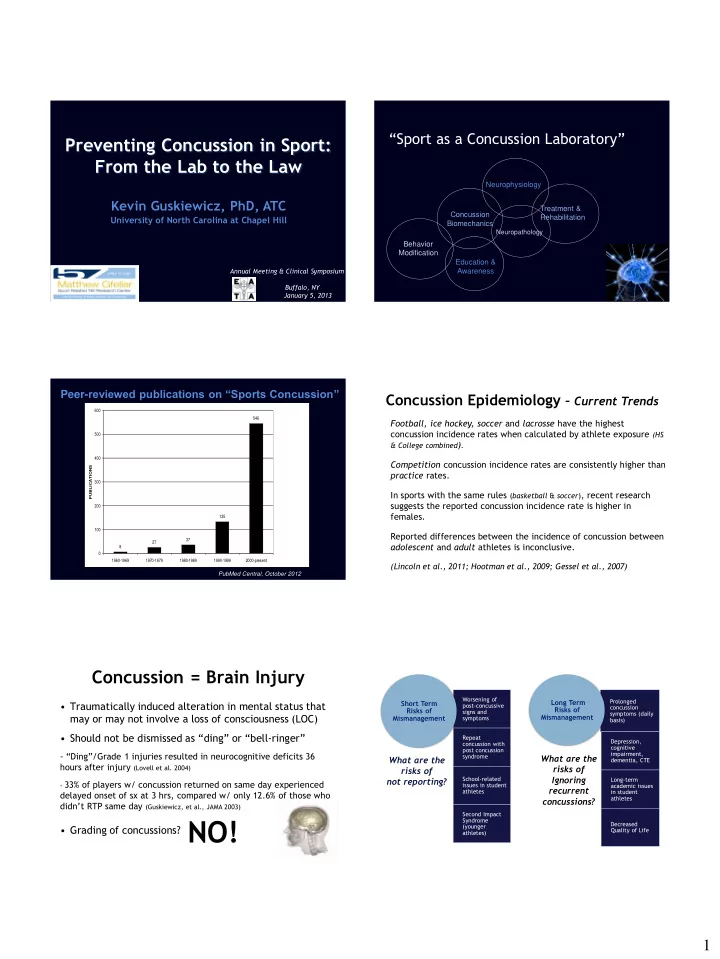
Preventing Concussion in Sport: From the Lab to the Law

Kevin Guskiewicz, PhD, ATC

University of North Carolina at Chapel Hill

Annual Meeting & Clinical Symposium Buffalo, NY January 5, 2013

Concussion Biomechanics Behavior Modification Education & Awareness Neurophysiology

Neuropathology

Treatment & Rehabilitation

“Sport as a Concussion Laboratory”

PubMed Central, October 2012

8 27 37 135 546 100 200 300 400 500 600 1960-1969 1970-1979 1980-1989 1990-1999 2000-present PUBLICATIONS

Peer-reviewed publications on “Sports Concussion”

Concussion Epidemiology – Current Trends

Football, ice hockey, soccer and lacrosse have the highest concussion incidence rates when calculated by athlete exposure (HS

& College combined).

Competition concussion incidence rates are consistently higher than practice rates. In sports with the same rules (basketball & soccer), recent research suggests the reported concussion incidence rate is higher in females. Reported differences between the incidence of concussion between adolescent and adult athletes is inconclusive. (Lincoln et al., 2011; Hootman et al., 2009; Gessel et al., 2007)

  • Traumatically induced alteration in mental status that

may or may not involve a loss of consciousness (LOC)

  • Should not be dismissed as “ding” or “bell-ringer”
  • “Ding”/Grade 1 injuries resulted in neurocognitive deficits 36

hours after injury (Lovell et al. 2004)

  • 33% of players w/ concussion returned on same day experienced

delayed onset of sx at 3 hrs, compared w/ only 12.6% of those who didn’t RTP same day (Guskiewicz, et al., JAMA 2003)

  • Grading of concussions?

Concussion = Brain Injury

NO!

Worsening of post-concussive signs and symptoms Repeat concussion with post concussion syndrome School-related issues in student athletes Second Impact Syndrome (younger athletes)

Short Term Risks of Mismanagement

Prolonged concussion symptoms (daily basis) Depression, cognitive impairment, dementia, CTE Long-term academic issues in student athletes Decreased Quality of Life

Long Term Risks of Mismanagement

What are the risks of not reporting? What are the risks of Ignoring recurrent concussions?

slide-2
SLIDE 2

2

Impact Biomechanics Symptoms Neurocognitive function Balance

Chronic effects (PCS, depression, MCI)

Linear acceleration Angular acceleration Location

The Concussion Solution

Frequency Acute Tx

  • Omega 3-FA?
  • Hyperbarics?
  • Progesterone?

Acute Dx

  • Biomarkers?

Clinical Recovery

Amnesia LOC Concussion Hx Sex

Symptoms Balance Brief Mental Status 570 Concussed HS & College Athletes 166 Control (uninjured) Athletes Prolonged Recovery (s/s >7 days) Typical Recovery (s/s <7 days) Controls (uninjured)

JINS (2012), 18, 1–12.

570 Concussed HS & College Athletes 166 Control (uninjured) Athletes Prolonged Recovery (s/s >7 days) Typical Recovery (s/s <7 days) Controls (uninjured)

JINS (2012), 18, 1–12.

570 Concussed HS & College Athletes 166 Control (uninjured) Athletes Controls (uninjured) Typical Recovery (s/s <7 days) Prolonged Recovery (s/s >7 days)

JINS (2012), 18, 1–12. PM R 2011;3:S445-S451

Purpose: Examine the proportion of concussed athletes with impairment disagreements across various clinical concussion assessment measures. Methods: N= 100 concussed collegiate– aged athletes assessed at BL & <72 hrs post-injury on GSC, computerized NP, and balance

slide-3
SLIDE 3

3

  • Significant disagreements (~52% of cases) between symptom

severity scores and all other clinical measures (NP & Balance Tests).

  • Symptom severity scores identified more impairments than all other

measures.

  • Emphasizes multifaceted approach to concussion assessment.

PM&R 2011;3:S445-S451

Purpose: Examine the proportion of concussed athletes with impairment disagreements across various clinical concussion assessment measures. Methods: N= 100 concussed collegiate athletes assessed at BL & <72 hrs post-injury on GSC, computerized NP, and balance

  • Disagreements between symptom severity total scores and all other clinical

measures (NP & Balance Testing). Disagreement proportions ranged from 22-52%.

  • Symptom severity total scores identified more impairments than all other

measures.

  • Emphasizes need for multifaceted approach to concussion assessment.

Clinical Test Battery Six 20 sec trials using 3 different stances (double, single, tandem) on 2 different surfaces (firm, foam) Recorded Errors

  • Hands lifted off iliac crests
  • Opening eyes
  • Step, stumble, or fall
  • Moving into >30 deg. of hip

flexion or abduction

  • Remaining out of testing

position for >5 secs.

Balance Error Scoring System (BESS)

Serial Evaluations

TOI: clinical eval & symptom checklist 1-3 hrs: symptom checklist 24 hrs: follow-up clinical eval & symptom checklist

Symptomatic Asymptomatic

  • 1. Continued rest
  • 2. Monitoring of s/s
  • 3. If deteriorating – consider

imaging

  • 1. Neuropsychological testing
  • 2. Balance testing
  • 3. Monitoring of s/s
slide-4
SLIDE 4

4

Serial Evaluations (con’t)

Once athlete has been asymptomatic for 24 hrs:

  • Reassess on clinical measures and compare to

baseline scores.

  • Continue to monitor symptoms for 24 hrs after

assessment.

  • If remain asymptomatic, reassess on clinical measures

to see where they are relative to baseline and to previous day.

  • Start Graduated RTP Progression if:

* 95% baseline achieved * no deterioration from previous day

5 Step Graduated Return to Play

  • Exertion Step 1: 20 minute stationary bike ride (10-14 MPH)
  • Exertion Step 2: Interval bike ride: 30 sec sprint (18-20 MPH/10-

14 MPH)/30 sec recovery x 10; and BW circuit: Squats/Push Ups/Situps x 20 sec x 3

  • Exertion Step 3: 60 yard shuttle run x 10 (40 sec rest); and

plyometric workout: 10 yard bounding/10 medicine ball throws/10 vertical jumps x 3; and non-contact, sports-specific drills for approximately 15 minutes

  • Exertion Step 4: Limited, controlled return to non-contact

practice

  • Exertion 5: Full sport participation in a practice

Working through the RTP Progression

  • The 5 steps do not necessarily require 5 days.
  • No more than 2 steps should be performed on the same day,

which allows for monitoring of both acute symptoms (during the activity) and delayed symptoms (within 24 hrs after the activity).

  • In general, If the exertional activities do not produce acute symptoms,

the athlete may progress to the next step.

  • The athlete may advance to Step 5 and return to full

participation once they have remained asymptomatic for 24 hrs following Step 4 of the protocol.

  • Always document the process, day by day, step by step!

Concussion-proof helmets?

  • Helmets do a great job of preventing catastrophic head

injuries

– Skull Fracture – More focal injuries

  • Properly fitted, properly worn, and good condition!

NO!

Managing energy inside the cranial cavity

Helmet Testing: Challenges

  • Different methods used for head injury risk assessment

– Peak linear acceleration (a) – Head Injury Criterion (HIC) – Severity Index (SI)

  • Predicts traumatic skull & brain injury risk

– Peak angular acceleration (α)

  • Best predictor of loss of consciousness
  • NOCSAE standard

– Severe head injury prevention (skull fx, hematomas, etc.) – Drop to rigid surfaces over 5 m/s – Severity Index <1,200 to pass; one size fits all

slide-5
SLIDE 5

5

Helmet Testing: Challenges

50 100 150 200 250 300 350 0.1 0.2 0.3 0.4 0.5 0.6 0.7 0.8 0.9 1 Peak Head Acceleration (g) Probability of Injury Collegiate Incidence Rate NFL Incidence Rate Funk et al. 2007 Concussive CDF Pellman et al. 2003

Injury Risk Curves – which one is correct?

  • Self-reported “cognitive impairment” was reported by nearly half of

the concussed athletes, yet NP testing did not identify many as

  • impaired. 30% of the athletes who were impaired on the GSC would have

cleared if only NP testing were utilized.

  • Nearly 1/3 of the concussed athletes reported either a “balance

problem” or “dizziness” but balance testing did not identify as

  • impaired. >30% of the athletes who were impaired on the GSC would have

cleared if only balance testing was utilized.

  • GSC should be administered by a trained health care provider, and

NOT simply placed in front of an athlete for them to complete. It will

not ascertain the same information as a clinician administered GSC.

  • Unless needed for academic or other outside performance based

decisions, using computerized NP testing while an athlete is still symptomatic is not clinically beneficial. Riddell– “Riddell views the use of third party aftermarket accessories or products that alter the fit, form and function of the helmet as unauthorized alterations to our football helmets. Such accessories may affect NOCSAE certification, and we do not recommend their use.” Schutt– “Adding (product) to anything from Schutt would add weight, compromise fit and could compromise the protection of your athletes. Using these (products) in any Schutt helmet would be considered altering the

  • helmet. Adding this (product or material) will void the helmet warranty and

release Schutt from all liability associated with the altered helmet.” Rawlings– “Rawlings does not recommend the use of third party aftermarket accessories or products that alter the fit, form, function, or performance characteristics of the helmet. In addition, Rawlings’ warranty may be voided by ‘any alterations of, additions to, or component omissions

  • r removals to’ the helmet.”

Aftermarket Helmet Inserts/ Force Reduction Materials?

Head Impact Telemetry (HIT) System

On-Field Biomechanics

  • Following 6 NCAA fall football seasons:

– 255,432 head impacts recorded in 107 players

  • Players’ ave. impact = 23.7g linear aceleration
  • The brain can withstand a large number of impacts

without clinically distinguishable injury; Ave 950 impacts per season; BUT what are the long-term effects?

  • Impacts sustained during helmets-only (“light”) practices

were higher than those in full contact practices and games/scrimmages

slide-6
SLIDE 6

6

Case # Player Position* Linear Magnitude (g) Rotational acceleration (rad/s2) Impact Location ΔSymptom Scores† ΔSOT Composite‡ ΔANAM Composite‡ 1 OL 60.31 5419.18 Front 2

  • 4.88

2 RB 60.51 163.35 Top 12

  • 19.15
  • 0.20

3 LB 63.84 5923.27 Front 8

  • 15.68
  • 0.35

4 WR 66.36 5573.42 Front 23 3.85 5 RB 77.68 3637.48 Top 8

  • 29.18

0.22 6 DB 84.07 5299.57 Front 7

  • 2.25
  • 0.26

7 DB 85.10 3274.05 Top 4 4.11 0.49 8 LB 94.20 7665.10 Front No baseline data available 9 DL 99.74 8994.40 Front 27

  • 4.07

0.14 10 OL 100.36 1085.26 Top

  • 2.00

1.01 11§3 LB 102.39 6837.62 Right 30

  • 60.01
  • 1.56

12 OL 107.07 2811.45 Top 9

  • 20.57
  • 0.76

13§5 RB 108.02 6711.00 Front 2

  • 17.79

14 DB 109.88 6632.77 Top 16 2.70

  • 0.06

15§14 DB 115.50 2303.63 Top 2

  • 1.49

16 DL 119.23 7974.22 Right 12 2.89 0.12 17 LB 157.50 1020.00 Front 14 0.71 0.42 18 WR 168.71 15397.07 Back 13 7.33 0.79 19 RB 173.22 4762.74 Top 32 8.08

Impact accelerations and corresponding changes for clinical measures after concussion in 19 collegiate football players: BIG hits ≠ biggest deficits!

Guskiewicz, Mihalik, Shankar, Marshall, et al., Neurosurgery, 2007

Injury Results:

  • 104
  • 100
  • 96
  • 92
  • 88
  • 84
  • 80
  • 76
  • 72
  • 68
  • 64
  • 60
  • 56
  • 52
  • 48
  • 44
  • 40
  • 36
  • 32
  • 28
  • 24
  • 20
  • 16
  • 12
  • 8
  • 4

4 8 12 16 20 24 28 32 36

Red = Lower FA

in concussed vs. control group

Diffusion Tensor Imaging – FA (white matter integrity)

p<0.05 FDR corrected Cluster size > 100 Two sample t-test

  • 104
  • 100
  • 96
  • 92
  • 88
  • 84
  • 80
  • 76
  • 72
  • 68
  • 64
  • 60
  • 56
  • 52
  • 48
  • 44
  • 40
  • 36
  • 32
  • 28
  • 24
  • 20
  • 16
  • 12
  • 8
  • 4

4 8 12 16 20 24 28 32 36

Diffusion Tensor Imaging – FA (white matter integrity)

p<0.05 FDR corrected Cluster size > 100

Red = Lower FA

value at post- season vs. pre- season

Paired t-test

Leading with the head: Is it still a problem?

  • Yes
  • 15% of all impacts occurred to top of head; down

from 19% (ave. seasons 1,2,3)

  • Players were 3x more likely to sustain

an impact of >80 g to top of the head than any other helmet location:

  • Mihalik, Bell, Marshall, & Guskiewicz. (Neurosurgery, 2007).

Are special teams (punts & kickoffs) a problem?

The Play The Data

157.5 g 1020.0 rad/s2 Front

slide-7
SLIDE 7

7

Play Type Closing Distance Ave Linear Acc. lower_cl upper_cl DF Prob.t

Defense >10 yards 25.36 23.14 27.79 9 <.0001 Defense <10 yards 23.47 21.99 25.05 9 <.0001 Offense >10 yards 24.66 22.48 27.04 9 <.0001 Offense <10 yards 23.94 22.59 25.36 9 <.0001 Special teams >10 yards 26.82 24.93 28.84 9 <.0001 Special teams <10 yards 20.93 18.13 24.15 9 <.0001

Impact magnitude by play type position

Ocwieja , Mihalik, Marshall, Schmidt, Trulock, Guskiewicz– ABME, 2011 Table 2. Regular Season Game Kickoff Statistics in 2011; 3-year Comparison Result of Kickoff Year Total Returns Touchbacks Fair Catches Kick Out of Bounds Short Free or Onside Kicks Opponent Received Total Kickoffs 2008 2114 371 7 36 47 1 2576 2009 2004 401 12 30 36 1 2484 2010 2034 416 7 39 43 2539 2011 1375 1120 1 26 50 2572 Average 2008-2010 2050.7 396 8.7 35 42 0.7 2533

NFL’s 2011 Kick-off Rule Change

Table 3. Significant Injuries As a Function of Kickoff Plays 2011 Regular Season; 3-year Comparison

Regular Season Games Year Concussions Neck/Spine Fractures ACL Sprain All Injuries 2008 (N=2576) 26 (1.0%) 12 (0.5%) 10 (0.4%) 3 (0.1%) 152 (5.9%) 2009 (N=2484) 25 (1.0%) 7 (0.3%) 6 (0.2%) 2 (0.1%) 147 (5.9%) 2010 (N=2539) 28 (1.1%) 7 (0.3%) 11 (0.4%) 8 (0.3%) 135 (5.3%) 2011 (N=2572) 15 (0.6%) 8 (0.3%) 8 (0.3%) 7 (0.3%) 136 (5.3%) Average 2008-2010 (N=2533) 26.3 (1.0%) 8.7 (0.3%) 9.0 (0.4%) 4.3 (0.2%) 144.7 (5.7%)

NFL’s 2011 Kick-off Rule Change

Vianno, 2007

Role of the cervical muscles?

Introduction Measurement Literature 3D Kinematics Conclusions

  • Athletes must be able to accurately:

– Identify static and dynamic features – scan and interpret visual information – alternate between looking between varying distances – perform efficient eye movements – respond quickly to visual stimuli

Sensory Input Anticipation Cervical Muscle Activation Head Impact Severity

slide-8
SLIDE 8

8

Level of Anticipation

Vision: Eye-Hand

Coordination

  • 8x6 grid of equally spaced

circle

  • Turquoise dot will appear

within one circle of the grid

Go/No Go

  • Dot stimulus could be either

turquoise or red (64 turquoise, 32 red)

  • Touch the turquoise dots and

avoid the red dots

The Play The Data

Safer Football, Taught From Inside the Helmet

UNC athletic trainer Scott Trulock and Dr. Kevin Guskiewicz talking with Offensive Linemen Alan Pelc. By ALAN SCHW ARZ Published: November 5, 2010 New York Times CHAPEL HILL, N.C. — Alan Pelc has been taught how to block since his Houston boyhood, how to push and pulverize and punish oncoming defenders on the football field. This was different. He was learning how not to punish himself. “Right there,” Dr. Kevin Guskiewicz said, pointing at a presentation screen showing more than a dozen arrows pointed straight into the top of a mannequin head. “These are all your recorded hits to the top of your helmet against L.S.U. Every time you drop your head. These are the ones we’re concerned about.”

4 weeks later

The University of North Carolina at Chapel Hill

THE UNIVERSITY OF NORTH CAROLINA AT CHAPEL HILL The Center conducts clinical and epidemiological research with the purpose of improving quality of life for retired athletes. Through these endeavors, the Center provides medical screenings to educate retired athletes about their potential health risks and needs.

slide-9
SLIDE 9

9

MCI & Memory Problems by Concussion History in Retired Football Players 2 4 6 8 10 12 14 16 18 20 Self-Report Memory Problems Spouse Report Memory Problems MCI Diagnosis Clinical Criterion % of Respondents 0 Concussions 1-2 Concussions 3+ Concussions

Risk For Late Life Cognitive Impairment?

Guskiewicz et al., Neurosurgery, 2005

Risk for Clinical Depression?

  • 11% of all respondents dx with

a bout with depression.

  • 0 concussions: 6.4%
  • 1-2 concussions: 9.8%
  • 3+ concussions: 21.2%

2= 71.51, df=2, p<.001

  • 87% still suffering from

depression & 46% currently being tx with anti-depressants.

Guskiewicz, K., et al. Medicine & Science in Sport & Exercise, 2007;39(6), 903-909. under 44 45 to 64 65 to 75

  • ver 75

Depression Incidence

2 4 6 8 10 12 14 16 under 35 35-44 45-54 55-64

  • ver 65

Percentage of Respondents NFL Retirees

Risk for Clinical Depression?

Grey Matter Volume:

Control vs. NFL Retirees

Temporal pole Cingulum_Mid Frontal_Sup_L Hippocampus Temporal_Mid Insula_R Temporal_Sup_R Postcentral_L P < 0.01 FDR-corrected, cluster size > 100, no significant NFL > control found Cingulum_Mid Cingulum_Ant_L Insula_R

Atrophy in NFL Retirees

White Matter FA: Control vs. NFL Retirees

P < 0.01 FDR-corrected, cluster size > 100 Inferior frontal-occipital fasciculus Genu Splenium

Red= decrease FA in NFL retirees

slide-10
SLIDE 10

10

Longitudinal Perspective on MTBI:

Influence of Multiple Trauma

ACUTE INJURY REPETITIVE MTBI Cumulative Effects: How many is too many (or, how much is too much)?

  • Risk of concussion
  • Influence on recovery
  • Chronic Symptoms
  • Cognitive Impairment

– Influence on post-injury recovery – Persistent neurocognitive effects

  • Neuropsychiatric

Disorders

– Mood disorders – Neurobehavioral changes

  • Neurodegenerative

Disease

– MCI – Dementia

States with Legislation on Management of Youth Sports-Concussions March 2009

NONE!

Source: National Conference of State Legislatures (www.ncsl.org)

42 State Laws Passed 8 State Laws Pending

States with Legislation on Management

  • f Youth Sports-Concussions December 2012

OH

OH

State Concussion Laws

  • Require that secondary school athletes:

– removed from play if concussed – MD clearance required before return – concussion education for coaches, parents & athletes

  • Evidence-based
  • Effectiveness unknown

Conclusion: Research Drives Change

  • Forcing clinicians to re-think how concussion is managed

– defining the recovery curves – guiding policy change: NFL, NCAA, NFSHSA, Youth Sports

  • Providing a better understanding of injury biomechanics

– determining the concussion threshold & influence of repetitive sub-concussive impacts? Behavior modification! – Helmet design, rules change, player/coaching education

  • Providing an understanding of long-term effects of TBI

– Slowed recovery and influence on academic performance & quality of life – Early detection of neurodegenerative processes (neuropsych, balance tests and advanced neuroimaging) – Introducing interventions (concussion education, hyperbarics, Omega-3 FA) gus@email.unc.edu

Thank You