NO DISCLOSURES Professor of Surgery and Radiology Old Paradigm: - - PowerPoint PPT Presentation

no disclosures
SMART_READER_LITE
LIVE PREVIEW

NO DISCLOSURES Professor of Surgery and Radiology Old Paradigm: - - PowerPoint PPT Presentation

3/7/2015 The Case for Overdiagnosis and Overtreatment: Breast Cancer Laura Esserman, MD MBA Director, UCSF Carol Franc Buck Breast Care Center NO DISCLOSURES Professor of Surgery and Radiology Old Paradigm: inexorable progression Normal


slide-1
SLIDE 1

3/7/2015 1

The Case for Overdiagnosis and Overtreatment: Breast Cancer

Laura Esserman, MD MBA

Director, UCSF Carol Franc Buck Breast Care Center Professor of Surgery and Radiology

NO DISCLOSURES CANCER IS A COLLECTION OF HETEROGENEOUS DISEASES

Our understanding of “cancer” has evolved over time :

3

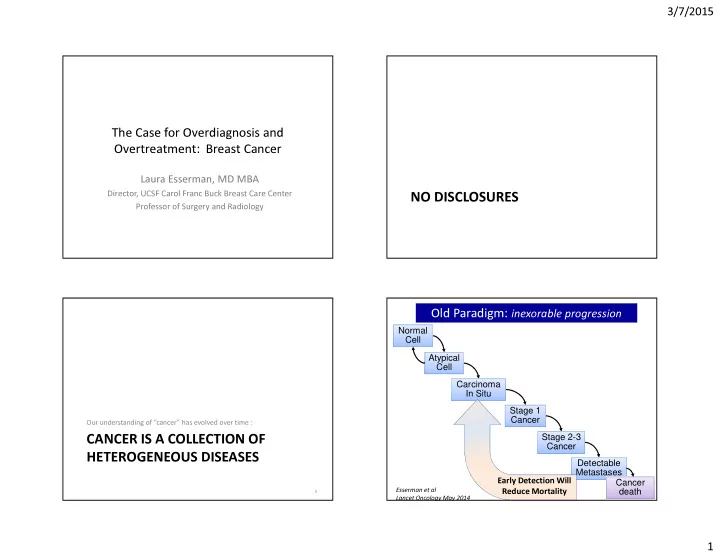
Detectable Metastases Normal Cell Atypical Cell Carcinoma In Situ Stage 1 Cancer Stage 2-3 Cancer Cancer death

Old Paradigm: inexorable progression

Early Detection Will Reduce Mortality

Esserman et al Lancet Oncology May 2014

slide-2
SLIDE 2

3/7/2015 2

Detectable Metastasis

New Paradigm: variable progression

Normal Cell Atypical Cell/CIS Stage 1 Cancer Stage 2-3 Cancer Cancer death Detectable Metastasis Normal Cell Stage 1-3 Cancer Cancer death Normal Cell Atypical Cell/CIS Stage 1 Cancer Systemic Therapy Key to Reducing Mortality Early Detection Will Not Impact Mortality Early Detection Can Reduce Mortality INDOLENT

  • r REGRESS

RAPID PROGRESSION SLOW PROGRESSION

IDLE tumors: Indolent lesions

  • f epithelial origin

“Cancer”

Dictionary.com Definition

6

can·cer noun 1.Pathology

  • a. a malignant and invasive growth or tumor, especially one
  • riginating in epithelium, tending to recur after excision

and to metastasize to other sites. b.any disease characterized by such growths.

  • 2. any evil condition or thing that spreads destructively; blight.

PATIENTS ASSUME THAT CANCER, LEFT UNTREATED, WILL KILL YOU

Physicians too

7

March 2012

  • Workshop convened around overdiagnosis
  • Subgroup to compile recommendations to NCI

– Signal the physician community – Signal the patient community – Generate shift in philosophy, enable improvement – Explain previous approach and motivate change

  • contentious debate exploration of new concepts
  • Findings summarized

– JAMA 2013 – Lancet Oncology May 2014

8

slide-3
SLIDE 3

3/7/2015 3

Recommendations to the NCI

1. Recognize that over-diagnosis occurs and is common

  • 2. Embrace the development of new terminology to replace the

word “cancer” where appropriate; use companion diagnostics to support this process

  • 3. Create observational registries for IDLE conditions with low or

uncertain risk of progression to cancer

  • 4. Mitigate over-diagnosis by testing strategies that lower the

chance of detecting unimportant lesions

  • 5. Embrace new concepts for how to approach cancer progression

and prevention

Recommendations Working Group

  • Laura J. Esserman

UCSF

  • Ian M Thompson

UTHSC, San Antonio

  • Brian Reid, M.D., Ph.D.

Fred Hutchinson CRC

  • Peter Nelson, M.D.

Fred Hutchinson CRC

  • David F. Ransohoff, M.D.

UNC, Chapel Hill

  • H. Gilbert Welch, M.D., M.P.H.

Dartmouth

  • Shelley Hwang, M.D.

Duke University

  • Donald A. Berry, Ph.D. UT

MD Anderson Ca Ctr

  • Kenneth W. Kinzler, Ph.D.

Johns Hopkins University

  • William C BlackM.D.

Dartmouth

  • Howard Parnes

NCI

  • Mina Bissell

LBL Berkeley

  • Sudhir Srivastava

NCI, EDRN

10

Esserman et al Lancet Oncology May 2014

RECOGNIZE THAT OVERDIAGNOSIS OCCURS AND IS COMMON

Recommendation #1

11

OVERDIAGNOSIS IS MORE COMMON WITH SCREENING

Recommendation #1

12

slide-4
SLIDE 4

3/7/2015 4

OVERDIAGNOSIS REPRESENTS OUR ABILITY TO DETECT THE ENTIRE SPECTRUM OF CANCERS THAT ARISE

For Both Breast and Prostate

Incidence Rates Have Risen and Remain Higher

14

BREAST PROSTATE Esserman et al JAMA 2009

Chance Increases with Screening

  • Lung:

– Screening of general population increases incidence without changing mortality: Focus on HIGHEST RISK pts

  • 20% decrease in lung ca death
  • Incidence of stage 1 CA >>reduction in stage 2-4 cancers
  • Nodules <1cm on CT: 1.5% chance of cancer

– Autopsy and screening: overdiagnosis 20-25%

  • Thyroid

– In office screening of thyroid nodules has become routine – SEER data: incidence has tripled, death rate constant

1975 2009 Incidence 4.9 14.3 Death rate 0.56 0.52

15

Non-invasive Cancer

  • Barrett’s Esophagus

– Common with gastric reflux – Considered high risk for esophageal cancer – Barrett’s patients are screened with biopsy

  • Longitudinal studies

– The vast majority will never develop Ca – Barrett’s is an adaptation to reflux

16

And yet, endoscopic screening continues . . .

slide-5
SLIDE 5

3/7/2015 5

A TUMOR WITH LITTLE POTENTIAL FOR METASTASIS AND NONE FOR DEATH an IDLE condition?

WHAT IS THE MAGNITUDE?

IDLE CONDITIONS are part of the spectrum of breast cancer biology

IDLE tumors

  • Evidence suggests ultralow cancers exist

– Pre-screening: 10-20% of all cancers – Post Screening Era: 25-50% of all cancers

  • Possibly up to 50% of non-palpable cancers (BMJ 2014)
  • Based on trials, cohort studies

– A problem if not recognized and treated accordingly

  • Opportunity to improve our approach to prevention

and treatment

  • Opportunity to improve screening

– Learn who is at risk for what type of cancer – What should be a target for call back/biopsy?

Canadian RCT: 25 years of followup

Women 40-69, conducted during the Tamoxifen Era With Mammograms With Mammograms

44,925 women received mammograms and breast exams 3,250 women had a diagnosis of breast cancer 500 women died from breast cancer

Without Mammograms Without Mammograms

44,910 women received breast exams 3133 women had a diagnosis of breast cancer 505 women died from breast cancer 1 in 424 women were diagnosed with and treated for cancers that would never come to clinical attention Miller et al BMJ Feb 2014

slide-6
SLIDE 6

3/7/2015 6

IDLE tumors

  • Excess of 106 cancers/
  • Estimate: 1/424 women screened
  • 22% of all cancers
  • 50% of non-palpable cancers

Finding cancer at the earliest possible point- may not be optimal under all conditions . . . IF WE CANNOT RECOGNIZE AND TREAT ACCORDINGLY

What Can Be Done?

  • Invest in better biomarkers of extremely low

metastatic potential

  • Recognize that non-palpable mammographically

detected breast cancers have a high chance of being IDLE

– AVOID OVERTREATMENT

  • Don’t overscreen

– Minimize detection of IDLE conditions – Don’t make low grade DCIS a target of early detection

Defining “IDLE” Tumors

70 gene Prognosis Signature: “Ultra-low Threshold”

70 significant prognosis genes

van´t Veer et al., Nature ,2002

Ultralow Threshold

23

50% of screen detected tumors in MINDACT are Ultralow risk Drukker et al BCRT 2014

Effect of screening on the detection of good and poor prognosis breast cancers

Laura Esserman, Yiwey Shieh, Laura Van’t Veer

Dan Moore, Emiel JT Rutgers, Michael Knauer,Valesca Retel, Stella Mook, Sabine Linn, Flora E van Leeuwen, Annuska Glas Early Detection Research Network, UCSF Dean’s Summer Research Fellowship

slide-7
SLIDE 7

3/7/2015 7 Study Design

  • Large database of 862 patients with known 70-gene

prognosis signature outcomes from previous European trials. Selected node-negative cases only.

  • Cohort 1: Prior to screening era: pts diagnosed 1980-
  • 1991. No population-wide screening in countries of origin

thus low uptake of mammography.

  • Cohort 2: Screening era: pts diagnosed 2004-6 in 17

community-based hosptials (RASTER) in the Netherlands, where screening uptake is approx 80%.

  • subset of screen-detected cancers
  • Analyzed 2 age groups separately:
  • Age 49-60: screened in cohort 2 but not cohort 1 (TEST)
  • <40 years: not screened in either cohort (CONTROL)

Findings

  • As age increases, the proportion of

– grade 1 tumors increases – MammaPrint low (good risk) tumors increase – Hormone receptor positive tumors increase

  • Distribution of good/poor risk tumors with screening

– Does not shift in women under the age of 40

  • 25-30% good risk

– Substantially shifts in women aged 49-60

  • Cohort 1: 40% good risk (no screening)
  • Cohort 2: 58% good risk (“screening”)

– 67% good risk in screen detected cancers

26

Shieh Esserman, van’t Veer ASCO 2010 Esserman, Shieh, van’t Veer Br Ca Research and Treatment 2011

HR+HER2- ultra-low risk patients: Tamoxifen (TAM) vs. Untreated

Preliminary Results: Stockholm 1 Randomized Trial

0.5 0.6 0.7 0.8 0.9 1 5 10 15 20 25 Survival proportion Years since primary tumor diagnosis

STO trial long-term survival in Mammaprint Ultra-low risk by treatment arm

TAM No TAM P-log rank= 0.15

Only 106 patients in total. Not significantly differential survival by treatment. X axis starts at 50% Lindstrom et al SABCS 2014

Proportion of Node-Negative Patients Classified as Low Risk by RS and RSPC: At least 50%

N=1444

RS 54.2% 26.7% 19.1% RSPC 63.8% 17.8% 18.4% Low Risk Intermediate Risk High Risk

RSPC classifies fewer patients as having intermediate risk.

Ca Cancer Registry/ SEER: Women >50 with stage 1 N0 grade 1 comprise 50% of all breast cancer ore

Tang G, et al. JCO. Oct 2011; 1-8.

Pathology-Clinical; RS, Recurrence Score
slide-8
SLIDE 8

3/7/2015 8

TREATMENT HAS NOT KEPT PACE

STUDY Accrual dates N Study arms 5 year LRR 10 year LRR 12.6 year LRR TARGIT-A 2010 2000 – 2012 2232 IORT 1.20% a N.A. N.A. EBRT 0.95% a

STUDIES COMPARING XRT vs. NO XRT

CALGB C9343 Hughes et al 2000 1994 – 1999 636 Tam 4% 7% 10% Tam+RT 1% 1% 2% Fyles et al 2011 1992- 2000 611 (all T1 patients) Tam 5.5% 13.8%b N.A. Tam+RT 0.4% 5.3% 114 (subset of G1/2, lum A patients) Tam 2%c 4.9% N.A. Tam+RT 5.5%

STUDIES COMPARING HYPOFRACTIONATED 3-WEEK EBRT vs. 5-WEEK EBRT

Whelan et al 2010 1993- 1996 1234 3 week EBRT 2.33%d 6.2% N.A. 5 week EBRT 2.17%d 6.7% START-B 2008 1999- 2001 2215 3 week EBRT 2.2%e N.A. N.A. 5 week EBRT 3.3%e

Review of Adjuvant Therapy to Reduce Local Recurrence

MITIGATE OVER DIAGNOSIS BY TESTING STRATEGIES THAT LOWER THE CHANCE OF DETECTING UNIMPORTANT LESIONS

Recommendation #4

31

What is the magnitude of the problem in screening?

  • The focus of screening shifted

– Invasive cancersDCISAny calcifications – 500,000-1 million biopsies a year in the US

  • No established benefit to the shift

– Should we be afraid to “observe” low risk calcifications? – Is someone’s life threatened by not knowing?

  • Aggregate cost of screening (Thorsen et al Annals of Int Med Feb 2014)

– 65% of population (age 40+ annually): $7.8 billion – 85% of population (age 40+ annually): $10 billion – 85% of population (USPSTF biennially): $3.5 billion

  • Biopsy rates are half (Kerlikowski Annals Int med 2011)
  • No significant increase in the rates of locally advanced cancers

It is time to step up as a community and call for a change

32

slide-9
SLIDE 9

3/7/2015 9

Embracing Learning and Change Going Forward

Look less hard when screening:

  • Many biopsies are performed for calcifications

with a low risk of being low grade DCIS-

– Most often benign, incidental DCIS – ?Should these be a target for screening? – ?Urgency to diagnose?

  • Targeting more appropriate lesions for

detection will reduce the number of biopsies

  • Target >50% risk DCIS or >10% Invasive Ca

34

1 cancer 3mm IDC grade 1

Flowers, Esserman SABCS 2011 Br Ca Research and Treatment 2012

Ways to Find Less DCIS

  • Raise Thresholds for biopsy
  • Consider Biennial screening for lower risk women

– Reduces biopsy rates substantially without significantly increasing late stage presentation

  • Future: risk based screening

– Tailor screening frequency to risk/ models

  • Family history, gene mutations and variations, breast density,

exposures

– Context of underlying risk could be an important predictor

  • f “consequential” disease

35

Indolent Disease

  • Is part of the spectrum of changes in tissues

– Reservoir of discoverable “disease”

  • More likely to be found with screening

– Especially if biopsy rates are high or ability to sample a large fraction of the target organ

  • Prostate is perfect example
  • Found for many organ types when screening is introduced

– Breast, Prostate, Lung, Thryoid, Barrett’s

  • Risk based screening is being tested as a strategy to improve the problem

– Lung cancer is an excellent example – Focus on individuals with greater risk for development of cancer

  • The case for prevention therefore becomes more compelling
  • Does the context of overall risk matter? Is it perhaps the most important?

36