No Disclosures Endometrial Intra-epithelial Neoplasia Jocelyn S. - - PowerPoint PPT Presentation

no disclosures
SMART_READER_LITE
LIVE PREVIEW

No Disclosures Endometrial Intra-epithelial Neoplasia Jocelyn S. - - PowerPoint PPT Presentation

No Disclosures Endometrial Intra-epithelial Neoplasia Jocelyn S. Chapman, MD Gynecologic Oncology Assistant Professor, Division of Gynecologic Oncology University of California San Francisco 1 2 Objectives What is endometrial


slide-1
SLIDE 1

1

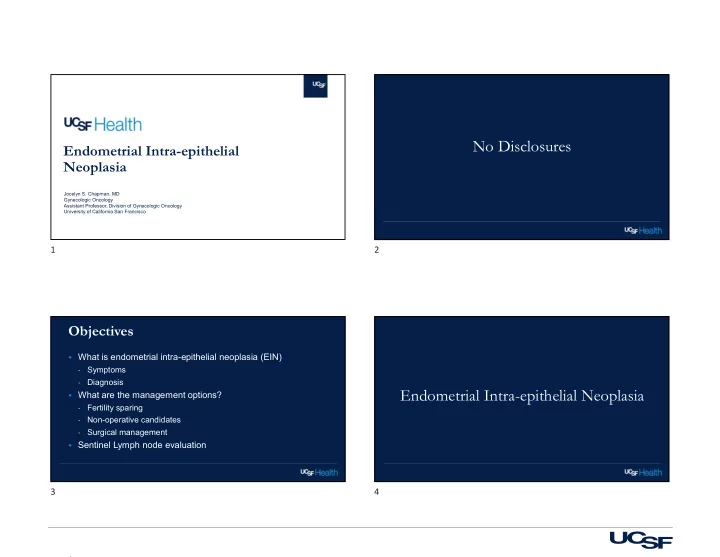
Endometrial Intra-epithelial Neoplasia

Jocelyn S. Chapman, MD Gynecologic Oncology Assistant Professor, Division of Gynecologic Oncology University of California San Francisco

No Disclosures

Objectives

  • What is endometrial intra-epithelial neoplasia (EIN)
  • Symptoms
  • Diagnosis
  • What are the management options?
  • Fertility sparing
  • Non-operative candidates
  • Surgical management
  • Sentinel Lymph node evaluation

Endometrial Intra-epithelial Neoplasia

1 2 3 4

slide-2
SLIDE 2

2

ACOG – Committee Opinion May 2015 ACOG – Committee Opinion May 2015 Prognostic accuracy of EIN Risk factors for EIN

5 6 7 8

slide-3
SLIDE 3

3

  • OBESITY
  • 21-50lb overweight – 3x incidence
  • >50lb weight - 10x incidence
  • Nulliparity – incidence increased 2x
  • Late Menopause - incidence increased 2.5x
  • Diabetes, hypertension, hypothyroidism are associated

with endometrial cancer

Risk factors for EIN

  • Bleeding
  • Present in 90% of all cases
  • 15% of patients with postmenopausal bleeding will have endometrial cancer
  • Other Signs/Symptoms
  • Vaginal Discharge
  • Pelvic Pain, Pressure
  • Referred Leg Pain
  • Change in Bowel Habits
  • Pyometria/Hematometria

Signs & Symptoms Diagnosis

  • Pap Smear
  • Only 30-50% patients with cancer will have an abnormal result
  • AGUS predictive of carcinoma in post-menopausal women
  • Endometrial Biopsy
  • False negative rate of 5-10%
  • Trans-vaginal Ultrasound
  • Not for routine screening or diagnosis (unless Lynch)
  • Suspicious findings include endometrial stripe >5mm, polypoid mass, or fluid

collection in uterus

Management of EIN

9 10 11 12

slide-4
SLIDE 4

4

  • Candidates
  • Benign endometrial hyperplasia
  • EIN PLUS
  • Desired fertility
  • No evidence of concomitant carcinoma
  • Non-operative candidates

Non-surgical management Consider MRI

  • Non-pharmacologic interventions
  • Removal of source of unopposed estrogen
  • Correct ovulatory dysfunction
  • Weight loss
  • Estrogen producing neoplasms (i.e. granulosa cell

tumors)

  • Progestin therapy

Non-surgical management Progestins

13 14 15 16

slide-5
SLIDE 5

5

LNG-IUD compared to MPA

SH = simple hyperplasia, CH = complex hyperplasia, ACH = atypical complex hyperplasia

Orbo A, Vereide A, Arnes M, Pettersen I, Straume B. Levonorgestrel-impregnated intrauterine device as treatment for endometrial hyperplasia: a national multicentre randomised trial. BJOG. 2014 Mar;121(4):477-86.

  • Repeat EMB q3-6 months until regression
  • If menses resumes (for pre-menopausal patients), no further

biopsy necessary

  • If EIN persists – add megace to LNG-IUD

If EIN persists despite dual agent therapy, patient has failed conservative management and should be recommended for hysterectomy

Monitoring & Regression

Role of Sentinel Lymph Node Evaluation

Risk of Lymph Node Metastases

17 18 19 20

slide-6
SLIDE 6

6

Sentinel Lymph Node Mapping with ICG

Abu-Rustum. Sentinel Lymph node mapping https://doi.org/10.6004/jnccn.2014.0026

SLN Mapping in Uterine Cancer

Sentinel lymph node (SLN) mapping algorithm. Abbreviation: LND, lymph node dissection.From Barlin JN, Khoury-Collado F, Kim CH, et al. The importance of applying a sentinel lymph node mapping algorithm in endometrial cancer staging: beyond removal of blue nodes. Gynecol Oncol 2012;125:534; with permission.

SLN Algorithm

Risks associated with lymphadenectomy

21 22 23 24

slide-7
SLIDE 7

7

Lymph node assessment risk for EIN

  • 43% with EIN will have cancer on hysterectomy

specimen.

  • 12% of cancers diagnosed pre-op as EIN will have

deeply invasive, high-grade tumors

  • 7% of patients staged at the time of hysterectomy with a

pre-operative diagnosis of EIN have nodal metastatic disease

  • Cancer. 2006 Feb;106:812-9.

Int J Gynecol Cancer. 2005 Jan-Feb;15:127-31.

Proposed protocol for EIN management with GYN and GYNONC

  • EIN or FIGO grade 1 endometrioid

adenocarcinoma

  • Pre-operative CT A/P and CXR (for FIGO grade 1)
  • Pre-operative ultrasound (for EIN)
  • CXR
  • If BMI > 40 must refer to GynOnc

Review Questions

What is one advantage of the endometrial intraepithelial neoplasia (EIN) diagnostic schema over the WHO94 schema?

  • A. EIN classification is more reproducible
  • B. EIN classification has been used longer
  • C. EIN classification is preferred by

pathologists

Presentation Title 27

78% 16% 6%

Review Questions

Which of the following describes a patient who can be

  • ffered non-operative management of her EIN?
  • A. A 47 year old woman who has had 4

endometrial biopsies over 2 years with persistent EIN while on progestin therapy.

  • B. A 28 year old woman who desires

pregnancy and has an MRI without evidence

  • f invasive carcinoma.
  • C. A 66 year old woman with class 3 obesity.

Presentation Title 28

3% 2% 95%

25 26 27 28

slide-8
SLIDE 8

8

Review Questions

Which of the following progestins appears to be most efficacious in regression of EIN?

  • A. Medroxyprogesterone acetate
  • B. Levonorgesterol intra-uterine device
  • C. Megace 180mg BID

Presentation Title 29

2% 8% 90%

Review Questions

What is the risk of lymphedema after a pelvic lymphadenectomy?

  • A. 5%
  • B. 10%
  • C. 20%

Presentation Title 30

7% 85% 8%

Questions? Thank you!

29 30 31