Next Generation Sequencing Technologies What is first generation? - - PowerPoint PPT Presentation

next generation sequencing technologies what is first
SMART_READER_LITE
LIVE PREVIEW

Next Generation Sequencing Technologies What is first generation? - - PowerPoint PPT Presentation

Next Generation Sequencing Technologies What is first generation? Sanger Sequencing DNA Polymerase Base-adding reaction +H +


slide-1
SLIDE 1

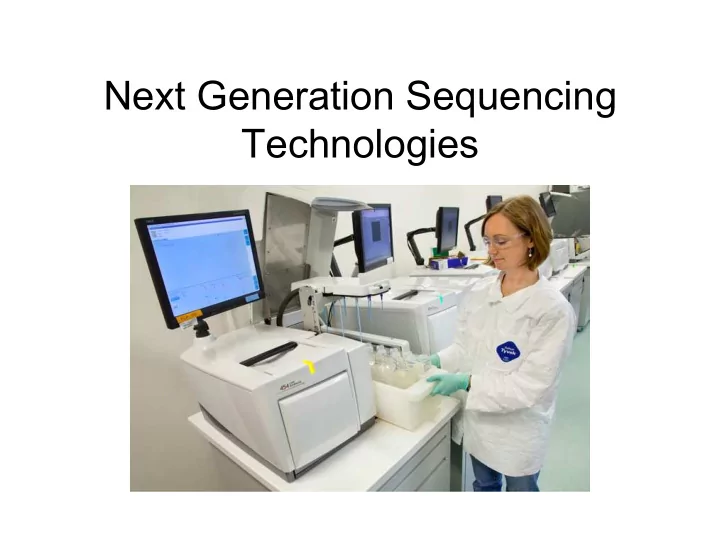
Next Generation Sequencing Technologies

slide-2
SLIDE 2

What is first generation?

  • Sanger Sequencing
slide-3
SLIDE 3
slide-4
SLIDE 4

DNA Polymerase

slide-5
SLIDE 5

Base-adding reaction

+H+

http://chemwiki.ucdavis.edu/Organic_Chemistry/Organic_Chemistry_With_a_Biological_Emphasis/Chapter_10%3A_Phosphoryl_transfer_reactions/Section_10.4%3A_Phosphate_diesters

slide-6
SLIDE 6

Pros and Cons of Sanger Sequencing

  • Polymerase errors

average out

  • Long sequences

(~450 bp)

  • Can only do 1

sequence at a time

  • Need a lot of DNA to

start with

  • Expensive: 2¢/base
slide-7
SLIDE 7

To solve these cons what do we need?

  • Cheaper
  • Multiplex different samples
  • Smaller starting amount
  • How might you do this?

– What do you need to be able to do?

slide-8
SLIDE 8

Activity

  • For 1 minute, write down all the things

you would need to do to be able to sequence DNA in a multiplexed way.

slide-9
SLIDE 9

Activity

  • Turn to your neighbors (1-2 people)
  • For 1 minute, discuss the things you

would need to do to be able to sequence DNA in a multiplexed way.

  • Be prepared to tell the class what you

think you need and why

slide-10
SLIDE 10

What you need to do multiplexed sequencing

slide-11
SLIDE 11

What’s different

  • Sequence many sequences at once
  • Technology is paired with DNA

sequence agnostic primers

  • Faster than SS
  • Shorter than SS
slide-12
SLIDE 12

Adapt sequences with known sequences

Mardis, ER; Ann Rev Genom & Hum Gen

slide-13
SLIDE 13

How to separate?

  • Emulsion PCR onto beads
  • Attach to location on chip

http://www.nature.com/nrg/posters/sequencing/Sequencing_technologies.pdf

slide-14
SLIDE 14

How to observe sequence

slide-15
SLIDE 15

454:2004 Imaging and light based

http://www.nature.com/nrg/posters/sequencing/Sequencing_technologies.pdf

slide-16
SLIDE 16

Illumina/Solexa: 2006 Fluorescence based, like Sanger Imaging based

http://www.nature.com/nrg/posters/sequencing/Sequencing_technologies.pdf

slide-17
SLIDE 17

SOLiD system: 2006 Uses ligation instead

  • f synthesis.

Also fluorescence based. Looks at each base twice.

http://www.nature.com/nrg/posters/sequencing/Sequencing_technologies.pdf

slide-18
SLIDE 18

Mardis, ER; Ann Rev Genom & Hum Gen

slide-19
SLIDE 19

As of 2010, all were imaging based

  • Why might this be problematic?
  • How else might you follow sequencing?
slide-20
SLIDE 20

Hydrogen Ion (pH) based, Ion Torrent: 2010

slide-21
SLIDE 21
slide-22
SLIDE 22

And Now for Something Completely Different Single Molecule Sequencing

slide-23
SLIDE 23

Pacific Biosciences: Single Molecule Sequencing (SMRT)

Benjamin A Flusberg, Dale R Webster, Jessica H Lee, Kevin J Travers, Eric C Olivares, Tyson A Clark, Jonas Korlach & Stephen W Turner Nature Methods 7, 461 - 465 (2010) Published online: 9 May 2010, doi:10.1038/nmeth.1459 http://www.pacificbiosciences.com/products/smrt-technology/

slide-24
SLIDE 24

Pacific Biosciences

  • Can get VERY long sequences

– 5,000-8,000 bases, on average – 30,000 bases sometimes

  • 99.99% accurate for each base
  • No averaging, so can find rare SNPs
  • No amplification needed before sequencing, so less

bias

  • Differences in rates of addition allow one to measure

epigenetic variations

  • Fewer total sequences so generally end up with

fewer total bases

  • Much more expensive than the other techniques
slide-25
SLIDE 25

Oxford Nanopore Technologies: Nov 2013?

https://www.nanoporetech.com/technology/introduction-to-nanopore-sensing/introduction-to-nanopore-sensing

Similar potential benefits as SMRT technology, but without drawbacks of polymerase and use of imaging technologies

slide-26
SLIDE 26

Oxford Nanopore Technologies: Nov 2013?

https://www.nanoporetech.com/technology/introduction-to-nanopore-sensing/introduction-to-nanopore-sensing

slide-27
SLIDE 27
slide-28
SLIDE 28

Pros and Cons of NGS

  • Fast
  • Cheap (<1¢/Mbase)
  • Lots of data
  • Fewer reads of each

base are combined, so less accurate

  • verall
  • Short reads (getting

longer, up to ~400 bases now)

slide-29
SLIDE 29

Activity

  • Take a hand out
  • Fill in what you think are the pros and

cons of each technology we discussed

– 90 sec

slide-30
SLIDE 30

Activity

  • Discuss with your neighbors what you

each put

  • Generate a consensus list to share with

the class

– 120 sec

slide-31
SLIDE 31
slide-32
SLIDE 32

Questions?