
SLIDE 1
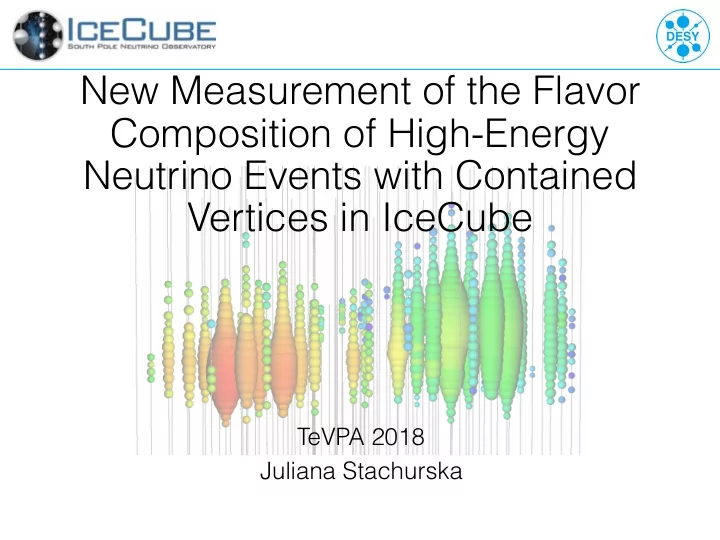
New Measurement of the Flavor Composition of High-Energy Neutrino - - PowerPoint PPT Presentation
New Measurement of the Flavor Composition of High-Energy Neutrino Events with Contained Vertices in IceCube TeVPA 2018 Juliana Stachurska Motivation IceCube observed astrophysical neutrinos, and identified first source Measure flavor
Juliana Stachurska
2
Juliana Stachurska
3
0.0 0.2 0.4 0.6 0.8 1.0
Fraction of νe IceCube Preliminary
68 % 95 % 68 % 95 %
νe:νµ:ντ at source
0:1:0 1:2:0 1:0:0
HESE with ternary PID IceCube APJ 2015
0.0 0.2 0.4 0.6 0.8 1.0
F r a c t i
νµ
0.0 0.2 0.4 0.6 0.8 1.0
F r a c t i
ντ
2 4 6 8 10 12 14 16 18 20
−2∆ log(Likelihood)
6 8
Juliana Stachurska
3
0.0 0.2 0.4 0.6 0.8 1.0
Fraction of νe IceCube Preliminary
68 % 95 % 68 % 95 %
νe:νµ:ντ at source
0:1:0 1:2:0 1:0:0
HESE with ternary PID IceCube APJ 2015
0.0 0.2 0.4 0.6 0.8 1.0
F r a c t i
νµ
0.0 0.2 0.4 0.6 0.8 1.0
F r a c t i
ντ
2 4 6 8 10 12 14 16 18 20
−2∆ log(Likelihood)
6 8
Juliana Stachurska
4 simulated 10PeV Double Cascade event ντ ντ τ had had./ em. ντ
Juliana Stachurska
5 Cascades: All nc interactions νe cc interactions ντ cc interactions with unresolvable lengths Tracks: νμ cc interactions Atmospheric muons ντ cc interactions with muonic tau decay
Juliana Stachurska
6 All HESE events in 7.5 years of data above 60 TeV
Juliana Stachurska
6 Observables from direct double-cascade reconstruction All HESE events in 7.5 years of data above 60 TeV
Juliana Stachurska
6 Observables from direct double-cascade reconstruction
> 1 m
All HESE events in 7.5 years of data above 60 TeV
Juliana Stachurska
6
Track sample with ντ – cc interactions creating μ, νμ – and atm. μ – tracks Double cascade sample: ντ + N τ + hadrons hadrons / electrons
>10m
Single cascade sample with not well- reconstructable ντ – cc interactions, all
Observables from direct double-cascade reconstruction
> 1 m
All HESE events in 7.5 years of data above 60 TeV
Juliana Stachurska
6
Track sample with ντ – cc interactions creating μ, νμ – and atm. μ – tracks Double cascade sample: ντ + N τ + hadrons hadrons / electrons
>10m
Single cascade sample with not well- reconstructable ντ – cc interactions, all
Observables from direct double-cascade reconstruction
> 1 m
Flavor composition All HESE events in 7.5 years of data above 60 TeV
Juliana Stachurska
HESE event class energy confinement cut energy asymmetry cut Topology ID sample single double track double single track
7
length E1 E2 ντ ντ
7
Juliana Stachurska
HESE event class energy confinement cut energy asymmetry cut Topology ID sample single double track double single track
7
E1 E2 ντ ντ
7
E1 E2
νμ
μ E1,C E2,C (E1,C+E2,C)/(E1+E2)≥0.99 E1,C E2,C
Juliana Stachurska
HESE event class energy confinement cut energy asymmetry cut Topology ID sample single double track double single track
7
length E1 E2 ντ ντ
7
length E1 E2 νe
Juliana Stachurska
background)
8
Juliana Stachurska
expectation of ~1:1:1 for astrophysical neutrinos
9
Maximum likelihood flavor composition fit based on 2D histograms:
single cascades, tracks
double cascades
Juliana Stachurska
10 20 30 40 50 20 40 60 80 100 120 140 160 50 100 150 200 250 300 350 400 100 200 300 400 500 20 40 60 80 100 120 140 10 20 30 40 50
saturated
Time Detected Photons
single cascade double cascade
reco with bright DOMs reco without bright DOMs
WORK IN PROGRESS
50 100 150 200
bright DOM* bright DOM*
* Bright DOMs are excluded from this analysis
10
16 m 1.2 PeV 0.6 PeV (E1-E2)/(E1+E2) = 0.29
Juliana Stachurska
10.0 10.1 10.2 10.3 10.4 10.5 10.6 5 10 15 20 9.9 10.0 10.1 10.2 10.3 10.4 10. 5 10 15 20 25 30 35 40 9.8 9.9 10.0 10.1 10.2 10.3 10. 20 40 60 80 100 120 9.8 9.9 10.0 10.1 10.2 10.3 10.4 50 100 150 200 250 300 350 9.9 10.0 10.1 10.2 10.3 10.4 10. 50 100 150 200 250 20 40 60 80 100
Detected Photons Time
50 100 150 200 250 300 350
OM(20, 27): 1506.9 pe
single cascade double cascade
reco with bright DOMs reco without bright DOMs bright DOM* bright DOM* bright DOM* bright DOM* bright DOM*
WORK IN PROGRESS
* Bright DOMs are excluded from this analysis
11
17 m 9 TeV 80 TeV (E1-E2)/(E1+E2) = -0.80
Juliana Stachurska
12
Juliana Stachurska
search and flavor composition measurement on 7.5 years of data
double cascade
signature are in preparation
13
10.0 10.1 10.2 10.3 10.4 10.5 10.6 5 10 15 20 9.9 10.0 10.1 10.2 10.3 10.4 10. 5 10 15 20 25 30 35 40 9.8 9.9 10.0 10.1 10.2 10.3 10. 20 40 60 80 100 120 9.8 9.9 10.0 10.1 10.2 10.3 10.4 50 100 150 200 250 300 350 9.9 10.0 10.1 10.2 10.3 10.4 10. 50 100 150 200 250 20 40 60 80 100 Detected Photons Time 50 100 150 200 250 300 350 OM(20, 27): 1506.9 pe single cascade double cascadeWORK IN PROGRESS
* Bright DOMs are excluded from this analysis Juliana Stachurska
14
Juliana Stachurska
by ~5% on average
15