
SLIDE 1
New Directions in Disk Forensics Simson L. Garfinkel
January 15, 2006, 3:15pm
Postdoctoral Fellow, Center for Research on Computation and Society Harvard University
1
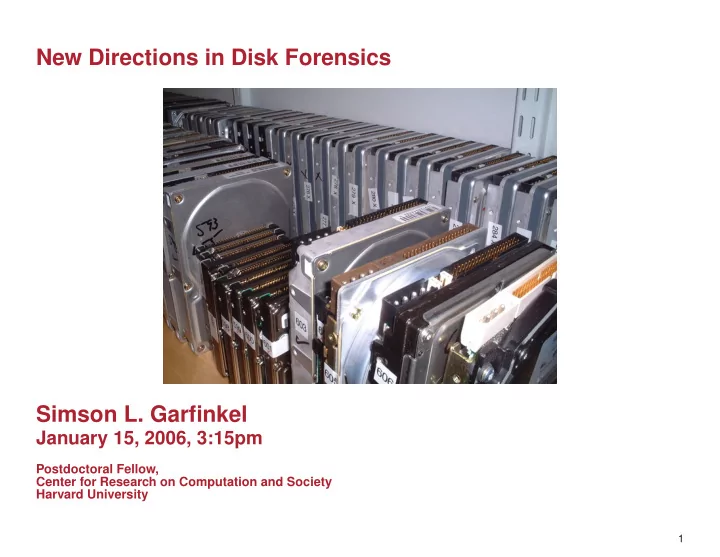
New Directions in Disk Forensics Simson L. Garfinkel January 15, - - PowerPoint PPT Presentation
New Directions in Disk Forensics Simson L. Garfinkel January 15, 2006, 3:15pm Postdoctoral Fellow, Center for Research on Computation and Society Harvard University 1 Here are 200 hard drives Which contain the email address
1
2
3
4
5
6
7
8
9
10
11
12
13
14
15
16
17
18
19
20
21
22
23
24
25
26
27
usr bin ls cp mv tmp slg / b a mail junk beth x5 x4 x3 x2 x1 x6 x7 x8
.
28
. .
time
29
. .
time
30
. .
time
31
. .
time
32
. .
time
33
. .
time
34
. . time
35
36
37
38
39
40
41
42
43
44
45
46
47
48
49
50
51
.
52
53
54
55
56
57
58
59
60
61
62
63
64
65
66
67
68
69
70
71
many of these sources, their credibility was difficult to assess and was often left to the foreign government services to judge. Intelligence Community HUMINT efforts against a closed society like Iraq prior to Operation Iraqi Freedom were hobbled by the Intelligence Community's dependence on having an official U.S. presence in-country to mount clandestine HUMINT collection efforts. (U) When UN inspectors departed Iraq, the placement of HUMINT agents and the development of unilateral sources inside Iraq were not top priorities for the Intelligence
against Iraq's weapons of mass destruction programs in Iraq after 1998. The Intelligence Community appears to have decided that the difficulty and risks inherent in developing sources
found no evidence that a lack of resources significantly prevented the Intelligence Community from developing sources or inserting operations officers into Iraq. When Committee staff asked why the CIA had not considered placing a CIA officer in Iraq years before Operation Iraqi Freedom to investigate Iraq's weapons
rare officer who can go in ... and survive scrutiny | ^ | [ m | | | for a long time." The Committee agrees that such operations are difficult and dangerous, but they should be within the norm of the CIA's activities and capabilities. Senior CIA officials have repeatedly told the Committee that a significant increase in funding and personnel will be required to enable to the CIA to penetrate difficult HUMINT targets similar to prewar Iraq. The Committee believes, however, that if an officer willing and able to take such an assignment really is "rare" at the CIA, the problem is less a question of resources than a need for dramatic changes in a risk averse corporate culture. (U) Problems with the Intelligence Community's HUMINT efforts were also evident in the Intelligence Community's handling of Iraq's alleged efforts to acquire uranium from Niger. The Committee does not fault the CIA for exploiting the access enjoyed by the spouse of a CIA employee traveling to Niger. The Committee believes, however, that it is unfortunate, considering the significant resources available to the CIA, that this was the only option available. Given the nature of rapidly evolving global threats such as terrorism and the proliferation of weapons and weapons technology, the Intelligence Community must develop means to quickly respond to fleeting collection opportunities outside the Community's established operating areas. The Committee also found other problems with the Intelligence Community's follow-up on the
72
73
74
75
76
77