Forensic Feature Extraction and Cross-Drive Analysis Simson L. - - PowerPoint PPT Presentation

forensic feature extraction and cross drive analysis
SMART_READER_LITE
LIVE PREVIEW

Forensic Feature Extraction and Cross-Drive Analysis Simson L. - - PowerPoint PPT Presentation

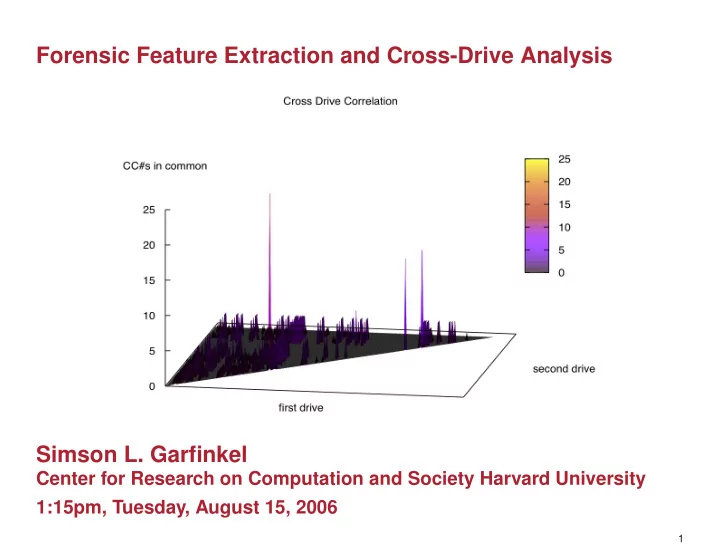
Forensic Feature Extraction and Cross-Drive Analysis Simson L. Garfinkel Center for Research on Computation and Society Harvard University 1:15pm, Tuesday, August 15, 2006 1 Todays forensic tools are designed for one drive at a time.

slide-1
SLIDE 1

Forensic Feature Extraction and Cross-Drive Analysis Simson L. Garfinkel

Center for Research on Computation and Society Harvard University 1:15pm, Tuesday, August 15, 2006

1

slide-2
SLIDE 2

Today’s forensic tools are designed for one drive at a time. Primary Goals: Search and Recovery. Interactive user interface. Usage scenarios:

  • Recovery of “deleted”

files.

  • Child porn scanning.
  • Trial preparation.

2

slide-3
SLIDE 3

Today’s tools choke when confronted with hundreds or thousands of drives. Which drives were used by my target? Do any drives belong to the target’s associates? Who is talking to who? Where should I start? Police departments and intelligence agencies have thousands of drives...

3

slide-4
SLIDE 4

Additional problems with today’s tools

  • Improper prioritization

Letting priority be determined by the statute of limitations.

  • Lost opportunities for data correlation

Was a message on hard drive X sent to hard drive Y?

  • Emphasis on document recovery rather than in furthering the

investigation.

4

slide-5
SLIDE 5

Correlating data between drives is an untapped opportunity. How large is my target’s reach? Who is in the organization? Captured drives are an ideal social network analysis.

5

slide-6
SLIDE 6

This talk introduces Cross Drive Analysis Large scale forensics problem Architecture

Image Collection & Library Building Feature Extraction
  • 1. Get a lot of drives
  • 2. Image to a big disk
Single Drive Analysis
  • 3. Extract the Features
1st order Cross-Drive Analysis 2nd Order Cross-Drive Analysis

}

  • 4. Apply statistics and correlation

Feature extraction

Single-drive feature application: drive attribution.

Drive #51: Top email addresses (sanitized) Count Address(es) 8133 ALICE@DOMAIN1.com 3504 BOB@DOMAIN1.com 2956 ALICE@mail.adhost.com 2108 JobInfo@alumni-gsb.stanford.edu 1579 CLARE@aol.com 1206 DON317@earthlink.net 1118 ERIC@DOMAIN1.com 1030 GABBY10@aol.com 989 HAROLD@HAROLD.com 960 ISHMAEL@JACK.wolfe.net 947 KIM@prodigy.net 845 ISHMAEL-list@rcia.com 802 JACK@nwlink.com 790 LEN@wolfenet.com 763 natcom-list@rcia.com

Most common email address is (usually) drive’s primary user.

13

First order analysis

.

200 10, 000 20, 000 30, 000 40, 000

Drive #80 1247 CCNS 286 unique Drive #21 5182 CCNS 1356 unique Drive #134 5875 CCNS 827 unique Drive #172 31348 CCNS 11609 unique Drive #214 709 CCNS 223 unique Drive #202 1334 CCNS 498 unique Drive #171 346 CCNS 81 unique

Second order analysis

6

slide-7
SLIDE 7

Forensic Feature Extraction and Cross-Drive Analysis

Image Collection & Library Building Feature Extraction

  • 1. Get a lot of drives
  • 2. Image to a big disk

Single Drive Analysis

  • 3. Extract the Features

1st order Cross-Drive Analysis 2nd Order Cross-Drive Analysis

}

  • 4. Apply statistics and correlation

7

slide-8
SLIDE 8

Uses of Cross-Drive Analysis

  • 1. Automatic identification of hot drives
  • 2. Improvements to single-drive systems
  • 3. Identification of social network membership
  • 4. Unsupervised social network discovery

Related Work:

  • Garfinkel & Shelat, 158 drives, 2002
  • FTK 2.0 — indexing multiple drives
  • IntelliDact and Workshare Protect scan for confidential information

8

slide-9
SLIDE 9

Feature extractors find pseudo-unique features Pseudo-Unique characteristics:

  • Long enough so collisions by

chance are unlikely.

  • Recognizable with regular

expressions.

  • Persistent over time.
  • Correlated with specific documents,

people or organizations.

Typical Features:

  • email addresses
  • Message-IDs
  • Subject: lines
  • Cookies
  • US Social Security Numbers
  • Credit card numbers
  • Hash codes of drive sectors

9

slide-10
SLIDE 10

Example: The Credit Card Number Detector. The CCN detector scans bulk data for ASCII patterns that look like credit card numbers.

  • CCNs are found in certain typographical patterns.

(e.g. XXXX-XXXX-XXXX-XXXX

  • r

XXXX XXXX XXXX XXXX

  • r

XXXXXXXXXXXXXXXX )

  • CCNs are issued with well-known prefixes.
  • CCNs follow the Credit Card Validation algorithm.
  • Certain numeric patterns are unlikely.

(e.g. 4454-4766-7667-6672)

10

slide-11
SLIDE 11

CCN detector: written in flex and C++ Scan of Drive #105: (642MB) Test # pass typographic pattern 3857 known prefixes 90 CCV1 43 numeric histogram 38 Sample output: ’CHASE NA|5422-4128-3008-3685| pos=13152133 ’DISCOVER|6011-0052-8056-4504| pos=13152440 .’GE CARD|4055-9000-0378-1959| pos=13152589 BANK ONE |4332-2213-0038-0832| pos=13152740 .’NORWEST|4829-0000-4102-9233| pos=13153182 ’SNB CARD|5419-7213-0101-3624| pos=13153332

11

slide-12
SLIDE 12

Even with the tests, there are occasional false positives. CCN scan of Drive #115: (772MB)

Test # pass pattern 9196 known prefixes 898 CCV1 29 patterns 27 histogram 13

.................@:|44444486666108|:<@<74444:@@@<<44 pos=82473275 ............#"&’&&’|445447667667667|..050014&’4"1"&’. pos=86493675 ......221267241667&|454676676654450|&566746566726322. pos=86507818 3..30210212676677..|30232676630232|.1.........001.01 pos=86516059 "&#&&’&41&&’645445&|454454672676632|.3............0.. pos=86523223 ..........".#""#"&’|445467667227023|..............366 pos=87540819 D#9?.32400.,,+14%?B|499745255278101|*02)46+;<17756669 pos=118912826 .GGJJB...>.JJGG...G|3534554333511116|...............6 pos=197711868 %.....}}}}}}.......|44444322233345|.....}}}}}}...... pos=228610295 %6"!) .&*%,,%-0)07.|373484553420378|<67<038+.5(+0+.3. pos=638491849 %6"!) .&*%,,%-0)07.|373484553420378|<67<038+.5(+0+.3. pos=645913801

12

slide-13
SLIDE 13

CDA Prototype System 1000 drives purchased on secondary market (1998–2006) 750 images 1.5TB data compressed. Many different organizations.

13

slide-14
SLIDE 14

Single-drive feature application: drive attribution.

Drive #51: Top email addresses (sanitized) Address(es) Count ALICE@DOMAIN1.com 8133 BOB@DOMAIN1.com 3504 ALICE@mail.adhost.com 2956 JobInfo@alumni-gsb.stanford.edu 2108 CLARE@aol.com 1579 DON317@earthlink.net 1206 ERIC@DOMAIN1.com 1118 GABBY10@aol.com 1030 HAROLD@HAROLD.com 989 ISHMAEL@JACK.wolfe.net 960 KIM@prodigy.net 947 ISHMAEL-list@rcia.com 845 JACK@nwlink.com 802 LEN@wolfenet.com 790 natcom-list@rcia.com 763

Most common email address is (usually) drive’s primary user.

14

slide-15
SLIDE 15

Attribution histogram works even with lightly-used drives.

Count on Total drives Extracted Email Addresses Drive #80 with address premium-server@thawte.com 117 278 server-certs@thawte.com 104 278 CPS-requests@verisign.com 61 286 personal-premium@thawte.com 44 253 personal-basic@thawte.com 42 250 personal-freemail@thawte.com 40 250 info@netscape.com 36 58 ANGIE@ALPHA.com 32 1 BARRY@BETA.com 23 1 CHARLES@GAMMA.com 21 1 DAVE.HALL@DELTA.com 21 1 DAPHNE@UNIFORM.com 20 1 ELLY@LIMA.com 18 1 FRANK@ECHO.com 16 1 HUGH@LIMA.com 16 1 IGGY@LIMA.com 16 1 GRETTA@XYZZY.com 15 1 VISTA@SNARF .com 15 1

Email addresses found on ≈> 20 drives are not pseudo-unique

15

slide-16
SLIDE 16

First Order Cross-Drive Analysis: O(n) operations on feature files Applications:

  • Automatically building stop lists
  • Hot drive identification

16

slide-17
SLIDE 17

Automatic “stop lists:” features on many drives are not pseudo-unique.

Drives with Total count Extracted Email Address address in corpus CPS-requests@verisign.com 286 64424 server-certs@thawte.com 278 32873 premium-server@thawte.com 278 31141 Mouse.Exe@Mouse.Com 262 493 LMouse.Exe@LMouse.Com 262 493 personal-premium@thawte.com 253 14660 personal-freemail@thawte.com 250 14843 personal-basic@thawte.com 250 14290 inet@microsoft.com 244 31456 mazrob@panix.com(*) 221 3265 java-security@java.sun.com 200 1200 java-io@java.sun.com 198 413 someone@microsoft.com 195 6193 bugs@java.sun.com 192 351 ca@digsigtrust.com 173 36800 name@company.com 169 1763

*mazrob@panix.com appears in clickerx.wav (Utopia Sound Scheme)

17

slide-18
SLIDE 18

A graph of # email addresses on each drive automatically identified drives used by bulk e-mailers.

500, 000 1, 000, 000 1, 500, 000 2, 000, 000 2, 500, 000 3, 000, 000 Email addresses Email addresses

18

slide-19
SLIDE 19

Hot drive identification: Drives with high response warrant further attention. Only 7 drives had more than 300 credit card numbers.

19

slide-20
SLIDE 20

Hot drive identification: Drives with high response warrant further attention.

.

200 10, 000 20, 000 30, 000 40, 000 Unique CCNs Total CCNs

Drive #21 5182 CCNS 1356 unique Drive #172 31348 CCNS 11609 unique Drive #171 346 CCNS 81 unique Supermarket ATM State Secretary's Office Medical Center Auto Dealership Software Vendor

These drives represent significant privacy violations.

20

slide-21
SLIDE 21

First order analysis of # SSNs Unique Total Drive SSNs SSNs Drive #959 260 447 Drive #974 178 674 Drive #696 33 872 Drive #969 33 33 Drive #690 8 14 Drive #680 2 4 Drive #959 contained consumer credit applications.

21

slide-22
SLIDE 22

Second-order analysis uses the multi-drive correlation D = # of drives F = # of extracted features d0 . . . dD = Drives in corpus f0 . . . fF = Extracted features FP(fn, dn) = fn not present on dn 1 fn present on dn Scoring Function: S1(d1, d2) =

F

  • n=0

FP(fn, d1) × FP(fn, d2)

22

slide-23
SLIDE 23

Graph of scoring function:

23

slide-24
SLIDE 24

Graph of scoring function:

Drives #74 x #77 25 CCNS in common Drives #171 & #172 13 CCNS in common Drives #179 & #206 13 CCNS in common Same Community College Same Medical Center Same Car Dealership

The three correlated drives have an extrinsic relationship. (180 drive corpus)

24

slide-25
SLIDE 25

The correlation between Drives #171 and #172 tells a story... Drive #171: Development drive

  • Has source code.
  • 346 CCNS; 81 unique.

Drive #172: Production system.

  • 31,348 CCNS; 11,609 unique
  • Oracle database (hard to reconstruct).

...The programmers used live data to test their system.

25

slide-26
SLIDE 26

Other CCN correlations #74, #77 Same college in Pacific Northwest. Correlated on CCN “false positive.” #339 – #356 All used by same New York travel agency #716, #718 Both from Union City, CA dealer #814, #820 Both from same Stamford, CT dealer In two cases, cross-drive correlation discovered drive cataloging errors!

26

slide-27
SLIDE 27

SSN correlation: identical documents on different drives SSN1 #342, #343, #356 “Thanks, Laurie” memo SSN2 #350, #355 “great grandchildren” memo But ignore these numbers: 666-66-6666 #313, #427, #429, #430, #612, #627, #744, #770, #808 123-45-6789 #328, #343, #345, #350, #351, #700 555-55-5555 #612, #690

27

slide-28
SLIDE 28

Possible reasons for the same SSN found on two drives

  • Two copies of the same document
  • Two documents about the same person
  • Accidental mismatch

Chance of a false match is 1 in 109.

28

slide-29
SLIDE 29

Future Work 1: What is the best scoring function? S1(d1, d2) =

F

  • n=0

FP(fn, d1) × FP(fn, d2)

29

slide-30
SLIDE 30

Discount features that appear on many drives DC(f) =

D

  • n=0

FP(f, dn) = # of drives with feature f S2(d1, d2) =

F

  • n=0

FP(fn, d1) × FP(fn, d2) DC(fn)

30

slide-31
SLIDE 31

Weigh features that are rare on some drives, but high on others DC(f) = # of drives with feature f FC(f, d) = count of feature f on drive d S3(d1, d2) =

F

  • n=0

FC(fn, d1) × FC(fn, d2) DC(fn)

31

slide-32
SLIDE 32

More Future Work:

  • Scaling cross-drive correlation to 10,000 drives.
  • More sophisticated feature extraction based on Sleuth Kit.
  • Use of sector hashes (MD5) to find fragments of documents on

different drives.

  • Combining CDA with carving and time line analysis.
  • Automatically sanitize personal information for publication.

32

slide-33
SLIDE 33

Acknowledgments

  • Abhi Shelat (CCN) and Ben Gelb (email)
  • Steve Bauer, Gene Spafford, Brian Carrier
  • Basis Technology
  • University of Auckland
  • Harvard University CRCS

33

slide-34
SLIDE 34

Summary Large-scale forensics is an important problem Feature Extraction and Cross-drive analysis allow:

  • Better single-drive tools
  • Intelligent stop-lists
  • Identification of social networks

Image Collection & Library Building Feature Extraction

  • 1. Get a lot of drives
  • 2. Image to a big disk

Single Drive Analysis

  • 3. Extract the Features

1st order Cross-Drive Analysis 2nd Order Cross-Drive Analysis

}

  • 4. Apply statistics and correlation

Questions?

34