Neutrino Neutrino What We What We Physics Physics Have Learned - - PowerPoint PPT Presentation

neutrino neutrino
SMART_READER_LITE
LIVE PREVIEW

Neutrino Neutrino What We What We Physics Physics Have Learned - - PowerPoint PPT Presentation

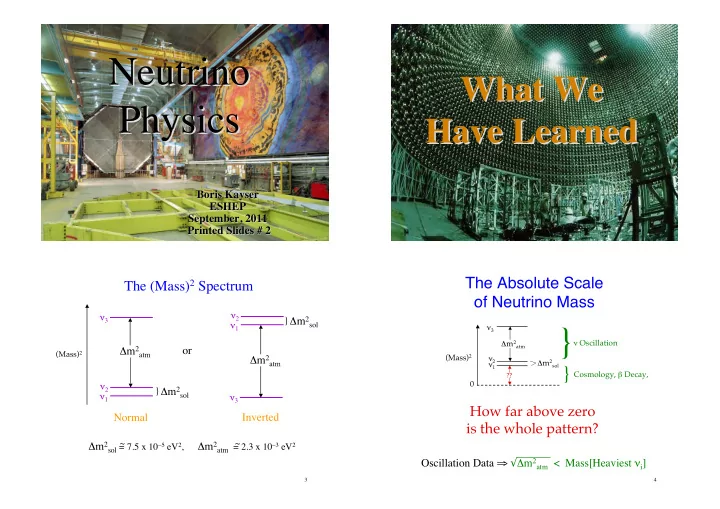
Neutrino Neutrino What We What We Physics Physics Have Learned Have Learned Boris Kayser Kayser Boris ESHEP ESHEP September, , 2011 2011 September Printed Slides # 2 Printed Slides # 2 1 2 The Absolute Scale The (Mass) 2


slide-1
SLIDE 1

1

Neutrino Neutrino Physics Physics

Boris Boris Kayser Kayser ESHEP ESHEP September September, , 2011 2011 Printed Slides # 2 Printed Slides # 2

2

What We What We Have Learned Have Learned

3

(Mass)2

!1 !2 !3

  • r

!1 !2 !3 } "m2sol

"m2atm

} "m2sol

"m2atm "m2sol = 7.5 x 10⁻⁵ eV2, "m2atm = 2.3 x 10⁻³ eV2

~ ~

Normal Inverted

The (Mass)2 Spectrum

4

How far above zero is the whole pattern?

!3 (Mass)2 "m2

atm

"m2

sol

??

!1 !2 ! Oscillation Cosmology, # Decay,

}

}

The Absolute Scale

  • f Neutrino Mass

Oscillation Data $ %"m2atm < Mass[Heaviest !i]

slide-2
SLIDE 2

5

The Upper Bound From Cosmology

Cosmological Data + Cosmological Assumptions $ & mi < (0.17 – 1.0) eV . Mass(!i) If there are only 3 neutrinos, 0.04 eV < Mass[Heaviest !i] < (0.07 – 0.4) eV %"m2atm Cosmology

~

Seljak, Slosar, McDonald Hannestad; Pastor

( )

Neutrino mass affects large scale structure.

6

The Upper Bound From Tritium

Cosmology is wonderful, but there are known loopholes in its argument concerning neutrino mass. The absolute neutrino mass can in principle also be measured by the kinematics of ! decay.

3H"3He + e# + $i ; i =1, 2, or 3

Tritium decay:

BR 3H"3He + e# + $i

( ) % Uei

2

In , the bigger mi is, the smaller the maximum electron energy is.

3H"3He + e# + $i

There are 3 separate thresholds in the ! energy spectrum.

7

Present experimental energy resolution is insufficient to separate the thresholds. The ! energy spectrum is modified according to —

E0 " E

( )2# E0 " E [ ] $

Uei

2 i

% E0 " E

( )

E0 " E

( )2 " mi

2 # E0 " mi

( ) " E

[ ] Maximum ! energy when there is no neutrino mass ! energy

Measurements of the spectrum bound the average neutrino mass —

m" = Uei

2mi 2 i

#

Presently:

m" < 2 eV

Mainz & Troitzk

8

This has the consequence that — |!i > = & U'i |!'> . Flavor-' fraction of !i = |U'i|2 . When a !i interacts and produces a charged lepton, the probability that this charged lepton will be of flavor ' is |U'i|2 .

'

Leptonic Mixing

Leptonic Mixing Matrix Mass eigenstate Flavor eigenstate

e, µ, or (
slide-3
SLIDE 3

9

!e [|Uei|2] !µ[|Uµi|2] !( [|U(i|2]

Normal Inverted

"m2

atm

!1 !2 !3

(Mass)2

"m2

sol

}

!3

"m2

atm

!1 !2

"m2

sol

}

  • r

sin2)13 sin2)13

The spectrum, showing its approximate flavor content, is

10

"m2

atm

!e [|Uei|2] !µ [|Uµi|2] !( [|U(i|2] !1 !2 !3

(Mass)2

"m2

sol

}

"3 # "µ +"$ 2

{

Bounded by reactor exps. with L ~ 1 km From max. atm. mixing, From !µ(Up) oscillate but !µ(Down) don’t

{ {

In LMA–MSW, Psol(!e* !e) = !e fraction of !2 From max. atm. mixing, !1+ !2 includes (!µ–!()/√ 2 From distortion of !e(reactor) and !e(solar) spectra

11

The Mixing Matrix

U = 1 c23 s23 "s23 c23 # $ % % % & ' ( ( ( ) c13 s13e"i* 1 "s13ei* c13 # $ % % % & ' ( ( ( ) c12 s12 "s12 c12 1 # $ % % % & ' ( ( ( ) ei+1/2 ei+2 /2 1 # $ % % % & ' ( ( ( )12 ! )sol ! 34°, )23 ! )atm ! 39-51°, )13 < 12° + would lead to P(!'* !#) " P(!'* !#). CP But note the crucial role of s13 , sin )13. cij , cos )ij sij , sin )ij

Atmospheric Cross-Mixing Solar Majorana CP phases

~ Hints??

12

Recent Evidence For Non-Zero "13

In an experiment where L/E is too small for the small splitting to be seen,

"m21

2 # m2 2 $ m1 2

P "µ #"e

( ) $ 4Uµ3Ue3

2 sin2 %m31 2

L 4E & ' ( ) * + = sin2 2,13sin2,23sin2 %m31

2

L 4E & ' ( ) * +

T2K has looked for in a long-baseline experiment: "µ #"e

slide-4
SLIDE 4

13

Source # * µ + $µ Near Detector Far Detector Super-K

$ Expectation Observation

295 km

The T2K experiment (Designed to seek $µ* $e) E = 0.6 GeV

The far detector is near the first

"m31

2

  • scillation maximum.

T2K sees 6 $e candidate events in the far detector, whereas 1.5 are expected if "13 = 0.

14

These take the "m2

21

contributions and matter effects into account.

"13 c

  • u

l d b e “ l a r g e ” .

15

MINOS, not designed to look for , sees "µ #"e 62 candidate events where 50 are expected if "13 = 0. While not highly significant by itself, this result is consistent with that from T2K.

16

P "

µ #" e

( ) $ P "µ #"e ( ) = 2cos%13sin2%13sin2%12 sin2%23sin&

' sin (m231 L 4E ) * + ,

  • .

sin (m232 L 4E ) * + ,

  • .

sin (m221 L 4E ) * + ,

  • .

All mixing angles must be nonzero for CP in oscillation.

There Is Nothing Special About )13

For example — In the factored form of U, one can put + next to )12 instead of )13.

slide-5
SLIDE 5

17

The Majorana CP Phases

The phase 'i is associated with neutrino mass eigenstate !i: U'i = U0'i exp(i'i/2) for all flavors '. Amp(!' * !#) = & U'i* exp(– imi2L/2E) U#i is insensitive to the Majorana phases 'i. Only the phase + can cause CP violation in neutrino oscillation.

i

18

The Open The Open Questions Questions Looking to the Future Looking to the Future

19

  • What is the absolute scale
  • f neutrino mass?
  • Are neutrinos their own antiparticles?
  • Are there “sterile” neutrinos?
  • Are there more than 3 mass eigenstates?
  • What are the neutrino magnetic

and electric dipole moments?

20

  • Is the spectrum like or ?
  • Do neutrino interactions

violate CP? Is P(!' * !#) - P(!' * !#) ? What is )13? How close to maximal is )23?

slide-6
SLIDE 6

21

  • What can neutrinos and the universe

tell us about one another?

  • Is CP violation involving neutrinos the

key to understanding the matter – antimatter asymmetry of the universe?

  • What physics is behind neutrino mass?
  • What surprises are in store?

22

Why the Why the Questions Are Questions Are Interesting Interesting, , and and How They May Be How They May Be Answered Answered

23

Does Does ! ! = = ! !? ?

24

What Is the Question?

For each mass eigenstate !i , and given helicty h, does —

  • !i(h) = !i(h)

(Majorana neutrinos)

  • r
  • !i(h) ≠ !i(h) (Dirac neutrinos) ?

Equivalently, do neutrinos have Majorana masses? If they do, then the mass eigenstates are Majorana neutrinos.

slide-7
SLIDE 7

25

Majorana Masses

Majorana masses mix ! and !, so they do not conserve the Lepton Number L that distinguishes leptons from antileptons: L(!) = L(!–) = –L(!) = –L(!+) = 1 Their effect:

X

! !

Majorana mass

  • r

X

!

Majorana mass

!

26

A Majorana mass for any fermion f causes f f. Quark and charged-lepton Majorana masses are forbidden by electric charge conservation. Neutrino Majorana masses would make the neutrinos very distinctive. Majorana neutrino masses have a different origin than the quark and charged-lepton masses.

27

In the SM, the top quark mass comes from — Such an operator does not mix quark and antiquark. A Majorana mass term does mix neutrino and antineutrino. A Majorana mass term must have a different origin than the quark and charged-lepton masses.

GtH0t

RtL " Gt H0 0t RtL

Higgs field Vacuum expectation value Top quark mass mt Coupling constant

X

mt t

( ) ( )

t Its effect:

28

As a result of K0 K0 mixing, the neutral K mass eigenstates are — KS,L . (K0 ± K0)/%2 . KS,L = KS,L .

Why Majorana Masses Majorana Neutrinos

Majorana masses induce ! ! mixing. As a result of ! ! mixing, the neutrino mass eigenstate is — !i = ! + ! . !i = !i .

slide-8
SLIDE 8

29

SM Interactions Of A Dirac Neutrino

! ! ! !

The weak interaction is Left Handed.

( (

These states, when Ultra Rel., do not interact.

makes !– makes !+ Conserved L +1 –1 We have 4 mass-degenerate states:

30

SM Interactions Of A Majorana Neutrino

! !

We have only 2 mass-degenerate states: makes !– makes !+ An incoming left-handed neutral lepton makes !–. An incoming right-handed neutral lepton makes !+. The weak interactions violate parity. (They can tell Left from Right.)

31

Can a Majorana Neutrino Have an Electric Charge Distribution Distribution? No!

+ – – +

Anti = But for a Majorana neutrino — Anti (!) = !

32

Splitting due to Majorana mass Dirac neutrino

A Majorana mass term splits a Dirac neutrino into two Majorana neutrinos.

Majorana Masses Split Dirac Neutrinos

Majorana neutrino Majorana neutrino

2 2 4

slide-9
SLIDE 9

33

Why Most Theorists Expect Majorana Masses

The Standard Model (SM) is defined by the fields it contains, its symmetries (notably weak isospin invariance), and its renormalizability. Leaving neutrino masses aside, anything allowed by the SM symmetries occurs in nature. Majorana mass terms are allowed by the SM symmetries. Then quite likely Majorana masses

  • ccur in nature too.

34

To Determine To Determine Whether Whether Majorana Masses Majorana Masses Occur in Nature Occur in Nature

35

The Promising Approach — Seek Neutrinoless Double Beta Decay [0!##]

We are looking for a small Majorana neutrino mass. Thus, we will need a lot of parent nuclei (say, one ton of them).

e– e–

Nucl Nucl’

36

0!## e– e– u d d u

! !

W W Whatever diagrams cause 0!##, its observation would imply the existence of a Majorana mass term: (Schechter and Valle) ! * ! : A (tiny) Majorana mass term / 0!## !i = !i

slide-10
SLIDE 10

37

!i !i W– W– e– e– Nuclear Process Nucl Nucl’

Uei Uei SM vertex i Mixing matrix

We anticipate that 0!## is dominated by a diagram with Standard Model vertices:

38

But there could be other contributions to 0!##, which at the quark level is the process dd * uuee. An example from Supersymmetry: d d u u e e e e 1

2 2 2

39

!i !i W– W– e– e– Nuclear Process Nucl Nucl’

Uei Uei SM vertex i Mixing matrix

Assume the dominant mechanism is — The !i is emitted [RH + O{mi/E}LH]. Thus, Amp [!i contribution] 3 mi Amp[0!##] 3 40 miUei24, m##

Mass (!i)

40

How Large is m##?

How sensitive need an experiment be? Note: 5 = m##2 |Nuclear M.E.|2 Phase Space Suppose there are only 3 neutrino mass eigenstates. (More might help.) Then the spectrum looks like —

sol <

!2 !1 !3

atm

!3

sol <

!1 !2

atm

  • r

Normal hierarchy Inverted hierarchy

slide-11
SLIDE 11

41

m##

Smallest 95% CL

Takes 1 ton Takes 100 tons

m!! For Each Hierarchy

42

There is no clear theoretical preference for either hierarchy. If the hierarchy is inverted— then 0!## searches with sensitivity to m## = 0.01 eV have a very good chance to see a signal. Sensitivity in this range is the target for the next generation of experiments.